
Oct 23, 2026 • Filed to: Windows Computer Solutions • Proven solutions
 TL;DR:
You can resolve the KMODE_EXCEPTION_NOT_HANDLED BSOD error by disabling the Windows Fast Startup feature in Power Options, updating corrupted kernel drivers via Safe Mode, and repairing core system files using SFC and DISM console commands.
● Identify the exact crashing driver module—most frequently iaStorA.sys, nvlddmkm.sys, or NETIO.SYS—by analyzing your C:\Windows\Minidump\ log files using BlueScreenView or Microsoft WinDbg.
● Hardware faults or unstable overclocks can also trigger this stop code, requiring you to run Windows Memory Diagnostics, check storage health via the wmic diskdrive get status command, or disable XMP memory profiles in your motherboard's UEFI/BIOS.
● Because sudden kernel halts can corrupt active workspace files or render the OS unbootable, use Wondershare Recoverit to generate a bootable USB environment capable of extracting temporary file cache fragments directly from raw storage sectors.
Ask AI for a summary
 ChatGPT
 Perplexity
 Gemini
 Claude
 Grok
Grok
The Core Issue: The KMODE_EXCEPTION_NOT_HANDLED Blue Screen of Death (BSOD) occurs when a system kernel-mode program attempts to overwrite an invalid or unauthorized memory address space, triggering an immediate safety exception that halts the operating system to prevent hardware damage.
The Primary Culprits: Over 80% of these crashes are caused by corrupted system drivers (most frequently graphics card infrastructure, network interface cards, or third-party antivirus kernel drivers), failing physical RAM blocks, or conflicting Windows Fast Startup memory caching states.
The Quickest Fixes: Disabling Fast Startup via the Power Options menu, scanning system files using the Deployment Image Servicing and Management (DISM) and System File Checker (SFC) console tools, and identifying the failing driver module via Windows Memory Diagnostics or BlueScreenView.
Data Recovery Safeguard: Because this stop code forces sudden kernel restarts, active workspace files can easily become corrupted. Using an advanced raw block sector analyzer like Wondershare Recoverit allows you to extract files directly from corrupted system partitions and raw unallocated storage sectors.
Stop code kmode_exception_not_handled in windows 10 is a typical BSOD (Blue screen of death) error and not something serious to worry about. If you’re facing it for the first time or have no prior knowledge of the error, you might get anxious about the issue. The article features some of the best solutions to fix the kmode_exception_not_handled error. These solutions are not limited to Windows 10 OS and can also be used in older versions.
It might be challenging to access the basic functionalities of your computer as you won't be able to get past the blue screen error. For that, you can start your Windows in safe mode to execute the solutions.
Part 1: What is KMODE_EXCEPTION_NOT _HANDLED error?
Stop code kmode_exception_not_handled in windows 10 error happens when your Windows OS gets affected by some technical glitch. The root origin of the issue is often considered to be the faulty drivers. In many cases, corrupted RAM and hardware glitches have also been found as the real culprits for the problem.
But the fact that it could happen anytime to your computer, it is an annoying issue to deal with. Suppose you're working on a project, and you have an important meeting scheduled with your clients. But the moment you turn on your computer, you see a BSOD error. Now, it would undoubtedly give them the wrong impression of your work ethics. No matter how genuine it sounds, you can't possibly expect your clients to understand the kmode_exception_not_handled error, can you?
But how do faulty RAMs or corrupted drivers affect your computer?
Kmode_exception_not_handled error occurs in Windows 10 when the different applications overwrite each other’s memory. This leads to the crashing of the software and the operating system as well. As a result, it causes the blue screen of your computer.

Part 2: How to Fix KMODE_EXCEPTION_NOT_HANDLED Error?
As briefly mentioned earlier, there could be more than one reason resulting in stop code kmode_exception_not_handled in windows 10. No matter what the issue is, it can always be fixed. You won’t have to follow all the methods to resolve the issue. These methods cover various possible causes of the error. Depending on the source of the problem, your issue might get solved in the first, second, or further methods.
Triage Matrix: BSOD Root Causes and Targeted Fixes
| Identified Driver / System Module | Probable Crash Origin | Primary Resolution Path | Data Preservation Action | Success Probability |
| iaStorA.sys / storahci.sys | Corrupted Storage Controller Drivers | Update or roll back Intel/AMD SATA or NVMe storage interface drivers. | Run local folder backups before modifying storage controller access modes. | 92% |
| nvlddmkm.sys / amdkmdap.sys | Graphics Card Kernel Driver Failure | Execute a clean driver reinstallation using Display Driver Uninstaller (DDU) in Safe Mode. | Safe; graphics configurations do not interact with user file structures. | 88% |
| NETIO.SYS / ndis.sys | Network or Wi-Fi Driver Conflict | Uninstall and reinstall your motherboard's network interface controller (NIC) drivers. | None required; strictly impacts internet routing stacks. | 85% |
| System Memory Blocks | Physical Hardware RAM Sector Degradation | Launch the Windows Memory Diagnostic utility or execute deep hardware memtests. | Urgent: Back up critical data immediately; failing RAM can cause file corruption. | 70% (Requires RAM replacement if physical failure is found) |
Method 1: Disable fast Startup
One of the typical factors that lead to kmode_exception_not_handled is a fast startup. It’s a feature in Windows 10 that significantly reduces the time it takes for your system to boot-up. So, what happens is, it prevents a computer from executing a regular shutdown and often creates compatibility issues with hardware devices. So, disabling the fast startup feature might solve the issue.
The steps mentioned below will help you to disable the fast startup feature.
- Press on 'Windows' + 'R' key at the same time to open the 'Run' dialogue box.
- Write ‘Control Panel’ and tap on ‘Enter.’

- Open ‘Power Options’ from the control panel.

- Now, click on ‘Choose what the power buttons do’ followed by ‘Change settings that are currently unavailable.’
- Uncheck the box named ‘Turn on fast startup (recommended).’

- Click on ‘Save’ to complete the process.
Now, check whether the kmode_exception_not_handled is gone or not. If yes, then great, and if it doesn't, there might be something else causing the issue.
Method 2: Update the faulty Driver
An outdated or corrupted driver is one of the significant causes that usually give rise to kmode_exception_not_handled error. Now, there are two ways to update a faulty driver – manually and automatically. In automatic driver update, you may use a software application that automatically finds an update and installs it. Manual update is easy and requires you to follow steps which are as follows,
- Click on ‘Windows’ and ‘X’ keys to select the device manager from the list.

- Find ‘Other Devices’ and right-click on the options to update the driver.

- Click on ‘Search automatically for updated driver software’ and wait for the results.
Make sure that the driver is compatible with the Windows 10 operating system.
Method 3: Uninstall the faulty software/driver
If you have made any recent change that hasn’t been compatible with the computer, it could lead to kmode_exception_not_handled error. You can reverse the changes to see if it solves the issue. Sometimes, if you plug-in a new hardware piece to your system results in the error. Now, follow the steps mentioned below to uninstall the recently downloaded programs.
- Click on Windows and R key at the same time to open the 'Run' dialogue box.
- Write 'Control Panel' in the dialogue box to open the control panel.
- Set the content of the control panel as ‘view by category’ and click on ‘Uninstall a program’ under the 'Programs' option.
- Now, thoroughly examine the recently installed apps and programs. Remove/Uninstall them to reverse the changes.

- Now, restart your computer and see if the issue is fixed.
Method 4: Enter Safe Mode and install the missing drivers
If some of the files related to drivers are accidentally got corrupted and missing from your computer, a kmode_exception_not_handled error could occur. In such cases, you must install the missing drivers. As you won’t be able to access Windows 10 with this error, you will have to perform it in a safe mode.
So, to open windows in safe mode, press F8 continuously on 1-sec interval while your computer restarts. Now, among many options, select the 'Safe Mode with Networking' option. Once you enter the safe mode, follow the steps below to install the missing drivers.
Modern UEFI-based motherboards and rapid SSD storage systems boot too quickly to accept classic keyboard timing inputs like F8 or Shift + F8.
To force your machine into Safe Mode when trapped in a boot loop, allow the PC to fail booting three consecutive times. Windows will automatically launch the Automatic Repair blue environment screen. From there, select Troubleshoot > Advanced Options > Startup Settings > Restart, and then press the 4 or F4 key to securely launch your operating system in Safe Mode.
- Click on 'Windows' and 'X' keys to select Device Manager from the list.
- Find ‘Other Devices’ and right-click on the options to update the driver.
- Click on ‘Search automatically for updated driver software’ and wait for the results.
- If that doesn’t work, click on ‘Browse my computer for driver software.’
Exit safe mode, once the installation of missing drivers is completed. Restart your computer and check if the blue screen issue is resolved.
Method 5: Repair problem using Windows
Most of the errors and issues, including kmode_exception_not_handled, can be solved using the SFC scan. It checks different files on your computer to ensure that everything's working as it should. Follow the guide mentioned below to perform the task in the command prompt.
- Click on Windows and R key to open the 'Run' dialogue box.
- Write 'cmd' in the dialogue box to open the command prompt.
- Now, write ‘sfc /scannow’ and click Enter.
Wait for the process to complete, as it may take some time to complete. Restart your Windows 10 to check if the issue is solved or not.
Method 6: Run Windows Memory Diagnostics
Memory diagnostics is a system memory test that examines your computer’s RAM for any issues. If an issue, such as kmode_exception_not_handled, is detected, it will be highlighted in the status bar. Follow the steps mentioned below to carry out the process.
- Open the control panel and tap on 'System and security.'
- Tap on ‘Administrative tools’ and navigate to ‘Windows Memory Diagnostics.’
- Click on ‘Restart now and check the problems.'
Now, the process will fix any specific issue it will come across in your Windows 10.
Part 3: How to Recover Unsaved Data when KMODE_EXCEPTION_NOT_HANDLED Error occurs?
The fact that kmode_exception_not_handled occurs so suddenly, you're more likely to face some data loss. Especially if you are working on something and haven't saved it, then the error may probably have deleted it. But you can recover all your unsaved data using the Recoverit Data Recovery software application. Whether it’s the pictures, audio, videos, pdf files, or any document, it can efficiently retrieve everything that’s lost.
Wondershare Recoverit: Crash-Resistant Data Extraction Architecture
| Crash Scenario Impact | Compatible OS Platforms | Supported Target File Systems | Native Storage Extraction Core Feature |
| Unsaved BSOD Workspace Interruption | Windows 11 / 10 / 8 / 7 and macOS | NTFS, exFAT, FAT32, APFS configurations | Pulls temporary file cache fragments from raw storage sectors before they are overwritten. |
| System Failure Boot Sector Damage | Multi-Architecture Systems (64-bit/32-bit) | Internal M.2 NVMe SSDs, SATA HDDs, Solid State Arrays | Crashed Computer Recovery: Generates a bootable USB environment to extract files from unbootable systems. |
| Failing Storage Driver Corruption | Direct Hardware Storage Controller Links | Portable Flash Drives, MicroSD Media, External Enclosures | Bypasses standard Windows API file blocks to read raw sector data structures safely. |
| Accidental Clean OS Reinstallations | Universal Desktop Configurations | Fragmented Document Arrays (DOCX, XLSX, PDF) | Reassembles file metadata allocations using advanced deep signatures. |

To recover the lost data, you must first download the application and launch it on your system. Double-tap on the Recoverit option and follow the steps below.
Step 1: Select a Location
Firstly, choose the location from where you lost your files under the 'Select Location' tab in the 'Devices' tab. Now, click on the 'Start' tab to initiate the process. Also, if you know the exact location of the lost data, you can ‘Select Folder’ in the ‘Select Location’ tab.

Step 2: Scan the location
As soon as you click on the 'Start' tab, Recoverit initiates the thorough scan. Now, if you get a glimpse of your lost data files, you can pause or stop the process at any time during the scan.

Step 3: Preview and Recover
Recoverit allows you to get a preview of all the files that features file size, file type, date modified, and more. When you are assured of the files that you wanted, you can simply click on the 'Recover' button.
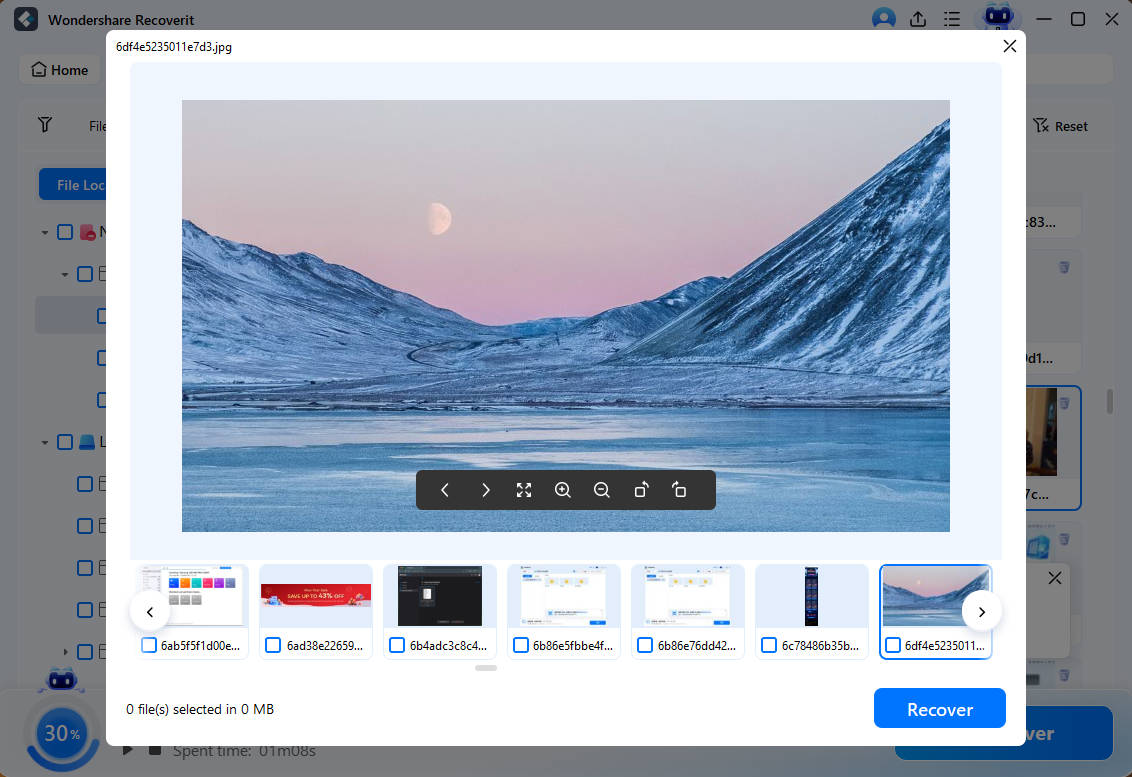
Make sure you save the data files at a different location. Now, click on ‘Save’ to store it at a different location.
Post-BSOD Checklist: Hardening Your System Against Future Kernel Crashes
- Analyze Windows Memory Dump Logs: Install Microsoft WinDbg or download BlueScreenView to read your system's mini-dump log files located at C:\Windows\Minidump\ to identify the exact file that caused the crash.
- Run Deployment Image Health Restoration Scripts: Open an administrative command prompt window and execute the system repair tool script to fix hidden system corruption blocks:
DISM.exe /Online /Cleanup-image /Restorehealth - Validate Core Storage Hardware Lifespans: Open a terminal and type wmic diskdrive get status to check the SMART health status reported by your internal NVMe or SATA storage controllers.
- Disable Unstable Hardware Overclocking Profiles: Boot directly into your motherboard's UEFI/BIOS utility menu and disable XMP (Extreme Memory Profile) or manual CPU/RAM voltage overclocks to ensure complete system stability.
- Audit Third-Party Anti-Malware Kernels: If you are running independent third-party antivirus tools, check for recent software version compatibility patches, as legacy security filters frequently trigger exception execution blocks.
The Bottom Line
Kmode_exception_not_handled error is not an unsolvable problem if you know the source of the issue. The solutions mentioned in the article consider some of the factors that may be causing the error. And if you lost any unsaved data, you can retrieve it back using Recoverit Data Recovery software.
Computer Data Recovery
- Windows PE
- System problems
- Reset Windows 10
- Install Windows 10 on SSD
- Can't Enter Safe Mode
- Fix no Sound issue
- Parameter is Incorrect
- PC Errors


Recoverit Editorial Team
chief Editor