


 TL;DR:
To recover a deleted video on a Samsung Galaxy phone, immediately check the 30-day Trash folders in Samsung Gallery, Google Photos, or My Files before attempting third-party software recovery.
● Stop recording new videos to prevent overwriting data, because recovering permanently deleted files directly from modern encrypted Samsung internal storage via USB is not realistically possible.
● If relying on a Microsoft OneDrive backup, you must search the standalone OneDrive app or website to restore the file, as direct OneDrive syncing with Samsung Gallery ended on September 30, 2026.
● Use desktop recovery software like Wondershare Recoverit strictly for scanning portable, non-encrypted microSD cards via a computer card reader, saving any recovered files to a separate healthy drive.
Ask AI for a summary
 ChatGPT
 Perplexity
 Gemini
 Claude
 Grok
If you accidentally deleted a video on your Samsung Galaxy phone, check Samsung Gallery's Trash first. Recently deleted videos can often be restored directly without installing software. If the clip is not there, check Google Photos, My Files, and any existing OneDrive backup. A video saved on a removable, non-encrypted microSD card may offer an additional recovery route through a computer.
The best method depends on where the video was stored and how it disappeared. Do not empty Trash, reset the phone, format a memory card, or record more videos while you are trying to recover missing files. The sections below explain how to retrieve deleted videos on Samsung safely, what each method can restore, and the limits of permanent-deletion recovery.
In This Article
-
- Method 1. Restore Deleted Samsung Videos From Gallery Trash
- Method 2. Retrieve Deleted Samsung Videos From Google Photos
- Method 3. Find Videos in My Files or Restore Them From Its Recycle Bin
- Method 4. Recover a Samsung Video Previously Saved to OneDrive
- Method 5. Recover Samsung Videos From a Removable microSD Card With Recoverit
Part 1. Find Out Where Your Missing Samsung Video Was Stored
Before choosing a recovery tool, identify the original location of the missing video. Samsung Gallery, Google Photos, OneDrive, internal storage, and removable memory cards do not share one universal recycle bin. A video may also have moved to a different folder without actually being deleted.
Match the Video Location to the Right Recovery Method
Use this comparison to start with the least disruptive option and avoid scanning a storage location that never held the missing file.
| Where the video was | Where to look first | What matters |
| Samsung Gallery, including videos taken with Camera | Gallery > Menu > Trash | Gallery Trash generally keeps deleted items for 30 days |
| Backed up through Google Photos | Google Photos > Collections > Trash | Current Google Photos help describes a 30-day Trash window |
| Downloaded or managed using Samsung My Files | My Files > Videos, Downloads, or Recycle bin | Folders and the file-manager recycle bin may contain the item |
| Previously uploaded to Microsoft OneDrive | OneDrive app > Photos or Files, then Recycle bin | Existing cloud copies remain accessible even after the Gallery sync change |
| Portable, non-encrypted microSD card | Computer card reader and storage recovery scan | The card must be detected; avoid writes and save recovered files elsewhere |
| Encrypted internal storage, permanently deleted without backup | Check every available backup before deciding on next steps | Ordinary desktop file-recovery software cannot reliably scan deleted sectors through a normal phone USB connection |
Protect the Original Video Before Trying Anything Else
If your Samsung phone still works, avoid actions that can remove the remaining recovery options. Start by checking the app's Trash or cloud copy, and verify any video you restore by playing it through to the end.
- Do not empty the recycle bin: The empty or permanently delete command removes the in-app recovery path.
- Do not factory reset your Galaxy phone: A reset is not a deleted-video recovery method and may destroy locally stored information.
- Avoid new writes to an affected microSD card: New recordings or downloads can overwrite lost video data.
- Check the correct account: Videos may exist under another Google account, Microsoft account, or a separate cloud backup.
Once you know the likely storage location, follow the corresponding method below instead of trying every option on the phone.
Part 2. Five Ways to Recover Deleted Videos on Samsung
The following methods cover the main places where Galaxy users store recordings, saved clips, and downloaded videos. Begin with the phone's own restore features, move to previously existing cloud copies, and use desktop recovery only for suitable removable storage.
Method 1. Restore Deleted Samsung Videos From Gallery Trash
Best for: A video deleted from Samsung Gallery within the retention period. Samsung states that Gallery items kept in Trash are generally available for 30 days. The menu labels may be Trash or Recycle bin depending on the phone and One UI version.
Step 1. Open the Gallery app on your Samsung phone. Tap Menu, usually shown as three horizontal lines, and choose Trash or Recycle bin.

Step 2. Browse the deleted items and look for the missing recording. Press and hold the video to select it; select additional videos if needed.
Step 3. Tap Restore or Restore all. Return to Gallery and open the recovered clip to confirm it plays correctly.
Note: Do not tap Empty or Delete while reviewing the recycle bin. For Samsung's current workflow and its 30-day rule, see the official Samsung Gallery Trash instructions. If the video is not listed, check a different storage location before assuming it has been permanently lost.
Method 2. Retrieve Deleted Samsung Videos From Google Photos
Best for: Videos that had already been saved to Google Photos or were deleted through the Photos app. The contents of Google Photos Trash are not the same as Samsung Gallery Trash. Google's current help says deleted items remain in Photos Trash for 30 days, provided they have not been permanently deleted.
Step 1. Open Google Photos on the Galaxy phone, making sure you are signed into the Google account that backed up the video. At the bottom, select Collections > Trash.
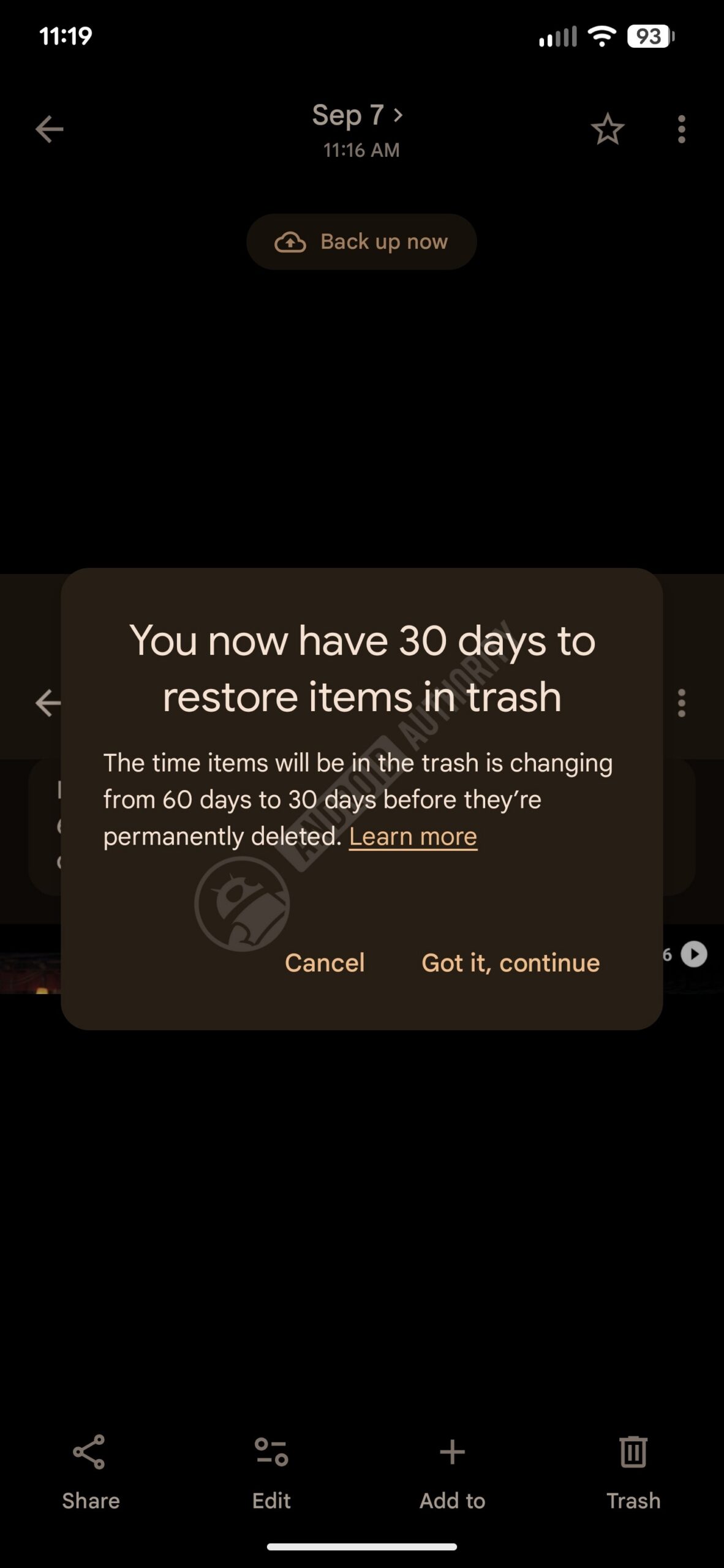
Step 2. If you see the missing video, touch and hold it and tap Restore. It should return to the Google Photos library and any applicable albums.
Step 3. If Trash is empty, inspect Archive, other Google accounts, and any local copies that may never have been uploaded. Review the official Google Photos deleted-video restoration guide for the currently supported path.
Note: Google's current 30-day notice replaces older instructions that distinguish a 60-day period for some backed-up items. Always trust the policy shown in your account and the latest official help. Videos permanently removed from Google Photos Trash cannot be restored by Google Photos.
Method 3. Find Videos in My Files or Restore Them From Its Recycle Bin
Best for: Videos downloaded from messages, browsers, or apps, and files managed directly through Samsung My Files. A missing video may have been moved to Downloads or another folder, rather than deleted from the camera album.
Step 1. Open My Files on your Samsung phone. Start with the Videos and Downloads categories, then check Internal storage or SD card if available.
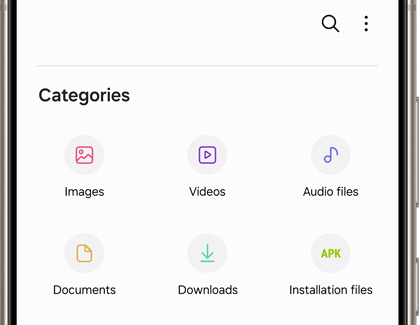
Step 2. If you cannot find the video in a regular folder, open My Files > Recycle bin. On supported One UI versions, tap Edit and select the deleted video files you want back.
Step 3. Tap Restore, then open the restored file in My Files or Gallery. Samsung's My Files recycle bin guide for One UI 6 and later confirms the selection and restore sequence.
Note: The Gallery and My Files recycle bin experience can overlap on newer Galaxy phones. Seeing an item under one app does not mean you should empty the other app's Trash.
Method 4. Recover a Samsung Video Previously Saved to OneDrive
Best for: Videos uploaded to Microsoft OneDrive before they disappeared from the phone. Starting September 30, 2026, Samsung Gallery stopped syncing directly with OneDrive, but previously uploaded videos remain accessible in OneDrive. You must check the OneDrive app or website rather than relying on the old Samsung Gallery Sync menu.
Step 1. Open the OneDrive app on your Samsung phone and sign in with the same Microsoft account used for the original backup. Search Photos and Files for the missing video.

Step 2. If the video is still in OneDrive, open its menu and download or save a copy to the device. If it was deleted from OneDrive, open the account menu, choose Recycle bin, select the item, and tap Restore.
Step 3. Confirm that the restored file is back in OneDrive, then save a device copy if you need offline access. Microsoft's Samsung Gallery sync transition notice explains why cloud files no longer appear directly in Gallery.
Note: Personal OneDrive files deleted to the cloud Recycle Bin are generally retained for 30 days; work or school accounts have different policies. If the clip was never backed up to OneDrive, this method cannot retrieve it.
Method 5. Recover Samsung Videos From a Removable microSD Card With Recoverit

Best for: Videos originally stored on a portable, non-encrypted microSD card that a computer still detects. This is a different situation from permanently deleted videos on a modern Samsung phone's encrypted internal storage. Desktop software such as Wondershare Recoverit is appropriate for scanning compatible removable media, not for bypassing Samsung device protection.
Step 1. Stop saving new files to the microSD card. Safely shut down the phone or unmount the card as supported by your model, remove it, and connect it to a computer using a compatible card reader. If prompted to format or initialize the card, cancel the prompt.
Step 2. Open Recoverit on the computer. Choose the detected memory card as your scan location and begin scanning. The example interface below shows desktop card selection; your actual Samsung card name may differ.
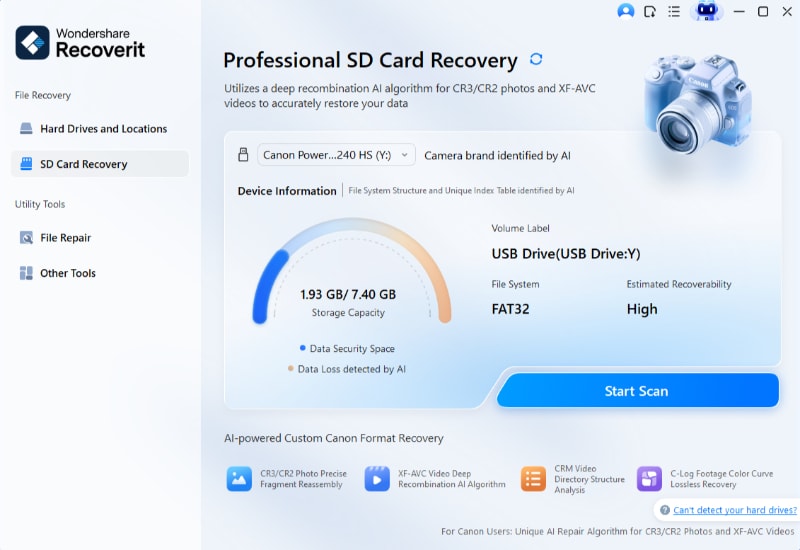
Step 3. Let the scan finish and inspect videos available for preview. Use file type, path, or file name when helpful to narrow the results. For more detail, follow the Recoverit guide to recover deleted videos from an SD card.
Step 4. Select the recoverable videos and save them to a different healthy drive, not the same microSD card. Open and play the recovered clips to verify the actual outcome.
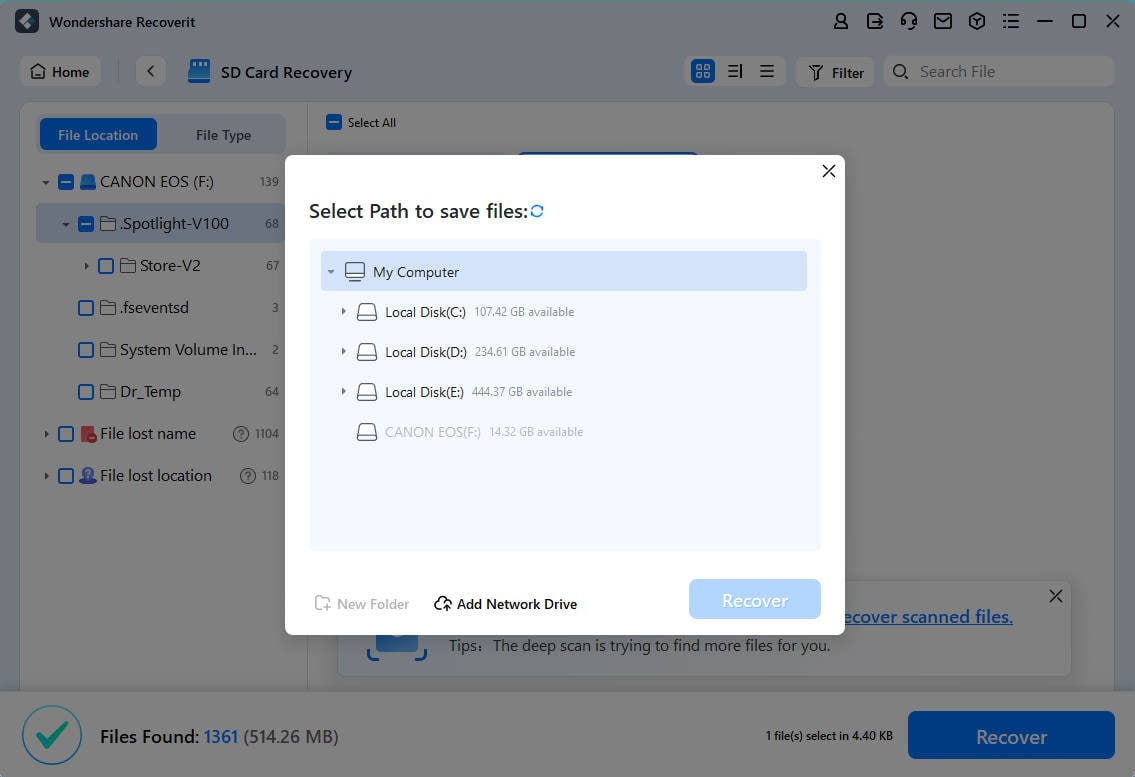
Limitations: If the card was set up as adopted/internal Android storage, it may be encrypted and unreadable on a separate computer. A scan does not guarantee that deleted video data has survived. Overwritten videos may be impossible to recover, and physically damaged or repeatedly disconnecting cards require professional assessment rather than repeated scanning.
Part 3. Can You Recover Permanently Deleted Samsung Videos?
Some deleted Samsung videos remain restorable because they are still in an app's Trash or were backed up before deletion. Once a video is permanently removed from both the device and every available backup, the situation changes substantially, especially for encrypted internal storage.
When Recovery Is Still Possible
The strongest recovery opportunities involve an existing copy, not an aggressive scan of the phone. Look for a video in Samsung Gallery Trash, Google Photos Trash, OneDrive Recycle bin, synced cloud folders, an old computer transfer, or a backup made before the incident.
If the video lived on portable microSD media and the card is still readable, a desktop scan may find file data that has not been overwritten. That possibility depends on the card's condition, file-system behavior, and subsequent writes. Never assume every permanently deleted video can be recovered in its original quality.
When Internal Storage Recovery Is Not Realistic
Modern Galaxy phones typically use encrypted internal storage and controlled file-transfer access. Connecting a phone by USB does not expose its internal flash memory as a raw removable disk for a normal PC file-recovery scan. Deletion, encryption-key changes, storage cleanup, and factory resets can leave no practical path to recover an old local video.
Be cautious of claims that any generic recovery program can instantly restore permanently deleted videos from every Samsung model, even after a reset. If an irreplaceable clip is missing and the device is malfunctioning, stop experimenting with resets or flashing and seek advice from a qualified technician. A technician may diagnose the phone, but recovery of permanently erased encrypted data still cannot be promised.
Part 4. How to Protect Samsung Videos From Future Loss
After you recover the clips you can, make more than one independent copy of the videos that matter. Backups protect against the next accidental deletion, device failure, or lost phone much more reliably than emergency recovery attempts.
Keep a Verified Copy Outside the Phone
Store important videos on a computer or separate external drive as well as a chosen cloud service. Open a few files from the backup to make sure the videos play; an enabled backup switch is not enough evidence that every clip was uploaded.
If you prefer OneDrive, use OneDrive's own Camera backup settings rather than the discontinued Samsung Gallery direct-sync workflow. If you prefer Google Photos, confirm that the correct account is signed in and backup has completed before you delete local originals.
Check Trash and Backup Status Before Cleaning Storage
Before using any phone storage cleanup or factory reset operation, check both the device's recycle bin and your cloud folders. Do not confuse a video that is visible online with an offline copy on the device. When you save recovered files, keep the original source unchanged until you have verified the new copies.
Conclusion
If you want to recover deleted videos on Samsung, the most reliable first steps are Gallery Trash, Google Photos, My Files, and any existing OneDrive backup. Check the actual storage location before assuming a video was permanently deleted. For a portable, computer-readable microSD card, Recoverit offers a separate scan-and-recover workflow with important limits. If the only copy was permanently deleted from encrypted phone storage, software cannot guarantee its return. Protect existing copies first, and verify every restored video before you consider the task finished.
FAQ
-
How do I get deleted videos back on my Samsung without an app?
Open Samsung Gallery, choose Menu, then Trash or Recycle bin. Select a deleted video and tap Restore. If it is not there, check My Files Recycle bin and any existing backups before installing software. -
Where can I find deleted videos on a Samsung Galaxy phone?
Start with Gallery Trash. Videos downloaded or managed in the file manager may be in My Files Recycle bin. Videos backed up elsewhere may still exist in Google Photos or OneDrive under the correct account. -
How long does Samsung Gallery keep deleted videos?
Samsung says Gallery Trash generally keeps deleted videos for 30 days. Items manually deleted from the Trash or already purged are no longer available through its Restore button. -
Can I restore Samsung videos after 30 days?
Possibly, but usually only if another copy exists in a cloud service, external backup, or storage device. The Gallery recycle bin will not restore videos that are no longer there. A separate portable microSD card may have other options if its data was not overwritten. -
Can I recover deleted Samsung videos after a factory reset?
Check backups made before the reset. Modern Samsung internal storage is normally encrypted, and a factory reset may make previous local data permanently inaccessible. Do not rely on a phone-to-PC scan to bypass that limitation. -
Does Recoverit recover videos directly from Samsung phone internal storage?
No general direct scan of protected Android internal memory is promised here. Recoverit is recommended for supported, computer-detected, non-encrypted removable microSD cards. Save any recovered video to a different healthy disk. -
Why are my older OneDrive videos missing from Samsung Gallery?
Samsung Gallery's direct sync with OneDrive ended on September 30, 2026. Videos already backed up to OneDrive remain accessible through the OneDrive app or website even though they may no longer be displayed through Gallery sync.


