 TL;DR:
Resolve MBR Error 1, 2, or 3 on legacy BIOS systems by first disconnecting external removable drives to verify the correct boot priority, and if the OS still fails to load, run Windows Startup Repair from the Recovery Environment before applying manual command-line fixes.
● Run the bootrec /fixmbr command only if Startup Repair fails and you have explicitly confirmed the Windows installation uses a legacy BIOS boot on an MBR-partitioned disk, as this command will not repair missing partition tables or UEFI/GPT setups.
● Differentiate these physical boot failures from MBR2GPT utility messages like "the disk you specified is not MBR formatted," which are disk layout validation errors that should never be bypassed by blindly converting or deleting partitions.
● Halt all software repairs, including disk conversions, CHKDSK, or cloning, if the internal drive emits clicking noises, repeatedly disconnects, or shows persistent hardware errors, as these indicate physical failure requiring professional recovery rather than boot-code changes.
Ask AI for a summary
 ChatGPT
 Perplexity
 Gemini
 Claude
 Grok
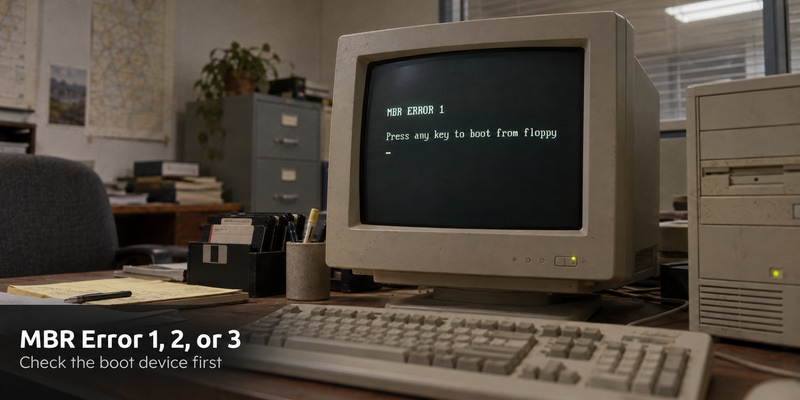
MBR Error 1, MBR Error 2, or MBR Error 3 may appear before Windows starts, sometimes with "Press any key to boot from floppy." First disconnect unnecessary removable drives and verify that your computer is trying to boot from the correct Windows disk. If that does not help, use Windows Startup Repair before attempting a command-line boot repair. Protect important files before making changes to boot records, partitions, or Windows.
These messages commonly appear on older or legacy-boot systems. They are not a universal Windows diagnostic code with three officially defined meanings, and they do not automatically prove your files are deleted. On a UEFI/GPT installation, the troubleshooting path differs from the familiar legacy BIOS/MBR procedure.
In This Article
Part 1. Identify the Error and the Boot Setup
The Master Boot Record (MBR) is a legacy disk partitioning and startup structure. A computer configured for legacy BIOS boot can encounter an early boot error when it cannot continue from the chosen device. A computer using UEFI and GPT has different boot components, so blindly applying an MBR command can target the wrong problem.
What MBR Error 1, 2, and 3 Indicate
Readers searching for mbr error 1, mbr error 2, or mbr error 3 often report a failed start before the Windows logo. Some older systems display a floppy-boot prompt even when no floppy drive is installed. The error number alone is not enough to distinguish corrupted boot code, an incorrect boot target, a missing disk, or a firmware mismatch.
| What you see | First safe interpretation | Best next check |
| MBR Error 1 / 2 / 3, with or without a floppy prompt | Firmware or legacy boot code may not be reaching the Windows loader. | Remove external boot media; inspect the correct boot device. |
| Drive is missing from firmware or repeatedly disconnects | The disk, connection, or storage controller may be unavailable. | Stop repeated attempts; check hardware and preserve data. |
| Windows disk appears normally but Windows will not start | Startup configuration may be damaged. | Try Windows Startup Repair after protecting important files. |
| MBR2GPT validation error inside Windows | Disk conversion prerequisites failed, not necessarily startup. | Inspect disk style and the selected system disk; do not convert blindly. |
MBR Boot Errors and MBR2GPT Conversion Failures
MBR Error 1/2/3 is the primary topic here: a machine fails before Windows starts. MBR2GPT, by contrast, is Microsoft's tool for converting a qualifying Windows system disk from MBR to GPT. Errors such as "cannot find OS partition" and "the disk you specified is not MBR formatted" concern validation of the disk layout or target. They are not synonyms for the older floppy-boot messages. Microsoft's MBR2GPT requirements list the checks performed before conversion.
Part 2. Make Safe Checks Before Boot Repair
Boot-repair tools can change startup information. If you have important files that are not backed up, prioritize an accessible copy or a qualified recovery path before editing partitions, rebuilding boot components, converting MBR to GPT, resetting Windows, or reinstalling the operating system.
Protect Files and Look for Drive Failure
If Windows can still load intermittently, copy your work files, photos, and project folders to a different healthy storage device and open several copies to verify them. If the PC does not boot, decide whether its internal drive is stable enough to be read on another computer or from a recovery environment. The unbootable Windows file recovery path is explained later.
Stop and seek professional data recovery if you hear clicking or grinding, notice a burning smell, see repeated drive disconnects, or receive persistent hardware diagnostics errors. Do not keep power-cycling such a drive, and do not start CHKDSK, formatting, DiskPart Clean, or cloning attempts on an unstable disk without professional guidance.
Note: You may need a BitLocker recovery key when entering Windows Recovery Environment or reading an encrypted disk from another device. If encryption is enabled, locate the key using Microsoft's BitLocker recovery instructions. Recovery software cannot bypass BitLocker encryption.
Check Connected Devices and Boot Priority
Use this first when: the MBR error appears after attaching a USB disk, changing firmware settings, or installing another drive. This is a non-destructive device-selection check; it does not repair damaged disk structures.
Step 1. Shut down the computer normally if possible. Disconnect unnecessary USB flash drives, external disks, optical media, and memory cards. Leave your keyboard and other essential peripherals connected.
Step 2. Start the computer and see whether Windows loads. If the same message returns, enter the BIOS/UEFI setup using the key shown by your PC manufacturer. Confirm the internal Windows drive or Windows Boot Manager is present and selected as the intended boot target.
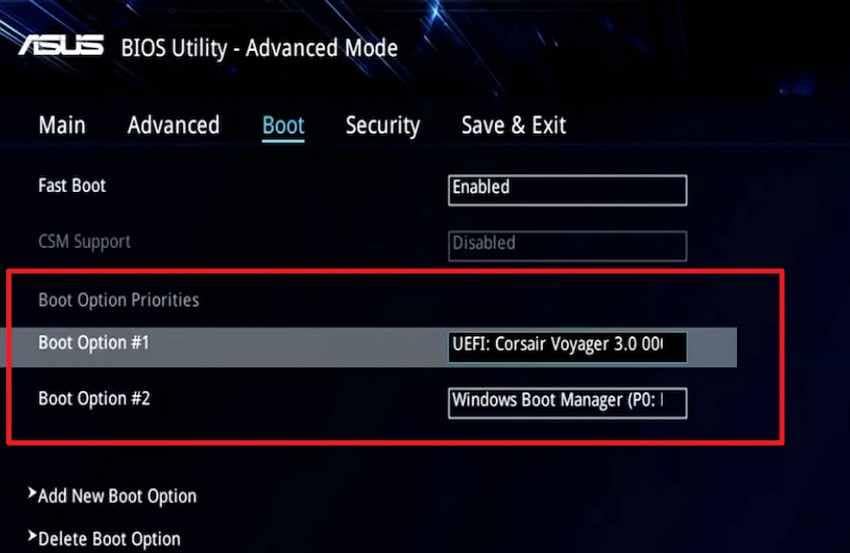
Step 3. Save only a verified boot-priority correction and restart. The screenshot shows one manufacturer's firmware interface, not a universal menu. Do not switch Legacy/CSM to UEFI, change SATA controller mode, or convert the disk just to clear this error. Those changes can make an otherwise intact Windows installation unbootable.
Expected result: Windows boots from its original disk. If the internal drive is absent in firmware, stop software repair and investigate the hardware connection or obtain professional help. If the drive is present but the error persists, continue after your important data is protected.
Part 3. Repair Windows Startup on a Healthy Disk
Use this section only if the storage drive appears reliably in firmware and there is no sign of imminent hardware failure. These are two different levels of intervention: automated Startup Repair first, and manual boot-code changes only for a confirmed legacy BIOS/MBR installation.
Method 1. Run Windows Startup Repair
Use this when: Windows 10 or Windows 11 fails before sign-in and the Windows Recovery Environment (WinRE) is available. Startup Repair can inspect and attempt to repair some startup-file, BCD, and MBR problems without requiring you to guess which command is appropriate. See Microsoft's Startup Repair instructions.
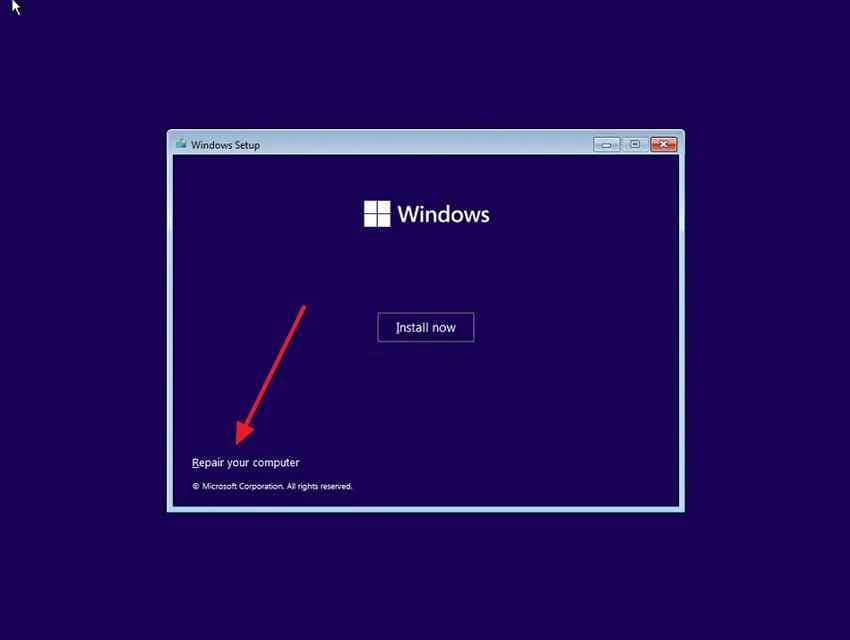
Step 1. Open WinRE from the recovery screen if offered. If the computer cannot reach it, use official Windows installation or recovery media prepared on another working computer. When installation media opens, choose the option to Repair your computer, not Install now.
Step 2. In WinRE, select "Troubleshoot > Advanced options > Startup Repair." Choose your Windows installation or account if asked, and provide the BitLocker recovery key if required.
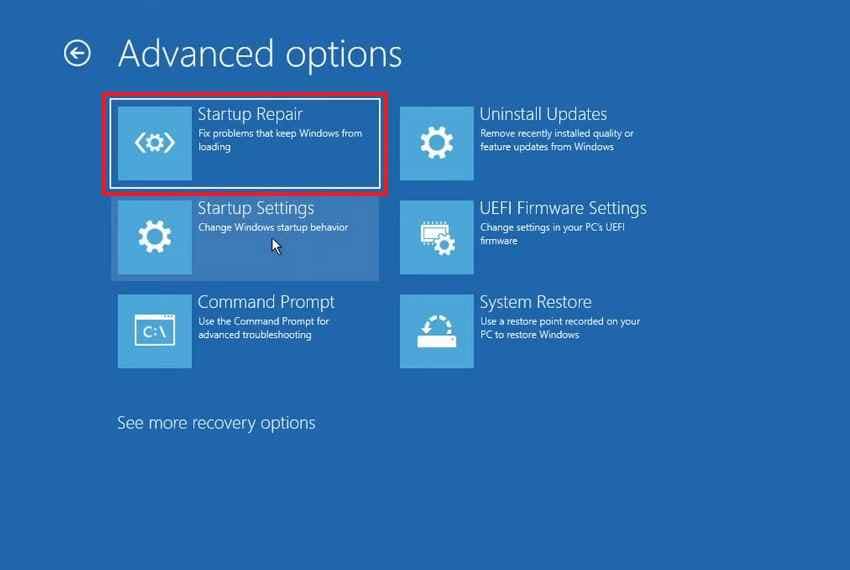
Step 3. Allow one repair attempt to complete, remove any installation USB if instructed, and restart normally. Menu appearance can differ between Windows 10 and 11, but the recovery option has the same purpose.
Expected result: Windows reaches the sign-in screen. If Startup Repair reports that it cannot repair the computer, record the message. Do not loop the repair repeatedly. If your disk uses GPT/UEFI, seek UEFI-specific boot guidance rather than applying legacy MBR commands.
Method 2. Repair Legacy MBR Boot Code When Appropriate
Use this only when: a backup or recoverable file copy is available, the disk is stable, the Windows installation uses legacy BIOS boot on an MBR-partitioned disk, and Startup Repair did not work. The command below is not a generic repair for UEFI/GPT PCs, missing partitions, failing hard drives, or MBR2GPT errors.
Step 1. From WinRE open "Troubleshoot > Advanced options > Command Prompt." Confirm the correct installation and partition style before changing startup code. A technician should review uncertain multi-disk or dual-boot layouts.
Step 2. On a confirmed legacy installation, run bootrec /fixmbr and record its result. This command writes the master boot code; it does not repair a damaged partition table. Do not run bootrec /fixboot, bootrec /rebuildbcd, diskpart clean, or repartitioning commands as an automatic sequence merely because they appear in an older guide.
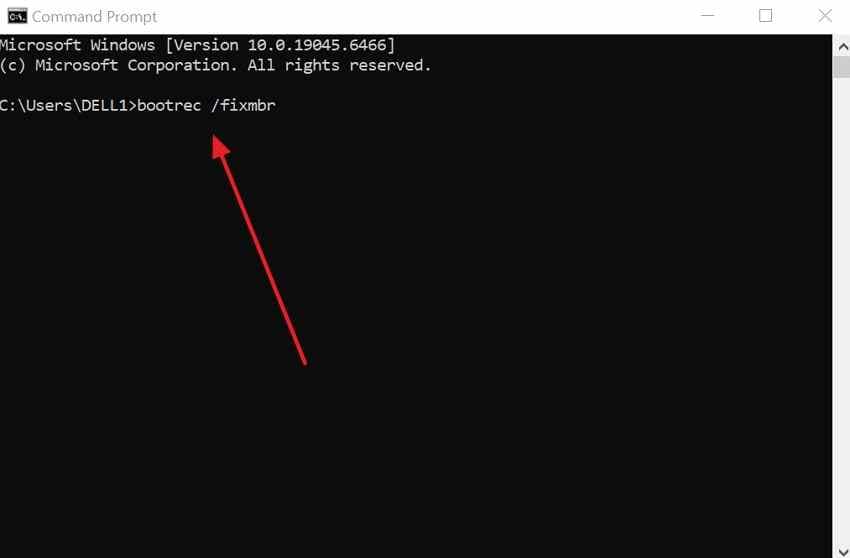
Step 3. Exit Command Prompt and attempt a normal restart. If Windows still will not load, stop and identify whether the problem is actually with BCD, a missing boot device, or hardware. Microsoft's Windows boot troubleshooting guidance separates MBR code repair from BCD diagnostics and explicitly notes the partition-table limitation.
Expected result: the original Windows installation starts. A successful command response alone is not proof that boot is repaired or files are safe. When disk style or firmware mode is uncertain, do not guess; get the configuration checked first.
Part 4. Handle MBR2GPT Messages Separately
Two of the related queries describe the MBR2GPT conversion utility, not the MBR Error 1/2/3 boot screen. Start with a read-only check. This page does not recommend converting or deleting partitions as a way to clear an unrelated boot message.
"The Disk You Specified Is Not MBR Formatted"
MBR2GPT accepts a qualifying MBR system disk as its input. If the selected disk is already GPT, or if a different disk was selected, validation may report that the disk is not MBR formatted. A GPT disk is not something to "fix" by forcibly switching it to MBR.
Step 1. If Windows boots, open Disk Management, identify the disk that actually holds the Windows installation, and inspect its Properties under the Volumes tab for Partition style. The first example shows an MBR disk; the next shows GPT. Both are authentic examples and neither by itself identifies your own OS disk.
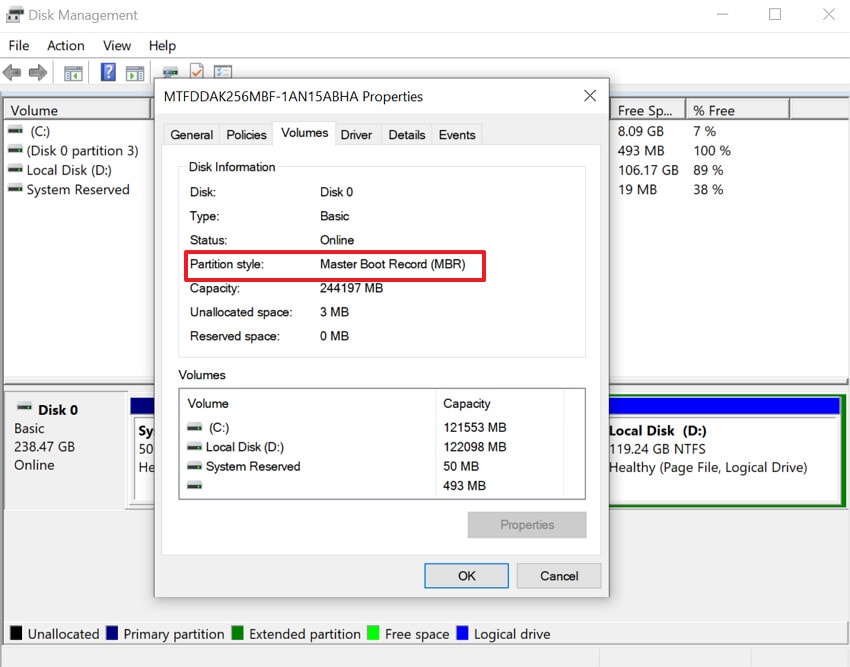
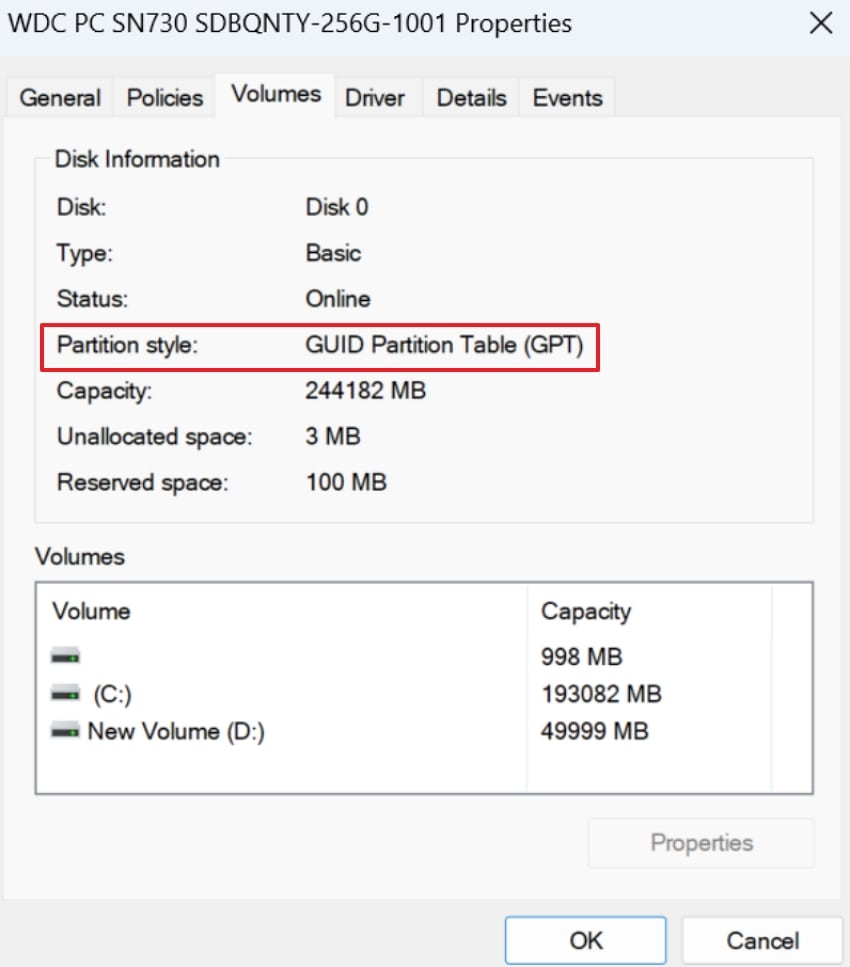
Step 2. You can also run the non-destructive command Get-Disk in an elevated PowerShell window to compare disk numbers and partition styles. Do not assume disk 0 is always the correct target, and do not use clean, convert mbr, or convert gpt on a disk holding important files.
Expected result: the selected disk's layout is identified. If it is GPT, do not rerun MBR2GPT against it. For a planned Windows upgrade on a genuine MBR system disk, use the separate Recoverit MBR2GPT guide and the official Microsoft prerequisites before any conversion.
"MBR2GPT Cannot Find OS Partition"
This message means MBR2GPT could not validate the selected disk's Windows/boot layout. Possibilities include an incorrect disk number or boot configuration spread across disks; it is not proof that the Windows files have disappeared. A 2026 Microsoft Q&A example illustrates a case in which Windows and System Reserved boot files were on separate disks.

Instructions. First preserve a complete backup. Check the correct Windows disk, its partition layout, and the BCD references. If Windows still starts, an administrator can inspect diskpart with list disk and list volume, and review bcdedit output without changing partitions. A read-only validation such as mbr2gpt /validate /disk:0 /allowFullOS is meaningful only after confirming that disk 0 really is the target Windows MBR system disk. The /allowFullOS option applies when the command runs inside a normal Windows session, not when run from Windows PE.
If validation fails: save the full output and refer to the official disk prerequisites. Do not follow unverified instructions to delete recovery partitions, move boot files, or run mbr2gpt /convert until the actual layout has been examined.
Part 5. Recover Important Files Before Further Changes
A boot error is not, by itself, lost data. However, if Windows cannot start and important files are not backed up, recovering or copying them before further repairs reduces risk. Recoverit is a file recovery tool, not an MBR code repair, firmware conversion, or hardware repair utility.
Recover Files From a Stable, Detectable Drive

MBR Error 1/2/3? Don't Let Boot Repair Risk Your Files
Windows won't start after an MBR Error 1, 2, or 3? Protect your files before rewriting boot records. Recoverit can scan stable, detectable storage for recoverable data, with bootable recovery options for inaccessible Windows systems. Save your files to another drive.
Use this when: the drive appears reliably in Windows, another working computer, or an appropriate recovery environment; the disk is not showing signs of physical failure; and files are missing or inaccessible. Avoid installing the program on the problem disk or saving recovered files to the same physical device.
Step 1. Use a healthy Windows PC, attach the readable source drive if needed, and open Recoverit. Select the correct affected disk, using capacity and other disk details to avoid scanning the wrong device. The image below shows a genuine earlier Recoverit interface; the current release groups locations differently, but selecting the correct disk remains the essential action.
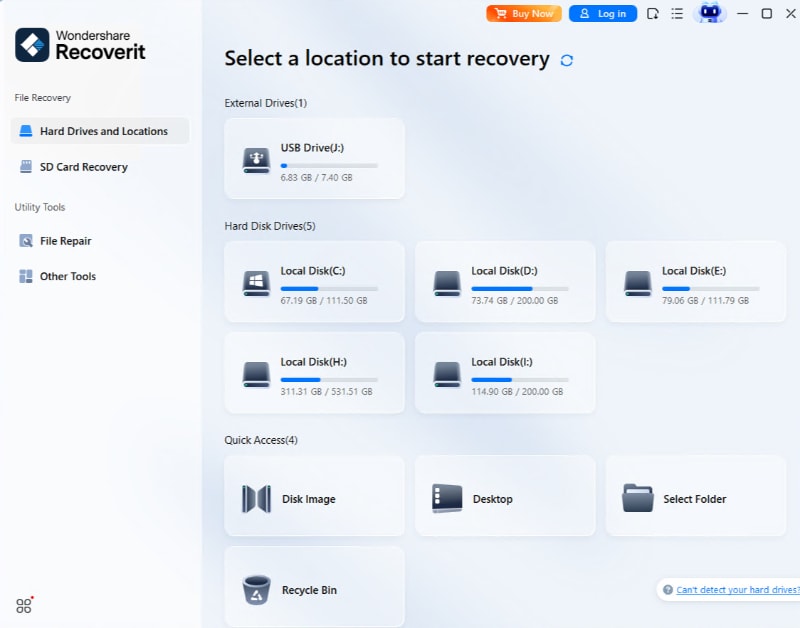
Step 2. Scan the selected device and review detected files. Preview supported items to confirm their contents where possible, then choose Recover. The following authentic older-version preview illustrates the action, not the exact 2026 button arrangement.
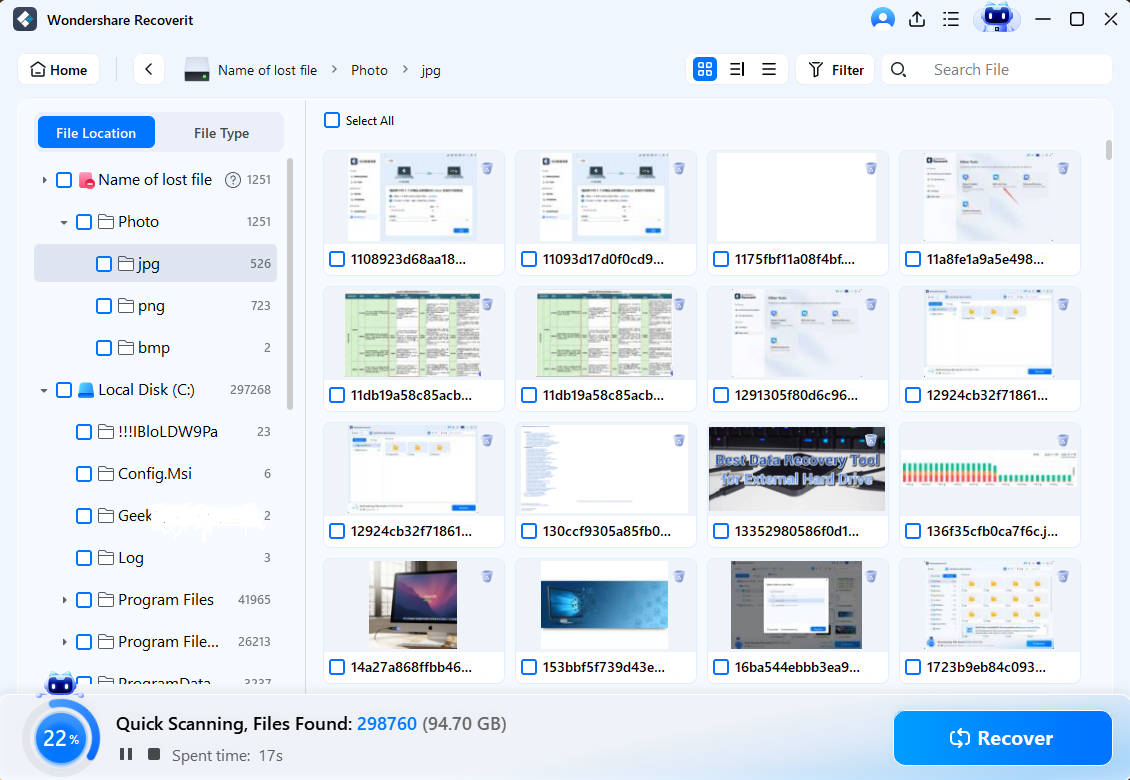
Step 3. Save recovered files to a different healthy physical disk, and open several exported files to verify they are usable. Recoverability depends on drive condition and whether data was overwritten. Read the current Recoverit Windows user guide for the up-to-date select, scan, preview, and save interface.
If the original Windows disk cannot be accessed normally: review the crashed-computer recovery options and create any bootable media on a different working computer. The USB drive used to create bootable recovery media may be erased. If the source repeatedly disconnects, makes unusual noises, or cannot be detected reliably, do not keep scanning it; consult a professional recovery lab instead.
Part 6. Confirm the Fix and Decide What to Do Next
A resolved boot issue means the computer starts from its intended internal drive, reaches Windows normally, and important files still open. Verify that unwanted external boot media is not required and that the same message does not return on a normal restart. If the error returns after a temporary fix, back up the data and assess disk health, firmware boot mode, and hardware connectivity rather than repeatedly rewriting boot code.
Keep the problems separated: MBR Error 1/2/3 is an early boot symptom; MBR2GPT validation concerns MBR-to-GPT eligibility; physical drive failure requires hardware diagnosis. This separation helps you choose the right next step and avoid destructive commands.
Conclusion
For MBR Error 1, 2, or 3, begin with the boot device and data safety checks, then use Startup Repair if Windows will not start. Reserve bootrec /fixmbr for a verified legacy BIOS/MBR system and do not substitute MBR2GPT conversion for startup repair. When files are inaccessible on a stable drive, recover them to another disk before pursuing more invasive changes.
FAQ
-
Is MBR Error 1 the same as MBR Error 2 or 3?
They are related early-boot messages seen on some legacy setups, but there is no single modern Windows definition assigning each number a separate, guaranteed cause. Check the exact text, boot device, disk visibility, and firmware mode instead of diagnosing by the number alone. -
Why does the computer say "Press any key to boot from floppy"?
Some legacy boot paths display this message when they cannot continue booting from the selected device. It does not necessarily mean the computer has a physical floppy drive. Remove removable media and check the correct boot target before repairing code. -
Does bootrec /fixmbr delete my personal files?
The command is designed to rewrite master boot code rather than the partition table or personal files, but it is still a boot-structure change and cannot fix every failure. On an unknown, encrypted, dual-boot, GPT/UEFI, or unstable disk, protect files and confirm the configuration first. -
How do I fix "the disk you specified is not MBR formatted"?
Confirm that you selected the correct Windows system disk and inspect its partition style using Disk Management or Get-Disk. If that disk is already GPT, MBR2GPT is not needed for it. Never erase the disk merely to satisfy this message. -
Can Recoverit repair MBR boot code?
No. Recoverit can attempt file recovery from stable, detectable storage in supported situations; it does not replace Windows Startup Repair, rewrite boot code as a system repair tool, or fix a physically failing disk.


