
Short verdict: TestDisk is worth using in 2026 if your main problem is a lost partition, damaged partition table, missing boot sector, RAW drive caused by file-system metadata damage, or a disk that stopped booting after a partition error. It is completely free, open-source, portable, and powerful. It is not the best choice for beginners who only need to recover deleted photos, documents, videos, or files from a readable drive.
This TestDisk review explains what TestDisk can actually do, how it differs from PhotoRec, what the current official version status is, where the command-line workflow becomes risky, how to recover a lost partition step by step, and when a graphical alternative such as Recoverit Data Recovery Free is a safer first step.
Before using TestDisk, stop writing data to the affected drive. Do not format it again, create a new partition, run CHKDSK, reinstall Windows or macOS, or write a new partition table unless you have verified the result. TestDisk can make permanent changes to disk structures. If the drive is clicking, disconnecting, physically damaged, or not detected, image the disk first or contact a data recovery lab.
TestDisk: Quick Verdict
- Overall editorial rating: 4.2/5 for advanced users and IT teams; 2.8/5 for beginners who need simple file recovery.
- Best for: lost partitions, partition table repair, FAT/NTFS/exFAT/ext2 boot sector repair, MFT mirror checks, non-booting disks, and copying files from found partitions.
- Not ideal for: users who want a graphical interface, file preview, one-click recovery, large video recovery, camera-card recovery by thumbnails, or recovery from physically failing storage.
- Current official status: CGSecurity lists TestDisk & PhotoRec 7.2 as the stable release from February 22, 2024, and 7.3-WIP as a beta download.
- Price: Free and open-source under the GNU General Public License.
- Key risk: TestDisk can write partition table and boot sector changes. Pressing the wrong option on the wrong disk can make recovery harder.
- PhotoRec note: PhotoRec ships with TestDisk and is better for recovering individual deleted files by signature, but it often loses original filenames and folder paths.
- Best alternative: Recoverit is better for general users who need a visual scan, file preview, deleted-file recovery, partition data recovery, and Windows/Mac recovery without command-line disk writes.
In this article
Part 1. TestDisk Review: Quick Verdict
TestDisk is one of the few free tools that still deserves its reputation. It is not a modern consumer recovery app. It is a low-level, text-based utility made for recovering lost partitions, fixing partition tables, rebuilding boot sectors, making some non-booting disks bootable again, and copying files from supported file systems when the structure is still readable.
That makes TestDisk excellent for the right person and risky for the wrong person. If you understand disks, partition tables, boot sectors, GPT/MBR, and file systems, TestDisk can solve problems that many paid tools hide behind a simple interface. If you only want to recover a few deleted photos from an SD card, a document from a USB drive, or videos from a readable external drive, TestDisk is usually the wrong first tool. Use PhotoRec or a graphical recovery tool instead.
Who Should Use TestDisk?
- Use TestDisk if: a partition disappeared, a drive shows as unallocated, a boot sector is damaged, a partition table was deleted, or Windows/macOS/Linux can detect the disk but not mount the original volume.
- Use PhotoRec instead if: you need to recover individual files from a formatted, corrupted, or partly unreadable drive and do not care about original filenames or folder paths.
- Use Recoverit instead if: you want a visual interface, previews, scan filters, simple deleted-file recovery, lost partition data recovery, or recovery from Windows and Mac without command-line disk writes.
- Use a lab instead if: the drive clicks, spins down, smells burnt, has liquid damage, has head/firmware failure symptoms, or is not detected by the computer.
At-a-Glance Rating
| Review area | Rating | What it means |
| Partition recovery power | 4.7/5 | Excellent for lost partitions, partition table repair, boot sector repair, and file-system metadata problems. |
| Free value | 5.0/5 | Completely free and open-source, with no file-size or subscription limits. |
| Beginner friendliness | 2.0/5 | The text interface, keyboard controls, and permanent Write option can intimidate or mislead beginners. |
| File recovery convenience | 2.8/5 | TestDisk can copy files from supported partitions, but it has no thumbnail preview or modern filtering. |
| Platform coverage | 4.5/5 | Official downloads cover Windows, macOS, Linux, DOS/Win9x, source code, and many package-manager options. |
| Safety for damaged drives | 3.0/5 | Safe when used read-only, risky when writing partition structures or scanning unstable hardware. |
| Recoverit alternative fit | 4.6/5 | Recoverit fits users who need GUI recovery, preview, common file recovery, and partition data recovery without editing disk tables. |
Part 2. What Is TestDisk?
TestDisk is a free and open-source data recovery utility from CGSecurity, created by Christophe Grenier. It is usually downloaded in the same archive as PhotoRec and QPhotoRec. The official documentation describes TestDisk as a tool for recovering lost partitions, fixing boot sectors, and recovering files from damaged or deleted file systems.
TestDisk's main job is not "recover every deleted file." It works at the partition and file-system metadata level. It can analyze the current partition table, search for lost partitions, list files from found partitions, repair some FAT/exFAT/NTFS boot sector problems, locate ext2/ext3/ext4 backup superblocks, and write corrected partition information when the user confirms it.
That is why TestDisk is often recommended in partition recovery guides. If you need background first, read this Recoverit guide on how to restore lost partition data. The key distinction is that recovering files and repairing a partition table are not the same task.
TestDisk is also portable. The official TestDisk download page says TestDisk & PhotoRec do not need an installer: users extract the archive and run the applications. That is useful because installing recovery software onto the affected drive can overwrite recoverable data.
Part 3. TestDisk Version, Price, Platforms, and File-System Support
The current official status is straightforward: TestDisk & PhotoRec 7.2 is the stable release from February 22, 2024. CGSecurity also provides TestDisk & PhotoRec 7.3-WIP as a beta build. For most users, 7.2 is the safer stable reference, while 7.3-WIP is for users who intentionally want the latest development build and understand that WIP files may change.
| Item | Current official information | Review note |
| Stable version | TestDisk & PhotoRec 7.2, released February 22, 2024. | Use this as the stable baseline for most recovery cases. |
| Beta version | TestDisk & PhotoRec 7.3-WIP. | Useful for advanced users who need latest fixes, but WIP builds may change. |
| Price | Free and open-source. | No license, subscription, recovery-size limit, or paywall. |
| License | GNU General Public License. | The source code is available for review and compilation. |
| Install type | Portable archive. | Extract and run. No installer is required. |
| Windows support | Windows 64-bit and 32-bit; official 7.2/7.3 notes list Windows Vista/Windows Server 2008 and above for 32-bit builds. | Run as Administrator when disk access is needed. |
| macOS support | macOS Intel 64-bit, macOS 10.6 or later; official page notes Mac M1 can run the 7.3-WIP Intel build. | Apple silicon users should verify current package or Homebrew behavior before starting. |
| Linux support | Linux x86_64, kernel 2.6.18 or later. | Run with root privileges when direct disk access is required. |
| Other builds | DOS/Win95/Win98 and source code are available from CGSecurity. | Useful for legacy recovery environments. |
CGSecurity's main page lists broad TestDisk file-system detection support, including NTFS, FAT12, FAT16, FAT32, exFAT, ext2, ext3, ext4, btrfs, BeFS, CramFS, HFS, JFS, Linux RAID, Linux Swap, LVM, LVM2, NSS, ReiserFS, UFS, and XFS. It can also undelete files from FAT, NTFS, exFAT, and ext2 file systems. For simple deleted-file recovery, see this Recoverit list of free data recovery software before deciding whether a command-line utility is the right fit.
Part 4. TestDisk Features and Real Risks
TestDisk is powerful because it works where many simpler tools stop: partition tables, boot sectors, MFT mirror checks, backup superblocks, and non-booting disks. The same power creates risk. A beginner can accidentally choose the wrong disk, mark the wrong partition type, or write a partition table before checking files with the P key.
Who Is TestDisk For?
- IT professionals and system administrators: TestDisk is useful when a machine cannot boot, a partition table is missing, or a disk needs structural analysis before a rebuild.
- Advanced computer users: It fits users comfortable with MBR, GPT, boot sectors, file systems, disk identifiers, and terminal/console navigation.
- Budget users with technical confidence: TestDisk is free and has no data recovery cap, so it is attractive when the user can safely interpret the scan results.
- Forensic-aware users: TestDisk can collect disk information and run from live media, but evidence-sensitive cases still need write blockers and proper imaging.
Who Is TestDisk Not For?
- Beginners with irreplaceable files: The lack of a GUI and the presence of permanent Write operations make mistakes costly.
- Users who only need deleted files: PhotoRec or a GUI tool is usually faster for deleted photos, documents, videos, or audio files.
- Users who need previews: TestDisk can list and copy files from some partitions, but it does not provide image thumbnails, video previews, or recovery-quality scoring.
- Physically damaged drives: TestDisk does not repair hardware. If the drive is unstable, image it first with a safer workflow such as ddrescue or use a lab.
| Feature | TestDisk capability | Practical warning |
| Recover lost partitions | Searches for partitions and can write corrected partition table entries. | List files with P and confirm the correct structure before using Write. |
| Fix partition table | Can repair some MBR/GPT partition table problems. | Wrong writes can make the disk harder to recover. |
| Repair FAT/exFAT/NTFS boot sectors | Can rebuild or recover boot sectors from backups in supported cases. | Recover files first if the disk contains important data. |
| Repair MFT mirror issues | Can use the MFT mirror in NTFS-related workflows. | This is an advanced repair path, not a one-click file recovery feature. |
| Locate ext backup superblocks | Can locate ext2/ext3/ext4 backup superblocks. | Linux file-system repair still requires caution and often external tools. |
| Copy files from found partitions | Can copy files from FAT, exFAT, NTFS, ext2/ext3/ext4 and other listed partitions. | There is no modern preview pane, and copying should go to another drive. |
| Make non-booting disks bootable | Can help when boot failure is caused by recoverable partition or boot-sector metadata problems. | It cannot fix failed hardware, corrupted Windows installations, drivers, BIOS, or malware damage. |
TestDisk vs Recoverit
| Feature | TestDisk | Recoverit |
| Primary interface | Text-based, keyboard-driven command-line style. | Visual interface with mouse-driven scan, filter, preview, and recovery workflow. |
| Main strength | Partition table and boot sector recovery. | General file recovery from readable storage, lost partition data recovery, and media recovery. |
| Price | Free and open-source. | Free version available with paid plans for expanded recovery needs. |
| Partition repair | Can write changes directly to disk structures. | Focuses on scanning and recovering files instead of editing partition tables. |
| File preview | No modern thumbnail/video preview. | Preview available for supported file types before recovery. |
| Skill level | Advanced users, IT support, system administrators. | Beginners, general users, creators, and office users who need a guided process. |
| Risk profile | Safe in read-only analysis, risky when writing partition changes without verification. | Lower risk for ordinary file recovery because it avoids partition-table repair decisions. |
TestDisk vs PhotoRec
TestDisk and PhotoRec are created by CGSecurity and usually downloaded together. They solve different problems, and choosing the wrong one wastes time.
| Feature | TestDisk | PhotoRec |
| Primary goal | Recover partition structures and repair boot/file-system metadata. | Recover individual files by scanning raw data for file signatures. |
| How it works | Analyzes and edits partition tables, boot sectors, and file-system metadata. | Ignores the file system and carves files by known signatures. |
| Best for | Missing partition, RAW partition, unallocated drive, boot-sector issue, non-booting disk caused by disk metadata damage. | Deleted files, formatted drive, corrupted file system, camera card recovery, and cases where the partition cannot be restored. |
| Result | May restore the original partition and preserve folder structure when metadata is valid. | Recovers files into folders with generic names; original filenames and paths are often lost. |
| Preview | No modern preview. | No typical GUI preview in command-line PhotoRec; QPhotoRec offers a graphical PhotoRec front end. |
| Main risk | Writing partition changes before verifying results. | Huge volume of recovered files with generic names, duplicates, and no original structure. |
CGSecurity states that PhotoRec handles more than 440 file formats, including JPG, Microsoft Office, and OpenOffice documents. That makes PhotoRec the better free CGSecurity tool for file carving, while TestDisk remains the better tool for lost partition recovery.
Pros and Cons of TestDisk
| Pros | Why it matters |
| Completely free | No trial wall, subscription, file limit, or license key. |
| Open-source | Source code is public and the tool is widely packaged in recovery environments. |
| Excellent partition recovery | Can recover lost partitions and repair boot/file-system metadata in cases GUI tools may not address. |
| Portable | No installer is required, reducing the chance of writing to the affected drive. |
| Cross-platform | Runs on Windows, macOS, Linux, DOS/Win9x, and from live media or source builds. |
| Pairs with PhotoRec | Users get both structure repair and file-carving options in one CGSecurity package. |
| Cons | Why it matters |
| No graphical interface | Most actions are keyboard-driven, and users must read technical disk information carefully. |
| Risky Write option | Writing the wrong partition table or boot sector can make recovery harder. |
| No preview thumbnails | Beginners cannot visually confirm photos, videos, or documents before copying files. |
| Not ideal for simple deleted files | PhotoRec or a GUI data recovery tool is usually faster and clearer. |
| Not for physical damage | It cannot repair failed heads, bad PCBs, firmware faults, or undetected disks. |
| Documentation-heavy workflow | Users often need to read official guides carefully before pressing Write. |
Part 5. How to Recover Lost Partitions with TestDisk
Use the following steps only when you understand the affected disk and the lost partition case. If your goal is simply to recover files, do not write partition changes. Copy files to another drive or use a GUI recovery tool first.
Before launching TestDisk, disconnect the affected drive or connect it to another computer as a secondary disk. If the drive has bad sectors or unstable behavior, create a disk image first. Do not run TestDisk from the same failing operating system if the drive is actively degrading.
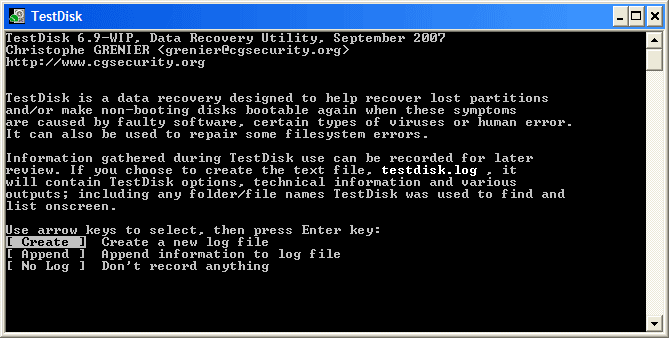
Step 1 Create a log file
Download TestDisk from the official CGSecurity TestDisk page, extract the archive, and launch TestDisk. On Windows, run it as Administrator. On macOS or Linux, run it with the permissions required for disk access. Select Create to create a new log file and press Enter.
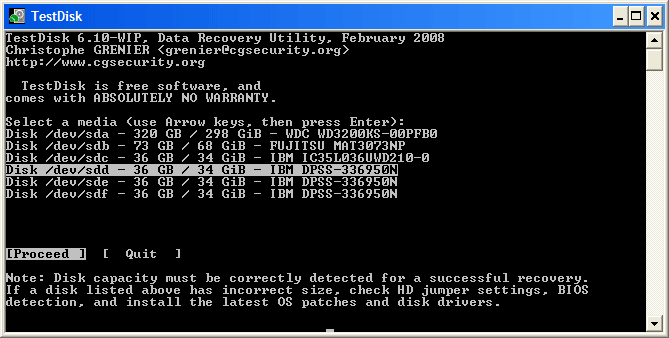
Step 2 Select the hard disk
TestDisk lists detected disks. Use the up and down arrow keys to select the drive that contained the lost partition. Confirm the disk size and model carefully. Do not select a different drive just because it appears first.
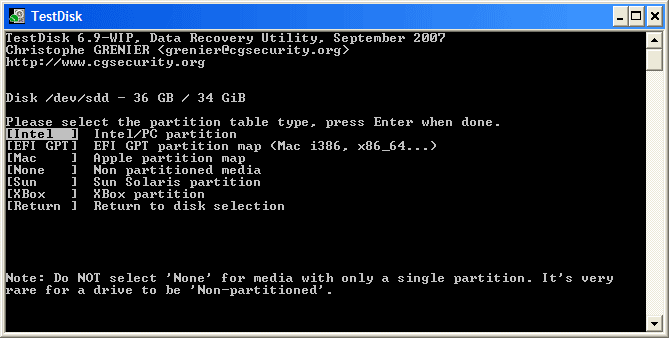
Step 3 Select the partition table type
TestDisk usually detects the correct partition table type automatically. On modern UEFI systems, EFI GPT is common. On older BIOS/MBR disks, Intel may be correct. On Macs, the detected option may differ depending on disk format. If you are not sure, stop and check the disk layout before continuing.
Step 4 Analyze and search for lost partitions
Select Analyze to check the current partition structure. Then use Quick Search to search for missing partitions. If the correct partition does not appear, use Deeper Search, but expect the scan to take much longer on large disks.

When TestDisk lists found partitions, highlight the suspected partition and press P to list files. This is the most important safety check. If your expected folders and files appear, copy critical files to another drive before writing any partition-table changes.
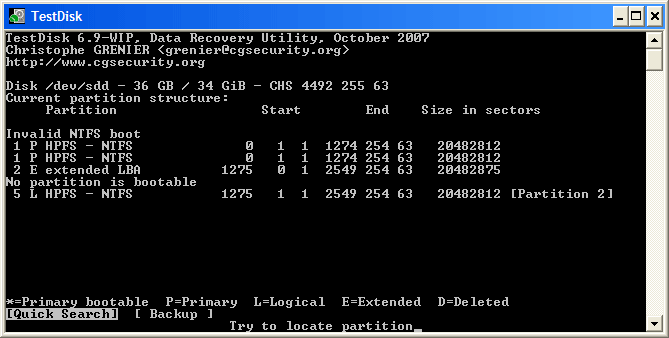
| Command key | Function in TestDisk | Safety note |
| Arrow keys | Navigate menus and choose disks or partitions. | Always confirm disk size and model before continuing. |
| Enter | Confirm a selection and proceed. | Read the screen before pressing Enter repeatedly. |
| P key | List files from a highlighted partition. | Use this before Write to verify that the partition is the correct one. |
| C key | Copy selected files in supported file listing screens. | Copy to another healthy drive, never to the affected disk. |
| Q key | Quit the current screen or go back. | Use Q if you are unsure rather than writing changes. |
| W key | Write partition table changes to disk. | Permanent change. Use only after verifying the partition and backing up critical files. |
TestDisk can be extremely effective, but it is not beginner-friendly. If the process feels unclear, use a safer file recovery path first. You can compare options in Recoverit's guides to free Windows data recovery software and free partition recovery software. If the goal is to restore files rather than repair the partition table, see Recoverit's partition recovery workflow.
Part 6. Best TestDisk Alternative: Recoverit Data Recovery Free
Recoverit Data Recovery Free is the better TestDisk alternative for users who want to recover files from a lost, formatted, deleted, inaccessible, or damaged partition without editing the partition table. It is built for a scan-preview-recover workflow rather than command-line repair.
Recoverit does not replace TestDisk for advanced partition-table repair. It is useful when the disk is readable and the priority is getting files out safely before any repair, format, reinstall, or partition rewrite. It also supports Windows and Mac recovery workflows, which makes it easier for non-technical users.
How to Restore Lost Partition Data with Recoverit
Step 1. Download and install Recoverit on a healthy drive. Launch Recoverit and choose the disk or location where the partition data was lost.
Step 2. Select the disk that contained the lost or deleted partition. Do not save anything to that disk during recovery.

Step 3. Start scanning. Recoverit searches for lost files and lets you filter results by type, path, time, or keyword when available.

Step 4. Preview supported files, select the data you need, and save it to another healthy drive.

When Recoverit Is Better Than TestDisk
| User need | Better choice | Why |
| Recover a few deleted files | Recoverit or PhotoRec | TestDisk is designed more for partition structures than simple undelete work. |
| Preview photos and documents before recovery | Recoverit | TestDisk does not offer a modern thumbnail preview interface. |
| Recover lost partition data without writing a partition table | Recoverit | Recoverit scans for files and saves them elsewhere instead of changing partition metadata. |
| Repair a missing partition table | TestDisk | This is one of TestDisk's strongest use cases when handled by an advanced user. |
| Recover camera, SD card, or video files | Recoverit or PhotoRec | PhotoRec can carve many file types, while Recoverit gives a graphical preview and stronger media workflow. |
| Use Windows and Mac with a simple workflow | Recoverit | Recoverit is easier for non-technical users who do not want terminal-style disk repair. |
| Use a fully free open-source tool | TestDisk/PhotoRec | No commercial GUI tool can beat TestDisk's free open-source value. |
Recoverit is also useful before risky actions such as formatting, repartitioning, reinstalling Windows or macOS, or attempting boot repair. It cannot repair failed hardware or recover overwritten data, but it can help recover local files from readable storage before those actions reduce recovery chances. For another free-tool comparison, see this iCare Data Recovery review.
Part 7. Final Verdict
TestDisk is still worth using in 2026, but only for the right recovery problem. It is one of the best free tools for lost partition recovery, partition table repair, boot sector repair, and advanced file-system recovery tasks. It is portable, open-source, cross-platform, and backed by long-running official documentation.
It is not the best first choice for most ordinary file loss. If you deleted a file, formatted an SD card, lost photos from a USB drive, or need thumbnails and previews before recovery, TestDisk will feel technical and slow. PhotoRec is better for free signature-based file carving, while Recoverit is better for users who want a visual workflow and safer file recovery before partition repair.
The practical recommendation is simple: use TestDisk when the partition structure is the problem and you understand what you are changing. Use Recoverit when the goal is to recover files from readable storage with less technical risk. Use a professional lab when the drive is physically failing.
FAQ
-
What is TestDisk used for?
TestDisk is used to recover lost partitions, repair partition tables, rebuild some boot sectors, make certain non-booting disks bootable again, and copy files from supported file systems when the partition can be found. -
Is TestDisk really free?
Yes. TestDisk is free and open-source under the GNU General Public License. It has no file-size limit, no subscription, and no paid unlock requirement. -
What is the latest TestDisk version?
CGSecurity lists TestDisk & PhotoRec 7.2 as the stable release from February 22, 2024, and TestDisk & PhotoRec 7.3-WIP as a beta version. Most users should choose the stable build unless they specifically need the WIP release. -
Is TestDisk easy for beginners?
No. TestDisk uses a text-based keyboard interface and includes options that can write partition changes. Beginners should avoid using Write unless they fully understand the scan result and have backed up critical files. -
What is the difference between TestDisk and PhotoRec?
TestDisk focuses on partition and boot-sector recovery. PhotoRec focuses on recovering individual files by signature. PhotoRec is better for formatted drives and deleted files, but it often loses original filenames and folder structure. -
Can TestDisk recover deleted files?
TestDisk can undelete files from some file systems such as FAT, NTFS, exFAT, and ext2, but it is not the most convenient deleted-file recovery tool. PhotoRec or a GUI recovery tool is usually easier for ordinary file recovery. -
Can TestDisk damage my drive?
TestDisk will not physically damage a drive, but writing the wrong partition table or boot sector can make logical recovery harder. Use read-only analysis first, verify files with the P key, and copy important files to another drive before writing changes. -
Is Recoverit better than TestDisk?
Recoverit is better for general users who need a graphical interface, file previews, deleted-file recovery, partition data recovery, and Windows/Mac workflows. TestDisk is better for advanced users who need free partition table or boot sector repair.


