


 TL;DR:
The safest way to delete junk files without accidentally erasing personal data is to use the built-in storage management tools specific to your operating system rather than manually deleting unfamiliar system folders.
● On Windows 11 and 10, review Cleanup recommendations in Settings > System > Storage or use the cleanmgr command, while macOS Ventura 13 or later users should use System Settings > General > Storage instead of using Disk Utility for routine cleanup.
● On Android 8.0 or later, Files by Google permanently deletes items from its Junk files card without moving them to Trash, and users must select "Clear cache" instead of "Clear storage" to preserve app data; meanwhile, iOS automatically purges caches, so iPhone users only need to follow iPhone Storage recommendations or offload unused apps.
● If a file is mistakenly deleted, check native Trash bins and cloud backups first, as Wondershare Recoverit can only retrieve data from supported Windows, Mac, and removable drives, and explicitly does not support data recovery from Android or iOS internal storage.
Ask AI for a summary
 ChatGPT
 Perplexity
 Gemini
 Claude
 Grok
Grok
Junk files usually mean temporary caches, old setup data, disposable thumbnails, app leftovers, or other files that can be recreated. But the safest cleanup method is different on Windows, macOS, Android, and iPhone. Start with each operating system's built-in storage tools, review what will be removed, and avoid treating Downloads, personal files, app data, or system folders as disposable just because they use a lot of space.
⚡Quick Fix: Delete Junk Files Without Deleting the Wrong Data
● Windows 11/10: Open Settings > System > Storage and review Cleanup recommendations or Temporary files; use Storage Sense for recurring cleanup.
● Mac: Open System Settings > General > Storage on macOS Ventura 13 or later, then review storage categories and built-in recommendations.
● Android: In Files by Google, open Clean and use the Junk files card; note that junk files cleared there are permanently deleted rather than moved to Trash.
● iPhone: Open Settings > General > iPhone Storage and follow Apple's recommendations; iOS already manages many cached and temporary files automatically.
In This Article
Part 1. What Counts as a Junk File?
Before deleting anything, separate files that are designed to be temporary from files that only look unnecessary. That distinction is the difference between a safe cleanup and accidentally deleting a download, project, app database, or rollback file that you still need.
Junk Files vs. Files You Should Review
There is no universal folder named "junk" across all devices. Operating systems typically classify disposable data by function, while personal files and app data require a human decision.
| File or Data Type | Usually Safe to Remove? | What to Check First |
| Temporary app or system cache | Often, through the operating system or app's own cleanup tool | Use a documented cleanup control instead of manually deleting unfamiliar system folders. |
| Thumbnails and disposable previews | Usually | Expect the system or app to recreate them later. |
| Recycle Bin, Trash, or recently deleted items | Only after review | Restore anything you may still need before emptying the container. |
| Downloads | Not automatically | Open installers, archives, documents, and media before deleting them. |
| Old operating-system installation or rollback data | Only when rollback is no longer needed | Removing it can eliminate the option to return to an earlier OS version. |
| Photos, videos, documents, projects, and app databases | No, unless you have identified them | Back up or verify another copy first. |
Which Cleanup Tool Should You Use?
For routine storage cleanup, start with the first-party tool that already understands what its operating system can remove. A third-party cleaner is not required for the basic tasks in this guide.
| Device | Best Starting Point | Why |
| Windows 11 or Windows 10 PC | Settings > System > Storage | Shows Temporary files, Cleanup recommendations, Storage Sense, and storage categories before removal. |
| Mac | System Settings > General > Storage | Shows categories and Apple-managed storage recommendations; macOS also manages System Data that should not be manually purged as a generic "junk" folder. |
| Android phone | Files by Google or the phone's Storage settings | Provides cleanup suggestions while keeping app data and personal files conceptually separate. |
| iPhone | Settings > General > iPhone Storage | Shows per-app usage and recommendations such as offloading unused apps while retaining documents and data. |
Part 2. How to Delete Junk Files on Windows 11 and Windows 10
Windows 11 and Windows 10 both provide current storage-management tools, so you do not need to hunt through system folders or use old menu paths such as Accessories > System Tools. Start with the review-based controls in Settings, then use the classic Disk Cleanup command only when it suits the task.
Method 1. Use Cleanup Recommendations and Temporary Files
Microsoft recommends reviewing storage through Settings before removing system-managed data. This is the safest general answer to how to delete junk files from a PC or laptop because you can see categories before confirming removal.
Step 1. Open “Settings > System > Storage.”
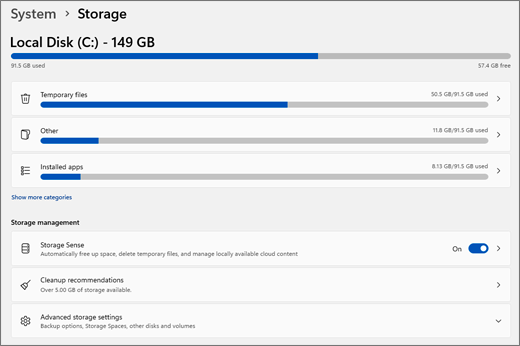
Step 2. Select Cleanup recommendations. Review categories such as temporary files, large or unused files, files synced to the cloud, and unused apps. Select only items you understand, then choose the cleanup action.
Step 3. If Temporary files is using significant space, return to Storage and open Temporary files. Read each category before selecting it. Pay particular attention to Downloads, Recycle Bin, and Previous Windows installation(s), because they may contain personal files or rollback data.
Step 4. After cleanup, reopen Storage and confirm what changed instead of repeatedly deleting more categories without checking the result.
For a deeper Windows 11 system-drive workflow, see the Recoverit guide to cleaning the C drive in Windows 11 safely.
Method 2. Turn On Storage Sense
Storage Sense is useful when temporary files and Recycle Bin contents build up repeatedly. Microsoft states that it works on the system drive and, by default, does not touch Downloads or cloud content unless you configure those behaviors.
Step 1. Go to “Settings > System > Storage” and turn Storage Sense on.
Step 2. Open Storage Sense and choose when it runs. Review how long Recycle Bin items are retained.
Step 3. Leave automatic Downloads cleanup disabled unless you deliberately want Windows to remove files based on age and you have verified that important downloads are stored elsewhere.
Microsoft's current Storage Sense documentation explains that the feature applies to Windows 11 and Windows 10 and is designed for system-drive storage management.
Method 3. Run Disk Cleanup With cleanmgr
If you searched for a run command to clean junk files from a computer, cleanmgr is the documented Windows command for Disk Cleanup and still applies to Windows 11 and Windows 10.
Step 1. Press Windows + R, type cleanmgr, and press Enter.
Step 2. Select the drive to clean if Windows asks, then review the available file categories.
Step 3. Select only categories you understand. Use Clean up system files when you specifically need to review eligible system cleanup items.
Step 4. Confirm the cleanup. Do not replace this review process with broad delete commands aimed at Windows, Program Files, ProgramData, or unknown AppData folders.
For automation, Microsoft documents options such as cleanmgr /sageset:n and cleanmgr /sagerun:n, but the interactive cleanup window is a safer starting point when your goal is simply to remove junk files once. See the official cleanmgr command reference.
Part 3. How to Delete Junk Files on a Mac
On a modern Mac, storage cleanup belongs in System Settings and Finder, not Disk Utility. Disk Utility's First Aid is for checking and repairing file-system structures, while Erase reformats a volume; neither should be presented as a routine junk-file cleaner.
Method 1. Use macOS Storage Settings
Apple's current guidance for macOS Ventura 13 or later starts at “Apple menu > System Settings > General > Storage.” Earlier macOS versions use the Storage view in About This Mac.
Step 1. Open “System Settings > General > Storage” and wait for macOS to calculate the categories.

Step 2. Review categories such as Applications, Documents, iOS Files, Mail, Messages, Photos, and Trash. If a category has a details control, open it and inspect individual items before deleting them.
Step 3. Use built-in recommendations when they match your needs. For example, Apple provides options for iCloud storage, optimization, and automatic Trash management depending on the macOS version and configuration.
Apple's current Mac storage guidance also recommends moving large files to another storage device, deleting unneeded downloads and media, uninstalling unused apps, and emptying Trash after review.
Method 2. Review Downloads, Trash, Apps, and Large Files
If Storage shows that personal files or apps are using most of the disk, deleting caches will not solve the main problem. Work through the category that is actually large.
- Downloads: Open Finder and choose “Go > Downloads.” Sort or group the files, open anything unfamiliar, then remove only files you no longer need.
- Trash: Review Trash before emptying it. Space used by deleted local files is not fully reclaimed until Trash is emptied.
- Applications: Uninstall software you no longer use through the app's supported uninstall path or Finder when appropriate.
- Large media and libraries: Move large files to another healthy storage device when you want to keep them, and verify the destination copy before deleting the original.
- Old iPhone or iPad backups: Delete only backups you have identified and no longer need.
What About Mac Cache Files?
macOS manages many caches as part of System Data, and Apple states that users cannot directly manage the contents of that category through Storage settings. Avoid bulk-deleting unfamiliar Library or system cache folders just to make the System Data number smaller.
If you temporarily need more working space for an update or installation, Apple notes that starting a Mac in safe mode can clear certain system caches that are automatically recreated as needed. Restart normally afterward.
Part 4. How to Delete Junk Files on Android
Android cleanup varies more by phone manufacturer than Windows or iPhone cleanup, but Google provides two broadly useful paths: Files by Google for junk-file suggestions and the Android Settings app for per-app cache management. The key distinction is that Clear cache removes temporary data, while Clear storage removes the app's data.
Method 1. Clear Junk Files With Files by Google
Files by Google is the clearest first-party match for the keyword “clean junk files app.” Google says it works on Android 8.0 and later.
Step 1. Open Files by Google.
Step 2. Tap Menu > Clean.

Step 3. On the Junk files card, tap the cleanup button, then confirm Clear.
Important: Google's current Files by Google junk-file guidance states that files cleared from the Junk files card are permanently deleted rather than moved to Trash. Review the cleanup card before confirming.
If your goal is specifically to restore or empty Android Trash rather than clear caches, use the dedicated Recoverit guide to emptying Trash on Android so the two intents do not get mixed together.
Method 2. Clear an App Cache Without Clearing App Data
Use this when one app's temporary data has grown or the app is behaving incorrectly. Exact labels vary by manufacturer and Android version, so follow your phone maker's wording when it differs.
Step 1. Open the phone's Settings and locate the app-management area.
Step 2. Select the app, then open its storage controls.
Step 3. Choose Clear cache when you want to remove temporary data. Do not choose Clear storage unless you understand that Google describes it as permanently deleting all app data.
Google's Android storage guidance explicitly notes that the exact settings path can vary by phone, which is why a single manufacturer-specific screenshot should not be treated as universal for every Android device.
Part 5. How to Clean Junk Files on iPhone
iPhone does not provide a system-wide “delete junk files” button comparable to Files by Google. Apple states that iOS automatically removes many cached and temporary files when space is needed, so the practical cleanup path is to review iPhone Storage, offload or delete apps deliberately, remove large content, and clear app-specific data such as Safari history when appropriate.
Method 1. Use iPhone Storage Recommendations
Step 1. Open “Settings > General > iPhone Storage.”

Step 2. Review Apple's recommendations and the app list. Tap an app to see more information about its storage usage.
Step 3. Choose the action that matches what you want to remove. Offload App frees the app's own storage while keeping its documents and data; Delete App removes the app and its related data.
Step 4. Review large videos, photos, messages, downloads, and app content individually instead of trying to manually purge System Data.
Apple's current iPhone and iPad storage guide, updated September 14, 2026, states that the device automatically removes cached and temporary files when it needs more space.
Method 2. Clear Safari History and Website Cache
Safari data is one of the few cache-related areas with a dedicated user-facing cleanup flow. In the current iPhone User Guide, Apple places the control inside Safari itself.
Step 1. Open Safari and go to a start page if needed.
Step 2. Open History, tap More, then choose Clear History.
Step 3. Review the available time range and confirm the history cleanup you want.
Apple notes that clearing Safari history does not remove browsing histories stored independently by websites or other apps. See the current Safari on iPhone guide for the latest interface.
Part 6. Which Files Should You Not Delete as Junk?
The biggest cleanup mistakes happen when a large file is assumed to be disposable simply because its name is technical or unfamiliar. Use the operating system's cleanup controls for system-managed data, and treat personal or application data as valuable until you identify it.
| Platform | Do Not Blindly Delete | Safer Alternative |
| Windows | Unknown files in Windows, System32, Program Files, ProgramData, Recovery, boot folders, or unfamiliar AppData locations | Use Storage, Cleanup recommendations, Storage Sense, Disk Cleanup, or the app's official uninstaller. |
| Mac | Unknown files in System, Library, hidden runtime folders, or System Data | Use General > Storage, Finder, supported app uninstallers, and Apple's storage recommendations. |
| Android | App storage/data when you only intend to clear cache, account databases, downloads you have not reviewed, or files outside a known cleanup suggestion | Use Clear cache, Files by Google suggestions, or the app's own download-management controls. |
| iPhone | App documents and data, synced content, photos, messages, or downloads you have not backed up | Use iPhone Storage recommendations, Offload App when appropriate, and app-specific deletion controls. |
Special caution for Windows.old: Microsoft warns that removing the previous Windows installation removes the option to roll back to that version. Delete it only through Windows cleanup tools after you know the current installation is stable and you no longer need rollback.
Part 7. What to Do If Cleanup Deletes an Important File
If a cleanup removed something important, stop doing more cleanup and identify where the file was deleted from. Recovery is usually easiest when the operating system or cloud service still has a reversible copy; storage-level recovery is a later option for supported computer drives and removable media.
Check Built-In Trash and Backups First
- Windows: Check Recycle Bin, OneDrive or another cloud copy, Windows Backup/File History if configured, and any external backup.
- Mac: Check Trash, iCloud Drive, Time Machine, and any other verified backup.
- Android: Check Files by Google Trash, Google Photos Trash, and app-specific recycle bins where available. Remember that Files by Google's Junk files cleanup is permanently deleted and does not go to Trash.
- iPhone: Check Recently Deleted areas in Photos, Files, Notes, Messages, and other apps that provide them, plus iCloud or computer backups when applicable.
Do not continue copying large files or installing cleanup tools onto the same computer drive if you are trying to recover a deleted local file. New writes can overwrite file content that recovery software would otherwise try to locate.
Use Recoverit Only for Supported Computer and Storage-Device Loss
If a file was deleted from a Windows or Mac computer drive, USB drive, memory card, or another supported storage device that the operating system can still detect, Wondershare Recoverit Data Recovery can be considered after you have checked reversible copies and backups. Stop using the affected source as much as possible and save recovered files to a different healthy drive.
Important scope: Recoverit's current official guide states that the product does not support data recovery from Android or iOS phones or tablets. It also cannot recover overwritten data or fix a physically damaged drive. For mobile-device internal storage loss, use the phone's own Recently Deleted/Trash features, cloud services, backups, or the device vendor's supported recovery path instead.
For computer recovery, the current Recoverit Windows guide documents a Select Location > Scan > Preview and Recover workflow and instructs users not to save recovered files back to the same source location.

Part 8. Keep Junk Files From Building Up Again
A good cleanup routine reduces repetitive work without giving an automatic tool permission to delete personal files you still need. Configure only the features whose retention rules you understand.
- Windows: Use Storage Sense for temporary files and Recycle Bin retention, and periodically review Cleanup recommendations. Keep Downloads automation off unless it matches your file-management habits.
- Mac: Check General > Storage when free space is falling, remove unused apps properly, review Downloads, and empty Trash after verifying its contents.
- Android: Use Files by Google cleanup suggestions selectively, clear individual app caches when they are genuinely large or troublesome, and avoid repeated Clear storage actions.
- iPhone: Use iPhone Storage recommendations, offload unused apps when appropriate, and manage large photos, videos, messages, and downloads at their source.
- Every device: Keep at least one verified backup of irreplaceable files before aggressive cleanup. A cleaner is a storage-management tool, not a backup.
Conclusion
The safest way to delete junk files is to use the cleanup controls that match the device. On Windows 11 and Windows 10, start with Storage, Cleanup recommendations, Storage Sense, or cleanmgr. On Mac, use General > Storage and Finder rather than Disk Utility. On Android, Files by Google provides a dedicated Junk files card, while app cache controls vary by manufacturer. On iPhone, use iPhone Storage recommendations and app-specific controls such as Safari history cleanup.
The important rule is simple: review personal data before deletion and do not confuse system repair, disk erasure, app-data deletion, or storage formatting with routine junk cleanup. If a desktop cleanup removes an important file, check Trash and backups first, minimize new writes, and use recovery software only when the storage and loss scenario are actually supported.
FAQ
-
What is the safest way to delete junk files on Windows 11?
Open Settings > System > Storage and start with Cleanup recommendations or Temporary files. Review Downloads, Recycle Bin, and Previous Windows installation(s) before selecting them. Storage Sense is useful for recurring cleanup after you configure its retention rules. -
What is the run command to clean junk files from a computer?
On Windows 11 and Windows 10, press Windows + R, type cleanmgr, and press Enter to open Disk Cleanup. Microsoft also documents cleanmgr command-line options, but the interactive window is the safer starting point for one-time cleanup because you can review categories before deletion. -
Can I delete everything in the Windows Temp folder?
Do not use a blanket rule. Some temporary files may be in use, and other folders that look temporary can contain data needed by apps or Windows. Use Temporary files, Cleanup recommendations, Storage Sense, or Disk Cleanup first because those tools provide a controlled cleanup path. -
What is a good clean junk files app for Android?
Files by Google is Google's first-party option for Android 8.0 and later. Its Clean area can show a Junk files card and other suggestions. Junk files cleared through that card are permanently deleted, so review the suggestion before confirming. -
How do I delete junk files on Android without deleting app data?
Use Files by Google for its Junk files suggestion or use the Android Settings app to clear an individual app's cache. Choose Clear cache rather than Clear storage when you only want to remove temporary app data; Google states that Clear storage permanently deletes all app data. -
How can I clean junk files on iPhone without a cleaner app?
Go to Settings > General > iPhone Storage, review Apple's recommendations and app usage, and offload or delete apps only when appropriate. iOS already removes many cached and temporary files when it needs more space, so a separate system-wide junk cleaner is not required for basic storage management. -
Does deleting junk files make a computer faster?
It can help when very low free space is interfering with updates or app operations, but junk cleanup is not a guaranteed speed fix. If performance is still poor after freeing space, investigate startup apps, updates, malware, hardware limits, or application-specific problems instead of repeatedly deleting more files. -
Can Recoverit recover files deleted while cleaning junk files?
Recoverit may help with deleted files on supported Windows or Mac drives and detectable removable storage when the data has not been overwritten. It does not support recovery from Android or iOS phones or tablets, physically damaged storage, or overwritten files. Check Trash, Recently Deleted, cloud copies, and backups first.


