USB Flash Drive Recovery
Recover Deleted USB Files
Recoverit helps recover deleted, formatted, corrupted, or unrecognized USB files from flash drives, pen drives, thumb drives, and USB sticks when the drive is still detectable and the files have not been overwritten. It is best suited to logical data loss, including accidental deletion, formatting, file system errors, virus infection, improper ejection, and RAW or inaccessible USB volumes.
If the USB flash drive is physically broken, water-damaged, burned, or not detected on any computer, stop repeated attempts and consider a professional recovery service.

Why USB Flash Drive Files Get Lost?

Physical Damage
Physical damage, such as water exposure, heat, or impact can damage the internal components or the storage medium itself, rendering a flash drive or pen drive unreadable.
Accidental Deletion
Files deleted from a USB flash drive usually do not go to the Recycle Bin. Stop saving new files to the same USB and scan the original drive before formatting it.
Formatting Errors
A formatted USB drive may still contain recoverable file data if the drive has not been reused. Recover files first, then decide whether the USB should be reformatted.
Virus or Malware Infections
Malware can hide, rename, or delete USB files. If the drive is still detected, recover the files to another location before repairing or wiping the USB.

File System Corruption
A RAW, unreadable, or corrupted USB file system can make folders disappear. Scan the original USB before running CHKDSK, formatting, or other repair commands.

Improper Ejection
Removing a USB stick while files are still being written can leave documents, photos, or videos incomplete or inaccessible. Recover first, then check whether leftover files need repair.
Physical or Electrical Damage
A cracked connector, water-damaged stick, burned circuit, or USB that is not detected on any computer is not a good software-only case. Stop repeated attempts and consider professional recovery.

Partition Loss
If Windows or macOS no longer shows the USB partition, the drive may still contain recoverable data. Avoid creating a new partition until the original USB has been scanned.
What To Do First After USB Flash Drive Data Loss?

Stop Using the USB Drive
Unplug the USB only after transfers have finished, then avoid copying, recording, or installing anything to the same stick. New data can overwrite deleted USB files.

Scan the USB With Recovery Software
If the flash drive is still detected, use Recoverit to scan the original USB and preview recoverable files. Save recovered items to your computer or another drive, not back to the same USB.

Use Professional Recovery
If the USB is physically damaged, makes no connection on any port or computer, or has suffered water or burn damage, stop repeated DIY attempts and contact a professional lab.
USB Flash Drive Recovery Software:
Deleted, Formatted, and Unrecognized Drives
virus infection, improper ejection, and file system errors.
when the data is still recoverable.
stick brands when the drive remains readable.
is not overwritten.
*Free download to scan and preview your lost or deleted data.

35+ Patents for
Data Recovery

Recovery Experts
Since 2003


24 x 7 Free Tech
Support

100% Secure Virus-Free
Guarantee
How to Recover Files from a USB Flash Drive with Recoverit
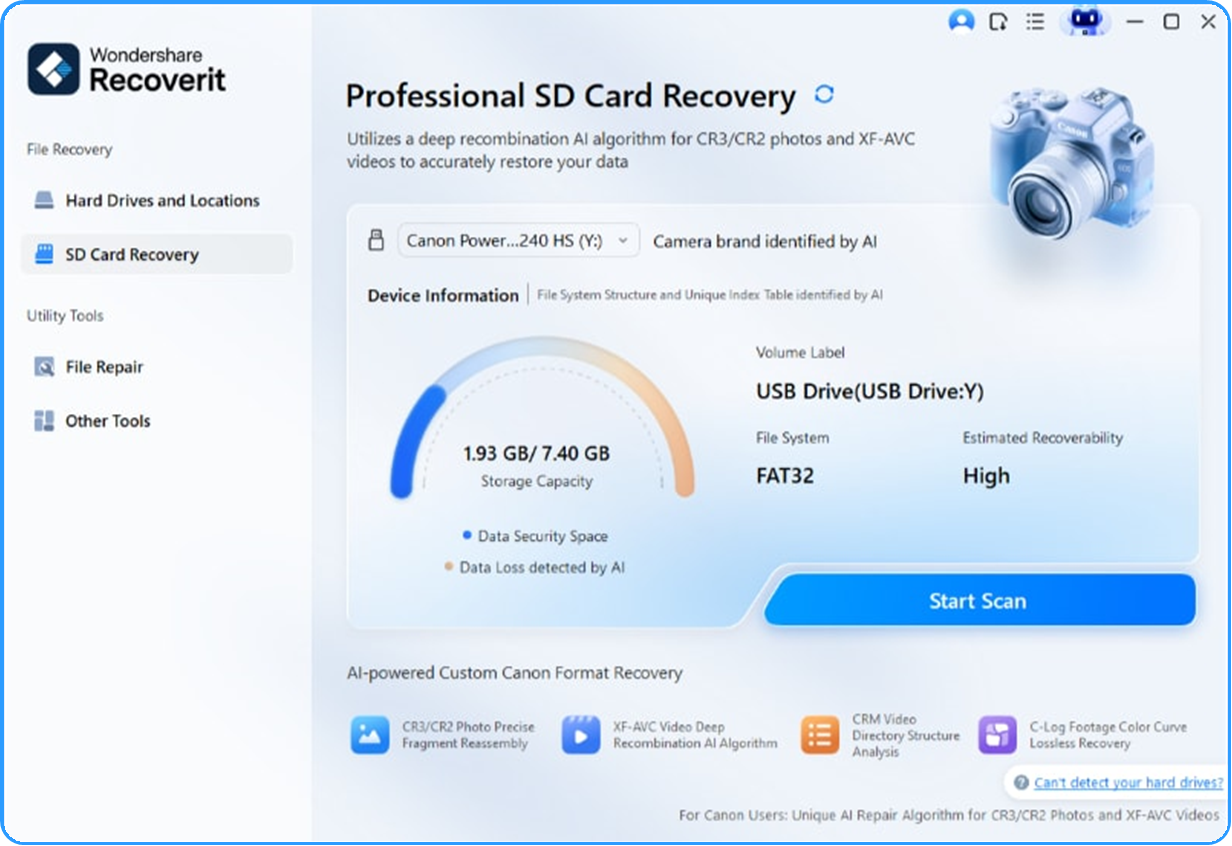
Step 1. Select the original USB flash drive
Plug the USB flash drive, pen drive, or USB stick into a working port. Open Recoverit and select the original USB volume, not another disk.
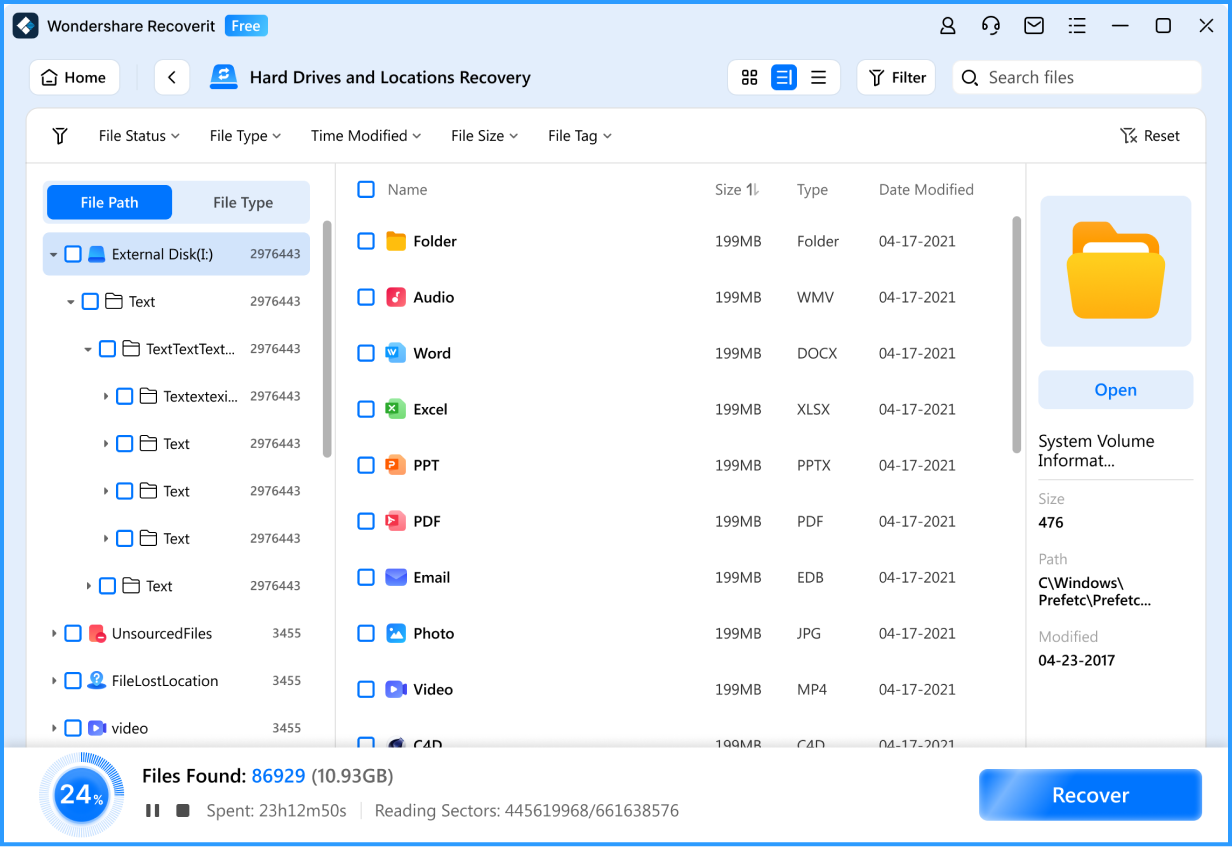
Step 2. Scan the USB for deleted and lost files
Start a scan for deleted, formatted, hidden, RAW, or inaccessible USB files. Keep the drive connected until the scan finishes.
Step 3. Preview and recover to a different location
Preview recoverable photos, videos, documents, or other files. Recover selected items to a computer or another drive. Do not save them back to the same USB.

Recover Files from USB Flash Drives, Pen Drives, and USB Sticks

Pen drives

USB flash drives

External hard drives

Android phone and tablets

USB-based digital cameras

USB-based gaming consoles
(e.g. X-box, PlayStation)

Portable SSDs

USB-based MP3/MP4 Players

USB-based camcorders

USB-A
USB-A
USB-A is the most common and recognizable type of USB connector. It's typically used to connect peripherals like keyboards, mice, printers, and flash drives.

USB-B
USB-B
USB-B connectors are less common than USB-A connectors and are typically found on printers, scanners, and larger devices.

Mini-USB
Mini-USB
Micro-USB connectors are smaller than USB-A and USB-B connectors. They were widely used in the past for devices like digital cameras, MP3 players, and older smartphones.

Micro-USB
Micro-USB
Micro-USB connectors are smaller than USB-A and USB-B connectors. They were widely used in the past for devices like digital cameras, MP3 players, and older smartphones.

USB-C
USB-C
USB-C supports faster data transfer speeds and can deliver higher power levels, making it suitable for a wide range of devices such as smartphones, laptops, tablets, and external storage devices.
Recover Photos, Videos, Documents, and Other USB File Types

Documents
DOC/DOCX (Microsoft Word Document), PDF (Portable Document Format), XLS/XLSX (Microsoft Excel Spreadsheet), PPT/PPTX (Microsoft PowerPoint Presentation), TXT (Plain Text), RTF (Rich Text Format), CSV (Comma-Separated Values), HTML (Hypertext Markup Language), etc.

Images
JPEG (Joint Photographic Experts Group), PNG (Portable Network Graphics), GIF (Graphics Interchange Format), TIFF (Tagged Image File Format), BMP (Bitmap Image File), RAW (Camera RAW Image), PSD (Adobe Photoshop Document), SVG (Scalable Vector Graphics), etc.

Videos
MP4 (MPEG-4 Part 14), AVI (Audio Video Interleave), MOV (QuickTime Movie), MKV (Matroska Video), WMV (Windows Media Video), FLV (Flash Video), MPEG (Moving Picture Experts Group), 3GP (3GPP Multimedia), etc.

Audio Files
MP3 (MPEG Audio Layer III), WAV (Waveform Audio File Format), AAC (Advanced Audio Coding), WMA (Windows Media Audio), FLAC (Free Lossless Audio Codec), OGG (Ogg Vorbis), AIFF (Audio Interchange File Format), M4A (MPEG-4 Audio Layer), etc.

Archives
ZIP (ZIP Archive), RAR (RAR Archive), 7Z (7-Zip Archive), TAR (Tape Archive), GZ (Gzip Compressed Archive), BZ2 (Bzip2 Compressed Archive), ISO (Disk Image File), CAB (Cabinet File), etc.

Other Files
PST (Personal Storage Table), EDB (Exchange Database), EML (Email Message File), EMLX (Apple Mail Message File), SQL (Structured Query Language), CAP (Packet Capture File), DB (Database), ASPX (Active Server Page Extended), etc.
User Reviews for Recoverit USB Data Recovery



USB Flash Drive Recovery Software Comparison

Wondershare
Recoverit |

|

MiniTool Power
Data Recovery |

|

|
|
|---|---|---|---|---|---|
| Star Rating |

|

|

|
|
|
| Modern UI | (GLI Tool) | ||||
| Supported OS | Windows, Mac | Windows, Mac | Windows | Windows | Windows, Mac, Linux |
| Supported USB File Systems | exFAT, FAT16, FAT32, NTFS, ReFS, HFS+, Encrypted HFS, HFSX, APFS, BTRFS, XFS, BFS, EXT4 | exFAT, FAT16, FAT32, NTFS, HFS+, APFS | FAT12, FAT16, FAT32, exFAT, VFAT, NTFS, NTFS5 | exFAT, FAT16, FAT32, NTFS, EXT2/3/4 | FAT12, FAT16, FAT32, exFAT, NTFS, HFS, HFS+, HFSX, JFS, BTRFS, XFS, EXT2/3/4 |
| Supported File Types | 1000+ | 400+ | 100+ | 50+ | 100+ |
| Quick and Deep Scan | |||||
| File Preview | Partial Support | ||||
| Resume Scanning Process | |||||
| BitLocker/T2/M1/M2 Encrypted USB Drive Recovery | Partial Support | ||||
| RAW Photo Recovery | Partial Support | Limited support | Limited support | Limited support | |
| RAW Video Recovery | |||||
| Lost Partition Recovery | |||||
| Document/Photo/Video Repair | Partial Support | Partial Support | |||
| Price | Starts at $59.99 | Starts at $39.99 | Starts at $69.99 | Starts at $24.95 | Free and open source |
Other Ways to Recover USB Files Before or After Software Recovery

If you're familiar with command-line operations, you can recover deleted files from a USB drive using simple commands. This method is especially effective for retrieving data from corrupted USB drives. Follow the step-by-step guide below to use the Command Prompt utility on Windows. By running a specific command, you can initiate a scan on the USB drive and potentially retrieve your lost files.
2. Open the Command Prompt by pressing the Windows key + R, typing "cmd," and pressing Enter.
3. In the Command Prompt window, type the following command: chkdsk X: /f (replace X with the drive letter assigned to the USB drive).
4. Press Enter to execute the command.
5. The command will scan and attempt to recover any lost data on the USB drive.
6. After the process completes, check the USB drive for recovered files.
Note: CHKDSK can repair some file system errors, but it is not a deleted-file recovery method. Do not run CHKDSK, format the USB, or create a new partition before recovery.
Windows has introduced the Restore Previous Versions feature to assist users in recovering deleted files. So, if you have enabled the "File History" feature or created system restore points on your computer, you can freely access previous versions of files and restore them from the USB drive without the need for third-party software.
2. Right-click on the USB drive and select "Properties."
3. In the Properties window, go to the "Previous Versions" tab.
4. Choose a previous version of the folder that contained the deleted files.
5. Click on the "Restore" button to recover the files to their original location on the USB drive.


Sometimes, temporary copies of files are created and stored on the USB drive. These temporary files might provide an opportunity to recover deleted files from USB without software. By searching for files with specific extensions, you can identify temporary copies and potentially restore your deleted data.
2. Open the USB drive in File Explorer (Windows) or Finder (Mac).
3. Look for files with extensions like ".TMP" or ".Bak" on the USB drive.
4. These temporary files often have names similar to the deleted files.
5. Select any files that match the criteria and rename them by removing the ".TMP" or ".Bak" extension.
6. Attempt to open the renamed files using the associated application (e.g., a Word document with ".docx" extension can be opened with Microsoft Word). If the renamed files open successfully, you have likely recovered the deleted files.
Note: Renaming TMP or Bak files is not USB flash drive recovery. It only applies when leftover temporary or backup copies are still visible on the computer.
to stop using the USB drive immediately after data loss to avoid overwriting the deleted files.
When USB Flash Drive Recovery Needs a Professional Lab
before sending the drive out.
Step 1: Research and compile a list
Step 2: Assess expertise and experience
Step 3: Check for cleanroom facilities
Step 4: Consider security and confidentiality
Step 5: Inquire about the recovery process
Step 6: Request a quote and turnaround time
Step 7: Verify data recovery success rates
Step 8: Consider customer support and after-recovery services
Step 9: Make an informed decision
consuming and expensive. These services require thorough analysis, it could take days or even weeks to retrieve your data. Additionally,
specialized tools and expertise contribute to higher costs. Consider the importance of the data and weigh the cost and time factors before opting
for professional assistance.
How to Reduce USB Flash Drive Data Loss
Back up important USB files
One of the most effective ways to prevent data loss is to create regular backups of your flash drive. By regularly copying your files to another storage medium, such as a computer, external hard drive, or cloud storage, you can ensure that even if your USB device becomes inaccessible or gets damaged, you still have a copy of your important data.
Eject the USB safely before unplugging it
Always practice safe removal of your USB flash drive from the computer or device. Use the "Safely Remove Hardware" or "Eject" option provided by the operating system to ensure that all data transfers are complete and the drive is ready for safe removal. This helps prevent data corruption or loss that can occur when the drive is disconnected abruptly.
Protect Against Physical Damage
USB flash drives are compact and portable, but they can also be fragile. To avoid physical damage that can lead to data loss, handle your USB drive with care. Avoid exposing it to extreme temperatures, moisture, or physical impact. Use protective cases or covers to shield the drive from potential harm.
Scan for Malware
Before transferring files to your USB stick, make it a habit to scan them with reliable antivirus software. Malware-infected files can corrupt data on the drive and compromise the security of other devices it connects to. Regularly update your antivirus software to ensure optimal protection.
Avoid filling the flash drive to 100% capacity
USB flash drives have limited storage capacities. Avoid overloading the drive with files and ensure it has sufficient free space. Running out of storage can lead to data corruption or loss. Consider using larger capacity drives or transferring older files to other storage solutions to free up space.
Keep Firmware and Drivers Updated
Manufacturers often release firmware updates for USB flash drives to enhance performance and address potential vulnerabilities. Check the manufacturer's website for updates and ensure that your drive's firmware and drivers are up to date. This can help prevent compatibility issues and improve the overall reliability of the drive.

Other Common USB Problems and Fixes

FAQs About Flash Drive Data Recovery
-
Can deleted files be recovered from a USB flash drive?Yes, if the USB is still detected and the deleted files have not been overwritten. Stop using the flash drive and scan the original USB before formatting it or saving new files to it.
-
Can I recover files from a formatted USB drive?Often, yes. Formatting usually removes file references first, so USB recovery may still be possible until new data overwrites the original files.
-
What should I do first after losing USB files?Stop using the USB, check whether the computer still detects it, and scan the original flash drive. Do not run CHKDSK or format the USB before recovery. Save recovered files to another drive.
-
Can software recover files from a physically damaged USB?Usually no, if the USB is cracked, water-damaged, burned, or not detected on any computer. Software needs a readable USB volume. Severe physical damage is a professional recovery case.
-
Should I run CHKDSK or format the USB before recovery?No. CHKDSK can change the USB file system, and formatting can make recovery harder. Recover files first, then repair or format the drive if needed.
-
Can overwritten USB files be recovered?Usually no. Once deleted USB files are replaced by new data, recovery is unlikely. That is why you should stop using the flash drive immediately after data loss.
-
Why is my USB flash drive not recognized?The USB may have a file system error, a failed controller, a bad port, or physical damage. Try another port or computer first. If the drive stays undetected, software recovery is unlikely.
-
How long does USB flash drive recovery take?Recovery time depends on USB capacity, scan mode, file count, and drive condition. Small flash drives may finish in minutes, while larger or heavily damaged volumes can take longer.