

 TL;DR:
The best photo and video recovery method depends entirely on the original storage location, requiring built-in Trash restoration for protected Android internal storage and desktop scanning software for removable SD cards and computer drives.
● Stop taking photos, recording videos, or installing apps on the affected device immediately to prevent permanent data overwriting, and strictly save any recovered media to a different drive or cloud destination rather than the scanned source.
● Android internal storage recovery is restricted without root access; if the 30-day Trash in Google Photos or Samsung Gallery is empty, apps like DiskDigger provide only a limited search for lower-resolution thumbnails and explicitly require a rooted device to recover deleted videos.
● For portable SD cards or computer disks, connect the removable media to a computer and use Recoverit for guided Windows and macOS visual filtering, PhotoRec for free open-source signature carving that loses original folder structures, or Recuva for a basic Windows-only recovery.
Ask AI for a summary
 ChatGPT
 Perplexity
 Gemini
 Claude
 Grok
Grok
The best photo and video recovery app depends on where the missing media was stored. A built-in Trash folder is the safest first choice for a recent deletion on Android. A phone recovery app may find cached images without root access, but it cannot promise original files from modern internal storage. For a removable SD card, camera card, USB drive, or computer disk, desktop recovery software can scan the storage device directly.
Before trying any recovery tool, stop taking photos, recording video, installing apps, clearing caches, or saving downloads to the affected storage. New data can overwrite deleted content. No app can recover a file after its underlying data has been overwritten, and recovered files should always be saved to a different drive or cloud location.
Quick Answer
● Recent Android deletion: Check Google Photos, Samsung Gallery, or your file manager's Trash first.
● Android internal storage: A no-root scan is limited and may return thumbnails or existing files instead of the deleted originals.
● Portable SD card or computer drive: Stop using the device, connect it to a computer, and scan it with desktop software such as Recoverit or PhotoRec.
● Adopted SD card: Keep it in the original Android device. Adopted storage is encrypted and tied to that device.
In This Article
Part 1. Choose a Photo and Video Recovery App by Storage Location
“Restore” and “recover” are not the same operation. A restore app returns a copy that still exists in Trash or a backup. Recovery software searches storage for file-system records or recognizable file data after the normal copy is gone. Repair software is different again: it attempts to fix a photo or video file that exists but will not open or play.
| Where the File Was Stored | Best First Choice | Important Limit |
| Google Photos library | Google Photos Trash | Google's current help page says items can be restored only while they remain in Trash; the current retention period is 30 days. |
| Samsung Gallery | Gallery Trash | Samsung retains deleted Gallery items for 30 days. |
| Files deleted through Files by Google | Files by Google Trash | Files remain in Trash for 30 days, but items deleted from the Junk files card are permanently deleted. |
| Android internal storage after Trash was emptied | DiskDigger basic scan as a last software attempt | Without root, the developer describes the scan as limited; original full-resolution recovery is not assured. |
| Portable microSD or SD card | Remove the card, use a card reader, and scan it on a computer | Do not format the card or save recovered files back to it. |
| Android adopted SD card | Keep the card in the original phone and check backups | Android formats and encrypts adopted media, binding it to the device that adopted it. |
| Windows or Mac drive, USB drive, or camera card | Recoverit, PhotoRec, or a comparable desktop scanner | The storage must be detected by the operating system or recovery application. |
| Physically damaged or undetected storage | Professional recovery lab | Software cannot repair a failed controller, broken connector, or damaged flash chip. |
Modern Android changes the answer to “Can a recovery app scan everything?” Android's official scoped storage documentation explains that Android 11 and later restrict how apps access other apps' files and private directories. A recovery app with permission to view shared media still does not automatically gain raw access to deleted blocks in protected internal storage.
A removable card used as portable storage is different. If the card is readable in a computer, desktop software can address the card as a storage device. An adopted card is not interchangeable: the Android Open Source Project states that adopted media is formatted and encrypted, with its key stored on the adopting device.
Part 2. Best Photo and Video Recovery Apps and Software in 2026
There is no credible single winner for every phone and storage type. The useful comparison is whether a tool can access the source, whether it needs root, whether it restores a retained copy or scans deleted data, and where it saves the result.
| App or Software | Best For | Platform | Scans Deleted Data? | Main Limitation |
| Google Photos | Recently deleted backed-up photos and videos | Android, iOS, web | No; it restores retained cloud items | Cannot restore an item that is no longer in Trash |
| Samsung Gallery | Recent deletions on a Galaxy device | Samsung Galaxy | No; it restores retained local items | 30-day Trash window |
| Files by Google | Files deleted through the Files app | Android | No; it restores retained files | Only covers items still in its Trash |
| DiskDigger | An in-phone scan after built-in restore options fail | Android | Limited without root; fuller scan with root | Video recovery requires root according to the developer; no-root photo results may be lower resolution |
| Recoverit | SD cards, camera cards, USB drives, and Windows or Mac disks | Windows, macOS | Yes, on detected storage devices | Not a scanner for protected Android internal storage |
| PhotoRec | Free signature-based recovery from cards and drives | Windows, macOS, Linux, and other systems | Yes | Recovered names and folder structure are usually not preserved |
| Recuva | Simple deleted-file recovery on Windows | Windows | Yes, on supported detected storage | No Android or macOS version of Recuva |
1. Google Photos, Samsung Gallery, and Files by Google: Best First Check
Built-in Trash is safer than a scanner because it restores an intact retained copy and does not require root access. Google currently instructs Android users to open Google Photos > Collections > Trash, select the photo or video, and tap Restore. The file returns to the library, relevant albums, and the phone's gallery when applicable. The Google Photos Help page also makes the hard limit clear: items permanently deleted from Trash cannot be restored through Google Photos.
Files by Google uses a separate Trash. Its official restore instructions direct users to Menu > Trash, where selected files can be restored. A photo deleted in one app may not appear in another app's Trash, so check the app that performed the deletion.
- Pros: No third-party scan, no root, intact names and metadata, and usually the fastest result.
- Limits: Works only while the retained copy still exists; different apps maintain separate Trash folders.
- Best for: Photos or videos deleted recently from an Android gallery, Google Photos, or Files by Google.
2. DiskDigger: Best Android App for a Last No-Root Attempt
DiskDigger is one of the few established Android apps whose developer documents the difference between a no-root and rooted scan. Its current Google Play listing says a non-rooted device receives a limited search of accessible storage, thumbnail caches, databases, and other available locations. The developer's documentation adds that full scanning requires root, video recovery requires root, and no-root photo results are likely to be lower-resolution copies.
- Pros: Runs directly on Android, offers a basic no-root scan, previews found images, and can send recovered items to another app or cloud destination.
- Limits: Installing the app writes new data to the same phone; a no-root scan may surface thumbnails, existing media, or cached images rather than deleted originals.
- Best for: A final software attempt on Android internal storage after every Trash and backup location has been checked.
3. Recoverit: Best Guided Option for SD Cards and Computer Storage
Recoverit Photo Recovery is a Windows and macOS desktop application for storage the computer can detect, including internal computer drives, external disks, USB drives, memory cards, and camera media. It is the most natural fit when deleted photos and videos were on a portable microSD card, camera SD card, or computer drive—not protected Android internal storage.
Its practical advantage is a guided workflow: choose the source, scan, filter or preview the results, and save selected files to another healthy location. For large or fragmented camera clips, the dedicated Recoverit Video Recovery page explains the video-focused workflow. Recovery is never guaranteed, especially after overwriting or physical failure.
- Pros: Visual interface, photo and video preview, file-type filtering, and support for common removable media.
- Limits: The source must be detected; the desktop app should not be presented as a direct Android internal-storage scanner.
- Best for: Deleted, formatted, or inaccessible media on an SD card, USB drive, external drive, or computer disk.
4. PhotoRec: Best Free Open-Source Desktop Recovery
PhotoRec is free, open-source, and multi-platform. It reads a drive or memory card without writing to the source and searches for known file signatures even when the file system is damaged or reformatted. That makes it useful for technically confident users who need a free tool for an SD card or drive.
The tradeoff is organization. Signature carving does not normally recover the original filename or folder tree, and fragmented video can be harder to reconstruct than a contiguous photo. The official documentation also warns users not to save recovered files to the source partition.
- Pros: Free, open-source, read-only source handling, and broad operating-system support.
- Limits: Less beginner-friendly; original names and folder structure are commonly lost.
- Best for: Free recovery from a card or drive when organization matters less than extracting file content.
5. Recuva: Best Simple Windows-Only Choice
Recuva offers free and paid Windows editions and can scan detected drives or removable media. The official download page lists Windows system requirements and does not offer Recuva for Android or macOS. This corrects a common comparison-table error that labels it as a cross-platform phone recovery app.
- Pros: Familiar Windows workflow and a free edition for basic recovery.
- Limits: Windows only and not designed to bypass modern Android internal-storage protections.
- Best for: Straightforward deleted-file recovery from a Windows-readable drive or card.
Part 3. Restore Photos and Videos on Android Safely
Start with restoration, not scanning. Put the phone in airplane mode if the missing files were stored internally, pause automatic downloads, and avoid camera use. Check the gallery that originally held the files, its Trash, cloud backups, messaging-app media folders, and the account that was active when the files disappeared.
Method 1. Restore Photos and Videos From Samsung Gallery Trash
Samsung's current support guidance says Gallery Trash retains deleted photos and videos for 30 days. The labels can vary slightly by One UI version and region.
- Open Gallery, tap the menu icon, and choose Trash.

- Tap Edit or touch and hold an item, select the photos and videos you want, and tap Restore. Confirm that the items are back in Gallery before doing anything else.

If the item is not there, check Google Photos separately. Samsung Gallery Trash and Google Photos Trash are different locations. The current Samsung Gallery Trash guide provides model-specific context.
Method 2. Try a DiskDigger Basic Scan Without Root
Use this only after Trash and backups fail. Installing any app can write to internal storage, so it may reduce the chance of recovering older deleted data. Do not root a phone solely for recovery unless you understand the device-specific consequences and already have a safe plan.
- Install DiskDigger only from its verified Google Play listing. Open it and choose Start Basic Photo Scan. Full Scan is reserved for rooted devices.
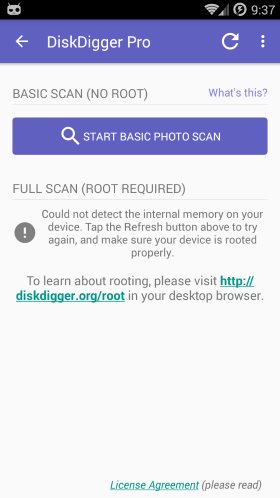
- Let the scan run, then filter the results by file type, size, or date where available. Inspect dimensions carefully: tiny files are often thumbnails rather than original photos.
- Select the files you recognize, tap Recover, and send them to a cloud service, email, or another storage location. Do not save them back to the same partition being scanned.


Finding a preview does not prove that the original file is intact. Open recovered photos at full size and play each recovered video from beginning to end before deleting any remaining source or backup copy.
Part 4. Recover Photos and Videos From an SD Card or Computer
If the missing files were on a portable SD card, camera card, USB drive, or computer disk, stop using that device. Eject a removable card safely, connect it to a Windows PC or Mac with a reliable reader, and confirm that the operating system or recovery program can detect it. Do not accept a prompt to initialize or format the card.
For a card that was formatted or now appears empty, see how to recover files from a formatted SD card. For a general removable-media workflow, Recoverit Memory Card Recovery covers SD, microSD, and camera-card scenarios.

- Launch Recoverit on Windows or macOS. Connect the card or drive, then select the correct source under the displayed storage locations. Verify the device capacity so you do not scan the wrong disk.
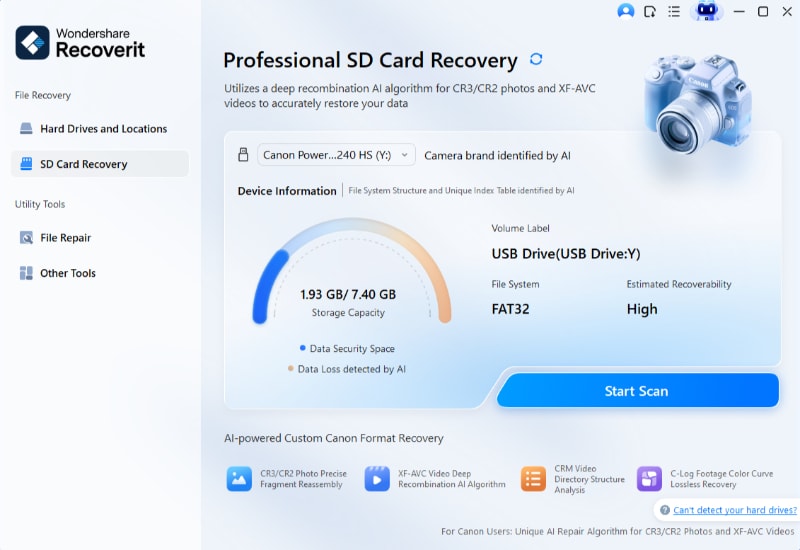
- Start the scan. Use file type, path, size, and date filters to narrow a large result set, but allow the scan to finish when the first pass does not show the required video or RAW photo.
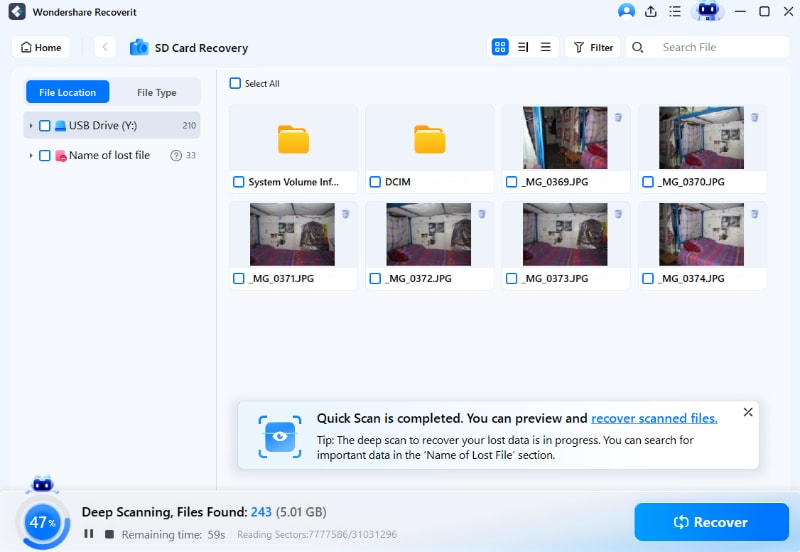
- Preview the candidates when supported, select the required files, and click Recover. Save them to a different healthy drive, never to the source card or volume.
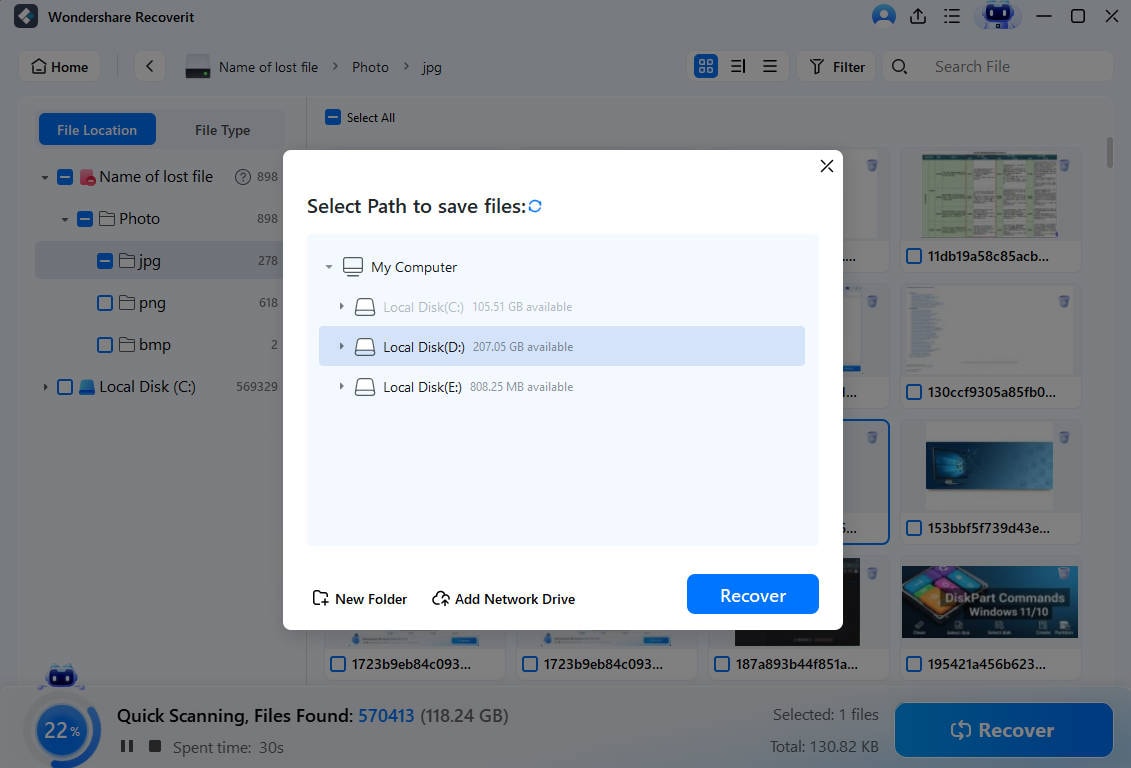
After recovery, open a sample from every camera, date range, and file type. Compare dimensions and file sizes with known originals. Scrub through recovered videos and check audio synchronization. A thumbnail or playable first frame does not guarantee that the entire file is complete.
Recover Photos and Videos From an SD Card or Computer
 Security Verified. Over 7,302,189 people have downloaded it.
Part 5. When a Free Desktop Alternative Is Enough
Choose PhotoRec when the source is a readable card or drive, the budget is zero, and you are comfortable sorting large numbers of generically named files. Choose Recuva when you are on Windows and want a simpler deleted-file workflow. Choose a guided commercial tool when preview, filters, camera formats, and a more visual process are worth more than a free command-line or basic utility.
| Priority | Better Fit | Why |
| No-cost, open-source recovery | PhotoRec | Free, read-only source access, broad platform support, and file-signature scanning |
| Simple Windows undelete | Recuva | Windows-focused interface with free and paid editions |
| Visual filtering and preview on Windows or Mac | Recoverit | Guided selection, scanning, filtering, preview, and recovery workflow |
| Protected Android internal storage | Trash, backup, or a phone-specific service | A desktop card scanner does not bypass Android's storage protections |
Part 6. What Can and Cannot Be Recovered
The age of a photo or video is not the decisive factor. An old photo that still exists in a cloud backup can be restored immediately. A video deleted five minutes ago may already be unrecoverable if recording, app installation, syncing, or system activity overwrote its data. Storage type, encryption, trimming, fragmentation, and later writes matter more than the calendar age.
| Scenario | Realistic Outlook | Safest Next Step |
| Item is still in Trash or a backup | Best case; an intact retained copy may be restored | Restore it and verify the result |
| Recently deleted from a portable SD card with no further use | Often a reasonable software-recovery case | Write-protect where possible, connect by reader, and scan |
| Quick-formatted memory card with no new recording | Some file data may remain, but names and folders may be damaged | Scan before reformatting or repairing |
| Permanently deleted from non-rooted Android internal storage | Low and device-dependent; cached or lower-resolution copies may be all that remains | Stop writes, check every backup, then consider a limited app scan |
| Adopted SD card removed from its original phone | Another computer normally cannot decrypt it | Return it to the original device and avoid formatting |
| Card or drive is not detected anywhere, disconnects, or gets hot | Possible physical or controller failure | Stop repeated power cycles and contact a professional lab |
| Recovered file exists but will not open | The file may be incomplete, fragmented, or corrupted | Preserve the recovered copy and try repair only on a duplicate |
For media that exists but is damaged, do not keep rescanning the source blindly. Preserve the best recovered copy, duplicate it, and use a repair workflow on the duplicate. Recovery finds data; repair attempts to make an existing file usable.
Part 7. Photo Video Recovery App Download and Privacy Checklist
A deleted photo and video recovery app may request broad storage access because scanning requires visibility into media locations. That does not make every permission request safe. Install only from the developer's official website or the verified app-store listing, and check the publisher name before granting access.
- Do not download repackaged APK files from “mod” or mirror sites.
- Read the current data-safety and privacy disclosures before granting photo, video, or all-files access.
- Be suspicious of claims such as “100% recovery,” “recover every permanently deleted file,” or “no overwrite limit.”
- Do not run cleanup, optimization, secure-delete, or free-space-wipe features before recovery.
- Do not pay before confirming that the tool supports your operating system, storage type, and required file format.
- Use preview as evidence that a candidate was found, not as proof that a large photo or video is fully intact.
- Save results to a different physical storage device or a trusted cloud destination.
For sensitive family photos, identity documents, or work footage, prefer a tool that can scan locally and clearly explains what data it collects. If a recovery app asks to upload the entire source, understand the privacy and transfer implications before proceeding.
Part 8. Final Verdict
The best photo and video restore option is the one that matches the storage location. Google Photos, Samsung Gallery, and Files by Google are the first choices when a retained copy still exists. DiskDigger is a reasonable last in-phone attempt on Android, but its own documentation confirms that no-root scanning is limited and video recovery requires root.
For a portable SD card, camera card, USB drive, or computer disk, use desktop recovery software before formatting or repair. Recoverit offers the more guided Windows and Mac workflow; PhotoRec is the stronger free open-source alternative; Recuva is a straightforward Windows-only option. If the device is physically failing or cannot be detected at any level, stop software experiments and use a professional recovery service.
Whichever tool you choose, the recovery order does not change: stop writes, confirm the source, scan without modifying it, save elsewhere, and verify every recovered file.
FAQ
-
What is the best photo and video recovery app for Android?
Check the built-in Trash or cloud backup first. For a permanently deleted item on internal storage, DiskDigger offers a limited no-root scan, but it may return thumbnails or existing files rather than the original. For a portable SD card, remove the card and use desktop recovery software. -
Can a photo video recovery app recover permanently deleted files?
Sometimes, but never after the underlying data has been overwritten. Modern Android permissions, encryption, flash-storage behavior, and lack of root access can make internal-storage recovery especially limited. -
Can Recoverit recover photos and videos from an Android phone?
Recoverit is appropriate when the media is on a removable SD card or another storage device that Windows or macOS can detect. It should not be described as a direct scanner for protected Android internal storage. -
Can old photos and videos still be recovered?
Age alone does not decide. An old file in a backup is easy to restore, while a newly deleted file may be unrecoverable after overwriting. Check backups and Trash before running a scan. -
Does DiskDigger recover deleted videos without root?
No. DiskDigger's developer states that video recovery requires a rooted device. Its no-root basic scan is mainly a limited photo search and may return lower-resolution versions. -
Should I install a recovery app immediately after deletion?
First check Trash and backups. Installing an app writes data to internal storage and can overwrite deleted content. If the missing files were on a removable card, stop using the card and scan it on a computer instead. -
Is PhotoRec better than Recoverit?
PhotoRec is better when you need a free, open-source, multi-platform carving tool and can sort generically named output. Recoverit is better suited to users who want a guided interface, filtering, and preview on Windows or Mac. Neither can guarantee recovery. -
Where should recovered photos and videos be saved?
Save them to a different healthy drive or cloud destination. Writing recovered files to the source device can overwrite other recoverable data.


