
 TL;DR:
Windows can format SD and microSD cards to NTFS using File Explorer, Disk Management, or DiskPart, but this file system should only be selected for strict Windows-only workflows that explicitly require permissions, encryption, or metadata journaling.
● exFAT is the safer alternative for transferring files larger than 4 GiB across different platforms, as Apple's Disk Utility does not natively offer NTFS formatting and the SD Association strictly assigns exFAT as the standard for SDXC and SDUC cards above 32 GB.
● Perform a data recovery scan before initiating any format if the card appears as RAW, files are missing, or Windows displays an unexpected format prompt, because creating a new file system will overwrite potentially recoverable file structures.
● If an NTFS-formatted card triggers an unsupported-card error in a camera, drone, or phone, you must reformat the media using the target device's built-in format command or the official SD Memory Card Formatter to restore the standard FAT32 or exFAT compatibility.
Ask AI for a summary
 ChatGPT
 Perplexity
 Gemini
 Claude
 Grok
Grok
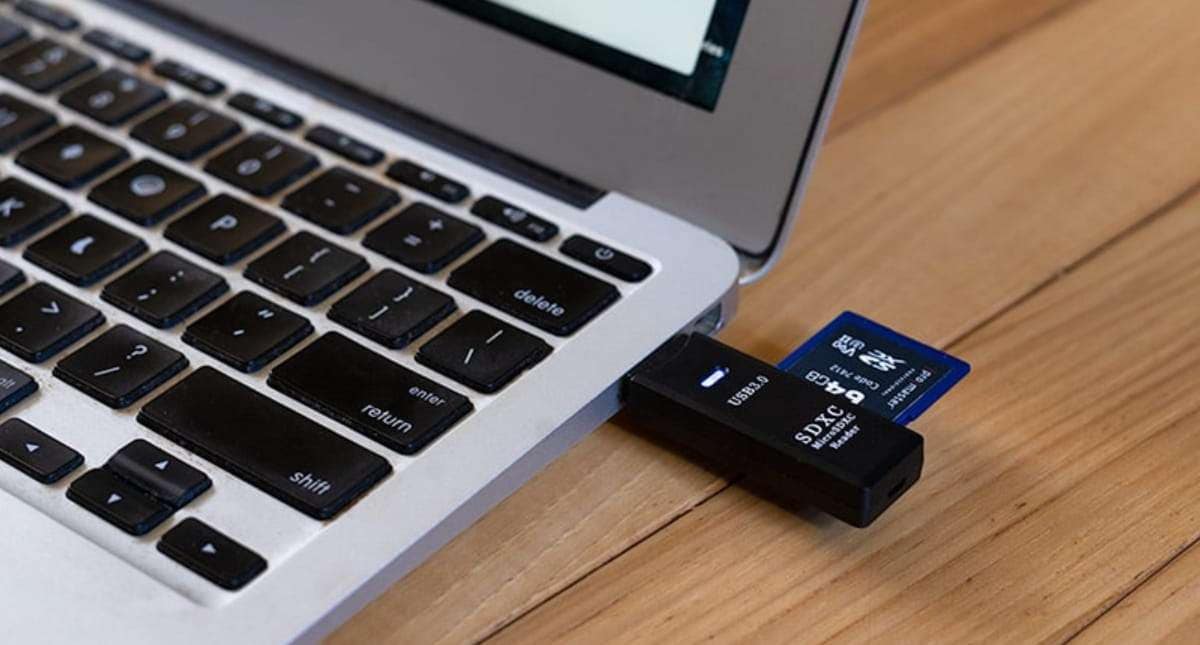
Quick answer: Windows 11 can format an SD or microSD card to NTFS through File Explorer, Disk Management, or DiskPart. Choose NTFS only for a verified Windows-only workflow. For cameras, drones, dashcams, phones, consoles, and cards shared with a Mac, FAT32 or exFAT is usually more compatible.
A FAT32 card that refuses a file larger than 4 GiB does not automatically need NTFS. exFAT also supports large files and is the SD Association's standard file system for SDXC and SDUC cards. NTFS is most useful when Windows permissions, encryption, compression, or metadata journaling are genuinely required and every destination supports the format.
Formatting makes existing files inaccessible. Follow this SD card backup guide if the files are readable. If files are missing, the card is RAW, or Windows asks you to format it, stop using the card and recover important data before creating a new file system.
In This Article
Part 1. Should You Format An SD Card To NTFS?
Choose the file system for the device that must read the card, not simply for the card's capacity. NTFS removes FAT32's 4 GiB single-file limit and adds Windows features such as access control lists, file-system encryption, compression, and metadata journaling. Those features can help a Windows-only working drive, but they do not make NTFS universally better for memory cards.
Formatting a card to NTFS does not automatically make it faster, repair failing flash memory, or guarantee data security. NTFS permissions apply within compatible Windows environments, while physical possession of an unencrypted removable card remains a separate risk. For large-file transfer without Windows-only requirements, exFAT usually delivers the required file-size support with broader device compatibility.
| Your Intended Use | Recommended Choice | Why |
| Windows-only file transfer, archives, disk images, or other files larger than 4 GB | NTFS can be appropriate | Windows supports NTFS natively, and NTFS supports large files plus Windows permissions and journaling. |
| Sharing large files between Windows and Mac | exFAT | Both operating systems support exFAT, while Apple's Disk Utility does not offer NTFS as a format option. |
| Camera, drone, action camera, dashcam, or recorder | Use the device's format command, usually FAT32 or exFAT | Embedded devices are designed for specific card types and file systems. NTFS may cause a card error or an unsupported-card message. |
| Android phone, tablet, TV, console, or car system | Check the exact device manual | NTFS support varies by manufacturer and firmware. Do not assume that a Windows-readable card will work in another device. |
| SDHC card over 2 GB through 32 GB | FAT32 for SD-standard compatibility | The SD Association assigns FAT32 to the SDHC capacity class. |
| SDXC or SDUC card above 32 GB | exFAT for SD-standard compatibility | The SD Association assigns exFAT to SDXC and SDUC cards. |
Practical rule: use NTFS only when you can answer yes to both questions: Will the card stay in the Windows ecosystem, and does every non-PC device that may receive it explicitly support NTFS? If either answer is no, exFAT or the device's own format function is usually safer.
Part 2. NTFS Vs exFAT Vs FAT32 For SD Cards
The file-size limit is only one part of the decision. According to Microsoft's current file-system comparison, NTFS and exFAT support files far larger than FAT32's 4 GiB maximum. The more important difference for an SD card is device compatibility.
| Feature | NTFS | exFAT | FAT32 |
| Maximum single-file size in Microsoft documentation | 264-1 bytes | 264-1 bytes | 4 GiB |
| Windows support | Native read and write | Native read and write | Native read and write |
| Mac formatting in Disk Utility | Not offered | Offered for Windows-compatible volumes over 32 GB | Offered as MS-DOS (FAT) for volumes of 32 GB or less |
| SD Association capacity class | Not an SD-standard default | SDXC and SDUC | SDHC |
| Metadata journaling | Yes | No | No |
| Best fit | Windows-only storage that requires NTFS features | Large removable cards and cross-platform transfer | Smaller or legacy cards and devices |
The SD Association capacity standard maps SD cards up to 2 GB to FAT12/16, SDHC cards over 2 GB through 32 GB to FAT32, and SDXC/SDUC cards above 32 GB to exFAT. Windows can technically place NTFS on many of these cards, but doing so moves the card outside its standard device-oriented file-system configuration.
Mac compatibility is another dividing line. Apple's current Disk Utility format guide lists MS-DOS (FAT) for Windows-compatible volumes of 32 GB or less and exFAT for larger Windows-compatible volumes; NTFS is not offered as a built-in erase format. If the same card must be written on both Windows and Mac, exFAT is normally the more practical option.
Part 3. Back Up Or Recover Files Before Formatting
If File Explorer can open the card, copy its entire contents to a healthy internal or external drive and verify several files before formatting. If files are missing, the card is RAW, or Windows asks you to format it before use, do not format yet. A recovery scan should come first because any new write can overwrite recoverable data.
| Good Fit For A Recovery Scan | Why |
| The SD card is detected by Windows, but files were deleted or lost. | A scan may find recoverable file records or file signatures if the missing data has not been overwritten. |
| Windows asks to format the card, or the file system appears as RAW. | Recovering before formatting avoids creating a new file system over the existing card structure. |
| The card was quick formatted by mistake. | A quick format rebuilds file-system structures without performing the same full overwrite as an overwrite format. |
| The card is cracked, burned, overheating, or not detected by any reader or computer. | Not a good fit for repeated software scans. Stop and consider a professional recovery lab. |
Method 1. Recover Important Files With Recoverit Before Formatting
Recoverit Memory Card Recovery is relevant at this point only when files are already missing or inaccessible and the card is still detected by the computer. It can scan SD and microSD cards for photos, videos, audio, documents, archives, and other supported file types. Do not install the program on, or save recovered files back to, the affected card. If the card was already formatted accidentally, the separate formatted SD card recovery guide explains how format type and overwriting affect recovery prospects.
- Stop using the card: remove it from the camera, phone, or recorder and connect it to the Windows PC with a stable card reader.
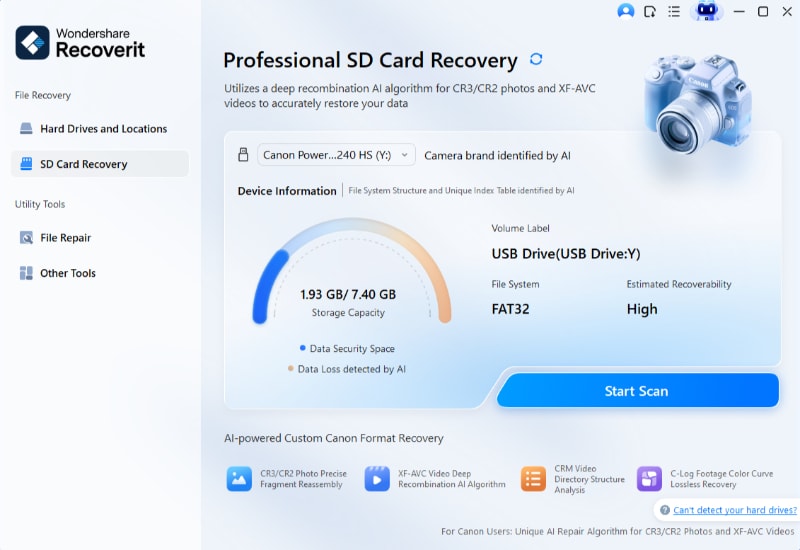
- Select the detected card: open Recoverit, choose SD Card Recovery, confirm the device and capacity, and click Start Scan.
- Review results while scanning: use file location, file type, search, and filters to narrow the results. Let the deeper scan continue if the first results do not include the files you need.
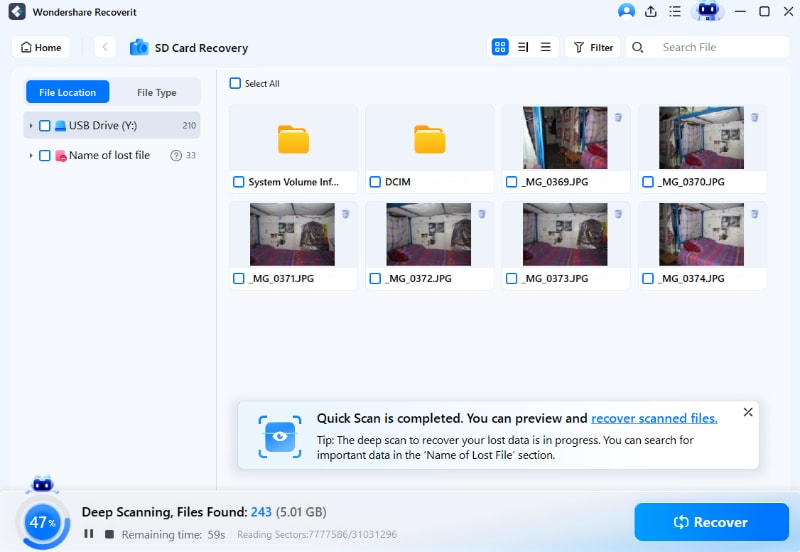
- Preview and recover: preview supported files, select the required items, click Recover, and save them to the computer or another healthy drive.
- Verify the recovery: open a sample of recovered files before formatting the original card.

Part 4. Format An SD Card To NTFS With File Explorer
Use File Explorer when the SD card is healthy, has a drive letter, and appears normally under This PC. It is the clearest option for most Windows users because it exposes the necessary file-system, label, and quick-format settings without disk-selection commands.
Method 2. Use The Windows Format Dialog
- Connect and identify the card: insert the SD or microSD card through a compatible reader. Open File Explorer > This PC and confirm the card by its drive letter and capacity.
- Open the format dialog: right-click the SD card and select Format. Do not choose a drive based on its letter alone because letters can change.
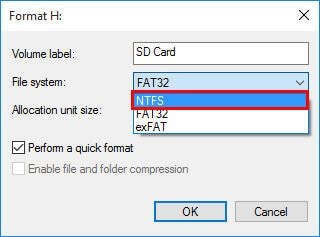
- Choose NTFS: set File system to NTFS. Leave Allocation unit size on Default allocation size unless a specific application requires another value. Add an optional volume label.
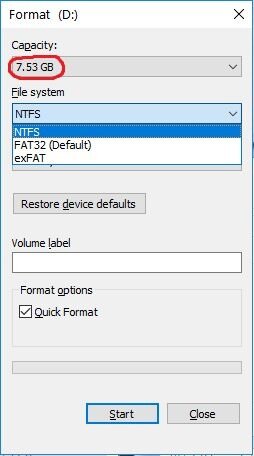
- Choose the format type: keep Quick Format checked for a previously formatted card that you know is healthy. Microsoft's format documentation says quick format deletes file-system tables but does not scan every sector for bad areas.
- Start and confirm: click Start, read the data-loss warning, and confirm only after rechecking the drive letter.
- Verify the result: after Windows reports completion, right-click the card, select Properties, and confirm that File system shows NTFS. Copy a noncritical test file, eject the card safely, and test it in its intended device.
Do not use a full format as a routine repair for a failing card. If the card disconnects, reports the wrong capacity, or repeatedly fails to format, recover any important data and replace the card rather than relying on it.
Part 5. Format An SD Card To NTFS With Disk Management
Disk Management is useful when the card is visible to Windows but missing from This PC, lacks a drive letter, or shows unallocated space. It also provides a clearer disk-and-volume view, which helps distinguish the memory card from internal drives before formatting.
Method 3. Format The Existing SD Card Volume
- Open Disk Management: right-click Start and choose Disk Management. You can also press Windows + R, enter diskmgmt.msc, and click OK.
- Identify the SD card carefully: find the removable disk by capacity and its current drive letter. Do not proceed until both match the physical card.
- Choose the correct volume action: if the card has an existing volume, right-click that volume and choose Format. If it is unallocated and contains no data you need, right-click the unallocated region and choose New Simple Volume.
- Set the file system: select NTFS, keep the allocation unit size on Default, enter an optional label, and use Perform a quick format only for a card known to be healthy.
- Confirm the warning: click OK and confirm that formatting will erase the selected volume.
- Assign a drive letter if necessary: if the formatted volume still does not appear in File Explorer, right-click it, choose Change Drive Letter and Paths, and assign an unused letter.
Microsoft's current Disk Management guide confirms that Windows 11 and Windows 10 use the same Disk Management workflow and warns that formatting destroys the selected volume's data.
Part 6. Format An SD Card To NTFS With DiskPart
Use DiskPart only when the graphical tools fail and you are comfortable identifying disks and partitions by capacity. A wrong selection can format another drive. The routine below deliberately omits the destructive clean command because an existing SD card volume does not need its partition table erased merely to change its file system.
Method 4. Use DiskPart Without Cleaning The Card
- Open an elevated terminal: search for Command Prompt or Terminal, right-click it, and choose Run as administrator.
- Start DiskPart and list disks: enter the commands below one line at a time. Compare the displayed capacities with the physical card before selecting a disk.
diskpart
list disk
select disk N
list partition
select partition N
format fs=ntfs quick label=SDCARD
assign
exit
Replace each N with the correct disk or partition number. After select disk, DiskPart should confirm that the intended disk is selected. If the capacity does not match the card, enter exit without formatting.

- Wait for the success message: do not remove the reader while the format is running. DiskPart should report that it successfully formatted the volume.
- Verify in File Explorer: confirm the card appears, open Properties, and check that the file system is NTFS.
The syntax follows Microsoft's current format command documentation. Its guidance recommends the default allocation unit size for general use and limits quick format to previously formatted volumes known to be in good condition.
Part 7. Fix Common SD Card NTFS Formatting Problems
| Problem | Likely Cause | What To Do |
| The card is write-protected. | The full-size SD card or microSD adapter lock is engaged, the reader is faulty, or Windows sees the disk as read-only. | Move the physical switch to the unlocked position, reconnect the card, and try another reader. Clear a software read-only attribute only after confirming the correct disk. |
| NTFS is missing from the File Explorer list. | The current volume layout, device presentation, or Windows state is preventing the expected option. | Recheck whether NTFS is truly required, then try Disk Management. If the card is intended for an SD device, choose its required FAT32 or exFAT format instead. |
| Windows was unable to complete the format. | The card may be busy, corrupted, disconnecting, counterfeit, or physically failing. | Close apps using the card, test another reader and port, and recover needed files. If more than one tool fails or the card reports an incorrect size, replace it. |
| The NTFS card works on Windows but not in a camera, phone, or other device. | The device does not support NTFS or expects a standard SD card file system and layout. | Back up the card, then format it in the target device or restore the standard FAT32/exFAT format with the official SD Memory Card Formatter. |
| The card does not appear in File Explorer but is visible in Disk Management. | The volume may lack a drive letter, be RAW, or be unallocated. | If files matter, recover them first. Otherwise assign a drive letter or create and format a new volume after verifying the correct disk. |
| The card is not detected by any reader or computer. | Reader incompatibility, controller failure, or physical damage may be involved. | Try one known-good compatible reader. If the card remains undetected and the data is valuable, stop repeated attempts and use a recovery lab. |
Can you convert FAT or FAT32 to NTFS without reformatting? Windows provides the command convert X: /fs:ntfs, where X is the card's drive letter. Microsoft says the conversion is designed to preserve existing files, but it still recommends a backup first. The conversion is one-way: returning to FAT32 or exFAT requires reformatting. It also does not solve camera or phone compatibility, so use it only for a Windows-only card. See Microsoft's FAT/FAT32-to-NTFS conversion guidance.
If Windows continues to report format errors after the physical lock, reader, port, and selected volume have been checked, separate file-system corruption from hardware failure. Use the dedicated memory card format error guide for error-specific checks, or the corrupted SD card formatting guide when data has already been protected.
Part 8. Return An NTFS SD Card To A Standard SD Format
If a camera, drone, phone, dashcam, or other host stops recognizing the card after it was formatted to NTFS, copy any readable files off the card first. Then format in the target device when its manual recommends that workflow, or use the SD Association's official formatter to restore an SD-standard file system. For broader phone, camera, Windows, and Mac workflows, use the dedicated microSD card formatting guide.
Method 5. Use The Official SD Memory Card Formatter
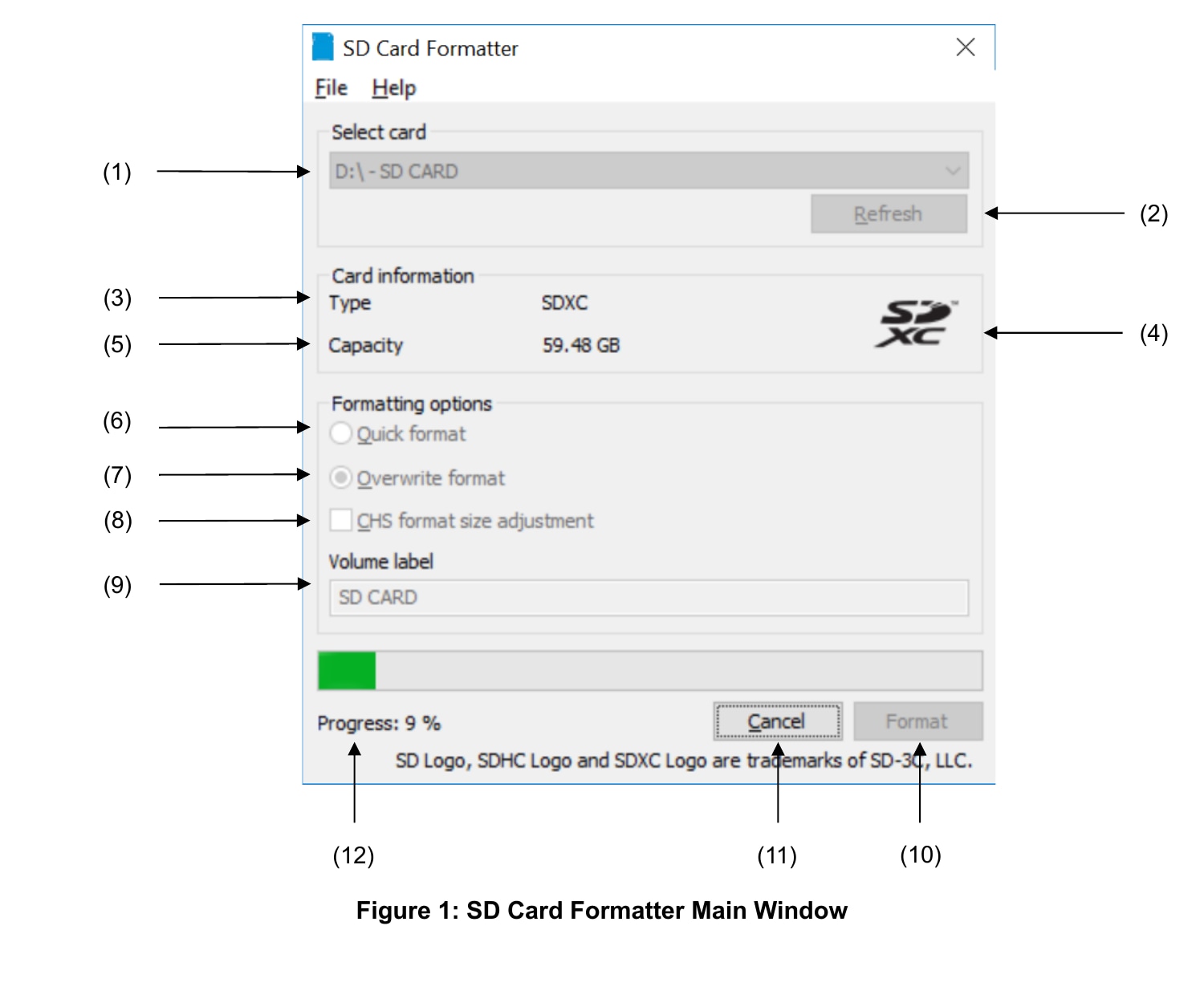
The SD Memory Card Formatter supports SD, SDHC, SDXC, and SDUC cards. It does not create NTFS. Instead, it applies the file system appropriate to the SD capacity class. The SD Association recommends this formatter over generic operating-system tools for SD cards because OS formatters may not be optimized for SD media.
- Download from the SD Association: install the official Windows or Mac version and connect the card through a compatible reader.
- Select the card: choose the correct drive and verify the displayed card type and capacity.
- Choose a format option: use Quick format after a normal backup when secure erasure is not required. Overwrite format writes across the user area and greatly reduces recovery prospects.
- Enter a label and format: add an optional volume label, click Format, confirm the warning, and keep the card connected until completion.
Part 9. Protect The Card After Formatting
- Test the destination before relying on it: copy a noncritical file to the NTFS card, eject it, reconnect it, and open the file. Then test the card in every intended device.
- Keep another copy: an SD card is removable working media, not the only backup. Maintain at least one verified copy on another drive or backup location and use the SD card backup workflow before reuse or reformatting.
- Do not switch devices casually: format a camera or recorder card in that device when the manufacturer recommends it, and avoid moving one active card among devices with different requirements.
- Eject before removal: wait for all writes to finish and use Windows Eject before removing the reader.
- Retire unreliable cards: repeated I/O errors, disconnects, capacity changes, slow writes, or multiple format failures are replacement signals.
- Label Windows-only NTFS cards: a physical label prevents someone from inserting the card into a camera or phone and accepting an unexpected format prompt.
Conclusion
Windows can format an SD card to NTFS, but capability is not the same as compatibility. File Explorer is the simplest route for a healthy card, Disk Management helps when the volume or drive letter needs attention, and DiskPart is an advanced fallback that demands careful disk identification.
Choose NTFS for a verified Windows-only workflow that genuinely needs NTFS features. For cameras, drones, phones, dashcams, cross-platform transfer, and standard SD card use, FAT32, exFAT, or the target device's own formatter is usually more appropriate. Protect readable files before formatting, recover missing data before writing a new file system, and replace a card that continues to disconnect or fail across multiple readers.
FAQ
-
Can An SD Card Be Formatted To NTFS?
Yes. Windows 11 and Windows 10 can format many SD and microSD card volumes to NTFS through File Explorer, Disk Management, or DiskPart. Use NTFS only when the card will stay in a Windows workflow or every target device explicitly supports it. -
Should I Format My SD Card To NTFS Or exFAT?
Choose NTFS for Windows-only storage that needs Windows permissions, journaling, or other NTFS features. Choose exFAT for large removable cards shared across Windows, Mac, cameras, or other compatible devices. For an SDXC or SDUC card, exFAT is the SD Association's standard file system. -
Can Windows 11 Format A 64 GB Or 128 GB SD Card To NTFS?
Yes, Windows can technically format a 64 GB or 128 GB card to NTFS. Those capacities are SDXC, however, and the SD standard assigns exFAT to SDXC cards. Confirm that the intended device supports NTFS before changing the format. -
Can I Convert FAT32 To NTFS Without Losing Files?
Windows provides the convert X: /fs:ntfs command and Microsoft says it preserves existing files, but you should still make a verified backup first. The conversion cannot be reversed to FAT32 or exFAT without reformatting, and it may reduce device compatibility. -
Why Does My Camera Or Phone Not Read An NTFS SD Card?
The device may not support NTFS or may expect the standard file system for the card type. Back up any readable files, then format the card in the target device or use the SD Association formatter to restore FAT32 or exFAT as appropriate. -
Can A Mac Format An SD Card To NTFS?
Not with Apple's built-in Disk Utility. Apple's current Disk Utility guide lists MS-DOS (FAT) and exFAT as its Windows-compatible format choices. Use a Windows PC only if NTFS is truly required; use exFAT for routine Windows-and-Mac sharing. -
Does Quick Format Delete Everything On The SD Card?
Quick format removes or rebuilds file-system structures so the files are no longer normally accessible, but it does not perform the same complete data overwrite as an overwrite format. If formatting was accidental, stop using the card immediately because new writes can overwrite recoverable data. -
What If Windows Cannot Format The SD Card To NTFS?
Check the physical lock switch, try another compatible reader and USB port, close apps using the card, and test Disk Management. If the card repeatedly disconnects, shows the wrong capacity, or fails in multiple tools, recover important files if possible and replace the card. -
How Do I Change An NTFS SD Card Back To FAT32 Or exFAT?
Back up the card, then reformat it with the target device or the official SD Memory Card Formatter. Use FAT32 for SDHC compatibility and exFAT for SDXC or SDUC compatibility, subject to the device's supported card type and capacity.


