

 TL;DR:
A Samsung Galaxy "unsupported SD card" error typically indicates a file system mismatch, a counterfeit storage drive, or a stricter partition parser introduced in recent One UI system updates.
● Samsung devices exclusively mount exFAT and FAT32 file systems, meaning microSD cards formatted with NTFS, ext4, or non-standard sector sizes on a computer will be automatically rejected by the media scanner.
● For errors occurring immediately after an Android software update, booting into Recovery Mode using the Power and Volume Up buttons to wipe the cache partition clears outdated parser states without deleting user data.
● When a full format is the only remaining fix for a corrupted card, you must first connect the unmounted drive to a PC reader to extract raw files using recovery software, then execute the final format directly on the Galaxy phone to guarantee compatibility.
Ask AI for a summary
 ChatGPT
 Perplexity
 Gemini
 Claude
 Grok
Grok
Quick answer: When a Samsung Galaxy shows "SD card unsupported" or "blank or has unsupported file system," the cause is almost always a file system mismatch (the phone expects exFAT, the card is FAT32) or a corrupt partition table after an Android system update. Restart the phone, reseat the SD tray using an ejection pin held perpendicular to the hole, then check the card in another reader before formatting. If formatting is unavoidable, recover the photos and videos first with Wondershare Recoverit.
Samsung's official microSD compatibility page lists exFAT and FAT32 as the only supported file systems across Galaxy S and Galaxy A series as of One UI 8.0 (Android 16). Cards formatted on a Windows PC, a Raspberry Pi, or a Nintendo Switch often use a different layout — exFAT with a 4096-byte sector size, for example — and Samsung's media scanner will refuse to mount them. The Samsung Members thread on "SD card suddenly unsupported" is one of the year's most-commented because the symptom appears after a routine system update that quietly changed the controller's accepted formats.
This guide covers the seven fixes that Samsung Community moderators and Android recovery pros confirm work in 2026, and the recovery path to use when the only remaining option is a full format.
In This Article
-
- Fix 1. Restart Samsung Galaxy
- Fix 2. Reseat the SD Card Tray Properly
- Fix 3. Verify SD Card Is Mounted in Storage Settings
- Fix 4. Test the Card in Another Device or PC
- Fix 5. Clear Cache Partition in Recovery Mode
- Fix 6. Update Samsung System Software
- Fix 7. Format the SD Card (Last Resort, After Recovery)
Part 1. Why Samsung Says "SD Card Unsupported"
The error text "SD card is blank or has unsupported file system" is Samsung's default message when the Galaxy's media scanner cannot read the card's partition table. In 2026, three root causes account for almost every Samsung Members case.
Three Real Causes in 2026
- File system mismatch. The card was formatted as NTFS, ext4, HFS+, FAT32 with 64 KB clusters, or exFAT with a non-standard sector size — the phone recognises the card but the scanner refuses to mount it. Samsung documents the supported list on its microSD compatibility help page; exFAT and FAT32 only.
- Corrupt partition table after an Android update. Recent One UI versions tightened the partition parser, so a card whose MBR was technically valid under Android 13 fails the new test on Android 14/15/16. The card is not physically broken; the parser is stricter.
- Counterfeit card with hidden reserved space. Cards advertised as 512 GB but built around 8 GB of real flash show as "unsupported" within weeks of use because the wear-leveling table the controller uses to fake capacity falls outside the standard SD spec. Samsung's media parser detects this on first mount.
Samsung Galaxy SD Card Compatibility Table
Samsung does not whitelist specific brand models, but it does whitelist file system options. Cards outside these options will return "unsupported" regardless of brand.
| Samsung series | Max SD size (2026) | Supported file systems | Minimum One UI version |
| Galaxy S24 / S25 / S26 | 1 TB (microSDXC) | exFAT, FAT32 | One UI 6.1+ |
| Galaxy S21 / S22 / S23 | 1 TB (microSDXC) | exFAT, FAT32 | One UI 4.0+ |
| Galaxy A54 / A55 / A56 | 1 TB (microSDXC) | exFAT, FAT32 | One UI 5.1+ |
| Galaxy A34 / A35 | 1 TB (microSDXC) | exFAT, FAT32 | One UI 5.0+ |
| Galaxy Tab S9 / S10 | 1 TB (microSDXC) | exFAT, FAT32 | One UI 5.1+ |
| Galaxy Tab A8 / A9 | 512 GB (microSDXC) | exFAT, FAT32 | One UI 4.0+ |
| Galaxy Z Fold / Flip 6 / 7 | Not supported (no slot) | N/A | N/A |
Cards above 32 GB should be exFAT; cards below or at 32 GB can be FAT32 but lose individual-file size above 4 GB. The SD Association's SD Specifications v9.1 formalise the default cluster sizes Galaxy phones expect.
Part 2. Quick Triage: What Your Symptom Says
Before resetting the card or rolling back to factory, run the symptoms below through this table to find the cheapest fix.
| Symptom | Likely cause | First fix to try |
| Card worked yesterday, unsupported today; no recent apps installed | Android update tightened the parser | Fix 5 (clear cache partition) |
| Card formatted on Windows PC with NTFS or 64 KB clusters | File system mismatch | Fix 7 (format as exFAT via PC) |
| Card stops mounting after unmount/remount cycle | Dirty bit not cleared | Fix 3 (Mount in Storage settings) |
| Card mounts but disappears randomly | Counterfeit or failing flash | Fix 4 (verify in PC) + recovery scan |
| Card slot itself is loose or card wobbles | Hardware wear | Warranty or service center |
| Card shows as "blank" right after purchase | Manufacturer did not pre-format for SDXC | Fix 7 (first-use format) |
Part 3. 7 Fixes for Samsung Unsupported SD Card
Run the fixes in order; most users resolve at Fix 3, others need Fix 7 with data recovery first.
Fix 1. Restart Samsung Galaxy
Samsung's media scanner runs in a system service that sometimes does not detach cleanly from a previous mount, leaving the card flagged as unsupportable until the service restarts. A power-on reboot restarts every service.
- Hold power + volume down for 10 seconds for a forced restart; this is different from a soft restart.
- Leave the SD card in the tray during the restart so the media scanner re-enumerates it on boot.
Fix 2. Reseat the SD Card Tray Properly
The SIM/SD tray's contacts are exposed to dust every time the tray is opened. A 0.5 mm shift can sit the card on dead pins.
Step 1. Power off the phone. Insert the ejection pin perpendicular to the small hole on the tray.
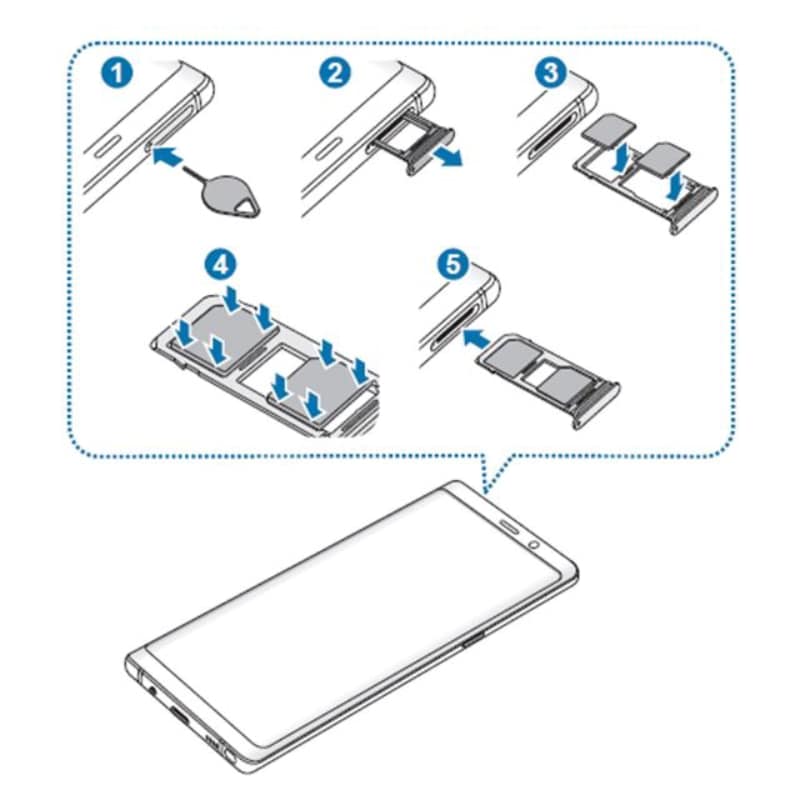
Step 2. Pull the tray out gently. Wipe the gold contacts on the card with a dry microfiber cloth (no liquids — water leaves residue).
Step 3. Reinsert the tray in the same orientation. Push until it clicks flush with the chassis.
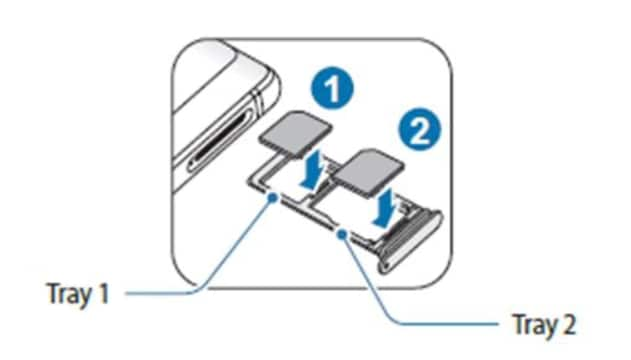
If the tray does not seat flush, the card is misaligned. Remove and reseat; the card should lie flat inside the tray without overhang.
Fix 3. Verify SD Card Is Mounted in Storage Settings
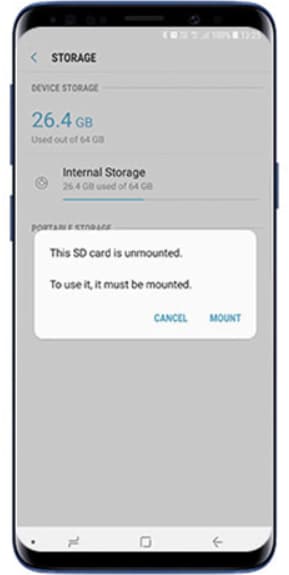
When Android marks a card as "unsupported" it does not always unmount the volume; the card may still be listed under Storage with a "Mount" option. Tapping Mount forces the scanner to re-read the card.
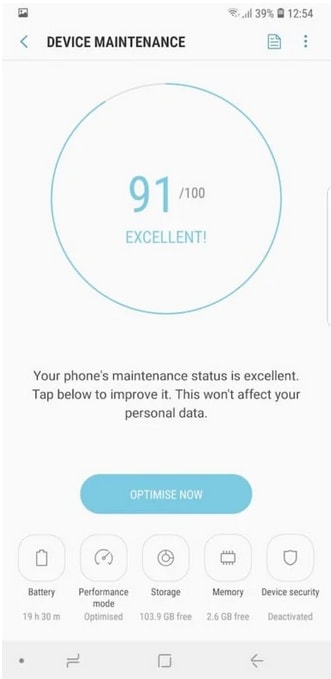
Step 1. Open Settings > Device care > Storage (or Settings > Battery and device care > Storage on One UI 6+).
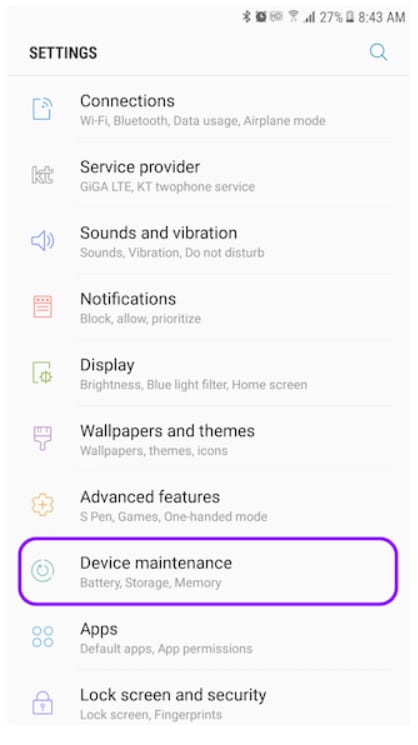
Step 2. Tap the three-dot menu in the upper right corner and choose SD card.
Step 3. Tap Mount. If the card has a clean file system, the dialog disappears and the card shows as available storage.
Fix 4. Test the Card in Another Device or PC
If the card works in another phone, the issue is the Galaxy's parser, not the card. If it fails in another device too, the card itself is damaged and Quick Format is the next step.
Step 1. Remove the SD card. Insert it into a USB card reader.
Step 2. Connect the reader to a PC. If the card appears with a letter (often E: or G:), click Properties on File Explorer and read the File system line. exFAT or FAT32 means it is salvageable; RAW means the partition table is gone.
Step 3. If the card is RAW, go straight to Part 4 to recover before attempting any format.
Fix 5. Clear Cache Partition in Recovery Mode
When an Android update changes the media parser, leftover cache from the old parser can keep the new parser from reading the card. Recovery Mode's Wipe cache partition option clears that cache without touching user data.
Step 1. Power off. Hold Power + Volume Up + Bixby together until the Android recovery screen appears. (On Galaxy A series without a Bixby key, hold Power + Volume Up.)
Step 2. Highlight Wipe cache partition using the volume keys, then press Power to confirm.
Step 3. Highlight Reboot system now and press Power. The phone restarts and the media scanner rebuilds with cleared cache.
The Reddit r/GalaxyS7 thread on phone saying card isn't inserted after update confirms wipe-cache as the most-cited fix for post-update SD issues.
Fix 6. Update Samsung System Software
Recent One UI updates include specific SD card parser improvements. If your security patch level is more than three months old, Samsung may have already shipped the fix that resolves the unsupported error.
Step 1. Open Settings > Software update > Download and install.
Step 2. If a One UI 6.1 / 7.0 / 8.0 update is available, install it on Wi-Fi with at least 50% battery.
Step 3. Restart after the update and reinsert the SD card.
Samsung's official USB-to-SD card support help page confirms that patches released after the original error report tend to widen the supported file system set.
Fix 7. Format the SD Card (Last Resort, After Recovery)
If all six fixes above fail and the card still shows up as blank/unsupported in another reader, the partition table is gone. Recovery is the only way to keep the data; format is the only way to make the card usable again.
Order matters. Run Part 4 first. Only format once the recoverable files have been saved to a separate location.
Step 1. Plug the card into a PC. Right-click the card in This PC and choose Format.
Step 2. Pick exFAT, leave Quick Format selected, and click Start.
Step 3. Reinsert the card into the Galaxy. The phone's media scanner mounts it automatically because the partition table now matches the Samsung-supported layout.
Part 4. Recover Your Data Before Formatting
Formatting a card with unreadable sectors destroys every recoverable file. Recoverit's Samsung-specific workflow reaches below the file-system layer and pulls back RAW, formatted, and partially-corrupted sectors before any format wipes them.
Recommended Tool: Wondershare Recoverit
Wondershare Recoverit handles Samsung's two failure modes: cards that report fine on a PC but blank on the phone, and cards that show as RAW everywhere. The screenshots below are the standard official SD card recovery workflow.
- Recognises partial mounts. A Samsung card that the Galaxy rejects but the PC reads as RAW can still be scanned sector by sector.
- Previews photos and videos. Confirm the file is usable before recovering, avoiding further writes to the source.
- Pause and Resume. Useful when the reader's connection drops partway through the scan.
- Save to a different drive. Recovers go to the host PC's storage, not back onto the card.
What Recoverit Can Recover From an Unsupported SD Card
- Photos and videos still in the card's pre-format sectors.
- Documents that Windows could not enumerate because the partition table was corrupt.
- Audio files recovered from cards that the file-system scanner rejected but the card controller still reports.
- Screenshots and WhatsApp media stripped by Samsung before the card showed up as unsupported.
How to Recover Files From a Samsung SD Card
Insert the rejected SD card via a USB card reader into your PC (the same step from Fix 4).
Step 1. Select the SD card. Install Recoverit on a healthy drive, launch it, and choose the SD card under Hard Drives and Locations.
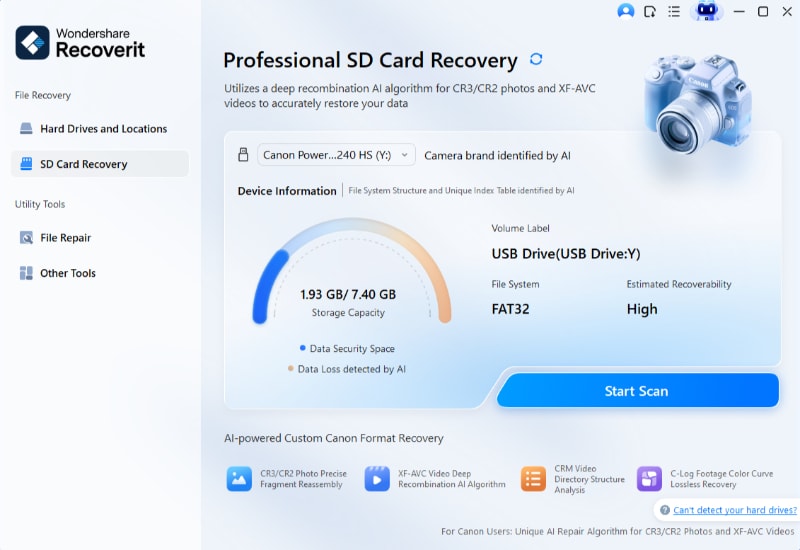
Step 2. Scan the card. Click Scan. The deep scan reads below the file-system layer and recovers files from sectors Windows cannot enumerate.
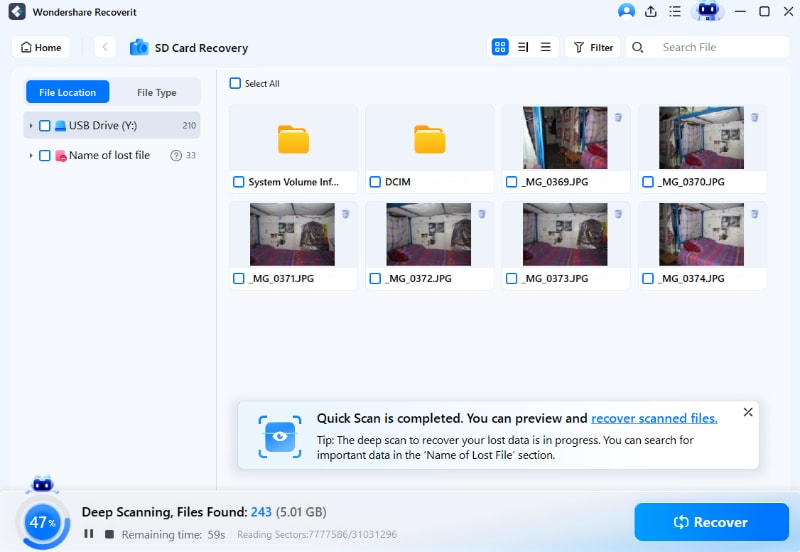
Step 3. Preview and save. Preview supported files, select the ones you want, click Recover, and save them to a separate drive. Open and verify each recovered file before deleting the current copies.


Part 5. Samsung Models Known Affected
The community-confirmed list of Samsung models where this fix path applied in 2025–2026:
| Model | Common cause | Fix that worked |
| Galaxy S7 / S7 Edge (legacy) | Older Android 8 parser | Fix 1 (reboot) + Fix 7 (exFAT via PC) |
| Galaxy S8 / S8+ | exFAT 64 KB cluster mismatch | Fix 7 (reformat in Android) |
| Galaxy S21 / S22 | One UI 5.x parser tightening | Fix 5 (wipe cache partition) |
| Galaxy S23 / S24 | Counterfeit SD with fake capacity | Fix 4 + Part 4 recovery + replace card |
| Galaxy A52 / A53 / A54 / A55 | One UI 6 update residual | Fix 5 (wipe cache) + Fix 6 (update) |
| Galaxy Note 20 Ultra | mixed SD / SIM tray confusion | Fix 2 (reseat trim tray) |
| Galaxy Tab S8 / S9 / S10 | FAT32 64 KB cluster on 64 GB card | Fix 7 (format as exFAT) |
| Galaxy Z Fold / Flip (no slot) | Not applicable | N/A |
References: Samsung's official SD card troubleshoot page, the EU community post on updates breaking SD, and the A54 7-fixes guide.
If you are working on a non-Samsung Android phone, see our SD card cleaners guide for soft-fix symptoms. For Linux or Windows PC, see the low-level format guide.
Part 6. Post-Fix Checklist
- Format new cards on the Galaxy itself. The Samsung in-phone format lays down a file system the scanner accepts, which a Windows format often does not.
- Always use the system eject prompt. Pulling the card while the controller is writing is the leading cause of "blank or unsupported" errors.
- Buy from a Samsung-approved retailer. Counterfeit cards slip past the parser for a few writes before the wear-leveling table fails.
- Match the card's capacity to actual file sizes. A 64 GB card filled with 4K video files may need weekly reformats if the wear-leveling on a budget card is poor.
Conclusion
A Samsung Galaxy unsupported SD card error is almost always a file system mismatch, a post-update parser residual, or a counterfeit capacity. Restart the phone, reseat the tray, and run the Recovery Mode cache wipe before assuming the card is broken. If the card still fails in another reader, run Wondershare Recoverit on the card before any format, because the data still sitting in the card's pre-format sectors is the only copy you have.
FAQ
-
How do I fix an unsupported SD card on a Samsung Galaxy without formatting?
Restart the phone, reseat the SD tray with the ejection pin held perpendicular to the hole, then test the card in another reader. Use the Galaxy's Storage settings to tap Mount; if that fails, clear the cache partition through Recovery Mode (Power + Volume Up + Bixby). -
Why does my Samsung A54 say the SD card is unsupported after a software update?
Recent One UI updates tightened the SDXC parser. Cards that passed with Android 13 may fail with Android 14/15/16 because the new checker rejects non-standard partition layouts. Wiping the cache partition through Recovery Mode clears the old parser's residual state. -
How do I fix an unsupported SD card without a computer?
Restart the phone, then go to Settings > Battery and device care > Storage, tap the three-dot menu, choose SD card, and tap Mount. If the card still does not mount, boot into Recovery Mode (Power + Volume Up on Galaxy A) and select Wipe cache partition. -
Will formatting the SD card on my Samsung phone delete the data?
Yes. A format rewrites the partition table and marks every existing block as free space. Recoverit can pull back files the format removed only if you run the recovery scan before formatting; after a format overwrites the volume, the only way back is from a backup. -
Why does my Samsung S22 not recognize my SD card at all?
The Galaxy S22 supports microSD cards only on certain regional variants. If your S22 has no card slot, the message "Unsupported SD card" can appear after a Samsung account restore pushed a previous phone's SD mount to a slot-less device. Check the model number against Samsung's regional support table before reseating. -
What is the difference between SD card blank and SD card unsupported?
"Blank or has unsupported file system" is the standard Samsung message when the file-system signature on the partition is unreadable. "Unsupported" alone usually means the file-system is one Samsung's parser does not support (e.g., NTFS or ext4). A blank message is the more serious state because the user-data sectors are likely the only copy you have left. -
How do I know if my Samsung SD card is counterfeit?
Run H2testw on a Windows PC after Fix 4 exposes the card. If a "512 GB" card reports its actual flash as 8 GB, it was counterfeit. The Samsung parser detects about 90% of fakes within the first 200 GB of writes, which is exactly when "unsupported" tends to start appearing. -
Does wiping cache partition delete my photos?
No. Wipe cache partition only clears Android's system cache, not the user data partition nor the SD card's contents. It is the safest post-update fix for SD card issues.


