


 TL;DR:
To safely recover data from a corrupted SD card, immediately stop all write operations, cancel any format prompts, and use recovery software to extract files to a different healthy drive before attempting any file-system repairs.
● DIY software recovery is only viable if the card is detected by the operating system, reports a plausible capacity, and maintains a stable connection; if the card shows 0 bytes, overheats, or repeatedly disconnects, stop scanning and use a professional lab.
● For recovery tools, Recoverit handles logical corruption like RAW volumes with visual file previews, while Windows File Recovery serves as a free command-line alternative for Windows 10 and 11 that requires a stable drive letter and Extensive mode for FAT/exFAT media.
● Never execute CHKDSK or disk repair utilities prior to securing your data, because these commands modify file allocation tables and can permanently overwrite recoverable files.
Ask AI for a summary
 ChatGPT
 Perplexity
 Gemini
 Claude
 Grok
Grok
Quick Answer
● Stop writes first: Do not format, repair, initialize, repartition, or save anything to the corrupted SD card while important files are still missing.
● If the card is detected and stable: Recover the files to a different healthy drive with Recoverit or, on Windows, Windows File Recovery.
● Check three signals: Operating-system detection, reported capacity, and connection stability tell you whether software recovery is appropriate or whether you should stop DIY attempts.
● Repair only after verification: Open and check the recovered files first. Then use repair or formatting tools only if you still want to reuse the card.
In This Article
Part 1. Diagnose the SD Card Before Recovery
A corrupted SD card can show up as RAW, ask to be formatted, display empty or missing folders, refuse to copy files, or become unreadable even though the card still appears in the operating system. These are not all the same failure. Before choosing data recovery software for a corrupted SD card, identify whether the computer can still communicate with the card well enough for a safe scan.
Do not use formatting or repair as a diagnostic shortcut. If Windows asks to format the card, cancel the prompt. If files disappeared rather than the entire card becoming unreadable, check the dedicated guide for pictures that disappeared from an SD card before assuming the file system is fully corrupted.
The Three-Signal Triage: Detection, Capacity, and Stability
Use these three signals together. One signal alone can be misleading, but the combination usually tells you which recovery path is safest.
| Signal | What to Check | What It Suggests | Safest Next Step |
| Detection | The SD card appears in Windows Disk Management, File Explorer, or macOS Disk Utility. | The operating system can still communicate with the device, even if the volume cannot be opened. | Software recovery may be appropriate. If the card is missing from normal file browsing, see the SD card not recognized guide for detection-layer checks. |
| Capacity | The reported capacity is close to the card's expected size. | The controller is at least reporting plausible media information. | If the card is also stable, recover files before attempting repairs. |
| Stability | The card stays connected during reads and does not freeze the computer. | A software scan is less likely to be interrupted by an unstable device. | Proceed with one careful recovery workflow and save results elsewhere. |
| Warning pattern | The card reports 0 bytes, a wildly wrong capacity, repeatedly disconnects, freezes the computer, becomes unusually hot, or is not detected by multiple readers. | Controller, flash-memory, electrical, or other physical failure may be involved. | Stop repeated scans. Use the damaged SD card recovery guide to decide whether professional recovery is warranted. |
If Windows labels the volume as RAW, that is a specific logical-recovery scenario. Do not format it just to make Windows assign a normal file system. Instead, follow the RAW SD card recovery workflow or use the recovery-first methods below.
Corruption Vs. Physical Damage
Logical corruption affects the structures used to locate or interpret files. Common examples include a RAW volume, a format prompt, inaccessible folders, missing directory entries, or a card that mounts but cannot be read normally. Software recovery is designed for this class of problem when the operating system can still detect the storage device.
Physical or controller-level failure is different. A cracked card, water or burn damage, repeated disconnections across multiple readers, abnormal heat, 0-byte capacity, or a card that never appears at the system level can be outside the reach of consumer recovery software. Repeated power cycles and long scans can add stress to an unstable device, so high-value data is a reason to stop earlier, not to try more repair commands.
If the card simply suddenly stopped working, first rule out the reader, adapter, USB port, and host device. A bad reader can look like card corruption and can waste recovery attempts on the wrong component.
Part 2. Recover Data From a Corrupted SD Card With Recoverit
When files are important, recovery should come before repair. Wondershare Recoverit is most relevant when the corrupted SD or microSD card is still detected by Windows or macOS but files are deleted, missing, formatted, RAW, or inaccessible. The broader Recoverit Memory Card Recovery page covers supported memory-card recovery scenarios and the distinction between logical data loss and physical failure.
When Recoverit Is the Right Fit
Use this method when the card passes the basic detection test and remains stable enough to read. Typical cases include:
- The card appears in Windows or macOS but its folders will not open.
- Windows shows a format prompt or the volume appears RAW.
- Photos, videos, documents, or folders disappeared after corruption or an interrupted transfer.
- The card was accidentally formatted while troubleshooting. If formatting already happened, use the dedicated formatted SD card recovery guide for the more specific recovery path.
Do not use software recovery as a substitute for professional work on a physically broken or consistently undetected card. No recovery program can guarantee files that have already been overwritten, and the recovered files should never be written back to the source card.

Step-by-Step Corrupted SD Card Recovery
Step 1. Stop using the card and connect it through a reliable reader.
Remove the SD or microSD card from the camera, phone, drone, dashcam, or recorder. Do not take new photos, record new video, or accept a format prompt. Connect the card to a Windows PC or Mac through a stable reader. If it disconnects repeatedly, stop instead of repeatedly rescanning it.
Step 2. Select the SD card in Recoverit.
Open Recoverit and choose SD Card Recovery or the detected removable-media entry. Before scanning, confirm that you selected the correct device by checking the card identity and approximate capacity. This avoids accidentally scanning another external drive.
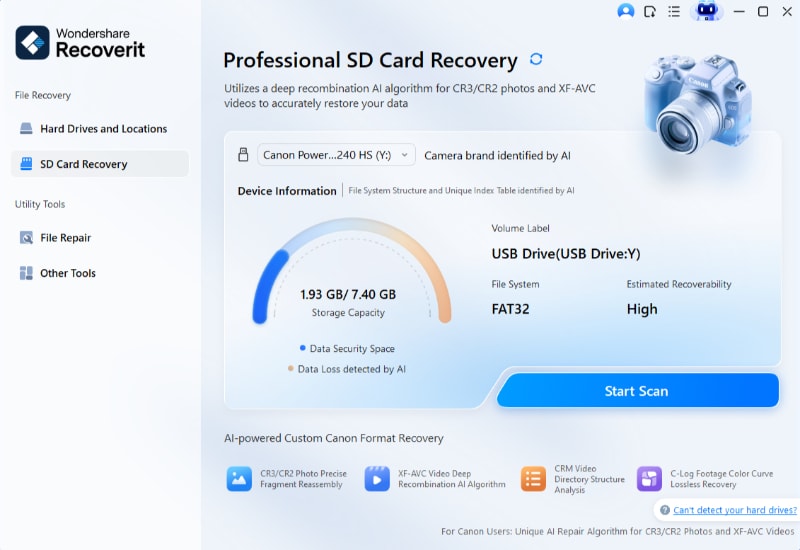
Step 3. Scan the corrupted SD card.
Start the scan and let Recoverit search for accessible and lost file records. Avoid running CHKDSK, First Aid, formatting, or another repair process at the same time because those tools can change the source while the recovery scan is trying to read it.
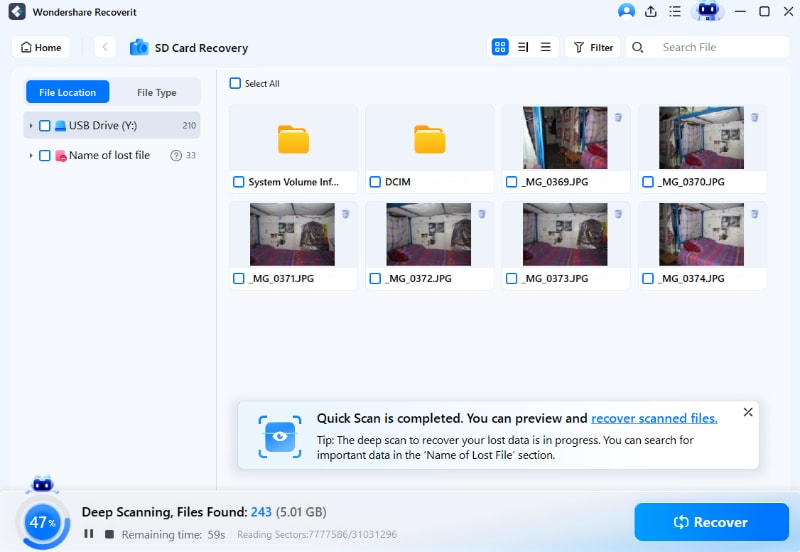
Step 4. Narrow the results by file type or other available filters.
If the card stored thousands of files, filter the scan results to the file types you actually need. Camera and creator workflows may include JPEG, HEIC, RAW photos, MP4, MOV, WAV, and project documents. Filtering helps you evaluate the important data before spending time on unrelated results.
Step 5. Preview representative files before recovery.
Preview several photos, videos, or documents from different folders and dates when the preview is available. A preview is useful evidence that Recoverit can read that file's content, but it does not guarantee that every file on the card is intact.
Step 6. Recover the selected files to a different healthy drive.
Click Recover and choose your computer drive or another external disk as the destination. Do not save the files back to the corrupted SD card. Writing recovered data to the source can overwrite other file content that has not yet been retrieved.
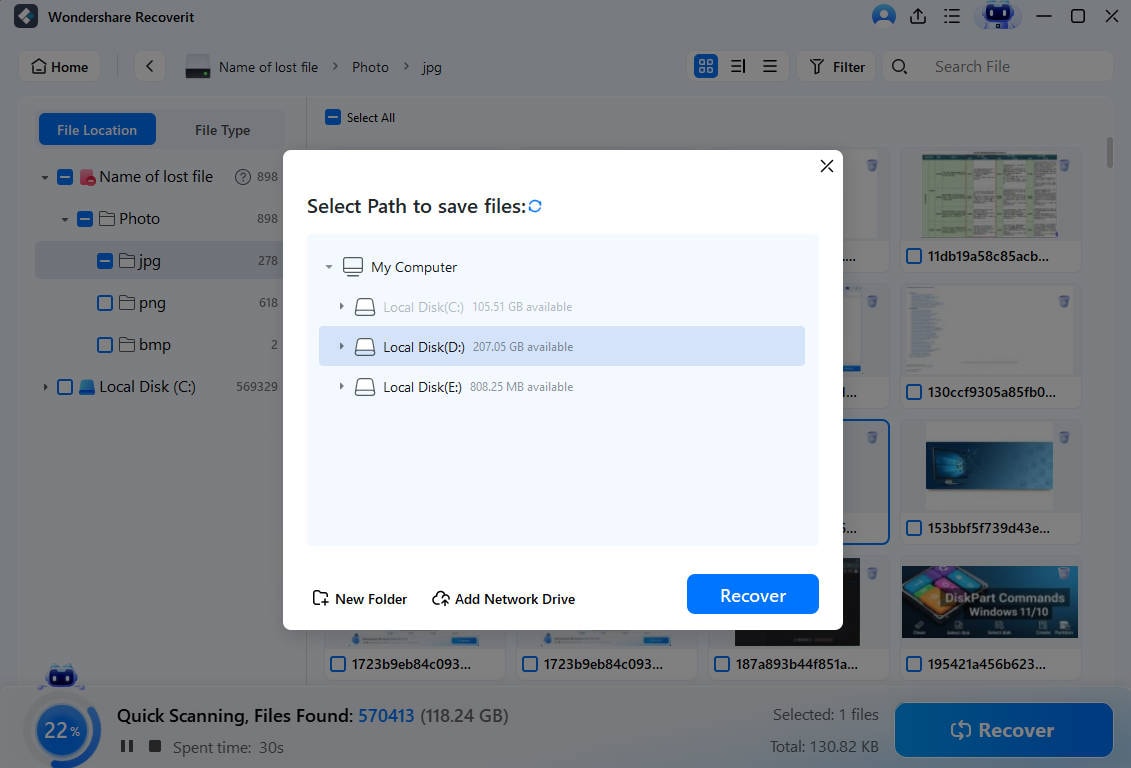
Step 7. Keep the source card unchanged until you verify the recovery.
Do not format or repair the card immediately after the scan finishes. First open representative recovered files and compare the result with what you expected to find. Part 5 explains what to verify before you decide the recovery is complete.
Recover Data From a Corrupted SD Card With Recoverit
 Security Verified. Over 7,302,189 people have downloaded it.
Part 3. Use Windows File Recovery as a Free Alternative
Windows File Recovery is Microsoft's command-line recovery app for Windows 11 and Windows 10. It can be useful if the corrupted SD card has a usable drive letter and you are comfortable working in Terminal. According to Microsoft's Windows File Recovery documentation, the source and destination drives must be different, and Extensive mode is the broad recovery option suitable for all file systems. Microsoft's mode guidance also places corrupted NTFS volumes and FAT/exFAT media in Extensive mode.
This method is less convenient than a graphical recovery tool because there is no Recoverit-style preview workflow before saving. It is also a poor fit if the SD card has no stable drive letter or disconnects during reads.
Step 1. Install Windows File Recovery from the Microsoft Store.
Install the app on the Windows computer, not on the corrupted SD card.
Step 2. Prepare a different destination drive.
If the SD card is E:, use another drive such as D: for the recovered data. Microsoft specifically requires source and destination to be different.
Step 3. Open Windows File Recovery and run Extensive mode.
For example, to search an SD card mounted as E: for common photos, videos, and documents and save them to D:, you can use:
winfr E: D: /extensive /n *.jpg /n *.jpeg /n *.png /n *.mp4 /n *.mov /n *.docx /n *.pdfConfirm the operation when prompted and let the recovery complete. Windows File Recovery creates a recovery folder on the destination drive.
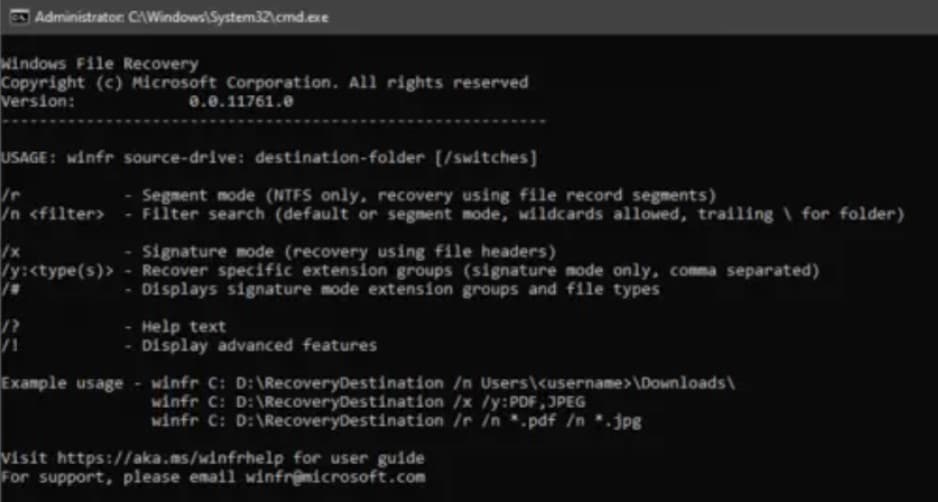
Step 4. Inspect the recovered files on the destination drive.
Do not run a file-system repair on the source card just because the command finishes. First confirm that the recovered set includes the files you need and that representative files open correctly.
Part 4. Use a Backup or Professional Recovery Service
Recovery software is not the only path. A clean backup can be safer than scanning the card, while unstable or physically damaged media may require a specialist.
Restore From an Existing Backup
Before doing another deep scan, check whether the missing files already exist elsewhere. Camera import folders, Lightroom or editing project folders, phone galleries, cloud backups, external drives, NAS storage, and earlier transfer folders may contain usable copies.
Copy the backup to a healthy destination. Do not restore the backup onto the corrupted SD card until the card has been tested, repaired or reformatted, and proven reliable enough for reuse. If you already have complete copies, you can skip recovery and move directly to the post-recovery repair decision in Part 6.
Know When to Stop DIY Recovery
Stop software scans and avoid repeated power cycles when any of these conditions apply:
- The card is bent, cracked, burned, wet, corroded, or visibly damaged.
- Multiple known-good readers and computers do not detect it at the operating-system level.
- The reported capacity is 0 bytes or far from the card's expected capacity.
- The card disconnects repeatedly, becomes unusually hot, or freezes the computer during reads.
- The files are irreplaceable and the device becomes less stable with each attempt.
These signs can indicate a problem beyond normal file-system corruption. Consumer software cannot repair a failed controller, broken contacts, or physically damaged NAND flash. In those cases, the safest next step is a professional data recovery lab rather than another repair command.
Part 5. Verify Recovered Files Before Repairing the Card
Recovery is not complete when files merely appear in a destination folder. Verify the result before you allow any tool to modify the source SD card.
| File Type | What to Verify | Why It Matters |
| Photos and RAW images | Open files from different dates, zoom in, and check whether thumbnails and full-resolution content both load. | A filename alone does not prove the image data is complete. |
| Videos | Play samples from the beginning, middle, and end; check audio and seeking. | Partially recovered video may open but fail later in the timeline. |
| Documents and archives | Open representative documents and test archives with their normal applications. | Directory recovery and file-content recovery are separate outcomes. |
| Whole recovery set | Compare important folders, dates, file counts, and approximate sizes with what you remember or with backups. | This helps identify missing groups before the source is repaired or reformatted. |
For irreplaceable data, make a second copy of the recovered files before changing the SD card. If a recovered file exists but will not open, treat that as a separate file-integrity problem. Data recovery retrieves file content from the storage device; it does not guarantee that a partially written or previously damaged file can be reconstructed perfectly.
Part 6. Repair or Reformat Only After Recovery
Once the important files are recovered, verified, and backed up, you can decide whether the SD card is worth repairing or reusing. Keep this phase separate from data recovery.
- For logical file-system errors on Windows: Use the dedicated fix corrupted SD card without formatting guide. Microsoft notes that CHKDSK with repair parameters changes file-system structures; on FAT file systems, repairs can change the file allocation table and can sometimes cause data loss. That is why it belongs after recovery, not before it.
- For a Mac-detected card: Apple's Disk Utility First Aid guidance says First Aid can check and repair formatting and directory-structure errors but cannot detect or repair every disk problem. Back up first.
- If the card must be reformatted: Back up everything first. The SD Association SD Memory Card Formatter is the standards body's formatting utility for SD-family cards. If a camera, drone, recorder, or other device has its own required in-device format workflow, follow the device maker's instructions after recovery.
- If errors return: Retire the card. A memory card that repeatedly corrupts, disconnects, or throws read errors should not be trusted with new irreplaceable data.
For broader error diagnosis after your files are safe, the Recoverit SD card error guide routes common format, read/write, recognition, and corruption errors to the appropriate fix without turning this recovery page into another repair tutorial.
Conclusion
To recover data from a corrupted SD card safely, protect the source first. Check whether the operating system detects the card, whether the capacity looks plausible, and whether the connection remains stable. A detectable, stable card with logical corruption is the best fit for Recoverit or, on Windows, Windows File Recovery. Save recovered files to another healthy drive and verify them before modifying the card.
If the card is physically damaged, undetected across multiple known-good readers, reports an implausible capacity, overheats, or repeatedly disconnects, stop DIY recovery. After successful recovery, repair or reformat only if you still need to reuse the card, and replace it if corruption returns.
FAQ
-
Can I recover data from a corrupted SD card?
Often, yes, when the SD card is still detected by the operating system and the storage can be read stably enough for a scan. Stop using the card, recover files to another drive, and avoid formatting or repair until the important files are verified. Recovery cannot be guaranteed if data has been overwritten or the card has physical failure. -
How do I recover files from a corrupted SD card that asks to be formatted?
Cancel the format prompt and stop writing to the card. If Windows or macOS still detects the card, use recovery software to scan it and save found files to a different drive. Format only after the files are recovered and checked. -
Can I recover data from a RAW SD card without formatting it?
Yes, a RAW volume can still contain recoverable files even though the operating system cannot mount the file system normally. Do not format it first. Recover the files to another drive, verify them, and repair or reformat the card only afterward. -
Should I run CHKDSK before recovering files from a corrupted SD card?
No when the files matter. CHKDSK repair parameters such as /f modify the file system, and Microsoft notes that FAT repairs can change the file allocation table and may sometimes cause data loss. Recover important files first, then use repair tools on the card. -
Can Windows File Recovery recover files from a corrupted SD card?
It can be an option when Windows assigns the SD card a stable drive letter. Use Extensive mode for a corrupted drive or FAT/exFAT media, and choose a destination drive that is different from the source. If the card has no stable drive letter or repeatedly disconnects, use another recovery path. -
What if my corrupted SD card is not detected anywhere?
Test one or two known-good readers, ports, or computers to rule out a connection problem. If the card remains undetected at the operating-system level, shows physical damage, reports 0 bytes, gets hot, or freezes the computer, stop repeated DIY scans and consider a professional data recovery service. -
Can I recover files from a corrupted microSD card?
Yes, the same recovery-first rules apply to microSD cards. Connect the microSD card through a reliable adapter or reader, confirm that the operating system detects it, scan it without writing to it, and save recovered files to another healthy drive. -
Can I save recovered files back to the same SD card?
No. Save recovered files to your computer or another healthy external drive. Writing recovered data back to the corrupted source can overwrite other data that has not yet been recovered.


