

 TL;DR:
Always run a read-only scan using chkdsk E: first to safely identify file-system errors on an SD card without altering data.
● Executing chkdsk E: /f modifies file-system metadata to fix logical FAT32, exFAT, or NTFS inconsistencies, requiring you to secure a verified backup or recover missing data beforehand to prevent permanent file loss.
● Avoid using chkdsk E: /r as your default repair command because its full-sector read process puts severe stress on unstable flash memory and should only be utilized after your data is completely safe.
● Windows will abort the scan if the SD card volume is RAW, lacks an assigned drive letter in Disk Management, or experiences repeated disconnections due to physical hardware wear.
Ask AI for a summary
 ChatGPT
 Perplexity
 Gemini
 Claude
 Grok
Grok
Quick Answer
● Check Only: Run chkdsk E: first, replacing E with the SD card's actual drive letter. This reports file-system errors without repairing them.
● Repair Logical Errors: After copying or recovering important files, run chkdsk E: /f. The /f option changes file-system metadata and is not lossless.
● Do Not Use CHKDSK: Stop if the card is RAW, unallocated, physically damaged, repeatedly disconnecting, or not detected with a drive letter. Recover data or address detection first.
● Avoid a Default /r Scan: /r includes /f and reads every sector. It is slower and more stressful for unstable flash media, so use it only after the data is safe and only for a specific reason.
In This Article
Part 1. Should You Run CHKDSK on the SD Card?
CHKDSK is a Windows file-system checker. On an SD or microSD card, it can inspect a mounted FAT32, exFAT, or NTFS volume and repair logical inconsistencies such as directory errors, cross-linked files, or allocation information that no longer matches the data in use. It does not repair cracked contacts, worn-out NAND flash, a failed controller, or a card that Windows cannot detect.
The safest decision depends on what Windows can still see and whether the files already have a verified copy. Use this table before entering any command.
| SD Card Condition | Can CHKDSK Help? | Safest First Action |
| The card opens and the files are backed up, but Windows reports file-system errors | Usually. Start with a read-only check, then use /f if errors are confirmed. |
Verify the backup and run chkdsk E:. |
| The card opens, but photos or videos are missing | Not as the first action. Repair may alter directory records that recovery software needs. | Stop writing and recover the missing files first. |
| Windows says the file system is RAW or the space is unallocated | No. CHKDSK normally reports that it is not available for RAW drives. | Recover data before formatting or rebuilding the partition. |
| The card appears in File Explorer with a drive letter but cannot be opened | Possibly, if the volume is stable and recognized as FAT32, exFAT, or NTFS. | Check Disk Management, protect the data, then run a read-only check. |
| The card has no drive letter or is absent from Disk Management | No. CHKDSK needs a volume that Windows can address. | Test another reader, adapter, USB port, and computer. Follow the SD card not reading guide if detection fails. |
| The card disconnects, shows 0 bytes, becomes hot, or causes I/O errors | Not safely. Repeated scans can worsen an unstable device. | Stop using it. Consider a sector image or a professional recovery service for irreplaceable data. |
Microsoft's current CHKDSK documentation makes an important distinction: the command without repair parameters reports status, while /f fixes errors and therefore writes to the volume. CHKDSK repair should never be described as a guaranteed “no data loss” operation.
What CHKDSK Can and Cannot Fix
| CHKDSK Can Address | CHKDSK Cannot Address |
| Logical FAT32, exFAT, or NTFS file-system inconsistencies | A card that is not detected by Windows |
| Invalid directory entries and some cross-linked files | Deleted-file recovery as a dedicated recovery tool would perform it |
| Lost allocation chains that Windows can identify | Physically damaged contacts, controller failure, or exhausted flash cells |
| Volume dirty-bit and allocation-table inconsistencies | A RAW or unallocated volume that has no readable file system |
Part 2. CHKDSK Commands for an SD Card
Replace E: in every example with the drive letter Windows assigns to your card. Confirm the letter in File Explorer before pressing Enter; running a repair command on the wrong volume can modify the wrong disk.
| Command | What It Does | When to Use It |
chkdsk E: |
Checks the file system and reports status without fixing detected errors. | Use this first when the volume is mounted and stable. |
chkdsk E: /f |
Repairs logical file-system errors and writes changes to the card. | Use after accessible files are copied and missing files are recovered. |
chkdsk E: /r |
Locates unreadable sectors, attempts to recover readable information, and includes /f. |
Reserve for a stable card when a full read is justified and the data is already safe. Do not use it as the default repair command. |
chkdsk E: /x /f |
Forces the volume to dismount and then repairs it. Open handles become invalid. | Use only if Windows cannot lock the volume, all apps are closed, and the data is protected. |
Two switches deserve special caution. /scan is an NTFS-only online scan and is not appropriate for the FAT32 or exFAT format used by most SD cards. /freeorphanedchains is available for FAT, FAT32, and exFAT, but it frees orphaned chains instead of preserving their contents. Do not use it when lost files still matter.
The card type does not determine the command by itself. According to the SD Association capacity and file-system standard, SDHC cards normally use FAT32, while SDXC and SDUC cards normally use exFAT. Windows CHKDSK can examine both when the volume is recognized and assigned a letter.
Part 3. How to Run CHKDSK on an SD Card
This procedure applies to Windows 11 and Windows 10. It begins with a non-repairing scan, so you can see the volume's state before choosing whether to modify it.
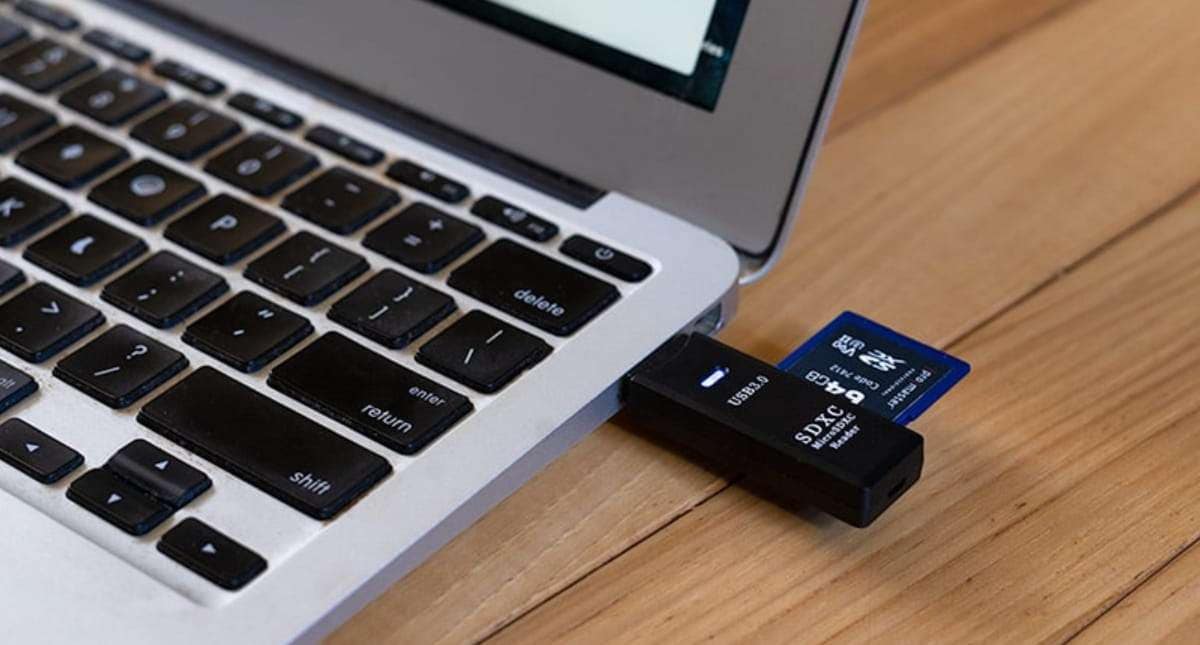
- Stop all writes to the card. End camera recording, file transfers, synchronization, and thumbnail-generation tasks. Insert the card through a stable built-in slot or a reliable USB reader. If you use a full-size SD adapter, inspect its lock switch.
- Protect the files before repair. Copy every file that still opens to another drive. If important files are missing or the copy fails, skip to Part 5 and recover them before running
/for/r. - Confirm the drive letter. Open File Explorer > This PC. Note the letter, label, and capacity of the SD card. In this example, the card is
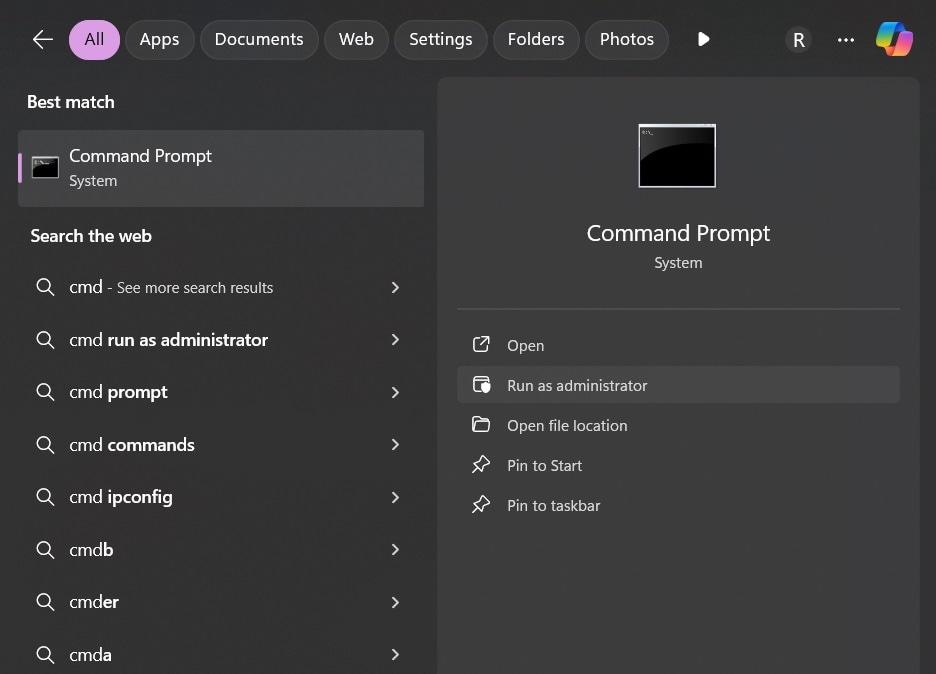
E:. - Open an elevated Command Prompt. Select Start, search for Command Prompt, and choose Run as administrator. Approve the User Account Control prompt.
- Run the read-only check first. Enter the following command and press Enter:
chkdsk E:
If Windows reports no problems, do not add repair switches just to be thorough. Check the reader, cable, device compatibility, and card health instead.
- Repair confirmed logical errors only after the data is safe. If the read-only result reports file-system errors, run:
chkdsk E: /f
- Let the operation finish. Do not eject the card, disconnect the reader, shut down Windows, or interrupt CHKDSK. The time required depends on capacity, connection speed, error count, and whether a surface scan was requested.
- Verify the result. Reopen the card, check representative photos and videos, and copy all important files to another disk. A successful CHKDSK run does not prove that the flash memory is healthy.
If CHKDSK repeatedly finds new errors, files become corrupt again, or the card disconnects during ordinary use, retire the card. A file-system repair can restore consistency, but it cannot reverse physical wear.
Part 4. What CHKDSK Results and Errors Mean
The final message determines the next step. Do not keep adding switches when Windows is telling you that the volume is unavailable, RAW, locked, or unstable.
| Message or Symptom | Meaning | Next Step |
| “Windows has scanned the file system and found no problems” | No logical errors were found in the mounted file system. | Test another reader or device. If problems persist, check the card's integrity after making a backup. |
| “Windows made corrections to the file system” | /f changed file-system records. |
Copy and verify the data immediately. Replace the card if errors return. |
| “Access denied as you do not have sufficient privileges” | The terminal is not elevated, or another process/security setting is blocking access. | Run Command Prompt as administrator, close apps using the card, and follow the CHKDSK access denied guide. |
| “The type of the file system is RAW. CHKDSK is not available for RAW drives” | Windows cannot identify a supported file system on the volume. | Stop. Do not format if the data matters. Use the CHKDSK RAW error guide or RAW SD card recovery guide. |
| “Cannot lock current drive” or “volume is in use” | An app has an open handle to the card. | Close File Explorer windows and media apps. Use /x /f only after protecting the data. |
| No media, 0 bytes, no drive letter, or repeated disconnects | The issue is below the mounted file-system layer. | Stop CHKDSK attempts. Test the reader and host; seek professional help for irreplaceable data. |
CHKDSK Exit Codes
For scripted checks, Microsoft documents four exit codes. They help distinguish a clean scan from an incomplete repair.
| Code | Meaning |
| 0 | No errors were found. |
| 1 | Errors were found and fixed. |
| 2 | Disk cleanup was performed, or cleanup was not performed because /f was not specified. |
| 3 | The disk could not be checked, errors could not be fixed, or errors were not fixed because /f was not specified. |
What Are FILE0000.CHK Files?
On FAT-family volumes, CHKDSK may find allocation chains that are no longer connected to a valid directory entry. If it offers to convert lost chains to files and you choose Yes, Windows can save them in the card's root as names such as FILE0000.CHK. These fragments may contain recoverable content, but the original name, extension, folder, or complete file structure may be missing. Preserve the card and the CHK files until you have verified every important recovery.
Part 5. How to Recover SD Card Files Before Repair
Use data recovery before CHKDSK when files have disappeared, the card requests formatting, or a repair command could change damaged directory records. Recoverit Memory Card Recovery is designed to scan a detectable SD or microSD card for deleted, formatted, or logically inaccessible files. It cannot repair physical hardware, and no software can guarantee recovery after overwriting.

Connect the card through a stable reader and save recovered files to a different healthy drive. Never install the software on, or recover files back to, the affected card.
- Select the SD card. Open Recoverit, choose SD Card or the matching removable device, verify its capacity, and start the scan.
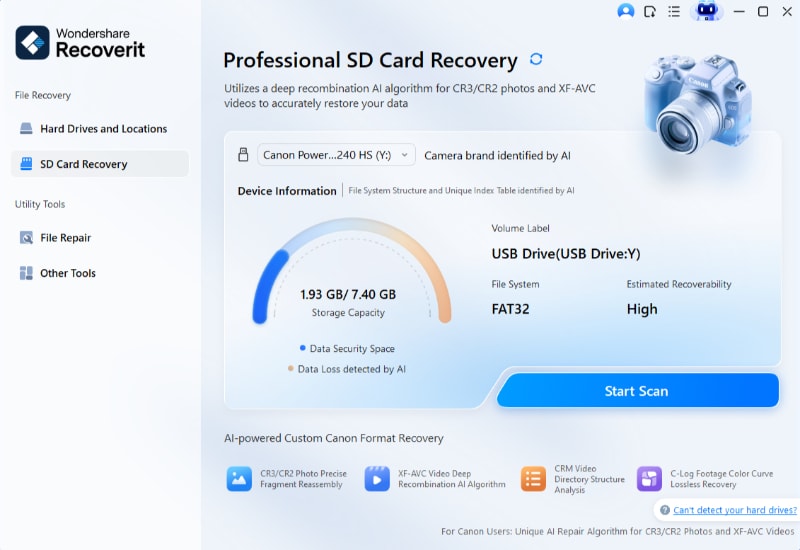
- Scan for the missing files. Let the scan continue while you filter by file type, location, size, or date. If the card starts disconnecting or making the system unstable, stop and reassess the hardware condition.
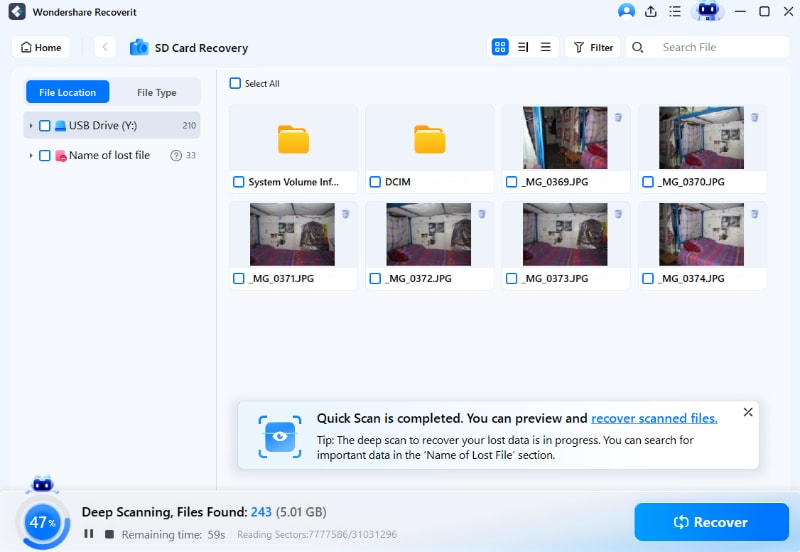
- Preview and recover to another disk. Preview representative files where supported, select the required items, click Recover, and choose a destination that is not the problem SD card.

Recover SD Card Files Before Repair
 Security Verified. Over 7,302,189 people have downloaded it.
After recovery, open a sample from every critical file type and compare counts against the original shoot or folder. Only proceed to CHKDSK, formatting, or a destructive integrity test after the recovered copy is verified.
Part 6. What to Do After CHKDSK
The command's completion is not the end of the diagnosis. Use the card's behavior after repair to decide whether it can be reused.
- If the card opens normally: Copy all files off immediately and verify them on another drive.
- If errors return: Replace the card. Recurring corruption after a clean format often indicates unreliable media, a faulty reader, unsafe removal, or a problematic host device.
- If the card is RAW: Recover the data first. Formatting is a reuse step, not a recovery step.
- If the card is stable and now empty: Format it in the device that will use it, or use the official SD Memory Card Formatter. Choose the file system required by the camera, phone, dash cam, or console.
- If you need to test capacity or write integrity: Perform the test only after recovery and backup because full write-verify tests overwrite free space or the entire card. The SD card health guide explains the difference between file-system checks and write verification.
How to Reduce Future SD Card Errors
- Stop recording and wait for the device's activity light to finish before removing the card.
- Use Eject or Safely Remove Hardware before unplugging a reader from Windows.
- Do not move one card repeatedly between cameras, phones, and computers with different format requirements.
- Keep at least two verified copies of irreplaceable photos and videos.
- Replace cards that produce recurring errors, speed drops, unexpected read-only behavior, or disconnections.
- Buy memory cards from reputable sellers and verify suspicious capacity claims before trusting the media.
Conclusion
The safest CHKDSK command for an SD card is the one that matches the card's actual condition. Begin with chkdsk E: to inspect a stable, mounted volume. If Windows confirms logical errors and the files are already protected, use chkdsk E: /f. Reserve /r for a justified full read after recovery, not as a routine first step.
CHKDSK is a file-system repair tool, not a deleted-file recovery tool or a cure for failed flash memory. When files are missing, the card is RAW, or the hardware is unstable, recover or image the data before making changes. That order preserves more recovery options and makes every later repair decision safer.
FAQ
-
What is the CHKDSK command for an SD card?
Usechkdsk E:for a read-only check, replacing E with the card's actual drive letter. After backing up or recovering important files, usechkdsk E: /fto repair confirmed logical file-system errors. -
Does CHKDSK delete files from an SD card?
It can change or remove damaged file-system records when a repair switch such as/fis used. CHKDSK may convert lost chains into CHK fragments, and severely damaged entries may lose their original names or folders. Protect important data first. -
Should I use CHKDSK /f or /r on an SD card?
Use/ffor confirmed logical errors after the data is safe./rincludes/fand reads every sector, so it takes longer and should not be the default for an unstable flash card. -
Can CHKDSK fix a RAW SD card?
No. Windows normally reports that CHKDSK is not available for RAW drives. Recover the data before formatting or rebuilding the volume. -
Can I run CHKDSK if the SD card has no drive letter?
No. CHKDSK needs a volume path or drive letter. If the card is absent from Disk Management, troubleshoot the reader, adapter, port, and card detection first. -
Why does CHKDSK say access is denied?
The Command Prompt may not be running as administrator, or another process may be using the card. Open an elevated Command Prompt, close apps and File Explorer windows that access the card, and check write protection. -
Can CHKDSK recover deleted photos or videos?
Not reliably. CHKDSK repairs file-system structures; it is not designed as a deleted-file recovery scanner. Stop writing to the card and recover missing files before using repair switches. -
Does CHKDSK work on a microSD card?
Yes, if Windows recognizes the microSD card through a reader or adapter, mounts a supported file system, and assigns a drive letter. The same commands apply.


