

 TL;DR:
To safely use a microSD card as internal storage on a supported Android phone, choose the Format another way or Format as internal option from the storage notification or settings, which permanently encrypts the card exclusively for that specific device to create room for movable apps.
● Adoptable storage is ideal for low-capacity phones needing space for supported applications, while portable storage is mandatory for Samsung Galaxy devices, which disable the feature entirely, or for users who frequently transfer media to a computer.
● An adopted card becomes unreadable to other devices and desktop data recovery software like Recoverit due to device-specific encryption, requiring you to migrate apps back to the built-in flash storage before safely removing or reformatting the card.
● App developers can still restrict their applications from being migrated to the SD card, and attempting to force the internal storage option using ADB commands on an unsupported phone will not bypass manufacturer limits and risks creating an unstable storage layout.
Ask AI for a summary
 ChatGPT
 Perplexity
 Gemini
 Claude
 Grok
Grok
Quick Answer: On a supported Android phone, insert the microSD card and tap the SD card detected notification. Choose Format another way, select internal or adoptable storage, confirm the erase warning, and then choose Move content or Move content later. If the card is already portable, the current Google path is Settings > Storage > SD card > Menu > Storage settings > Format > Format another way > Format.
The exact wording varies by manufacturer. Some phones show Format as internal; others do not support the feature at all. Do not use an ADB command to force the option when the manufacturer has disabled it. Forced adoption can leave the phone with an unsupported storage layout and does not change the manufacturer's performance or reliability limits.
In This Article
What Adoptable Storage Actually Does
Android calls this feature Adoptable Storage. It was introduced in Android 6.0, but it remains an optional device feature rather than a promise that every Android phone can use it. When a card is adopted, Android formats it with a system file system, encrypts it, and ties the encryption key to the phone that adopted it. The Android Open Source Project documentation confirms that an adopted card cannot be mounted on another device because its key remains on the original phone.
Adoption does not turn a microSD card into the same hardware as built-in flash storage. It adds capacity that Android may use for supported apps, app data, photos, videos, and files. The operating system remains on built-in storage, and app developers can prevent their apps from being moved.
| Capability | Portable Storage | Adoptable/Internal Storage |
| Store photos, videos, and documents | Yes | Yes |
| Store supported apps | No | Yes |
| Read the card in a computer or another phone | Yes, with a compatible file system | No |
| Card encryption | Not required by portable setup | Encrypted and tied to one phone |
| Safe to remove frequently | Yes, after ejecting | No; moved apps and data depend on it |
| Formatting required to switch modes | Yes | Yes |
If your goal is only to store photos, videos, downloads, or music, portable storage is usually the safer choice. Use the separate Android SD card formatting guide for that workflow.
Should You Use An SD Card As Internal Storage?
Adoptable Storage is most useful on a supported phone with limited built-in capacity when uninstalling apps or moving media is not enough. Its biggest benefit is space for movable apps; its biggest risks are lower performance, dependence on a removable card, and difficult recovery after encryption.
| Your Situation | Best Choice | Reason |
| Low-storage phone supports Adoptable Storage | Consider internal storage | It may create room for supported apps and their data. |
| You regularly move the card between devices | Portable storage | An adopted card is encrypted for one phone. |
| You mainly need more camera or media space | Portable storage | It preserves easy computer access and simpler backups. |
| The card is old, counterfeit, slow, or unreliable | Replace it first | App data needs consistent random read and write performance. |
| You use a Samsung Galaxy phone or tablet | Portable storage | Samsung officially states that Adoptable Storage is unavailable. |
| The phone contains irreplaceable work or family data | Use internal storage only with a current backup | Card failure can make moved content and apps unavailable. |
A card marked A1 or A2 is designed to meet minimum random and sequential performance requirements for application use. The SD Association's Application Performance Class specification explains those ratings. A2 reaches its intended performance only when both the card and host support A2 features, so check the phone's storage specifications before buying a card. A Class 10 marking alone describes sustained sequential writing and does not guarantee responsive app performance.
Before You Format The SD Card
Formatting is destructive. Complete these checks before tapping the final confirmation:
- Confirm feature support: Look for Format as internal, Use as phone storage, or Format another way in the phone's Storage settings. The phone manual is more reliable than a generic list of Android versions.
- Back up the card: Copy every file you can still open to a computer, another drive, or cloud storage. A verified SD card backup is safer than assuming cloud sync has completed.
- Check the card: Use a genuine card within the capacity supported by the phone. Repeated read errors, disconnections, or capacity mismatches are reasons to replace it, not adopt it.
- Protect power: Charge the phone and do not restart, remove the card, or open the SIM tray during formatting and migration.
- Leave built-in space available: Android still uses internal flash for the operating system, system apps, and some app data.
Stop before formatting if files are already missing. If the card is still portable and a computer can detect it, recover the missing files first. Once Android adopts and encrypts the card, desktop recovery software cannot decrypt it outside the original phone.
Method 1: Format A New SD Card As Internal Storage
This is the cleanest route when the phone supports Adoptable Storage and the microSD card is new or has already been backed up. The current Google Android Help instructions use the SD card notification.
- Insert the microSD card correctly. If the phone uses a combined SIM/microSD tray, power it off first unless the device manual explicitly supports hot insertion.
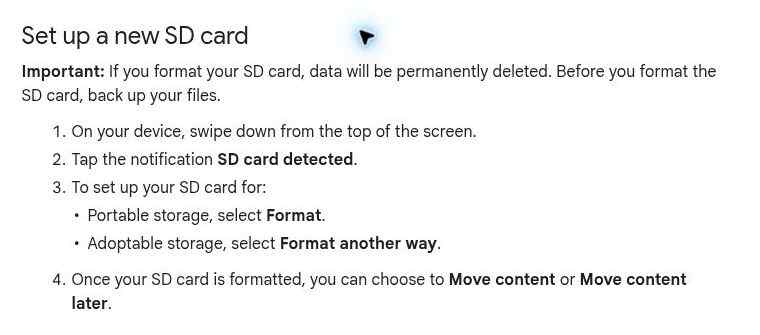
- Unlock the phone and swipe down from the top of the screen.
- Tap the SD card detected notification.
- Select Format another way for adoptable storage. On some supported phones, the equivalent option is Use as internal storage or Format as internal.
- Read the erase and encryption warning, then confirm the format.
- When Android finishes, choose Move content to migrate supported data now or Move content later to finish setup without immediate migration.
Do not remove the card when Android is testing its speed or migrating data. If the phone warns that the card is slow, cancel if possible and use a faster, reputable card. Continuing can cause longer app launches, delayed updates, and background-task failures.
Method 2: Convert Portable Storage To Internal Storage
Use this method only after copying all current files off the card. Conversion formats the card; it does not preserve the portable file system or its contents.
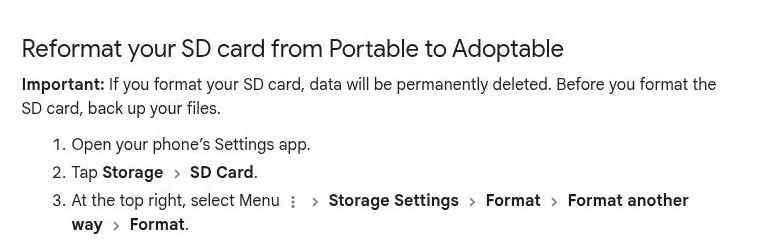
- Open Settings.
- Tap Storage, then select the SD card.
- Open the three-dot Menu and choose Storage settings.
- Tap Format, then Format another way. A manufacturer may instead show Format as internal.
- Tap Format and keep the phone powered until the operation completes.
- Choose whether to move content immediately.
If the menu shows only Format or Format as portable, do not assume a hidden internal-storage option exists. Check the phone manufacturer's support page for your exact model.
Method 3: Move Apps And Content To The Adopted Card
Choosing Move content after formatting lets Android migrate supported content. To move an individual app later, use the app's Storage page. Menu names vary, and the option is available only when the app developer and phone software allow it.
- Open Settings > Apps or Apps & notifications.
- Select the app you want to move.
- Tap Storage.
- Tap Change, select the SD card, and tap Move.
- Wait for the move to finish before opening the app or restarting the phone.
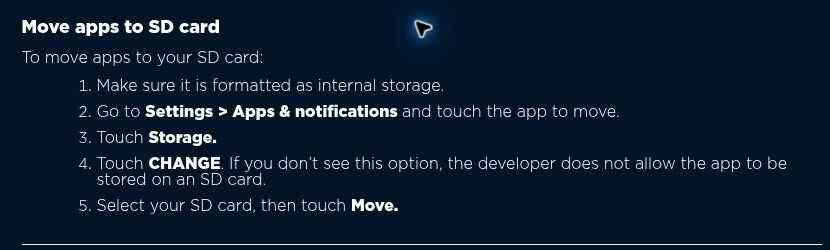
The current Motorola support instructions state that a missing Change button means the developer does not allow that app to be stored on the card. Android also keeps system components and many preinstalled apps on built-in storage. Adoptable Storage increases file and app capacity; it does not increase RAM.
Why The Format As Internal Option Is Missing
The most common reason is manufacturer policy, not a damaged card. Android provides the framework, but device makers decide whether to enable it.
| What You See | Likely Cause | What To Do |
| Only portable formatting on a Samsung device | Samsung disables Adoptable Storage | Use the card for media and files; do not force adoption. |
| No internal option on another Android phone | The manufacturer or model does not support it | Check the exact model manual and use portable storage if unsupported. |
| The SD card is absent from Storage | Insertion, tray, compatibility, or card failure | Power off, reseat the card, test a supported known-good card, and inspect the tray. |
| Formatting starts but fails | Unstable card, counterfeit capacity, low power, or file-system error | Stop using the card, copy readable files, and replace it if errors recur. |
| Work-profile or managed phone blocks changes | Administrator policy | Ask the device administrator; do not bypass the policy. |
Can Samsung Format An SD Card As Internal Storage?
No. Samsung's current support page states that Adoptable Storage is unavailable on Samsung devices. A Galaxy phone can format and use a microSD card as portable storage, and supported apps such as Camera or My Files can save media to it. That is not the same as adding the card to internal app storage.
Should You Force Adoptable Storage With ADB?
No for a normal consumer device. Commands circulated in older guides can expose hidden Android storage-manager functions, but they do not add manufacturer testing, device-specific support, or a safe migration path. They can erase the wrong disk, create an unsupported mixed partition, or leave apps unavailable after an update. ADB is a developer tool, not a reliable substitute for a missing Format as internal option.
Fix Common Adoptable Storage Problems
The Phone Became Slow After Formatting
Android benchmarks media during adoption and can warn when it is significantly slower than built-in storage. Back up the phone, move apps back to internal storage, return the card to portable mode, and replace it with a genuine application-rated card supported by the phone. Do not keep reinstalling or reformatting a card that disconnects or reports errors.
Internal Storage Still Looks Full
Adoption does not move the operating system, every app, every cache, or all private app data. Open Settings > Storage to see which categories still occupy built-in flash. Remove unused downloads, clear only disposable caches, uninstall unused apps, and move eligible apps individually. Do not clear an app's data unless you understand what will be deleted.
Apps Will Not Move To The SD Card
If Change is missing, the app developer or manufacturer has prevented migration. Banking, device-management, widget, accessibility, and system-dependent apps commonly remain internal because they need to be available before removable storage is mounted. There is no safe universal override.
Apps Disappeared After The Card Was Removed
Power off the phone, reinsert the same adopted card, and restart. If the card mounts, move important content and eligible apps back to the phone before any future removal. Motorola warns that removing adopted storage without moving apps first can make those apps inaccessible and degrade phone performance.
The Phone Says The Adopted Card Is Corrupted
Do not format immediately if the original phone can still mount the card. Copy or export accessible data from the phone first. Because the card is encrypted with a key stored on that phone, connecting it to a Windows or Mac computer normally shows an unreadable partition. A computer cannot reconstruct the missing Android encryption key.
If the card was still portable when the error started, follow the SD card error guide and recover important files before repair or formatting.
Method 4: Change The Card Back To Portable Storage
Reverting the card formats it again. First copy photos and documents elsewhere and move eligible apps back to built-in storage. Make sure the phone has enough free space for the move.
- Move apps back through Settings > Storage > SD card > Apps, or open each app's Storage page and choose Internal shared storage.
- Copy remaining files to cloud storage, a computer, or another drive while the card is still mounted in the original phone.
- Open Settings > Storage > SD card.
- Open the top-right Menu and tap Format.
- Choose Format card or the manufacturer's equivalent Format as portable option, then confirm.
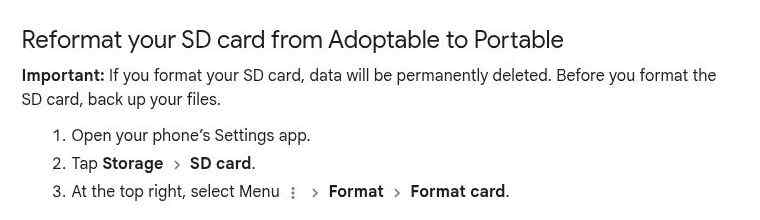
After the portable format, the card can be used in compatible devices again. It will be empty, so restore only the files you need from your backup.
Recover Files Before Formatting The Card

Wondershare Recoverit is relevant when the SD card is still portable, files were deleted, or the phone prompts you to format a card that a computer can detect. Connect the card through a reliable reader and avoid saving new data to it. This reduces the chance that deleted file records will be overwritten.
Important limitation: Recoverit does not decrypt Adoptable Storage and does not recover files from a phone's built-in storage. If Android already adopted the card, keep it in the original phone and export whatever the phone can still access. If the original phone and its encryption key are unavailable, desktop scanning cannot turn the encrypted sectors back into files.
Step 1: Select The Portable SD Card
Install Recoverit on a Windows PC or Mac, connect the card through a reader, open SD Card, and select the detected card. Confirm the capacity and device name so you do not scan the wrong drive.
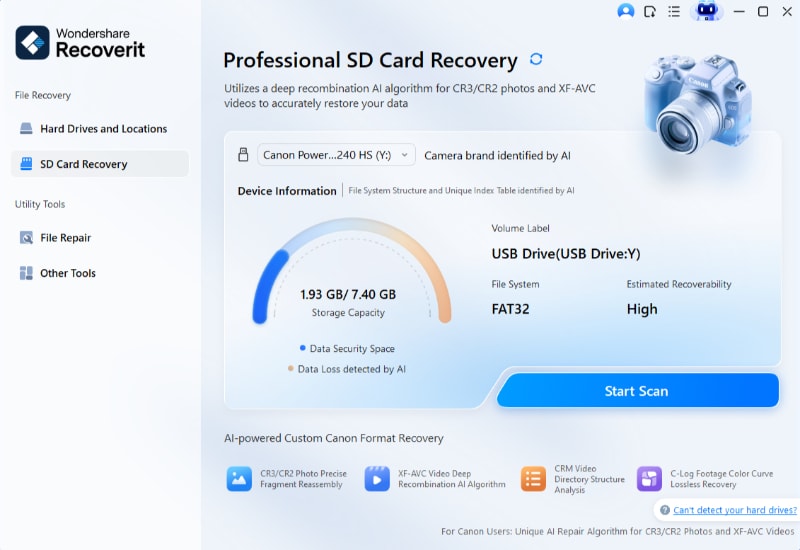
Step 2: Scan Without Writing To The Card
Start the scan and let Recoverit search the card. Use file type, size, date, and path filters to narrow a large result set. Do not copy new files to the source card while scanning.
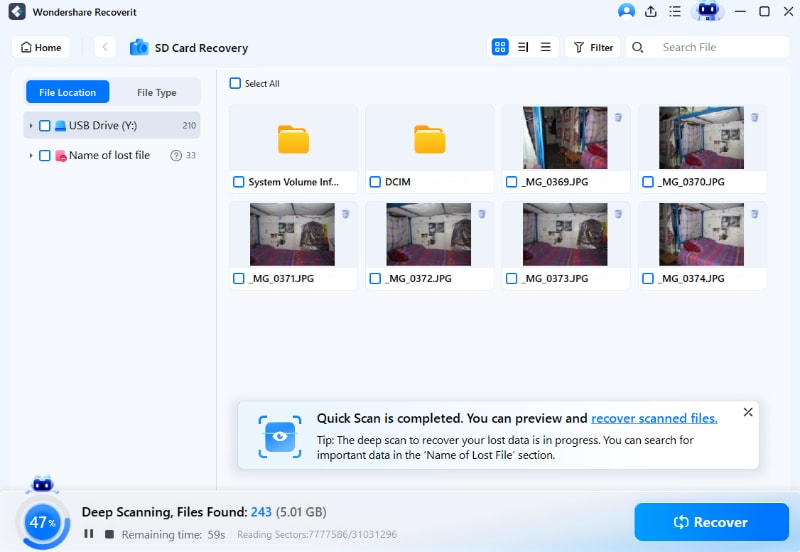
Step 3: Preview And Recover To Another Drive
Preview supported photos, videos, and documents, select the files you need, and save them to the computer or another external drive. Never recover them back to the same SD card before the recovery is complete. See the full memory card recovery workflow or the guide to recover files from a formatted SD card for additional cases.

Conclusion
To format an SD card as internal storage safely, first confirm that the exact phone supports Adoptable Storage, back up or recover the card, and use the option exposed by Android's Storage settings. Adoption is best for a supported low-capacity phone that will keep a reliable card installed permanently. Portable storage is better when you need easy computer access, frequent removal, or compatibility with Samsung devices.
The decisive trade-off is encryption: adoption may add room for supported apps, but it binds the card to one phone and makes off-device recovery impractical. Choose the mode based on how the card will be used, not only on the amount of space shown in Settings.
FAQ
-
Why Can't I Format My SD Card As Internal Storage?
Your phone manufacturer may have disabled Adoptable Storage, the model may support portable storage only, or the card may not be detected correctly. If the Storage menu does not show Format as internal or Format another way, check the exact model manual and use portable storage. Do not force the feature with ADB. -
Can I Format An SD Card As Internal Storage On Samsung?
No. Samsung officially states that Adoptable Storage is unavailable on its phones and tablets. You can use a compatible microSD card as portable storage for photos, videos, music, and documents. -
Does Formatting An SD Card As Internal Storage Erase It?
Yes. Android permanently deletes the card's existing content, creates a new file-system layout, and encrypts the adopted storage. Back up or recover important files before confirming the format. -
Will An SD Card Make My Phone Faster?
No. Adoptable Storage adds capacity; it is not a performance upgrade. A microSD card is often slower than built-in flash, and Android may warn about a slow card during setup. -
Which MicroSD Card Is Best For Internal Storage?
Use a genuine card whose capacity is supported by the phone. An A1 or A2 Application Performance Class rating is more relevant to app workloads than a Class 10 label alone. A2 benefits require an A2-compatible host. -
Can I Remove An SD Card Formatted As Internal Storage?
Not safely during normal use. Moved apps and data depend on the card. Move apps and files back to the phone, eject it, and reformat it as portable before using it elsewhere. -
Can A Computer Read An Adopted SD Card?
Normally no. Android encrypts adopted storage and keeps the key on the phone that adopted it. A computer may detect partitions but cannot mount the protected contents as ordinary files. -
Why Won't Some Apps Move To The SD Card?
The app developer or phone manufacturer can prevent migration. If the app's Storage screen has no Change option, keep that app on built-in storage. -
Can I Undo Adoptable Storage Without Losing Data?
You can move accessible files and eligible apps back to the phone first, but changing the card to portable storage still requires formatting and erases the card. Maintain a separate backup before switching modes. -
Can Recoverit Recover An SD Card Formatted As Internal Storage?
Recoverit can scan a card that is still portable and readable by a computer. It cannot bypass Android encryption on an adopted card. If the original phone still mounts the adopted card, export accessible data from that phone before taking further action. -
Does Formatting An SD Card As Internal Storage Increase RAM?
No. Storage and RAM are different resources. Adoptable Storage may add space for supported apps and files, but it does not increase the phone's working memory.


