

 TL;DR:
To resolve sluggish transfer speeds and hidden junk files without data loss, utilize OS-specific tools like Clean My Drive for macOS, SD Maid for Android, or Super Cleaner for Windows, but perform a full OS-level format if the card becomes virus-infected, unmountable, or displays as RAW.
● macOS users should select Clean My Drive for automatic .DS_Store removal upon safe eject or the paid Blue Harvest for continuous background metadata scrubbing, while Android users require SD Maid (Android 6.0+) to target deep orphaned app data or Files By Google (Android 5.0+) for basic one-tap cache clearing.
● Software cleaners cannot bypass malware, controller locks, or file-system allocation table corruption; these symptoms require a full format via macOS Disk Utility, Windows File Explorer, or Android Settings to restore drive functionality.
● If a quick format or cleaner accidentally deletes critical files, Wondershare Recoverit can salvage the pre-format data directly from the recoverable sectors, provided the storage has not undergone SSD-style TRIM wear-leveling or the SD Association's Overwrite Format.
Ask AI for a summary
 ChatGPT
 Perplexity
 Gemini
 Claude
 Grok
Grok
Quick answer: Use Clean My Drive on macOS to strip .DS_Store and Spotlight metadata, SD Maid or Files By Google on Android to remove thumbnail caches and orphaned app data, and Super Cleaner on Windows for one-tap temporary-file cleanup. If a card is virus-infected, write-protected, or RAW, a full format through Windows File Explorer, macOS Disk Utility, or Android Settings is safer than cleaning.
SD cards slow down because the same files keep being read, written, and re-cached on the same flash cells. The SD Association explains that consumer cards have no public write-cycle counter, so wear builds silently and a card that “still has plenty of space” can feel sluggish, transfer at 1 MB/s instead of 90 MB/s, or refuse to mount entirely.
This guide covers what SD card cleaners actually remove, when to clean versus when to format, the five best cleaners across Windows, Mac, and Android, and what to do if a clean or format accidentally erases important files.
In This Article
Part 1. Why You Need an SD Card Cleaner
An SD card cleaner is a utility that scans a card for platform-specific junk files (thumbnail caches, hidden metadata folders, uninstalled-app leftovers, or temporary copies) and removes only those files. It is a file-level cleanup, not a full format, so a working card keeps its data and only the bloat is gone.
What an SD Card Cleaner Does
Different platforms create different junk on a shared SD card. A single card swapped between a Mac, an Android phone, and a Windows PC soon carries files from all three operating systems. The confusion shows up as slow transfers, “you need to format this disk” warnings, or folders full of files that Windows cannot read.
| Junk file or folder | Source platform | Effect on a card shared with other devices | Best tool to remove it |
.DS_Store |
macOS Finder | Caches per-folder view settings; causes directory-reading delays on Windows and many cameras | Clean My Drive / Blue Harvest |
._AppleDouble and other ._* files |
macOS resource forks | Read as “corrupted” or “unrecognizable” on Windows, Linux, and most camera firmware | Blue Harvest |
.thumbnails folder |
Android | Grows as apps render preview images; eats space on cards used mainly for photos | SD Maid / Files By Google |
System Volume Information |
Windows | Holds indexing data for the drive; can block safe-eject cycles on card readers | Super Cleaner |
| Orphaned app data | Apps uninstalled without clearing their off-card folders | Dead files no app references; SD Maid’s Corpsefinder module catches these | SD Maid |
These files are small individually but accumulate over weeks of card sharing. A dedicated cleaner finds them all and removes only what is safe, while leaving untouched the actual photos, videos, and documents.
When to Clean, and When to Format
A cleaner is the right tool when the card still mounts and your files are still readable. A format is the right tool when the card no longer mounts cleanly, carries a virus, shows as RAW in Disk Management, or has a write-protection error that will not clear.
| Symptom | Likely cause | Recommended action |
| Card transfers run slowly | Fragmented cache files and metadata | Run a cleaner first; avoid full format |
| Files show broken names | Cross-platform metadata interference | Strip ._* and .DS_Store with Clean My Drive or Blue Harvest |
| “SD card is write protected” | Controller lock from bad logical sectors | Toggle the physical lock switch; format only if the lock does not clear |
| Drive shows RAW in Disk Management | File-system allocation table corruption | Back up first, then full format; if files matter, run a deep recovery scan before formatting |
| Card carries a virus | Malware-infected files | No cleaner resolves it; full format is the only safe option |
If the card is already failing, format only after a backup or after a recovery scan. Cleaning a card that is about to die can strip the last readable sectors and make recovery harder later.
Part 2. 5 Best SD Card Cleaners for 2026
Five cleaners cover the mainstream mix of Windows, macOS, and Android users. Each is the leading tool in its category on a real-world workflow, not a feature-count comparison.
Clean My Drive (macOS)
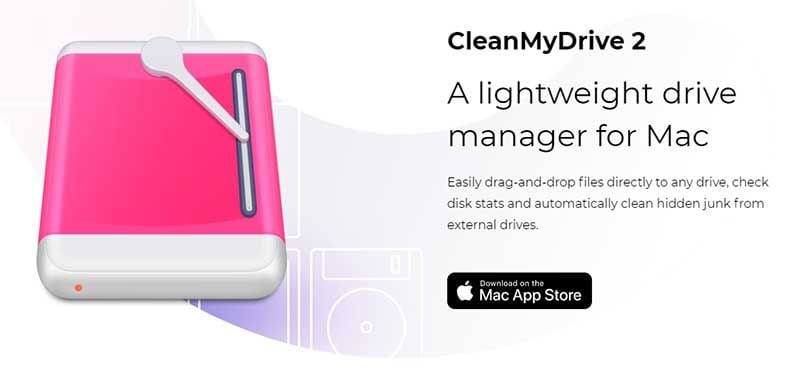
Clean My Drive by MacPaw is a menu-bar utility that detects external drives and SD cards as soon as they mount, then cleans them on safe eject. It is the most common choice for creative teams moving cards between Mac editing bays and Windows render nodes.
- What it cleans:
.DS_Store,.Spotlight-V100,.Trashes,.fseventsd, and other macOS metadata folders. - How it triggers: Auto-clean on safe eject, on demand, or on schedule.
- Where it runs: macOS only.
- Pros: Small footprint, set-and-forget automation, clear storage readouts in the menu bar.
- Cons: No deep internal drive scan; macOS only.
SD Maid (Android)
SD Maid is the most thorough Android cache cleaner because of its Corpsefinder module. Corpsefinder compares every folder on the card against what your installed apps actually use and flags dead data left behind by uninstalled apps.
- What it cleans: App caches, thumbnail folders, orphaned app data, duplicate files, empty directories across SAF and rooted access.
- How it triggers: Scheduled scans, manual full scan, or one-tap quick clean.
- Where it runs: Android 6.0 and newer; deep cleaning needs root.
- Pros: Catches files other cleaners miss; works without a PC.
- Cons: Root-only for the deepest modules; the interface can be busy for casual users.

Files By Google (Android)
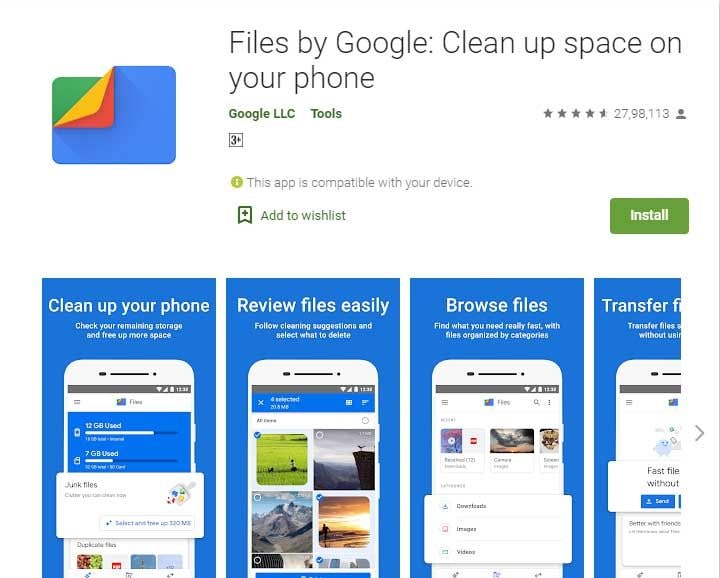
Files By Google combines a file manager with a cleaning hub. It is often preinstalled on Android 9+ devices and is the safest choice when a casual user wants a one-tap cleanup without granting extra permissions.
- What it cleans: Junk app cache, duplicate media, large files, unused downloads, recently shared through cached copies.
- How it triggers: One-tap “Clean” button, scheduled weekly clean, prompted when storage hits a threshold.
- Where it runs: Android 5.0 and newer.
- Pros: Free, no ads, integrated cloud offload to Google Drive, beginner-friendly.
- Cons: Treats internal and SD storage as one pool, so targeted SD-only cleaning is harder.
Super Cleaner (Windows)
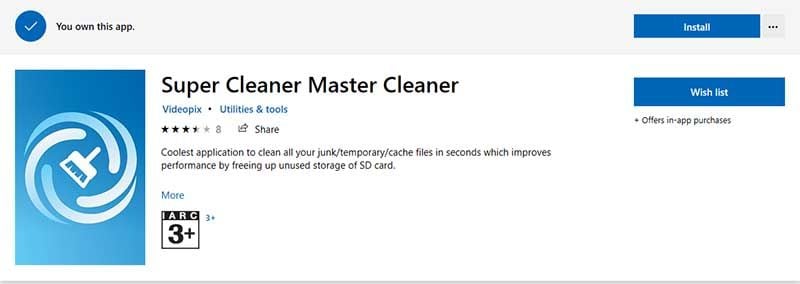
Super Cleaner from the Microsoft Store is the simplest one-tap scan-and-clear option for Windows 11/10 users who do not want to install a heavy antivirus or full system utility.
- What it cleans: System Temp folders, browser caches, thumbnail caches, recycle bin contents, and the contents of any removable drive the user selects.
- How it triggers: One-tap “Scan” + “Clean,” no scheduling by default.
- Where it runs: Windows 10 (1809+) and Windows 11.
- Pros: Recognises SD cards as removable drives; clean and minimal interface.
- Cons: No auto-clean on eject; bundled prompt-screen offers in the free version.
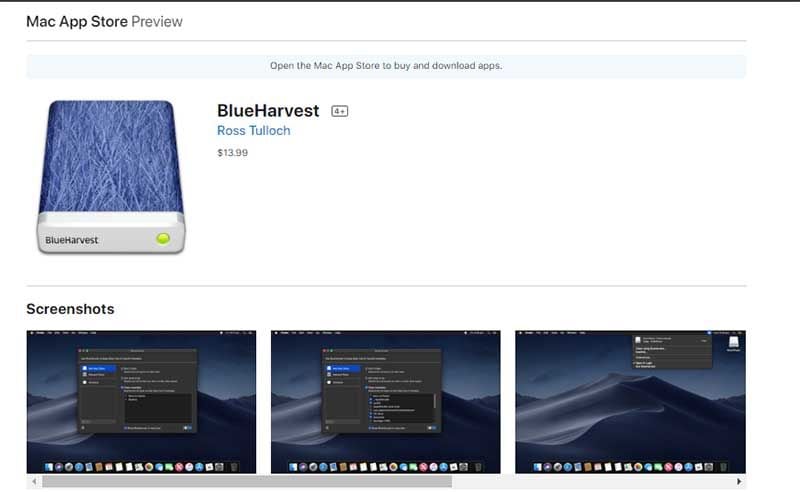
Blue Harvest (macOS)
Blue Harvest focuses on a narrow job: removing every Apple metadata artifact from non-Apple-formatted volumes. If your SD card is shared with Windows or Linux render farms, Blu-ray authoring rigs, or pro cameras, Blue Harvest is the only tool that scrubs .AppleDouble and ._* files reliably and continuously.
- What it cleans:
.AppleDouble,.DS_Store, all._*resource forks, and Spotlight indexes. - How it triggers: Live background monitor, not one-time scans.
- Where it runs: macOS only.
- Pros: Most thorough Apple-metadata scrubber; works silently in the background.
- Cons: macOS only; paid (no free tier); no general-purpose cleanup features.
Part 3. How to Format an SD Card When Cleaners Cannot Fix It
When a card carries a virus, shows as RAW, or refuses safe eject, cleaning will not help. A full format is the only safe option, and the right tool depends on which operating system you have in front of you.
Format an SD Card on Windows 11/10
Windows File Explorer’s Format dialog is the fastest path. Windows also ships the official SD Memory Card Formatter from the SD Association, which writes a card with optimal block alignment that File Explorer’s format does not always produce.
Step 1. Insert the SD card through a powered USB card reader. Press Win + E to open File Explorer, then navigate to This PC and locate the card under Devices and Drives.
Step 2. Right-click the card and choose Format. Under File system, pick exFAT for cards larger than 32 GB and FAT32 for smaller cards. Keep Quick Format selected unless the card is documented as failing.
Step 3. Click Start. Read the data-loss warning and confirm. Windows writes the new file system and reports “Format Complete.”
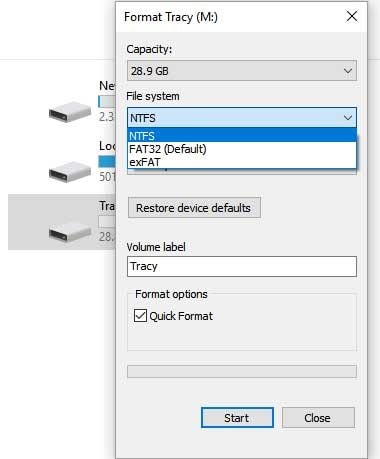
If the card is acting up after a basic format, run the official SD Card Formatter from sdcard.org instead and choose the “Overwrite Format” option. That command writes fresh block alignment across the entire card.
Erase an SD Card on macOS
macOS Disk Utility provides two erase options: a fast format and a multi-pass secure erase. Most cleaning tasks need only the fast erase.
Step 1. Insert the SD card through a compatible USB-C adapter. Press Cmd + Space, type Disk Utility, and open it.
Step 2. In the menu bar, click View > Show All Devices. The external card now shows in the left sidebar with a parent drive entry and a child volume.
Step 3. Select the parent drive row (not just the volume) and click Erase in the top toolbar. Set Name, Format to ExFAT (or MS-DOS (FAT) for cards ≤ 32 GB), Scheme to GUID Partition Map, and click Erase.
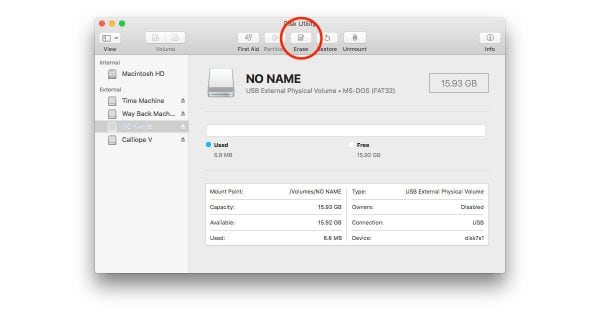
For cards that previously stored sensitive files, switch to Security Options > 3-pass Secure Erase before clicking Erase. Apple documents the steps in its Disk Utility user guide.
Format an SD Card on Android
Android ships a system formatter that works without root and preserves the card as a portable volume.
Step 1. Open Settings and tap Storage. Under Portable storage, tap your card’s name.
Step 2. Tap the three-dot menu in the upper right corner and choose Storage settings, then Format.
Step 3. Read the system warning that all data will be erased and tap Format SD card to confirm.
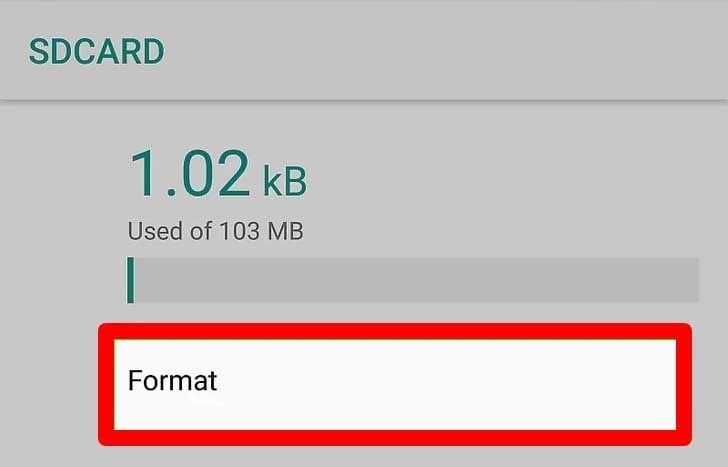
On older Android versions (10 and earlier) the path is Settings > Storage > SD card > Format. Android documents the procedure on the Android Help Center.
Part 4. Recover Lost Data If Cleaning or Formatting Erased Important Files
Cleaning wrongly classified a file, a format wiped more than expected, or a card failed before the clean finished. In each case, the next move is a deep recovery scan on a separate drive.
Recommended Tool: Wondershare Recoverit
Wondershare Recoverit scans a card that the OS still detects (even if it shows as RAW or “not formatted”) and locates files that were written to storage before the clean or format. It supports photo, video, document, and audio formats on SD, microSD, SDHC, and SDXC cards.
- Recovery source: Mounted SD card, USB card reader, SD-to-USB adapter on Windows or Mac.
- Recovery scope: Office documents, PDF, photo RAW, video MP4/MOV/AVI, audio WAV/MP3, archive, plus thousands of other formats.
- Preview & filter: File path and file type filters narrow scan results, and supported files open in a preview before recovery.
- Recovery destination: A separate drive, not back onto the source card.
What Recoverit Can Recover
- Files wiped by an SD card cleaner that mis-flagged them.
- Files erased by a Windows, macOS, or Android full format.
- Photos and videos from a card that shows RAW in Disk Management.
- Documents still present in recoverable sectors when the file allocation table was overwritten.
- Files recovered through SD Card Association Formatter’s “Overwrite Format” are not recoverable, but pre-format files can still come back if they were never TRIMmed.
How to Recover Files From an SD Card
The screenshots below are from the official Wondershare Recoverit SD card recovery workflow.
Step 1. Select the SD card. Install Recoverit on a healthy drive, launch it, and choose the SD card under Hard Drives and Locations.
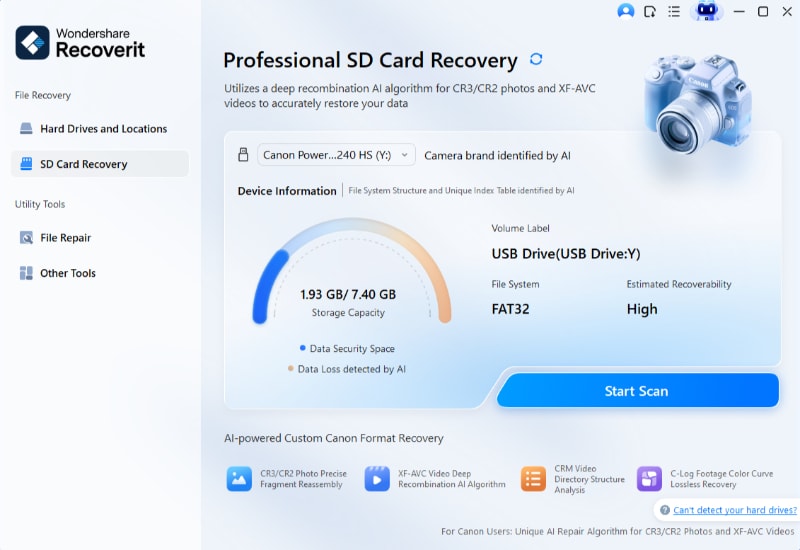
Step 2. Scan the card. Click Scan to begin a deep read. Recoverit supports Pause and Resume, so you can stop the scan to preview early results without losing what has already been read.
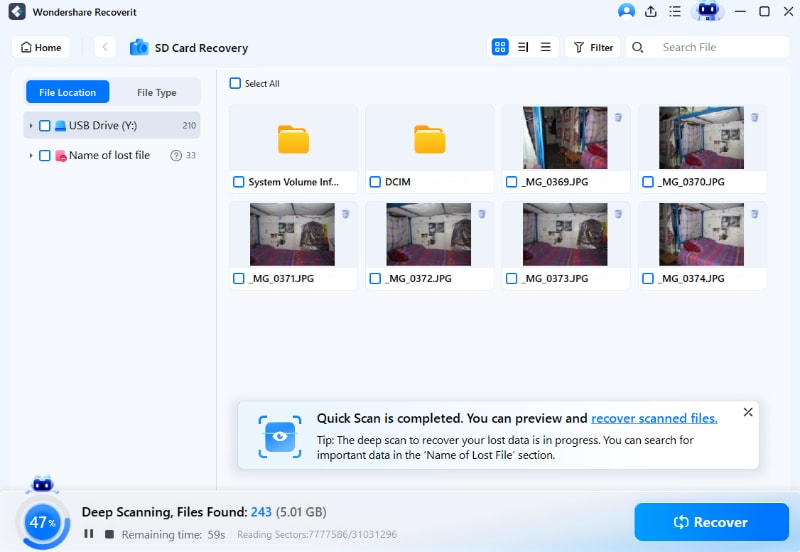
Step 3. Preview and save. Preview any supported file in the scan results. Select the files you want, click Recover, and save them to a separate drive. Open and verify the recovered copies before deleting the current ones.

Recover Files From an SD Card
 Security Verified. Over 7,302,189 people have downloaded it.
What Recoverit Cannot Restore
- Files never written to storage: Anything that existed only in memory when the card was removed.
- Overwritten or TRIMmed data: SSD-style TRIM and SSD wear-leveling can erase the original sectors a recovery scan would have read.
- Physically inaccessible storage: Software cannot scan a card the OS cannot detect.
- Crypto-locked encrypted data: Recovery does not bypass device or app-level encryption without the unlock key.
Part 5. SD Card Cleaner Comparison
Choose by OS first, then by depth. The cheap, fast, narrow cleaners (Blue Harvest) and the broad, free Android ones (Files By Google) sit at opposite corners.
| Tool | Platform | Price | Best for | Auto-clean on eject | Depth |
| Clean My Drive | macOS | Free + paid tiers | Mac users who shuttle cards to Windows | Yes | Apple metadata only |
| SD Maid (Corpsefinder) | Android | Free + paid tiers | Deep orphaned app data on cards | Scheduled | App caches + orphans + duplicates |
| Files By Google | Android | Free | Beginners wanting a one-tap clean | Scheduled + prompted | Cache + duplicate media + large files |
| Super Cleaner | Windows 11/10 | Free (Microsoft Store) | Windows users wanting a minimal tool | No | System Temp + drives + Recycle Bin |
| Blue Harvest | macOS | Paid | Pro photographers and post houses | Live background monitor | All Apple metadata, recursive |
Detailed side-by-side reviews of broader backup and recovery utilities live in our free cloning software comparison, and the official SD Memory Card Formatter is the standard recovery path when a card needs a low-level overwrite.
Part 6. Post-Cleanup Checklist
- Confirm file system matches the target device. exFAT for modern cameras, drones, and Windows/Mac; FAT32 for older gear (32 GB cap); NTFS only when the card stays on Windows.
- Spot-check a small folder of files. Open a few photos and documents to confirm the clean did not remove anything important.
- Format once more in the destination device. Cameras and drones read cards faster after a device-side format because the camera writes its own block alignment.
- Stop the host’s background indexer on removable drives. Windows Search indexer and macOS Spotlight re-fill
System Volume Informationand.Spotlight-V100respectively, undoing part of the clean in days. - Back up the card before the next clean or format. A copy on an external SSD or NAS means the next cleaner mishap is recoverable without paying for a deep-scan tool.
Conclusion
The right SD card cleaner depends on which operating system created the junk. Use Clean My Drive or Blue Harvest on macOS to remove Apple metadata, SD Maid or Files By Google on Android to clear orphaned app data and thumbnail caches, and Super Cleaner on Windows for one-tap temporary-file cleanup. When the card is virus-infected, shows as RAW, or refuses safe eject, a full format via Windows File Explorer, macOS Disk Utility, or Android Settings is safer than any cleaner.
If a clean or format accidentally removes something important, run Wondershare Recoverit against the card before its sectors are TRIMmed. The deep scan reads sectors below the file-system layer and recovers photo, video, document, and audio files that a clean or a quick format would otherwise make disappear for good.
FAQ
-
What is the best SD card cleaner for Windows 11?
Super Cleaner from the Microsoft Store is the simplest one-tap option for removing Temp folders and thumbnail caches on a drive. For broader coverage of system caches and removable media, run Windows Disk Cleanup (cleanmgr) as administrator and select the removable drive; for cases where the card is failing, use the official SD Memory Card Formatter from sdcard.org instead of a cleaner. -
What is the best SD card cleaner for Android?
SD Maid is the most thorough Android cleaner because of its Corpsefinder module, which finds data left behind by uninstalled apps even after the apps themselves are gone. Files By Google is the easiest one-tap option for casual users. -
What is the best SD card cleaner for Mac?
Clean My Drive offers the simplest set-and-forget cleaning of.DS_Storeand macOS metadata on every eject, while Blue Harvest is the most thorough scrubber for creators who share cards with Windows or Linux post-production rigs. -
Can a cleaner remove a virus from an SD card?
No. No cleaner resolves virus-induced corruption. The only safe option for an infected card is a full format through Windows Explorer, macOS Disk Utility, or Android Settings, then a fresh restore of the data from a verified backup. -
Will cleaning an SD card delete my photos?
A correctly configured cleaner removes only junk files (thumbnail caches,.DS_Store,._*resource forks, orphaned app data) and never touches photo or video files. If you are unsure, back up the card first using your computer’s file manager before running any cleaner. -
What is the difference between cleaning and formatting an SD card?
Cleaning removes individual junk files while keeping everything else in place; formatting rewrites the entire file system and erases every file. Cleaning is the right response to a slow card with readable files; formatting is the right response to a virus, a RAW error, or a card that will not mount. -
How often should I clean my SD card?
For cards that move between Mac, Windows, and Android, a monthly clean keeps Apple and Windows metadata from piling up. Cards that stay in one device rarely need cleaning; a quarterly format in the host device is enough. -
My SD card is not recognized after cleaning. What should I do?
Remove the card safely, blow out the contacts, and try a different USB port or reader. If Windows or macOS still does not detect it, the card is failing at the controller level rather than at the file level, and a deep scan with Wondershare Recoverit may still rescue files before the card is replaced.


