
Aug 18, 2026 • Filed to: SD Card Solutions • Proven solutions
 TL;DR:
Stop recording and recover your missing footage using a data recovery tool before confirming any formatting prompts or running repairs, as these actions clear the visible file system and prevent successful file extraction.
● Upgrade to a microSD card rated A2 V30, UHS-3, or higher for cameras like the HERO13 Black, because generic Class 10 cards are too slow for high-bitrate modes and directly cause unexpected recording stops.
● Run Windows CHKDSK only as a final repair step on the SD card after securing your files, since Microsoft notes that FAT file system repairs alter the file allocation table and cause further data loss.
● Select the Enhanced Video Recovery option in tools like Recoverit to successfully reconstruct large, fragmented 4K MP4 files, ensuring you restore the original footage rather than low-resolution LRV previews.
Ask AI for a summary
 ChatGPT
 Perplexity
 Gemini
 Claude
 Grok
Grok
A GoPro SD card error can mean a seating problem, an incompatible card, a write-protect lock, a file system problem, or actual data loss. The first job is to protect the footage, not to format the card immediately.
If the files still matter, stop recording, power off the camera, remove the card only after the camera is off, and cancel any Windows format prompt. Copy visible files first. If the card looks empty, unreadable, RAW, or recently formatted, scan it with data recovery software before CHKDSK or a full format.
| GoPro SD Card Scenario | Try First | Use Recovery Software When | Avoid |
| Only this GoPro shows an error | Reseat the card, try another official-recommended card in the same camera, and update or restart the camera. | The original card later looks empty, RAW, or unreadable on a computer. | Formatting the original card before checking whether another card works in the same GoPro. |
| Another camera or computer also fails | Treat the card as the problem. Copy any visible files, then scan the card. | Folders are missing, the card asks to format, or files cannot be copied. | Assuming the card is empty just because Windows or GoPro cannot display the files. |
| Files are already missing | Stop using the card and connect it with a reliable card reader. | The card is still detected by Windows, macOS, or recovery software. | Recording new footage or saving recovered files back to the same card. |
| Windows asks to format or the card is RAW | Cancel the prompt and scan the full card. | The volume is still seen by Disk Management or a recovery tool. | Running format or CHKDSK before important files are recovered. |
| Write-protected message | Unlock the adapter switch and try another reader or adapter. | Files are missing after the lock issue is ruled out. | Forcing a format just to clear the write-protect message. |
| Card is not detected | Try another reader, USB port, computer, Disk Management, and driver refresh. | The card appears in Disk Management or recovery software without a drive letter. | Repeatedly forcing a cracked, overheating, or undetectable card to connect. |
Part 1. Causes and Symptoms of GoPro SD Card Errors
A GoPro SD card warning can come from the camera slot, the card itself, the computer card reader, a write-protect lock, or file system damage. Use the symptom to decide whether you should reseat the card, copy visible files, recover data, or stop and replace the media.
| Symptom | What It Usually Means | Safest First Action |
| GoPro shows a black screen or SD is not accessible | The camera cannot mount the card. The files may still exist. | Power off, reseat the card, and try another official-recommended card in the same GoPro. |
| Photos or videos disappear unexpectedly | The file index may be damaged, or files were deleted, hidden, or overwritten. | Stop recording and scan the card before formatting. |
| PC shows no folders, a read/write error, or an empty card | The file system may be damaged, or the computer is reading a different volume state than the camera. | Try another reader, then recover if folders are still missing. |
| Memory card error or corrupt memory card | The card may be incompatible, failing, or logically corrupted. | Copy anything still visible, then recover before repair. |
| Windows asks you to format the card | The partition table or file system is not being read correctly. | Cancel the prompt. Do not format if the footage still matters. |
| Files are visible but cannot be copied, deleted, or saved | The card may be write-protected, locked, or mounted with errors. | Check the lock switch and another reader before any format. |
| Common Cause | How It Creates the Error | Recovery Impact |
| Removing the card or powering off while files are writing | The MP4 or JPG may not finish, and the file system can break. | Recover first. The recovered video may later need repair if recording stopped mid-file. |
| Using an unsupported or slow card | The GoPro may drop frames, stop recording, or report a card error. | Replace the card after backup. Do not keep using a card that failed during 4K or high-bitrate recording. |
| Formatting in the wrong device or with the wrong file system | The camera or computer may not read the card correctly. | After files are saved, format the card in the GoPro, not as the first recovery step. |
| Incompatible card reader or USB port | Windows may show RAW, no drive letter, or a read/write error even when the card still works in the camera. | Try another reader before assuming the files are gone. |
| File system corruption, power surge, or malware after connecting to a PC | Folders can disappear, files can become hidden, or the card can ask to format. | Scan the card and check hidden files before CHKDSK or antivirus cleanup that writes to the card. |
| Dust, bent pins, lock switch, or physical damage | The camera or computer cannot make a stable connection. | Clean contacts gently. If the card is physically damaged, stop DIY recovery. |
| GoPro Card or Format Spec | Current Official Guidance | What It Means for Errors |
| HERO13 Black card type | Use a microSD, microSDHC, or microSDXC card. | A full-size SD card or unapproved adapter can cause “card not detected” or format errors. |
| HERO13 Black speed class | GoPro specifies a card rated class A2 V30, UHS-3, or higher. | Slow or no-name cards are a common cause of recording stops and memory card errors. |
| Recommended card list | Use GoPro’s current recommended-card list instead of a generic shop list. | A generic Class 10 card may still be too slow or unstable for current GoPro recording modes. |
| Newer in-camera format path | On HERO13 Black, swipe down to the Dashboard, swipe left, then tap Preferences > Reset > Format SD Card. | Use this only after the files are copied or recovered. Older cameras may still use Preferences or a Trash/Delete format path. |
| Computer format after backup | If you format on a PC after backup, use FAT32 for cards 32GB and smaller, and exFAT for cards 64GB and larger, then format again in the GoPro if the camera asks. | Computer format is a last step after recovery, not a first fix for missing footage. |
Part 2. General Fixes on GoPro SD Card Errors
GoPro errors are more common when the card is too slow, not on the official recommended list, or formatted in the wrong device. If you already used a high-quality card and still see an error, isolate the fault before you wipe the card.
- Protect the files. Stop recording, power off the GoPro, and do not format yet if the footage matters.
- Isolate the fault. Test the original card in another camera or reader, and test another official-recommended card in the same GoPro.
- Copy or recover. Copy visible files first. If the card is empty, RAW, or unreadable, scan it with recovery software.
- Repair only after recovery. Use CHKDSK or a format only when the files are already saved or the card is being retired.
1. Connect the SD Card to Another Camera or Reader
The first check is whether the problem is the GoPro, the card, or the computer reader.
- Reseat the card in the original GoPro. Power off first, then insert the card fully and power on again.
- Try the same card in another camera or a computer card reader. If the other device can read the files, copy them immediately.
- Try another official-recommended card in the original GoPro. If the new card works, the first card is the problem.
- Decide the next step. If every device fails on the original card, recover the files first. Do not format yet just because a second camera also shows an error.
2. Format the GoPro SD Card Only After Backup or Recovery
Formatting can clear a stubborn card error, but it also wipes the visible file system. Use it after the photos and videos are copied or recovered, not as the first repair.
- Save the files first. Copy visible files, or complete a Recoverit scan, before any format.
- Format in the GoPro when possible. On newer cameras such as HERO13 Black, open Preferences > Reset > Format SD Card. Older cameras may still use Preferences or a Trash/Delete format option.
- Use computer format only after backup. Right-click the card in File Explorer and choose Format. Use FAT32 for 32GB and smaller cards, and exFAT for 64GB and larger cards.
- Let the camera rebuild the folder structure. After a computer format, put the card back in the GoPro and format it again in the camera if the camera asks.
3. Use CHKDSK Only After Important Files Are Recovered
CHKDSK can repair file system errors on a GoPro SD card. It is not a deleted-file recovery tool. Microsoft notes that repairs on FAT file systems usually change the file allocation table and can cause data loss. Use it after you have copied or recovered the footage you still need.
- Connect the card with a reader. Note the drive letter in File Explorer, such as
E:. - Open Command Prompt as administrator. Search for cmd, right-click, and choose Run as administrator.
- Run a repair command. Type
chkdsk E: /fand replaceE:with the real drive letter. - Review the result. Windows may fix errors or save leftover chains as
FILEnnnn.CHKfiles. Those files are not original GoPro MP4 or JPG names. - Copy anything useful off the card. If folders return, back them up immediately, then format the card in the GoPro before reuse.

4. Reinstall the Driver When Windows Cannot See the Card
A driver refresh can help when the GoPro card is not detected, disconnects, or shows a yellow warning in Device Manager. It does not recover deleted files by itself.
- Open Device Manager. Right-click This PC or My Computer, choose Manage, then open Device Manager.
- Expand Disk drives. Right-click the removable SD card or card-reader device and choose Uninstall device.
- Disconnect and restart. Remove the card or reader, restart Windows, then reconnect it.
- Check Disk Management. If the card appears without a drive letter, assign a letter. If Windows asks to format, cancel and scan first.
5. Use Another Official-Recommended SD Card
A slow or unapproved card can cause GoPro recording errors even when the camera is working. If the current card failed during 4K or high-bitrate recording, switch to a card from GoPro’s current recommended list rather than a generic Class 10 shopping list.
- Match the camera spec. For HERO13 Black, start with a microSD, microSDHC, or microSDXC card rated A2 V30, UHS-3, or higher.
- Check the official list. Use GoPro Works With GoPro and the HERO13 recommended-card article before buying a replacement.
- Do not treat capacity as the main risk. A larger official-recommended card is safer than an old “use small cards” rule. Leave free space and format the new card in the GoPro after it is confirmed empty.
- Retire a failing card. If one card repeatedly goes RAW, drops recordings, or overheats, recover the files and stop using that card.
6. Clean the Card Contacts and Keep the Card Read-Only Until Files Are Saved
Dust or oil on the gold contacts can look like a dead card. Physical cleaning is useful. “Internal cleaning” should not mean deleting files or formatting while the footage is still missing.
- Inspect the card and slot. Look for dust, sand, moisture, or a bent pin.
- Clean the contacts gently. Use a dry lint-free cloth. Do not scrape the contacts or soak the card.
- Check the lock switch. If you are using a microSD-to-SD adapter, make sure the write-protect switch is unlocked.
- Copy files before antivirus cleanup. If you suspect malware after connecting the card to a PC, copy or recover the GoPro files first, then scan the computer. Avoid writing antivirus repair changes to the original card until the footage is safe.
Part 3. Specific Fixes on GoPro SD Card Errors
Use these steps when the general checks are not enough. If photos or videos are already missing, skip extra repair experiments and recover the card first.
1. Lost GoPro Photos and Videos
Missing files are a recovery problem, not a reason to keep formatting. A GoPro SD card has no Recycle Bin. If the camera, computer, or a previous fix already hid or deleted the files, stop writing to the card and go to Part 4.
- Do not record a test clip on the same card.
- Do not format to “see if the card still works” before recovery.
- Do not save recovered files back to the same SD card.
2. Unreadable GoPro SD Card or Missing Drive Letter
Changing the drive letter can help only when Windows already sees the card as a volume but cannot assign a usable letter. It will not fix a RAW card, a physically dead card, or a card that never appears in Disk Management.
- Remove the card from the GoPro and use a card reader. Try another USB port or another computer if needed.
- Open Disk Management. Right-click This PC or My Computer, choose Manage, then open Disk Management.
- Look at the card status. If it has no letter, right-click the volume and choose Change Drive Letter and Paths.
- Assign an unused letter. Pick a letter that is not already used by another drive.
- Check the result. If folders appear, copy them immediately. If the card is RAW, unallocated, or still unreadable, cancel any format prompt and scan it with recovery software.

Video Tutorial on Go Pro SD Card Corrupted? How to Get Your Footage Back

Part 4. How to Recover Lost Photos and Videos from a GoPro SD Card
Use Recoverit Data Recovery when GoPro files were deleted, the card was formatted, the card is RAW, or Windows and the camera no longer show the original folders. Connect the card through a reader whenever possible instead of leaving it in the camera.
| Recoverit GoPro Recovery Point | What It Does | Limit or Benefit |
| Supported storage | Recover local files from SD cards, microSD cards, cameras, USB drives, external drives, and computer folders. | This covers deleted files, formatted cards, camera storage, and computer copies of GoPro media. |
| File filters | Filter for original GoPro media such as MP4 and JPG. Check DCIM results before preview files. |
Prevents users from restoring only LRV or THM previews. |
| Enhanced Video Recovery | Use Enhanced Video Recovery for large, fragmented, or 4K and higher GoPro clips. | Hero cameras often write large video files that need a deeper video scan. |
| Free version | Recoverit official free page currently lists free recovery up to 500MB, with Premium for larger recoveries. | The free version can restore a limited amount of data; larger recoveries need Premium. |
| Safety boundary | Save recovered files to another drive. Recoverit cannot rebuild overwritten data or fix severe physical card damage. | Success depends on overwrite, card health, and whether the original files are still readable. |
- Connect the GoPro card. Power off the camera, remove the microSD card, and insert it into a reliable card reader.
- Select the storage location. Launch Recoverit and choose the SD card under the SD Card Recovery section or the drive letter assigned to the card.
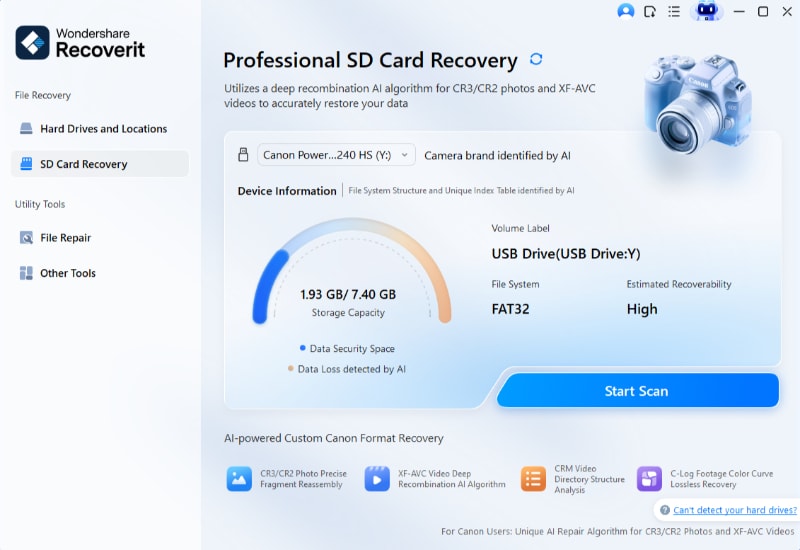
- Scan the card. Let the scan finish. Use filters for MP4 and JPG if you are looking for original GoPro footage.
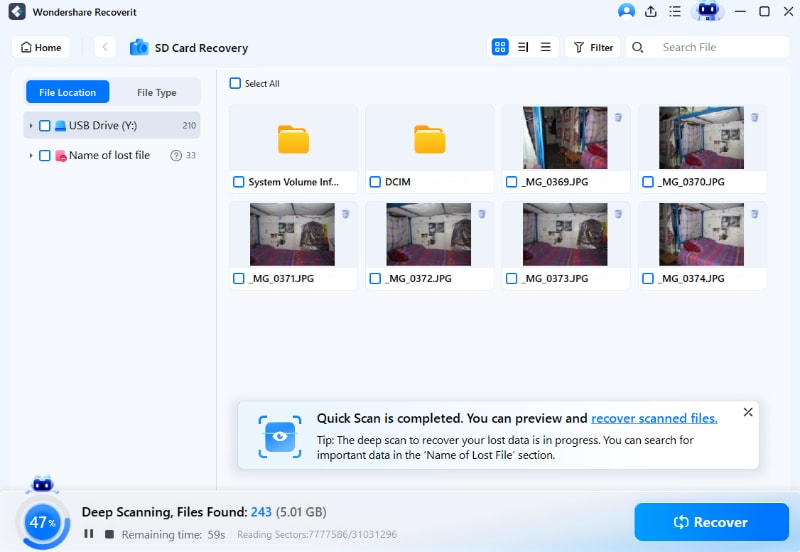
- Use Enhanced Video Recovery when needed. Choose it for large 4K or high-bitrate clips that do not appear in a regular scan.
- Preview before recovery. Confirm the file is an original recording, not a small LRV preview or THM thumbnail.

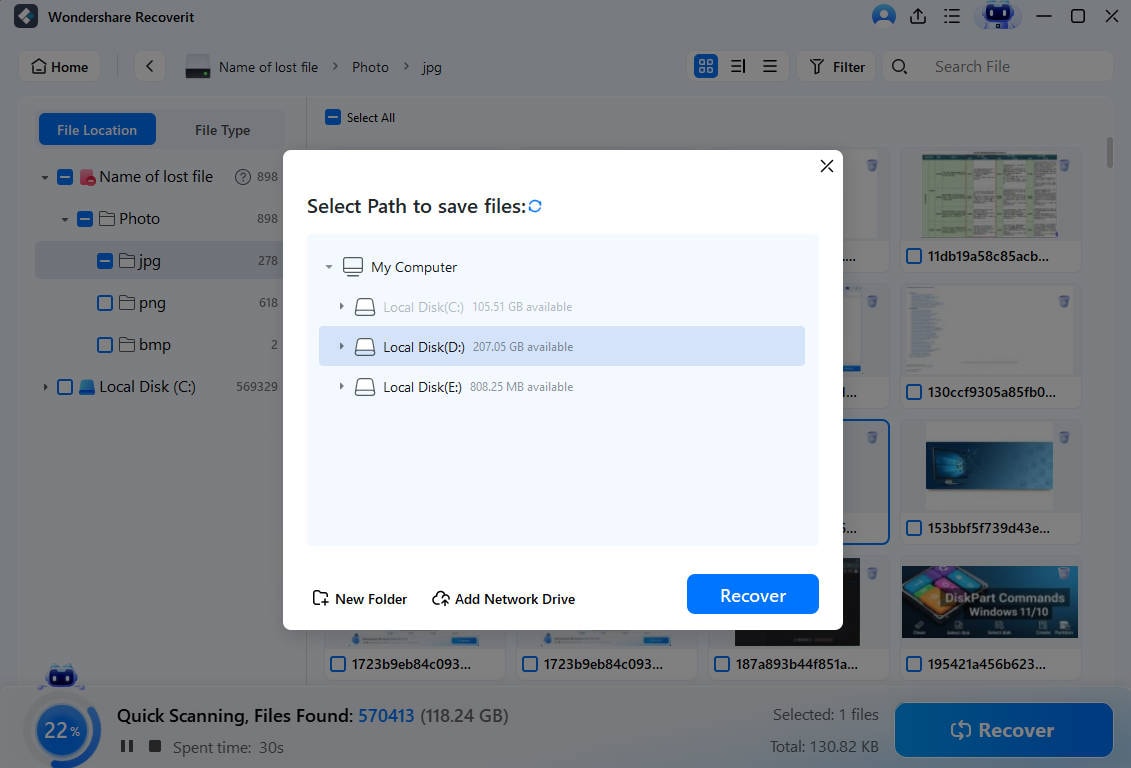
- Recover to another drive. Save the files to a computer disk or external drive, not back to the same GoPro card.
| GoPro File Type | What It Is | Recovery Tip |
| MP4 | The original GoPro video file in most Hero workflows. | Filter by MP4 and sort by file size and recording date. Keep the largest matching files. |
| JPG or JPEG | The original still photo in most GoPro photo modes. | Filter by image type and look in DCIM first. |
| LRV | A low-resolution video preview created by the camera. | Do not treat LRV as the original 4K or high-bitrate recording. |
| THM | A small thumbnail image paired with a video. | Use it only as a clue that an original MP4 may still exist nearby. |
| DCIM folder | The common camera folder that stores original GoPro media. | If DCIM is missing, scan the whole card instead of only visible folders. |
| Preview, cache, or computer copies | Files already copied to a PC, phone, or editing folder. | Check Recycle Bin, backup folders, and editing disks before assuming only the card remains. |
Part 5. Tips Against GoPro SD Card Errors
Most GoPro card errors are easier to prevent than to repair. Use an official-recommended card, format it in the camera after backup, leave free space, and never pull the card while the camera is writing.
| Prevention Tip | What to Do | Why It Helps |
| Use an official-recommended card | Choose a microSD card from the current GoPro list and match the camera’s speed class, such as A2 V30 UHS-3 or higher on HERO13 Black. | Unsupported or slow cards are a common cause of recording errors. |
| Format new or reused cards in the GoPro | After the card is empty or fully backed up, use the camera format path, such as Preferences > Reset > Format SD Card on newer models. | In-camera format creates the file system and folders the GoPro expects. |
| Leave free space | Do not fill the card to 100 percent before a long recording. | A full card is more likely to stop recording or leave an incomplete MP4. |
| Power off and eject safely | Stop recording, wait for the camera to finish writing, power off before removing the card, and use Safely Remove Hardware on a computer. | Unsafe removal is a frequent cause of corrupt or RAW cards. |
| Format after backup, not file-by-file deletion | Copy the files off, verify playback, then format the card in the GoPro. | This is a prevention step after backup, not a way to recover missing files. |
| Store cards in a case | Keep spare cards in a protective case, away from water, sand, and pressure. | Physical damage cannot be fixed by formatting or recovery software. |
Conclusion
To fix a GoPro SD card error, identify the fault first: camera slot, card, reader, write-protect lock, or file system damage. If the photos or videos still matter, recover them before CHKDSK or format. If the card is readable, copy the files. If it looks empty, RAW, or unreadable, scan it with Recoverit and save the results to another drive.
After the footage is safe, format the card in the GoPro and switch to an official-recommended card that matches your camera. Recovery can work when the data has not been overwritten, but it is not guaranteed and it cannot repair a physically failed card.
People Also Ask
-
Should I format a GoPro SD card first to fix an error?
No. Format last if the files still matter. Stop recording, copy any visible files, and scan the card before formatting. After backup or recovery, format the card in the GoPro so the camera can rebuild the folder structure it expects. -
Can CHKDSK recover deleted GoPro files?
No. CHKDSK repairs file system errors. It is not an undelete tool. Microsoft notes that FAT repairs usually change the file allocation table and can cause data loss. Recover or image the card first, then runchkdsk E: /fonly if you still need to repair the card. -
What microSD card does GoPro HERO13 Black require?
GoPro specifies a microSD, microSDHC, or microSDXC card rated class A2 V30, UHS-3, or higher. Use the current recommended-card list on GoPro’s site instead of a generic Class 10 or old Polaroid-style shopping list. -
Why is my GoPro SD card write-protected?
Write-protect is often caused by the lock switch on a microSD-to-SD adapter, a reader problem, or a card that has gone read-only after errors. Unlock the switch, try another adapter or reader, copy any visible files, and recover before formatting. -
Can Recoverit recover files from a GoPro SD card?
Yes, Recoverit can scan local GoPro SD cards, cameras, and drives for deleted, formatted, or missing MP4 and JPG files. The official free page currently lists recovery up to 500MB. Use Enhanced Video Recovery for large 4K clips, and save recovered files to another drive. -
What should I do if the GoPro card is unreadable or RAW?
Cancel the Windows format prompt. Try another card reader, check Disk Management, and scan the card with recovery software before CHKDSK or format. Changing the drive letter helps only when Windows already sees a volume without a letter. -
How do I format a GoPro SD card after backup?
Copy and verify the files first. On newer cameras such as HERO13 Black, use Preferences > Reset > Format SD Card. Older cameras may still use Preferences or a Trash/Delete format path. If you format on a computer, use FAT32 for 32GB and smaller cards and exFAT for 64GB and larger cards, then format again in the GoPro if asked.


Eleanor Reed
staff Editor