

 TL;DR:
An INSV file is an Insta360 video source format that must be opened and exported to MP4 using the Insta360 Studio desktop software on Windows or macOS to ensure proper lens stitching and playback compatibility.
● You must keep all matching INSV files in the same folder without renaming them prior to import, because cameras like the Insta360 X3 split a 360 recording into two files, whereas models like the X4, X4 Air, and X5 recording at 5.7K or higher combine both video tracks into one file.
● Within the Insta360 Studio export settings, select 360 Video to maintain an interactive view designed for compatible 360 players, or select Video to create a flat, reframed MP4 that locks the viewer into a specifically chosen perspective.
● Do not simply rename the .insv file extension to .mp4 or rely on generic online converters, as this bypasses necessary camera-specific processing and will only expose an unstitched dual-fisheye video stream rather than a finished 360 video.
Ask AI for a summary
 ChatGPT
 Perplexity
 Gemini
 Claude
 Grok
An INSV file is a video source file used by Insta360 cameras. It can contain footage and camera information needed for editing, stabilization, or stitching. Depending on the camera and recording mode, one clip may have one INSV file or several related files.
To convert INSV to MP4, open the complete recording in Insta360 Studio on Windows or macOS and export it as either a 360 video or a reframed flat video. Keep the original files together until you have checked the export and made a backup.
In This Article
Part 1. What Is an INSV File?
An INSV file is an Insta360 video recording format. Some INSV recordings contain the information needed to combine lens views and adjust the perspective in supported software. The extension alone does not tell you whether a recording is a complete 360 video, a single-lens clip, or one part of a recording.
For example, an Insta360 X3 360 recording can create two INSV files, one for each lens, plus a lower-resolution LRV file. Keep the matching INSV files in the same folder and retain their original names. Insta360 describes the source and proxy files in its X Series file-format guide.
Other cameras organize footage differently. Insta360's developer guide states that X4, X4 Air, and X5 recordings at 5.7K or higher can store two video tracks in one INSV file. Check the files produced by your camera and mode rather than assuming every clip needs two separate INSV files.
| File | Typical role | What to keep |
| INSV | Insta360 video source footage | Keep every matching source file for the recording. |
| LRV | Lower-resolution preview or proxy in some camera workflows | Keep it with the source until the clip and backup are verified. It is not necessarily the full-resolution video. |
| INSP | Insta360 photo source format used by some models | Keep the original when you may want to edit or export the photo again. |
| MP4 | A video container used for many exported clips | Check whether the export is a flat video or a 360 video and whether it plays on the intended device. |
Note: A file that does not open in a standard player is not automatically damaged. Try a copy in compatible Insta360 software before deciding that it needs repair.
Part 2. How to Convert INSV to MP4 in Insta360 Studio
Insta360 Studio is a desktop option for opening and exporting supported camera footage. You will need the complete recording, a compatible Windows or Mac computer, and enough free space for the exported video. The controls can differ with the Studio version and the source footage.
Step 1. Copy the original camera files to a working drive. If your recording has paired INSV files, copy both to the same folder without renaming them. Keep the camera card unchanged until you have verified the copies. On supported X Series cameras, the files can be copied from the camera's DCIM > Camera01 folder; see Insta360's file transfer instructions for the applicable model.
Step 2. Install a version of Insta360 Studio that supports your camera; see the official download and installation instructions. Open Studio, drag the local footage into the media library or use the import control, and open the clip in media-editing mode. Some versions call this the Media page. When a recording uses paired files, keep its companion file in the same folder so Studio can find it.
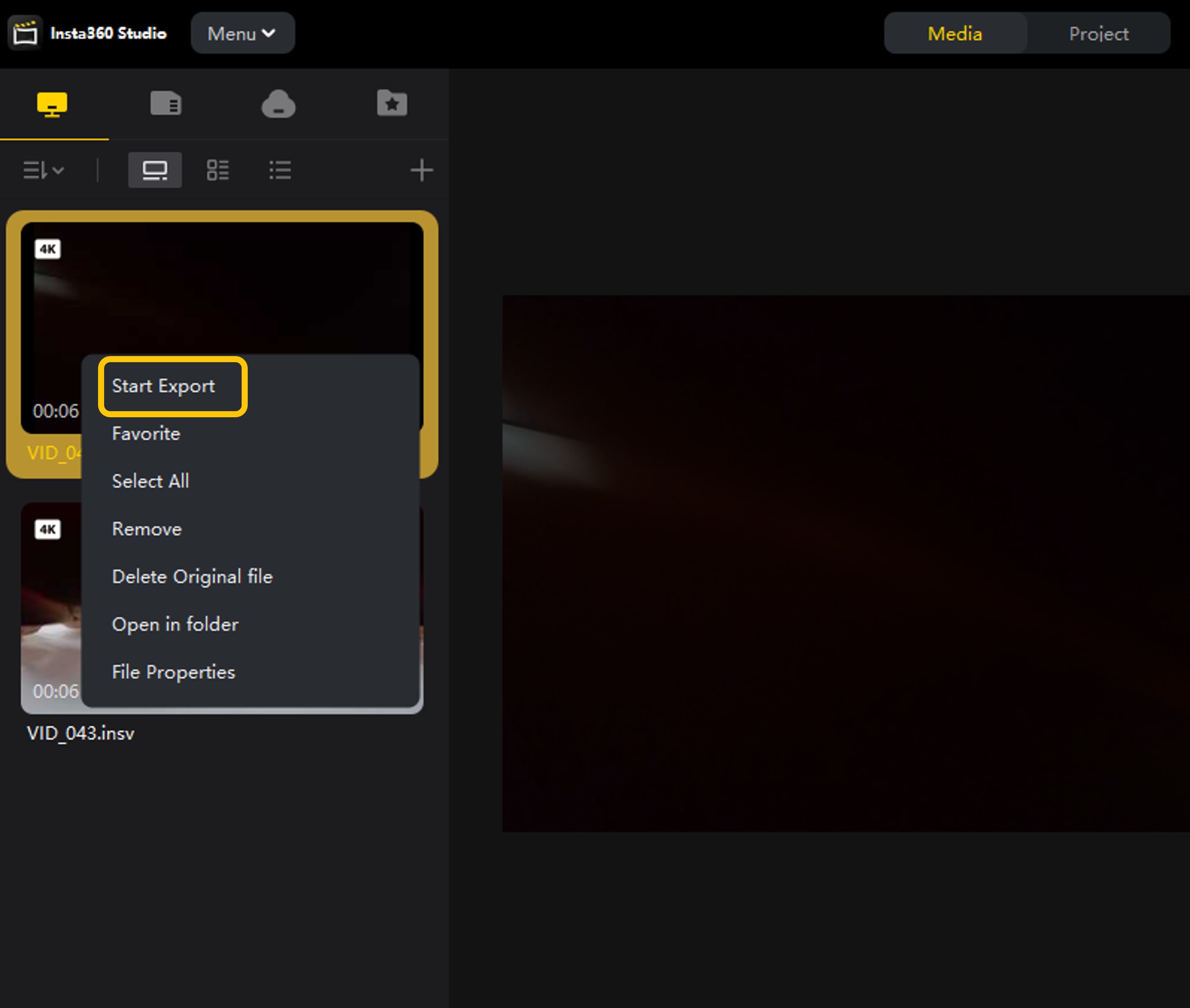
Step 3. Select the clip and confirm that it opens in the preview. Depending on your Studio version, right-click it and choose Start Export or Export, or use the Export control on the screen.
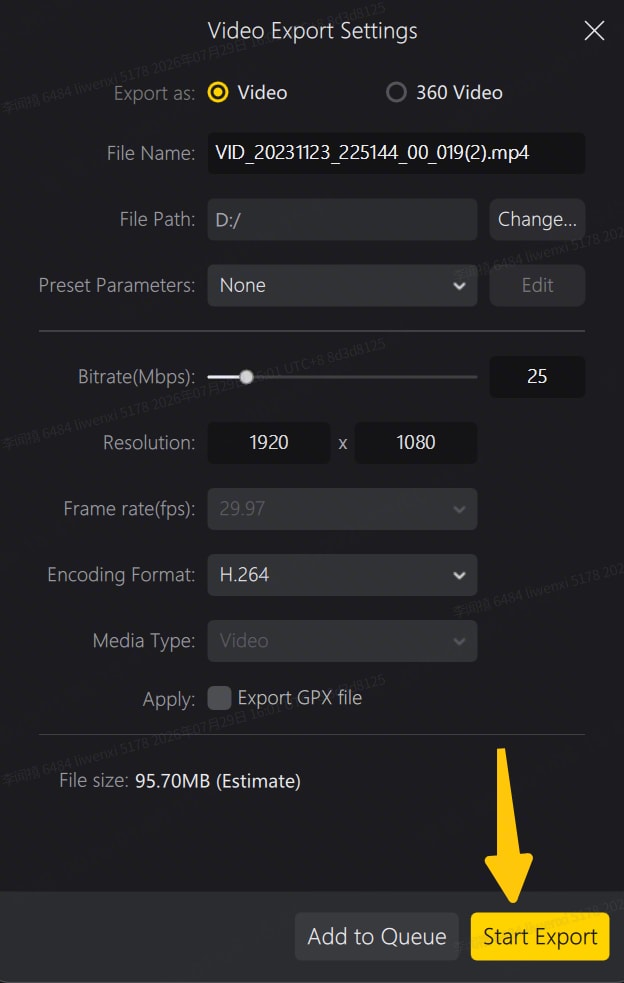
Step 4. In the export settings, select 360 Video if you want a supported interactive 360 output, or Video for a flat reframed output. Choose an MP4 output where offered, then set the file name, destination, resolution, frame rate, and encoding format. Start the export. The official Media export example below shows an MP4 file name and H.264; available controls depend on the clip and software version.
Step 5. Wait for the export to finish and open the saved MP4. Check the beginning, middle, end, and audio. For a 360 export, test it in a player or on a platform that supports interactive 360 video and confirm that you can change the viewing direction.
Insta360's current Studio export guide describes the export controls and file destination. Retain your INSV source files even after the MP4 plays correctly: an export made for one view does not replace the original footage for future reframing.
Part 3. Choose Between a 360 Video and a Reframed MP4
An MP4 can hold either an interactive 360 video or a conventional flat video. Decide how the finished clip should be watched before choosing the export mode.
Export a 360 Video
Choose 360 Video when viewers should be able to look around the scene. A 360 player uses a compatible projection and metadata to present the video interactively; a normal player may instead show the image as a flat, stretched panorama. Uploading or recompressing the file can affect how a destination recognizes it, so test the actual destination.
For editing several clips into a 360 project, follow Insta360's separate 360 project guide. Its version requirements and controls differ from the single-clip export workflow above.
Export a Reframed Video
Choose a flat Video export when you want the viewer to see a selected direction, such as a horizontal clip or a vertical social video. Set the frame and any keyframes before exporting. The result plays like an ordinary video, but viewers cannot look outside the chosen frame.
Codec choice: MP4 is the container; H.264 and H.265 are encoding options. H.264 is often a practical starting point for broad playback compatibility. H.265 may be useful when your target player supports it. Match resolution and frame rate to the footage and the destination rather than assuming a higher setting restores missing detail.
Part 4. Can You Convert INSV to MP4 Online?
Some websites advertise an INSV to MP4 converter, but accepting an upload does not prove that the service can combine the right lens files, apply camera-specific processing, or preserve 360 playback. Check these capabilities before choosing an INSV file converter. Large clips can also take time to upload, and private footage leaves your device.
For example, Wondershare's online INSV-to-MP4 page advises checking whether the particular file is accepted and using an Insta360 workflow when stitching or reframing is needed. Review the service's current file limits, privacy terms, and output options before uploading a copy. For a complete 360 recording, Studio is the safer first choice for preserving the intended view.
If your footage is already available in the Insta360 mobile app, the app can export supported media to a phone's album. Its mobile export guide explains which 360 and flat outputs are available and how they differ from downloading media into the app.
Changing a copy's extension from .insv to .mp4 is not the same as a stitched export. Insta360 notes that a renamed INSV can expose an unstitched dual-fisheye stream. It does not promise a finished, interactive 360 video; use Studio when you need the stitched or reframed result.
Part 5. Fix Common INSV Import and Export Problems
Start with the source files and the expected output. These checks can help you distinguish a missing companion file from a playback or export problem without changing the originals.
| What you see | What to check |
| Studio cannot find part of the clip. | Check the original camera folder or backup for matching files. Keep paired INSV files together with their original names, then import the recording again. |
| Only an LRV file is available. | Look for the original INSV recording on the camera, card, computer, or backup. An LRV may be useful as a preview but may not contain the full-resolution footage. |
| The video shows two circular lens views. | The source may be unstitched. Open the complete recording in Studio and export using a 360 or reframed option supported for that clip. |
| The 360 MP4 looks flat or stretched. | Try a player or destination that supports 360 video. Check the export mode and the destination's 360-video requirements before re-exporting. |
| Export stops or produces an incomplete file. | Check available destination space, the source connection, and the exact Studio error. Copy accessible source files to a stable drive and retry from the copy. Keep the original files. |
| The file exists but still will not open. | Test a verified copy, check for companion files, and consult the camera maker's support. If the file is genuinely damaged, follow a separate INSV video repair guide. |
Do not format the source card merely because an INSV file will not play. If the card disconnects repeatedly, overheats, or is physically damaged, stop repeated scans and consider a professional recovery service.
Part 6. Recover Missing INSV Files From an SD Card
If the original INSV files are present, use the export workflow above. If they were deleted or the card was formatted, stop recording and saving files to that card. Check an existing computer copy or backup first: new data can overwrite recoverable footage.
If you deleted only an app copy, check whether the original remains on the camera. Insta360 states that its Android Retrieve Historical Files feature is not a recycle bin; see the app's current deletion and retrieval guidance. Do not assume the app can restore a file deleted from the camera.
If the computer detects the SD card and Recoverit can access it, Wondershare Recoverit can scan supported storage for recoverable video files. Recovery depends on the remaining data and the card's condition; it cannot guarantee a complete clip or repair physically failed hardware.
Step 1. Connect the card to a Windows or Mac computer with a reliable card reader. Prepare a different healthy drive with enough space for the recovered files. If the card is not detected or appears physically damaged, avoid repeated scanning.
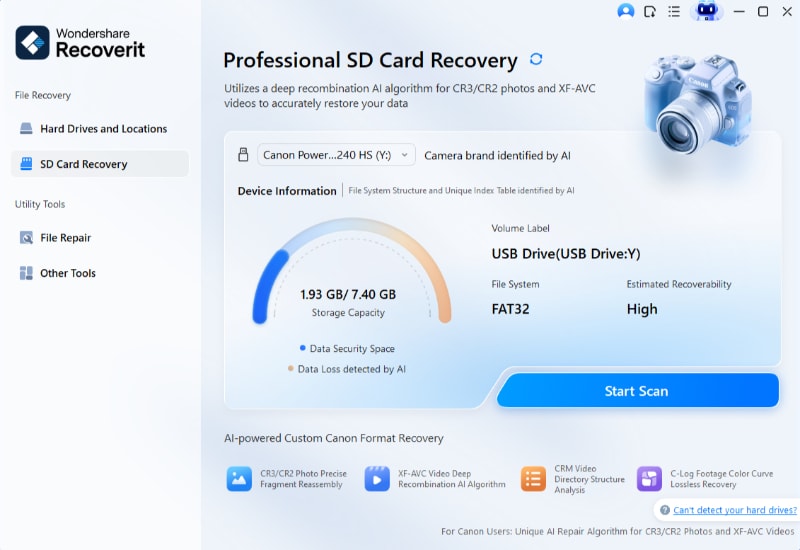
Step 2. Open Recoverit, select SD Card Recovery or the available drive-location workflow, and choose the affected card. Start the scan. The example below shows a Sony card; the detected camera name and available scan options may differ on your system.
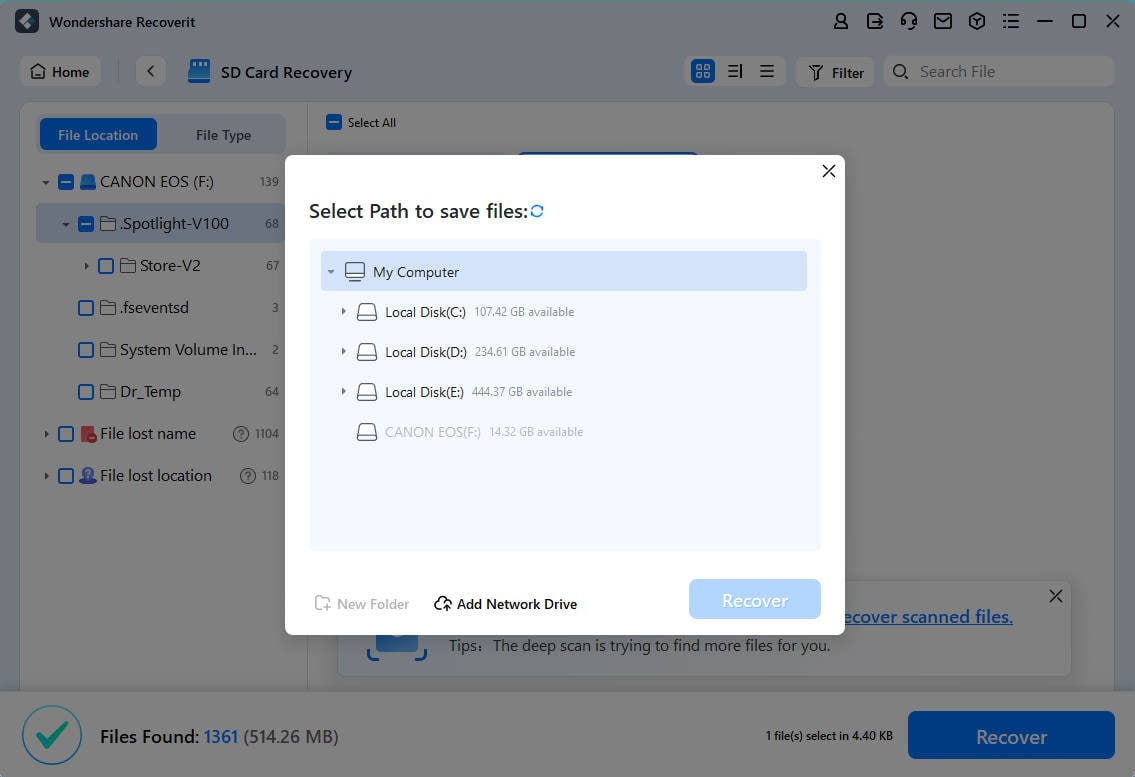
Step 3. Let the scan finish, then review the results for the missing footage. Search by original name, date, or video type when available, and preview supported results. Save any related INSV files together to the other healthy drive, never back to the source card.
Step 4. Open the saved copies in Insta360 Studio. If the camera produced paired files, check that both are present and retain the corresponding names. Play the clip and test an export before relying on the recovered footage. See the Recoverit user guide for the current scan and save workflow.
Note: The SD Card Recovery example is labeled Pro. Feature availability, preview support, and recovery limits depend on the version and license. A free download does not mean every file can be recovered for free; review the current offer before purchasing.
Conclusion
An INSV file is a source video from an Insta360 camera. Keep the complete recording together, open it in compatible Insta360 software, and choose a 360 or reframed MP4 according to how you want to watch it. If a source file is missing, protect the original storage before attempting recovery.
FAQ
-
What program opens an INSV file?
Insta360 Studio can open supported INSV footage on Windows and macOS. Compatibility depends on the camera, footage, and Studio version. The Insta360 mobile app also supports footage from compatible cameras. -
Can I convert an INSV file to MP4 without losing 360 viewing?
Export as a supported 360 video rather than a flat reframed video, then test it in a 360-capable player or on the intended platform. Playback also depends on the destination recognizing the file's 360 information. -
Do I need both INSV files?
Keep both when your camera created a paired recording. Other models and modes may store the relevant video tracks in one INSV file, so check the original files for your camera rather than relying on a single rule. -
Why does my exported MP4 show only one view?
A flat or reframed export uses a selected view. Check the export mode and, for interactive playback, try a 360-capable player. Keep the original source files if you want to make a different export. -
Can Recoverit convert INSV to MP4?
Recoverit is used to find recoverable files on supported storage. For a supported INSV-to-MP4 export, use Insta360 Studio or another tool that explicitly supports the recording and the desired output.


