


A video that refuses to open may have a damaged container index, a missing recording header, unreadable video data, or simply a player-compatibility problem. Different problems need different tools. That is why searching for a free video repair tool can lead to disappointing results when the app fixes your preview but charges to save it.
This guide compares genuinely free software with free-to-try video fixer apps for Windows, Mac, Linux, and Android. It also shows a tested FFmpeg workflow and explains when Recoverit 15 can help with a damaged or missing local video. Always preserve the original file and work on a copy before trying repairs.
In This Article
Part 1. Identify the Video Problem Before Choosing a Repair Tool
Start with a few observations rather than installing several programs at once. The symptoms help distinguish playable media in a troublesome wrapper from lost footage that software cannot simply recreate.
| What you observe | Likely next check | Best starting point |
| Video plays in one player but not another | Codec, container, player or device compatibility | VLC for playback testing; FFmpeg for stream copy if readable |
| MP4 or MOV stopped recording after power loss | Incomplete or missing container metadata | Untrunc with a healthy reference video from the same device |
| AVI plays but seeking does not work | AVI index damage | VLC's AVI index repair attempt |
| MP4 can be probed and decoded, but editing software rejects it | Container or timestamp compatibility | FFmpeg remux to a compatible container |
| Video is deleted from an SD card or drive | Missing source file rather than playable-file corruption | Preserve the storage device and consider data recovery |
| File is 0 bytes, overwritten or not actually recorded | Missing underlying media data | Check backups or professional recovery options; repair cannot invent the footage |
Before you begin: Copy a damaged file to a healthy drive if it remains readable. Do not run repair or write recovered output to a failing memory card. A screenshot, filename, or file size alone is not proof that all video frames still exist.
Part 2. Best Free Video Repair Software and Video Fixer Apps Compared
Freeware, a free preview, and a fully usable free repair are different offers. This comparison focuses on the tools' documented scope, not unverified success-rate claims or an invented benchmark.
| Tool | Free status | Best use | Main limitation |
| VLC media player | Free, open source | Test playback; attempt an AVI index rebuild | Not a universal MP4/MOV recovery engine |
| FFmpeg and ffprobe | Free, open source | Inspect streams; remux readable tracks | Cannot replace missing packets or frames |
| Untrunc | Free, open source | Unfinished MP4/MOV/M4V/3GP recordings | Needs a suitable healthy reference clip for best results |
| MP4Fix (Android) | Free repaired preview; paid save | Broken videos recorded by an Android phone | Limited capture scope and platform |
| Wondershare Recoverit 15 | Download/trial available; check export entitlement | Corrupt local files and recovery of deleted videos | Not guaranteed free-to-save; cannot restore overwritten footage |
| Wondershare Repairit | Free trial preview; paid complete preview/save | Dedicated local-file repair with sample-assisted mode | Full repaired video export requires purchase |
Fully Free Options: VLC, FFmpeg, and Untrunc
These three are appropriate when you specifically need video repair freeware, but they solve different problems. Start with the least invasive tool that matches your file state.
VLC media player: The free VLC media player can open many common formats and offers an AVI index repair prompt or preference. VideoLAN's documentation distinguishes temporary AVI index handling from permanent file repair. Playing a damaged MP4 in VLC does not prove its container or frames have been reconstructed.
FFmpeg and ffprobe: They are free command-line utilities. ffprobe reports recognized streams and container metadata; FFmpeg can copy readable streams into a new container without re-encoding them. Part 3 includes real terminal screenshots taken while testing a deliberately truncated AVI sample.
Untrunc: This open-source tool focuses on truncated MP4, MOV, M4V, and 3GP recordings. Its official project repository describes using a working sample from the same camera and similar recording settings. It is not suitable for recreating footage that was never saved, and its setup is less beginner-friendly than a desktop app.
Free-to-Try and Mobile Options: MP4Fix, Recoverit, and Repairit
If a one-click interface matters more than entirely free export, compare the restrictions before installing a tool or uploading personal videos to a server.
MP4Fix: The official MP4Fix Android listing says a repaired-video preview is free but saving the result is an in-app purchase. It is aimed at recordings made by the same Android phone, not general internet downloads or physically damaged SD cards. It is not an iPhone video repair app.
Recoverit 15: Recoverit provides File Repair for damaged local videos and Enhanced Recovery for lost footage. It is a downloadable trial, not unrestricted video repair freeware; verify current save and license limits in your installed edition. Parts 4 and 5 explain when to use each function.
Repairit: The dedicated Wondershare Repairit Video Repair offers a trial that can generate repaired previews. Its official FAQ says full preview and local saving require the purchased version. Do not confuse Repairit with Recoverit, and do not claim their trials are fully free exports.
Part 3. Repair a Corrupted Video for Free With FFmpeg When Streams Are Readable
This reproducible workflow uses a real FFmpeg/ffprobe 7.1.5 terminal session captured on October 10, 2026. For illustration, a locally generated AVI test clip had its final bytes truncated. The screenshots are direct captures of the actual running tools, not fabricated application mockups. The output retained readable frames; it did not recreate missing footage.
Method 1. Check the Video Streams With ffprobe
Use this first when a player says the file is unsupported or corrupt. If ffprobe cannot identify a video stream, copying the file into another container will probably not resolve the underlying issue.
Step 1. Install an official FFmpeg build, preserve a copy of the damaged file, and open Terminal or Command Prompt in the folder containing that copy. Consult the ffprobe documentation for stream-inspection options.
Step 2. Run ffprobe -v error -show_entries stream=codec_name,codec_type -show_entries format=format_name,duration -of default=noprint_wrappers=1 damaged-demo.avi. Replace the demo filename with your copied file's name.
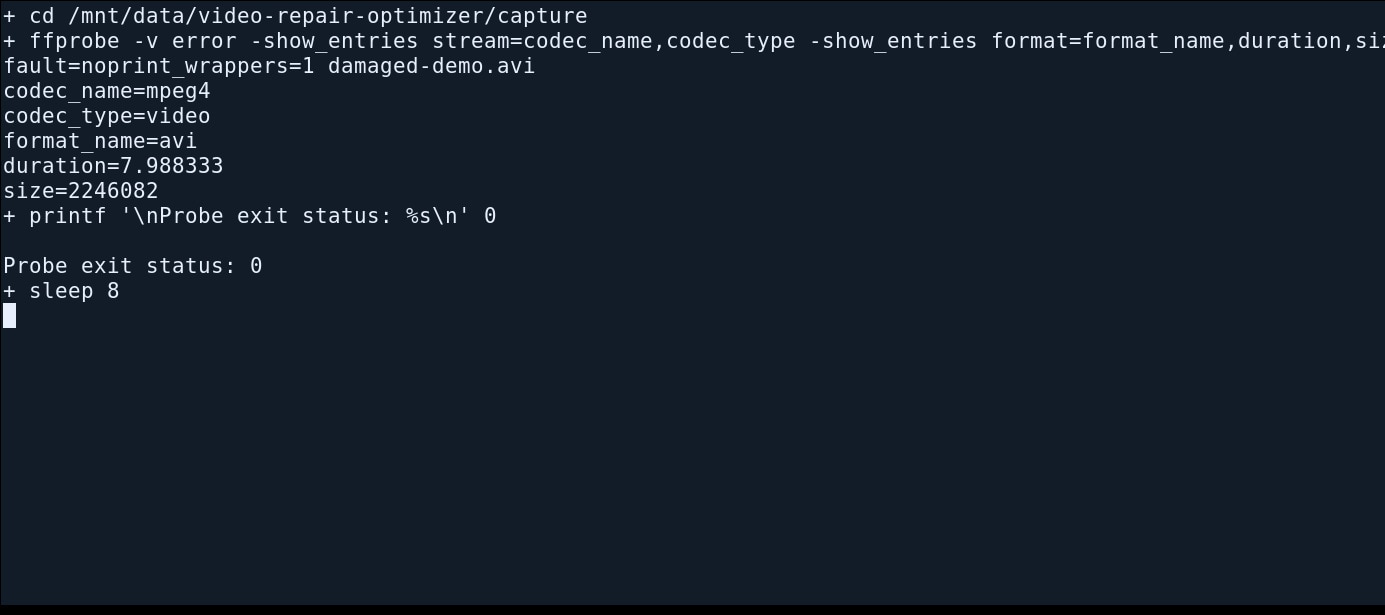
Expected result: Recognized codec and duration fields indicate that FFmpeg can inspect some of the media. They do not prove every frame survived. If it fails: Try another trusted player, check file size and source storage, and skip directly to reference-assisted repair or recovery where appropriate.
Method 2. Remux Readable Streams Without Re-encoding
Remuxing can help when playable streams are inside a container another application rejects. FFmpeg's -c copy preserves the surviving encoded packets instead of reconstructing or enhancing damaged frames.
Step 1. Confirm that ffprobe recognized a stream in the copied input. Check the official FFmpeg stream-copy options if your recording has multiple audio or subtitle tracks.
Step 2. In the same folder, run ffmpeg -i damaged-demo.avi -map 0 -c copy remuxed-from-damaged.mkv. Choose a new destination filename and never overwrite your original recording.
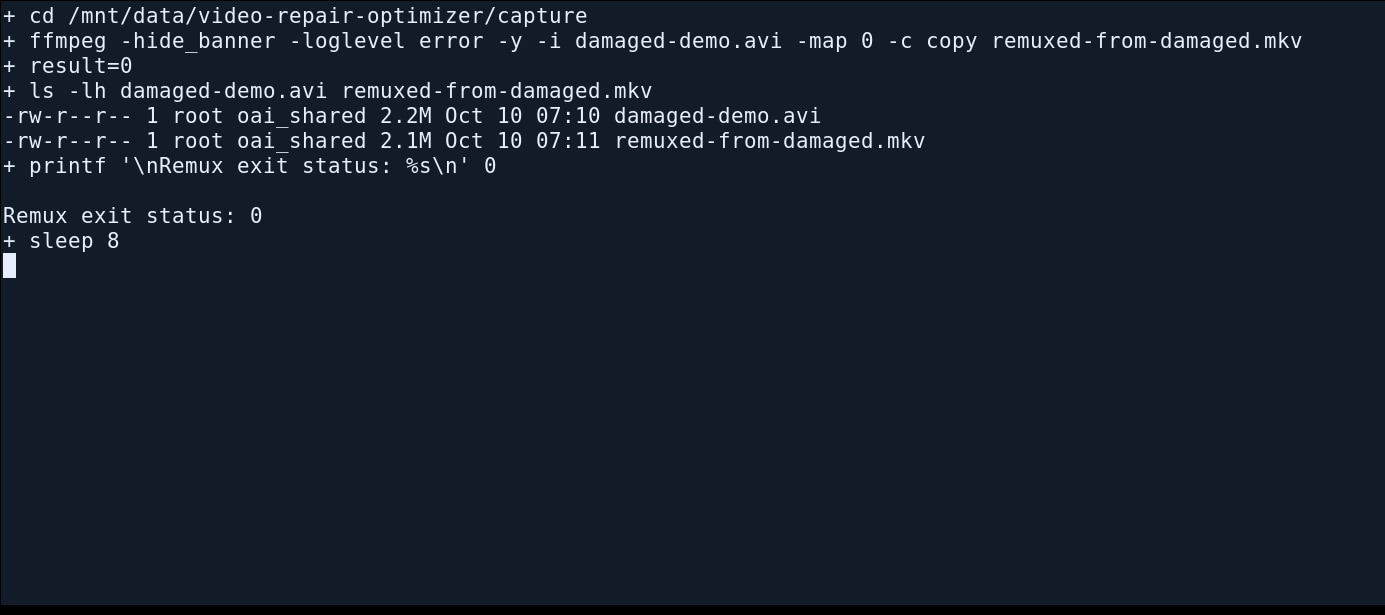
Expected result: A new MKV file contains the readable data. If it fails: Unsupported streams, invalid timestamps or missing metadata may require another container, a healthy reference file, or a different tool. Do not repeatedly overwrite the original file.
Method 3. Verify That the New File Can Decode
A successful exit code alone is insufficient. Confirm the output has real video streams and test whether the new file plays from start to finish.
Step 1. Run ffprobe -v error -show_entries format=duration -show_entries stream=codec_name,codec_type -of default=noprint_wrappers=1 remuxed-from-damaged.mkv to inspect the output.
Step 2. Run ffmpeg -v error -i remuxed-from-damaged.mkv -f null - to check for reported decoding errors, then play the file in a media player and seek across the timeline.
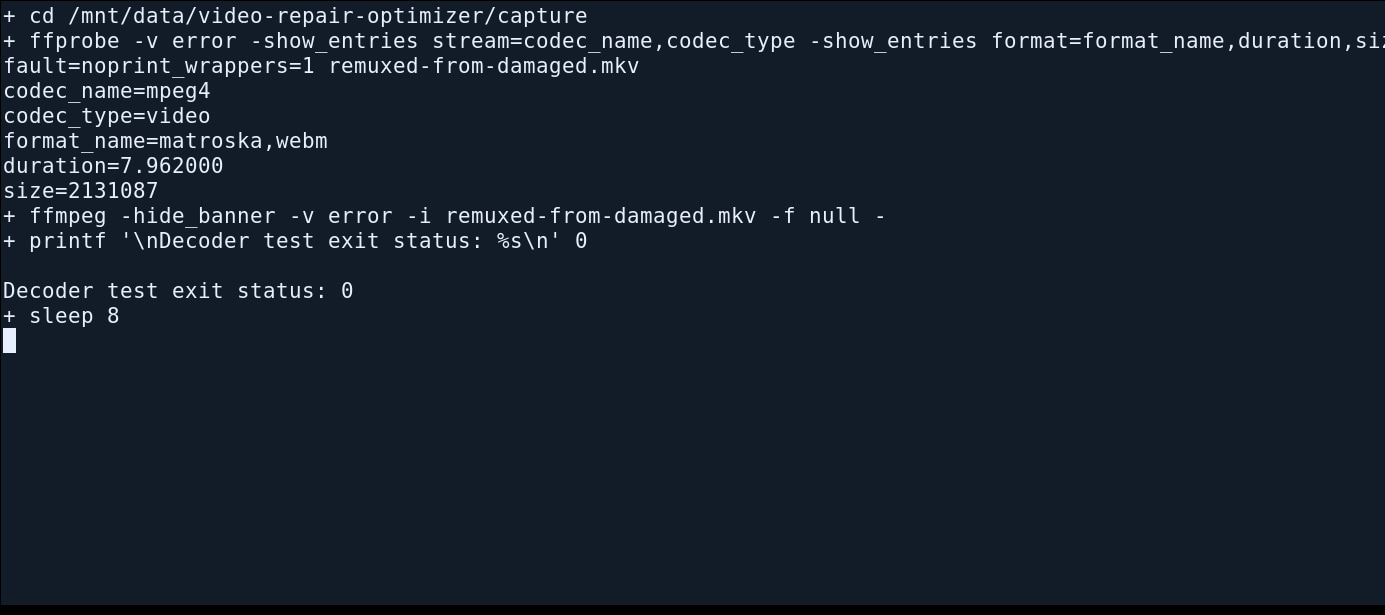
If the output is still damaged: Compare its actual duration with the original recording. The demo's truncated source produced a slightly shorter output; missing footage was not restored. For an MP4 with a missing final recording header and a healthy reference clip, consider Untrunc instead of repeating stream copy.
Part 4. How to Use Recoverit 15 for Corrupted or Missing Local Videos
Free media tools help when the recording's data is readable. If the file itself remains damaged, or if the original was deleted from a memory card, Recoverit provides separate File Repair and recovery workflows. These are different operations and should not be described as guaranteed free fixes.
Method 4. Try Recoverit File Repair on an Existing Damaged Video
Choose this only when the video file still exists on a healthy disk and fails to open across multiple players. The following interface steps follow the current Recoverit V15 official Windows Guide; screenshot URLs below are the Guide's original Wondershare assets.
Step 1. Open Recoverit 15, go to File Repair, choose Video Repair, and select Add Video or the add-files control to load a copied damaged video.
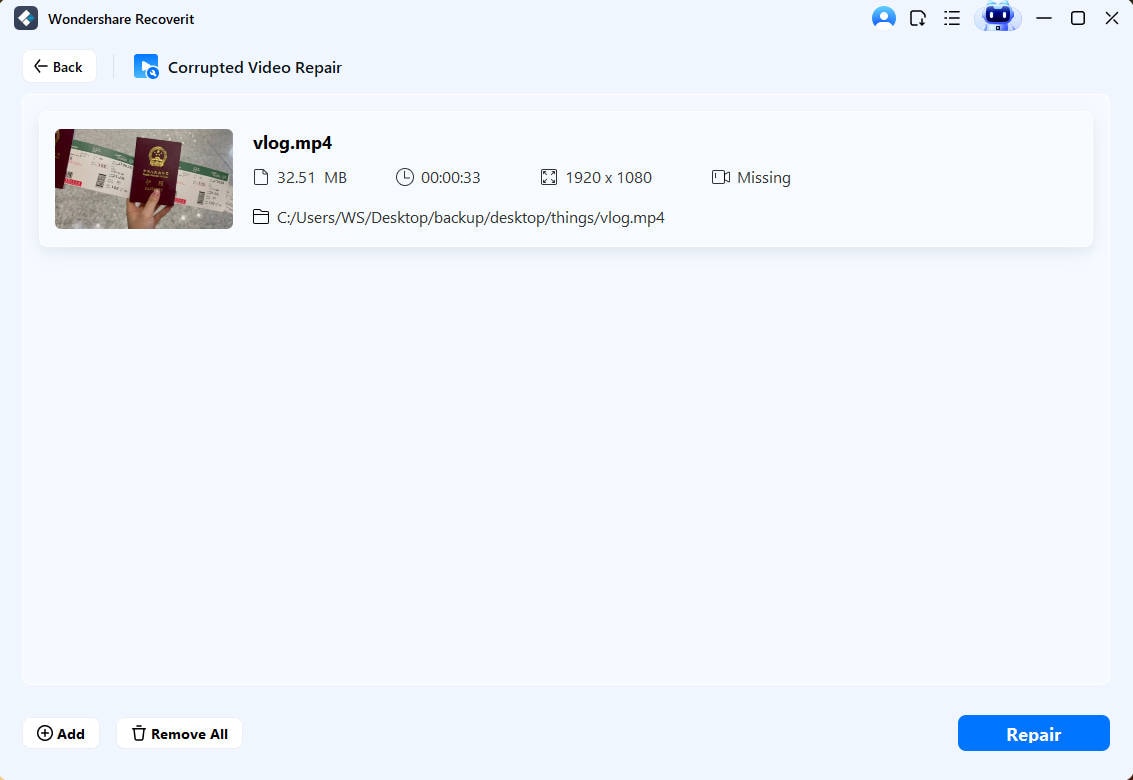
Step 2. Select Repair, wait for analysis, and use Preview to inspect the output. If available, Advanced Repair may request an undamaged reference recorded with the same device and matching format.
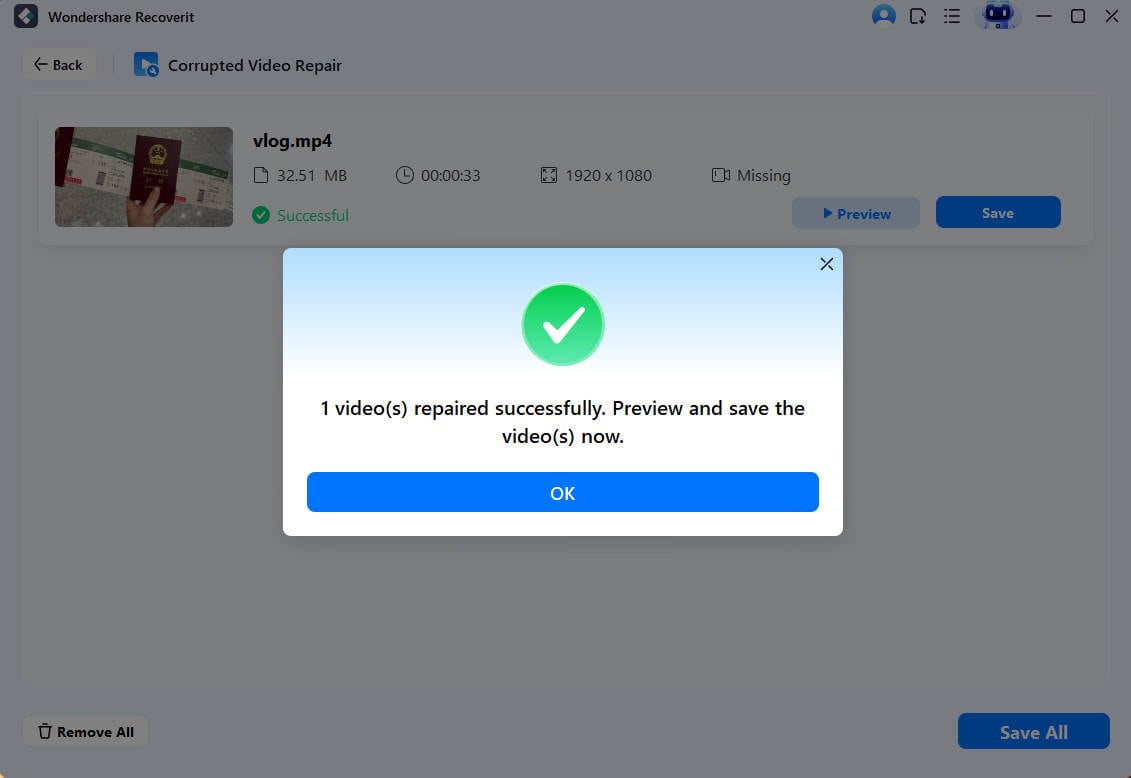
Step 3. Save only after you have inspected the repaired video, and choose a different destination. Check your edition's license and export conditions before assuming saving is free.
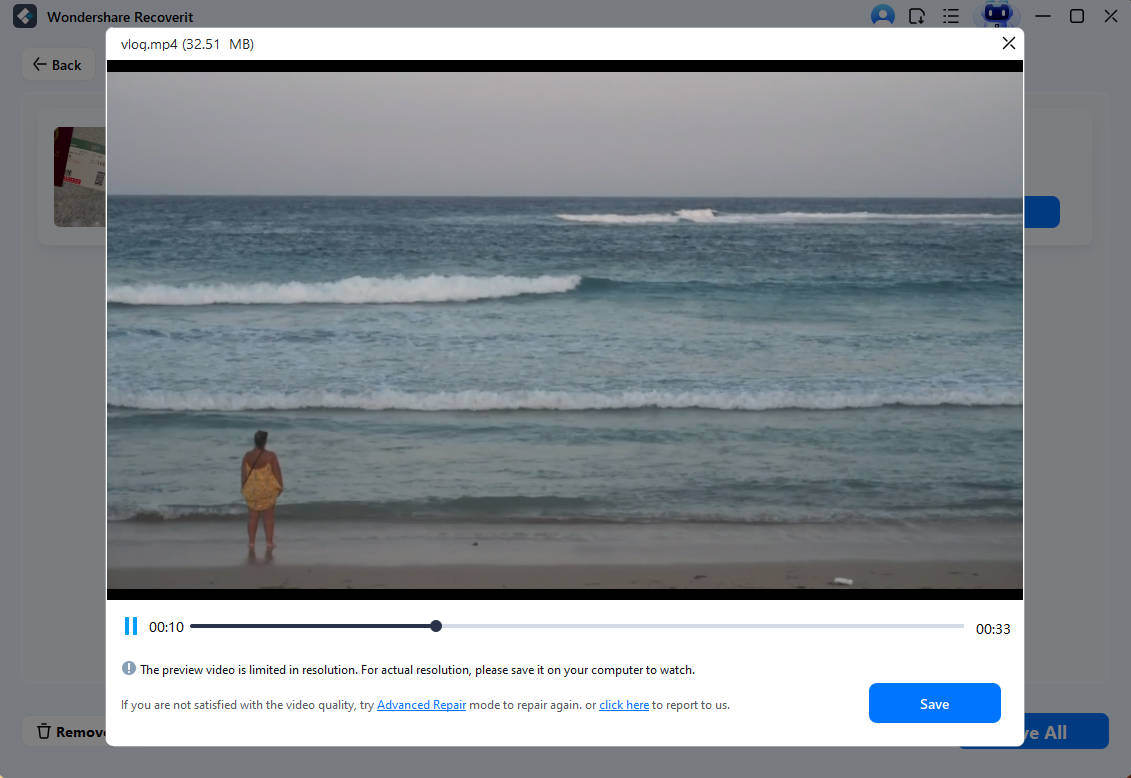
If preview fails: Stop retrying on a potentially failing device. An intact matching reference recording may help Advanced Repair, but software cannot regenerate footage that was overwritten or never captured.
Method 5. Recover a Deleted Original Video Before Attempting File Repair
If the video was deleted from an SD card or disk rather than merely corrupted, scanning the original storage is a recovery task. Limit further writes to the source device and save any results elsewhere.
Step 1. Connect the storage device safely, open Enhanced Recovery in Recoverit, select the affected source and relevant video format, then scan. Use the official interface image below as the reference for the mode.
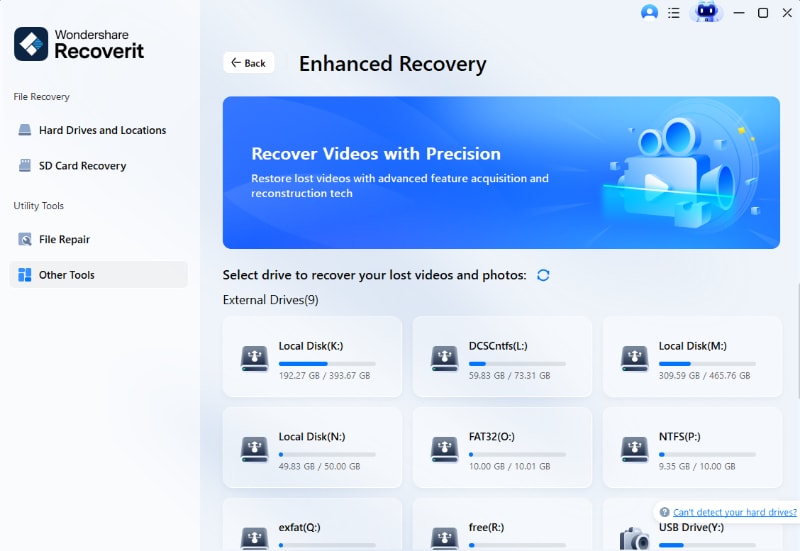
Step 2. Preview located video candidates before recovering them to a different healthy drive. If the drive clicks, repeatedly disconnects or has serious hardware faults, avoid additional scanning and seek specialist advice.
You can review the current Recoverit options from the Recoverit official product page. Scanning, preview and saving limits depend on the edition and license; availability of a free download is not the same as unlimited free recovery.

Part 5. What the Best Free Video Repair Tools Cannot Do
Many repair attempts fail not because the software is bad, but because the requested data no longer exists or the selected tool targets a different failure.
- Missing or overwritten frames: Remuxing, re-indexing and a reference file cannot guarantee reconstruction of content that is no longer stored.
- Physically failing storage: Repairing files in place can increase the risk of losing the only remaining readable copy; preserve the media and consider professional assessment.
- Unsupported camera modes: Some reference-assisted utilities require nearly identical recording settings. Check codecs, frame rate and recording device rather than using any random MP4.
- Video repair free software versus trial: A successful free preview may still require payment to export. Look for documented save limits before running a lengthy repair.
- Privacy: Local tools such as VLC, FFmpeg and Untrunc do not require uploading private footage to an online repair service in their standard workflows.
For videos with readable streams, test a free local method first. If a video is missing or fragmented after deletion, use a recovery-specific workflow rather than changing its filename or repeatedly converting unrelated copies.
Conclusion
The best free video repair software depends on what is actually wrong. VLC can diagnose playback and some AVI indexing issues, FFmpeg can remux readable streams, and Untrunc targets truncated MP4/MOV recordings when a matching reference exists. None is a universal way to recover overwritten or never-recorded footage.
MP4Fix and Repairit offer free previews with paid saving limitations; Recoverit 15 offers both local File Repair and deleted-video recovery workflows, with edition-specific export terms. Make an untouched copy, match the symptom to the tool, confirm the result by playback, and save output away from the source.
FAQ
-
Can I repair a corrupted video for free?
Sometimes. VLC may temporarily handle certain AVI index problems, FFmpeg may remux still-readable streams, and Untrunc may rebuild missing MP4/MOV structure with a healthy reference. Success depends on what media data remains intact. -
Is free video repair software the same as a free trial?
No. Free and open-source tools can be used without a paid export license. A free trial may let you inspect a repaired preview while charging to download or save the full video. -
Does VLC fix every corrupted MP4 file?
No. VLC is primarily a media player. Its documented AVI index handling should not be presented as a universal repair for MP4 files with missing headers or missing frames. -
Which video repair app can fix recordings on Android?
MP4Fix focuses on certain damaged camera recordings created on the same Android phone and needs a matching working clip. Its store listing indicates that preview is free while saving requires a purchase. -
Can a video repair tool restore a 0-byte or overwritten video?
No program can reconstruct recording content that was never written or has been overwritten. Check original camera storage and backups; if the source storage is failing, stop writes before attempting recovery. -
When should I use Recoverit rather than a standalone freeware repair tool?
Use a free local tool for a readable video with container or player issues. Consider Recoverit File Repair for an existing damaged file and its recovery functions when a video was deleted from supported storage. Check current licensing before saving.


