


 TL;DR:
Diagnose Firefox video playback failures by testing the stream in Troubleshoot Mode and a secondary browser to isolate extension conflicts, site permissions, or graphics decoding issues before altering advanced settings.
● Toggle the hardware acceleration setting to troubleshoot black screens or frozen frames, but restore the original configuration and check for device maker GPU driver updates if playback worsens.
● Resolve DRM stream warnings and embedded player blocks by verifying Widevine content decryption module compatibility and granting media permissions through the site information panel rather than disabling tracking protections globally.
● Reserve the Refresh Firefox feature and data recovery tools like Recoverit for extreme cases; a browser refresh removes all extensions and customizations, while recovery software cannot fix online streaming and only applies to genuinely missing local files.
Ask AI for a summary
 ChatGPT
 Perplexity
 Gemini
 Claude
 Grok
Grok
When Firefox is not playing videos, the browser is not necessarily broken. A player can fail because a site blocks an embedded stream, an extension changes scripts, the graphics decoder misbehaves, a protected stream requires DRM, or the connection never delivers enough data. Start with a comparison that tells you which kind of failure you have, then change only the relevant setting.
Try the same legitimate video in Firefox and a second up-to-date browser, then open a known-working video on another website in Firefox. Record whether you see a black player, an endless spinner, an unsupported-format message, audio without a picture, or a play button that simply does not respond. Keep the original file and browser profile intact while testing.
In This Article
Part 1. Why Firefox Videos Fail and What to Check First
A short fault-isolation test saves more time than repeatedly clearing the entire browser. Use the pattern below to decide whether the next step concerns the website, Firefox settings, graphics playback, or a locally stored recording.
| Observed symptom | Most useful initial test | Likely boundary |
| Only one website fails | Try a second playable site and a private window | Site-specific player, permission, script or account |
| Every website displays a black player | Try Troubleshoot Mode and compare audio | Extension, hardware acceleration or protected playback |
| Video continually buffers | Use a different connection or lower quality where available | Network delivery or the service |
| Video starts but audio is missing | Check site/tab mute and OS audio output | Audio routing is distinct from video decoding |
| Streaming works but one downloaded video fails | Open a known-good local file in another player | File/container/codec or damaged local media |
| A subscription movie shows a DRM warning | Verify licensing and protected-content settings | Widevine/service support, not ordinary cache |
If a video plays in another browser, that observation suggests a Firefox-specific setting or compatibility issue; it does not prove the media file is corrupted. If the same cloud stream fails on all browsers, investigate the website, service status, account, and network before touching Firefox. DRM-protected content should be accessed only through an authorized service.
Decide Whether the Issue Is Browser-Wide or Site-Specific
Use two distinct websites and, where possible, both normal and private windows. A private window is a comparison tool rather than a reliable extension-free test: some add-ons can run in private browsing when allowed. If only one embedded player fails while the provider site works, the embedding site or its permissions may be responsible.
- One site only: Review the site information panel, cookies, tracking protections and provider status.
- All sites: Review extension conflicts, Firefox version and decoding acceleration before resetting anything.
- Only paid movies: Investigate DRM support and service-specific restrictions instead of downloading random codec packs.
- Local video only: Compare its file integrity and codec with a second known-good recording.
Check Whether an Error Message Gives a Better Clue
Messages such as “No video with supported format and MIME type found” can point to a website or media-format mismatch. “Media playback was aborted due to a corruption problem or because the media used features your browser did not support” does not, by itself, establish that a file is damaged. Capture the exact message, URL and browser version before changing advanced preferences.
Part 2. Four Illustrated Firefox Troubleshooting Methods
Work from low-risk comparisons to more disruptive configuration changes. Each method below includes the applicable symptoms, steps you can verify, an authentic source screenshot, and a next action if the result is negative. Screenshots from Firefox’s newer settings design are identified separately from older examples.
Method 1. Locate Current Firefox Settings and Check for Updates
Use this first when videos suddenly stopped working after a browser or system change, especially if other websites also behave strangely. Recent Firefox builds have redesigned settings screens, so follow the section names shown in your installation rather than relying on older screenshots showing a single long Options page.
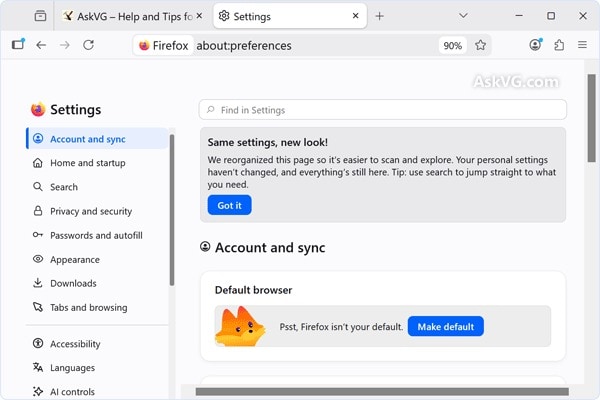
Step 1. Open the Firefox application menu and select Settings. Locate the settings search field or the relevant category in the left sidebar. The visual below illustrates the redesigned Firefox settings layout; the exact rollout and section labels can vary by build.
Step 2. Open the application menu, choose Help or Help and Report as shown in your build, then select About Firefox. Allow Firefox to check for available updates and follow any prompt to restart.
Step 3. Reopen the same failing video and a known-good video on another site. If playback works after updating, stop here; you do not need to clear cookies, remove extensions, or refresh the profile.
What success looks like: The failing player starts, seeks and plays sound and picture at normal speed. If it fails: Note the installed version shown under About Firefox and continue with a controlled extension test. Managed company devices may restrict updates; ask the administrator rather than bypass policy.
Method 2. Check Site Privacy and Media Permissions Without Disabling Protection Everywhere
Choose this when one site or embedded video fails while most other videos play. Firefox privacy controls can affect cross-site resources, but turning tracking protection off globally is unnecessary and may reduce protection for unrelated browsing.
Step 1. Open the affected site. If Firefox shows a shield icon at the address bar, inspect its site-specific tracking protection status. If the site is trusted and a privacy block appears to break the player, perform a temporary, site-only comparison; return the control to its previous state afterward.
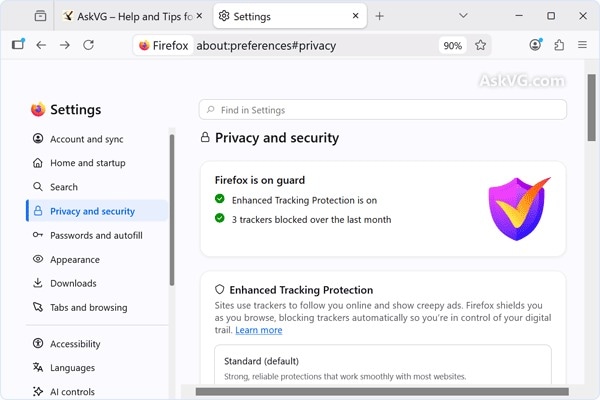
Step 2. Open Settings and locate Privacy & Security or the corresponding category in the redesigned settings navigation. This genuine Firefox settings image illustrates where privacy controls appear in a newer layout.
Step 3. Check whether Firefox reports a blocked autoplay request or a site permission decision. Playback initiated by a direct click differs from automatic video with sound; test a manual click before changing the permission. If autoplay controls are available under a site information panel or privacy settings, grant only the permissions needed by that trusted site.
Step 4. Reload the page and try a different video on the same provider. If signing out, a required cookie or a site restriction is implicated, inspect only that website’s stored data first; be aware that clearing it can sign you out.
What success looks like: Video plays on the affected website while normal protections remain enabled elsewhere. If it fails: Revert temporary exceptions and continue to extension testing; a service outage or faulty embedded player requires action from the provider, not the browser user.
Method 3. Compare Hardware Acceleration and Graphics Decoding
Use this branch when the video area is black, frames freeze while audio continues, playback flickers, or symptoms started after a GPU-driver update. Graphics acceleration is useful on many systems, so do not permanently disable it on every computer. Test one change, restart, then compare.
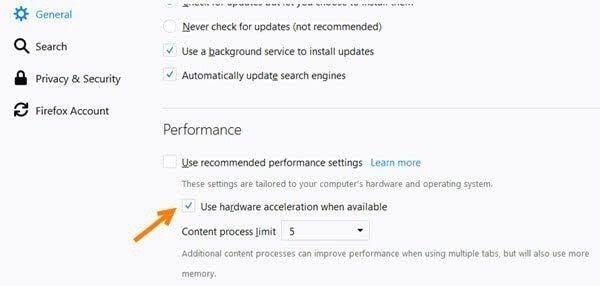
Step 1. Open Firefox Settings. Search for “performance” or navigate to the section providing performance controls in your installed build. Where present, deselect Use recommended performance settings to expose Use hardware acceleration when available.
Step 2. Note the current hardware-acceleration state. Temporarily reverse it, then quit and restart Firefox. The illustrated controls below are from an authentic older Firefox interface; the switch concept remains relevant, but the present-day screen placement can differ.
Step 3. Replay the same video at the same resolution. Look for improved picture rendering without new CPU overload, tearing, stuttering, or excessive heat. If the symptom worsens, restore the original setting and restart again.
Step 4. If the workaround helps only temporarily, check graphics-driver updates from the device maker and review Firefox release notes. A driver or platform media-decoder bug requires an appropriate vendor fix; changing a checkbox is a diagnosis, not proof of the underlying cause.
What success looks like: The formerly black, frozen or flickering player produces stable video and synchronized sound. If it fails: Restore the previous performance setting and move to Troubleshoot Mode; avoid experimental about:config media switches without an identified problem.
Method 4. Review Firefox Privacy Controls and Isolate Extension Conflicts
If Firefox loads a normal webpage but video buttons do nothing, an ad blocker, script filter, privacy extension or modified browsing profile may be interfering. Unlike deleting a profile, a temporary extension isolation test is reversible and protects bookmarks and other user data.
Step 1. Save any unsent form content, then choose the Firefox menu, Help (or Help and Report) and Troubleshoot Mode. Restart and choose Open, not Refresh Firefox. The Mozilla Troubleshoot Mode guide explains that this mode temporarily disables extensions and several customizations, including hardware acceleration; therefore one positive result alone does not identify an extension as the sole cause.
Step 2. In the troubleshooting session, test one reliable video from the affected site. If the player now works, quit Troubleshoot Mode and start Firefox normally. Open Add-ons and themes and disable extensions in small groups before retesting. Restore extensions individually to find the specific conflict.
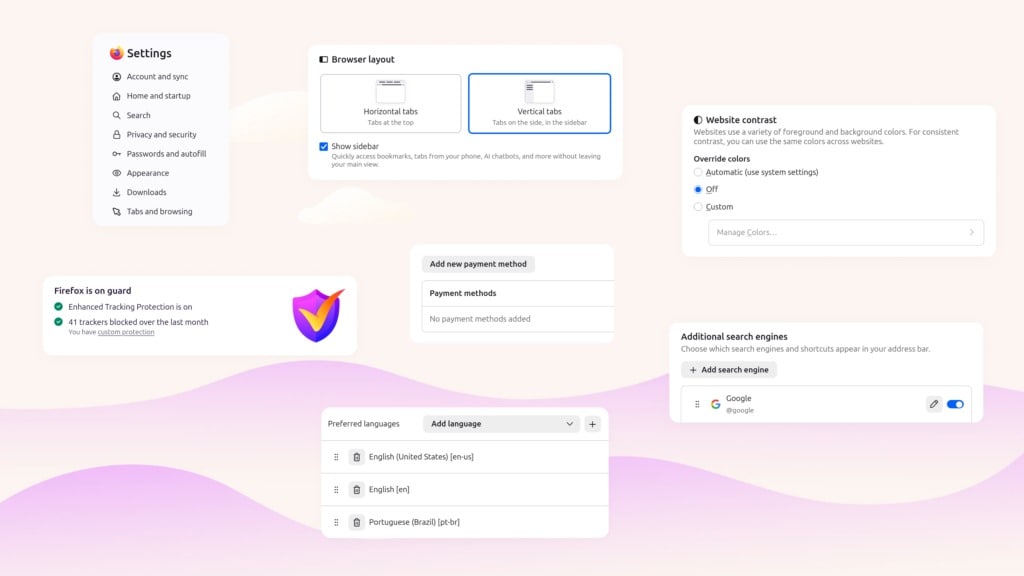
Step 3. Review the site’s content and tracking permissions. The image below is a genuine Mozilla illustration of the redesigned Firefox privacy controls and protective site features, not a screenshot of the Troubleshoot Mode dialog.
Step 4. Once the responsible extension or setting is identified, update it, create a narrow allow rule for a site you trust, or replace it. Do not leave all content protections disabled merely to make one embedded player work.
What success looks like: The video works in normal Firefox after one specific extension or customization is adjusted. If it fails: If the issue also happens in Troubleshoot Mode, investigate DRM, the network/service and the exact media error rather than deleting extensions at random.
Part 3. Targeted Diagnosis for DRM, Buffering, Audio and Unsupported Formats
Some failures are not resolved by the four illustrated settings tests. The next branches explain when another remedy is appropriate and what to verify before attempting it; they are diagnostic decisions rather than unsupported claims of a universally effective browser setting.
DRM-Protected Video Is Not Playing in Firefox
Subscription services may rely on Encrypted Media Extensions and a platform-compatible content decryption module such as Widevine. Check whether the provider officially supports your Firefox version and operating system, whether the account is authorized, and whether the browser has permission to play DRM-controlled content. Firefox settings may offer Play DRM-controlled content, but its location can differ across UI generations. A disabled, updating or unavailable content-decryption module can cause protected movies to fail while ordinary HTML5 videos work.
Avoid trying to download protected content, install unofficial decryption plugins, or bypass the provider’s restrictions. If the provider does not support your OS, browser or geographic access, use a legitimately supported playback method. A browser error on a protected stream does not mean a local video needs file recovery.
YouTube or Other Streams Keep Buffering
When the player starts but pauses to load, test a lower resolution in that service’s quality menu and compare on another network. Also test the same content on a second browser using the same connection. If both browsers buffer, inspect internet reliability or provider status before reconfiguring Firefox. VPNs, network filters or congested Wi-Fi can affect delivery, but changing them should follow local network/security policy.
For one website that stopped playing after cached data changed, Firefox’s official troubleshooting guidance recommends clearing relevant cookies and temporary cached pages. Be selective: clearing all cookies may sign you out of multiple accounts. Restart the affected tab and verify whether the video loads beyond its previous stopping point.
Firefox Plays Audio but Shows a Black Screen
Audio without picture frequently directs attention toward the video output path, graphics acceleration, codecs or a site player overlay. First compare the same stream in another browser, then try the hardware-acceleration test in Part 2. If an embedded video is black but the provider’s own player works, report the embedding problem to that site. Do not install anonymous “codec update” executables from pop-ups.
An Unsupported Format or MIME-Type Message Appears
Websites determine which media files, containers, codecs and MIME types they serve. An unsupported video message can indicate a site configuration or media compatibility fault even if Firefox is healthy. Ask the site owner to check the delivered video and content type when multiple modern browsers disagree about support. For files you own, test a known-good MP4 in another player and inspect the container and codec with a reputable media-inspection tool before deciding whether conversion is necessary.
Firefox Has No Sound but the Picture Plays
Check the tab’s mute indicator, the player’s own volume control and the operating system’s selected output device. On Windows, compare the browser entry in the volume mixer; on macOS, confirm the selected audio output. Bluetooth devices and HDMI monitors can receive the audio unexpectedly. If other websites also have silent audio, this is unlikely to be a single video-file corruption problem.
Part 4. When Should You Reset Firefox or Recover a Local Video?
A reset can remove extensions or preferences and is not the first response to video playback failure. Data recovery is an even narrower use case: it helps only when the user actually lost a locally stored original video, not when an online player buffers or a website lacks a stream.
When a Firefox Refresh or New Profile Is Justified
Consider Refresh Firefox only after documented low-risk tests fail and you have recorded extension and preference changes. The Mozilla troubleshooting documentation says a refresh retains important data such as bookmarks and passwords while removing extensions and resetting customizations. Confirm the current supported behavior in the official Mozilla help documentation, and export or back up important profile information before proceeding. A clean additional Firefox profile can be a safer diagnostic alternative when you want to compare profiles without overwriting the original one.
When a Missing Local Video Is a Recovery Problem
If a local video was accidentally deleted from your computer or removable storage, stop adding new files to that storage and check backups first. Recoverit can be considered for a genuine missing-file recovery attempt on a supported device. See the Recoverit for Windows data recovery page for applicable scenarios and product limitations. If recovery is possible, save recovered files to a different device to reduce overwrite risk. Recoverit does not repair an online website or Firefox browser.
If a video exists on disk but will not play in any compatible local application, file corruption is a different question from browser performance. For confirmed missing local recordings, the Recoverit video recovery feature overview describes recoverable storage scenarios; a website playback error alone does not qualify. If you have an independently verified file-integrity problem, retain the untouched original before trying repair or conversion.

Part 5. Quick Firefox Video Playback Troubleshooting Checklist
Keep this checklist as a decision record instead of changing multiple variables simultaneously. Each item should produce a yes/no observation that narrows the cause.
- Site: Does the same video work at its provider URL rather than an embedded copy?
- Scope: Do two unrelated websites fail, or only one?
- Browser: Does a second up-to-date browser play it on the same connection?
- Extensions: Does Firefox Troubleshoot Mode change the result?
- Graphics: Does reversing acceleration change black-screen or stutter symptoms?
- Protected content: Is the video DRM-protected and the provider officially compatible?
- Network: Does reducing quality or switching networks remove buffering?
- Local file: Can a known-good video play in a standalone media player?
If the same error remains after these comparisons, collect the exact Firefox version, OS version, website, error text and troubleshooting results before contacting Mozilla support or the streaming provider. Include screenshots only after hiding account information and personal browsing details.
Conclusion
Firefox videos not playing can have several unrelated causes, and the fastest safe fix depends on where playback first fails. Check the site and a control video, verify a current Firefox build, try site-specific permissions, compare graphics acceleration, and isolate add-ons without deleting your profile. Handle DRM support, unsupported media and network buffering as separate diagnostic branches. Reserve Recoverit for a genuinely missing local file; it does not fix Firefox or a streaming service.
FAQ
-
Why is Firefox not playing videos even though Chrome works?
A Firefox-specific extension, site permission, graphics configuration or compatibility difference may be responsible. Test two sites and Troubleshoot Mode before changing system codecs. -
How do I fix a black video screen in Firefox?
Test a known-good video and compare hardware acceleration with a Firefox restart. If audio works but the video is blank, inspect the graphics decoding path and site player. -
Why does Firefox keep loading videos forever?
A buffering spinner may reflect network delivery, provider issues, blocked site resources or stale site data. Compare networks, video quality and another browser. -
Can I enable video autoplay in Firefox?
Firefox offers site-specific and global autoplay controls. Test a manual click first and permit sound autoplay only for sites you trust. -
What does Firefox no video with supported format and MIME type found mean?
The website may be serving a format, codec or MIME type the browser cannot handle. This is not automatic proof that your downloaded file is corrupt. -
Does Firefox support protected Netflix-style videos?
Supported DRM playback depends on Firefox, operating system, content decryption module and service requirements. Use officially supported devices and services. -
Should I disable hardware acceleration permanently?
Not automatically. Reverse the setting only as a controlled comparison, restart and restore it if performance or rendering gets worse. -
Should I refresh Firefox if videos will not play?
Only after targeted comparisons fail and you understand which extensions and settings will reset. Back up important profile data first. -
Can Recoverit fix Firefox videos not playing?
No. Recoverit is for supported data recovery tasks such as genuinely lost local files, not for streaming servers, autoplay controls or browser add-ons. -
Why do videos play in private browsing but not a normal window?
The difference can involve cookies, stored site data or extensions with different private-window permissions. Compare settings rather than assuming the problem is fixed by deleting your profile.


