TL;DR:
You can recover lost data from a BTRFS-formatted desktop external drive by mounting the volume as read-only on Linux, extracting files from existing snapshots, or using cross-platform sector-level recovery software.
● Stop all write operations immediately and mount the affected partition in read-only mode (`sudo mount -o ro`) to prevent further file system corruption.
● Avoid running `btrfs check` with write options on a heavily damaged volume, as this can worsen data loss; create a full disk image using `ddrescue` before attempting any advanced repairs.
● If the volume fails to mount or was quick-formatted, use block-level recovery tools like Wondershare Recoverit (which does not require a native Linux OS) and save the recovered files to a completely different physical drive to avoid overwriting sectors.
Ask AI for a summary
 ChatGPT
 Perplexity
 Gemini
 Claude
 Grok
Grok
Introduction about recovering BTRFS from Desktop External Drive
If your Linux external disk suddenly shows up as empty or unreadable, it is still possible to recover BTRFS from Desktop External Drive volumes in many cases. By avoiding new writes, running a few safe checks, and then using purpose-built data recovery tools, you can often bring back important photos, projects, and backups without permanent loss.
Try Recoverit to Recover Lost Data
 Security Verified. Over 7,302,189 people have downloaded it.
In this article
Data Loss Scenarios about BTRFS in Desktop External Drive
To successfully recover BTRFS from Desktop External Drive, it helps to understand how and why files disappear. Data loss can be caused by simple user mistakes, file system issues, or deeper hardware faults that need professional help.
- Accidental deletion of folders, subvolumes, or snapshots using rm, btrfs subvolume delete, or file managers.
- Quick format or re-partitioning of the external drive to another file system such as ext4, NTFS, or exFAT.
- File system corruption after unsafe ejection, power failure, kernel panic, or system crash during writes.
- Metadata damage in BTRFS due to bugs, improper btrfs balance, or interrupted scrub/defrag operations.
- Malware or ransomware encrypting or wiping visible files on the external drive.
How To Recover Lost BTRFS Data from Desktop External Drive
This section covers simple, relatively safe actions you can try yourself to recover BTRFS from Desktop External Drive before turning to specialized recovery software. Always minimize writes to the affected disk as you work.
Method 1: Basic connection and system checks
Step 1: Check physical connections and power
- Connect the desktop external drive directly to a rear USB port on your PC instead of a hub.
- For 3.5-inch desktop drives, make sure the external power adapter is firmly plugged in and the LED is on.
- Try a different USB cable and a different computer to rule out port or cable faults.
Step 2: Confirm the drive is detected by the OS
- On Linux, run lsblk or sudo fdisk -l to see if the disk and partitions are listed.
- Check dmesg | tail immediately after plugging in to look for connection or file system errors.
- If the disk appears but is not auto-mounted, avoid formatting prompts from graphical tools.
Step 3: Mount the BTRFS volume read-only
- Create a safe mount point, for example: sudo mkdir -p /mnt/recover_btrfs.
- Attempt a read-only mount to prevent further changes: sudo mount -o ro,relatime /dev/sdXN /mnt/recover_btrfs (replace /dev/sdXN with your partition).
- If it mounts successfully, immediately copy your most important files to a separate disk.
When to stop: If mounting hangs, produces repeated I/O errors, or the drive makes unusual noises, stop and avoid further DIY attempts. Continued access can worsen physical damage and make later recovery harder.
Method 2: Use BTRFS tools and snapshots
Step 1: Inspect file system health cautiously
- Use sudo btrfs filesystem df /mnt/your_mountpoint (if it mounts) to examine space usage and see if data is still allocated.
- Check available subvolumes and snapshots with sudo btrfs subvolume list /mnt/your_mountpoint.
- If you see expected snapshots, you may be able to restore older versions of deleted files.
Step 2: Recover from BTRFS snapshots or older states
- Browse into a snapshot directory (for example, .snapshots or your distro-specific path) in read-only mode.
- Copy needed files from the snapshot to another healthy drive instead of moving them within the damaged one.
- If your distribution uses Btrfs with automatic snapshots (like openSUSE or some backup tools), target the snapshot created just before the loss occurred.
Step 3: Use btrfs check only when necessary
- Running btrfs check with write options on a damaged volume can sometimes worsen corruption.
- If data is critical, first create a full disk image with ddrescue to another drive and work on the copy.
- For complex errors or unfamiliar output, consider switching to a professional solution rather than forcing repairs.
If these techniques do not allow you to recover BTRFS from Desktop External Drive or the volume will not mount at all, using a dedicated recovery program that scans at the sector level is usually the safest next step.
How to Use Recoverit to Recover Lost BTRFS Data from Desktop External Drive
When manual checks and BTRFS tools are not enough, a professional utility can greatly improve your chances to recover BTRFS from Desktop External Drive devices. Recoverit by Wondershare is a powerful yet easy-to-use data recovery program that works with external hard drives, SSDs, USB flash drives, and more. It scans your disk sector by sector to find deleted, formatted, or inaccessible files and lets you preview them before restoring. You can download it safely from the Recoverit official website for Windows or macOS.
- Supports recovery from external HDDs, SSDs, USB drives, memory cards, and other common storage devices.
- Uses advanced scanning algorithms to locate deleted, formatted, or corrupted files, even when the file system is damaged.
- Offers file preview before recovery so you can confirm you are restoring the correct photos, videos, documents, and more.
Step-by-step guide: recover BTRFS from Desktop External Drive with Recoverit
-
Choose a Location to Recover Data
Install and launch Recoverit on a working computer. On the main interface, you will see a list of detected disks and partitions. Locate your desktop external drive that previously used the BTRFS file system. Select this drive as the target recovery location.
Make sure the drive is firmly connected and visible to the system. If it does not appear, try another USB port or cable, then restart Recoverit so it can rescan the hardware list.

-
Deep Scan the Location
Click "Start" to begin scanning the selected external drive. Recoverit will automatically run a full, in-depth scan that reads the disk sector by sector to locate lost or deleted data.
During the scan, you can monitor progress in real time. Use the file type and path filters on the left panel to narrow down the results while the scan continues in the background. For a heavily used or large desktop drive, allow the scan to complete so that all possible recoverable items are listed.

-
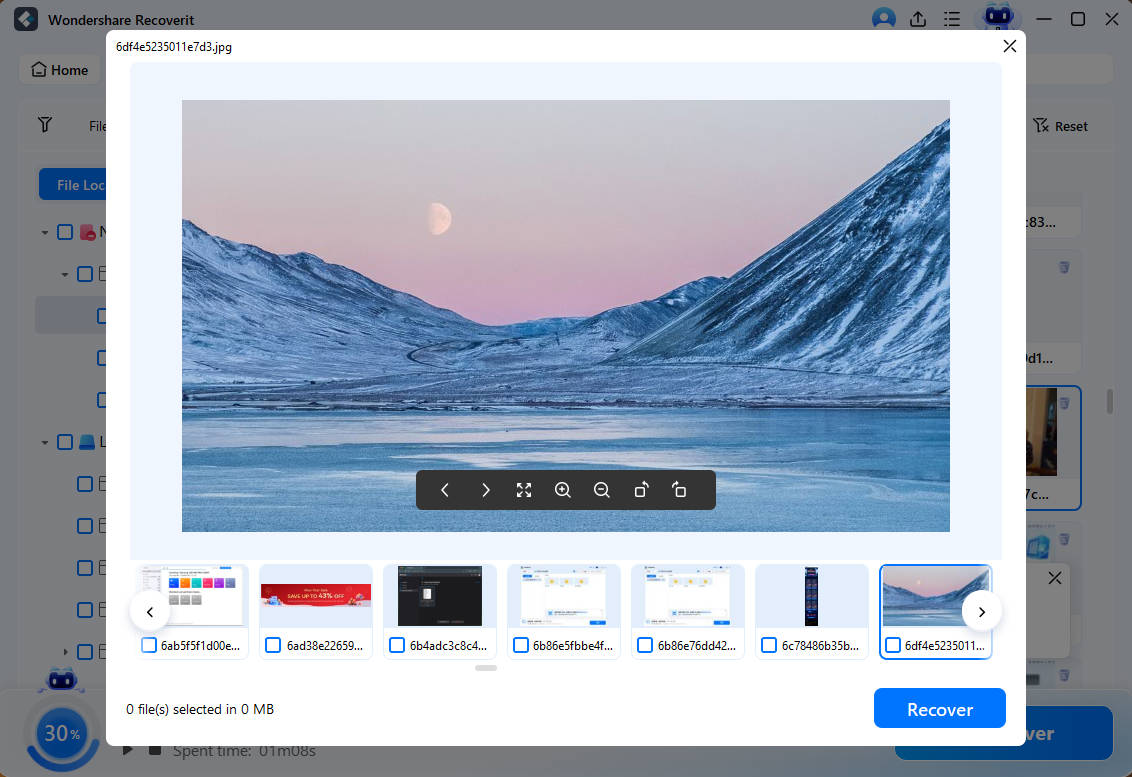
Preview and Recover Your Desired Data
When the scan is finished, browse the results by file type (images, videos, documents, etc.) or original folder structure. You can also search by file name if you remember specific items.
Click on a file to preview it and confirm the content is intact. When you have selected everything you want to restore, click the "Recover" button. Choose a safe destination on a different drive or partition (not the original BTRFS external disk) to save the recovered files and avoid overwriting any remaining data.
Practical Tips for BTRFS Desktop External Drives
- Stop using the affected drive immediately after noticing data loss to reduce the risk of overwriting recoverable sectors.
- Whenever possible, connect the external drive to a stable Linux system and attempt read-only access first.
- Create a full disk image with ddrescue before experimenting with advanced tools or risky repairs.
- Enable BTRFS features such as periodic snapshots to give yourself more restore points for future incidents.
- Use a reliable UPS and always safely eject the external drive before unplugging it to avoid sudden power cuts.
Conclusion
Data loss on a BTRFS-formatted desktop external drive can be stressful, but your files are often still present on the disk. By acting quickly, avoiding new writes, and starting with simple checks and BTRFS snapshots, you can frequently restore important folders on your own.
When manual methods fail or the file system is badly damaged, Recoverit provides a structured, user-friendly way to scan the drive deeply and bring back deleted, formatted, or inaccessible data. Combine this with regular backups and careful handling of your external hardware to greatly reduce the impact of any future problems.
Next: Recover Ntfs From Desktop External Drive
FAQ
-
1. Can I recover data from a BTRFS desktop external drive after formatting it?
Yes, in many cases you can still restore files after a quick format. The operation usually removes file system references but does not immediately overwrite all sectors. Stop using the drive, avoid copying anything new onto it, and run a deep scan with a recovery tool like Recoverit to locate and restore the lost data. -
2. Do I need Linux installed to recover BTRFS from Desktop External Drive?
No. While BTRFS is native to Linux, you can attach the external drive to a Windows or macOS computer and use cross-platform recovery software that scans at the block level. For advanced BTRFS-specific commands or mounting, however, a Linux environment, live USB, or virtual machine is recommended. -
3. Is it safe to run btrfs check on a corrupted external drive?
btrfs check can help in some situations, but using it with write options on a badly damaged file system may make the situation worse. If the data is very important, first create a full disk image with tools such as ddrescue, then test repairs or recovery on the image rather than the original drive. -
4. What should I avoid when my BTRFS external drive becomes inaccessible?
Avoid reformatting, repeatedly unplugging and reconnecting the drive, running heavy benchmarks, or copying new files to it. Each write operation can overwrite sectors that still contain recoverable data, lowering your chance of successful recovery. -
5. How can I prevent future data loss on BTRFS external drives?
Keep multiple backups on separate devices, enable BTRFS snapshots where appropriate, always safely eject the drive, protect it from power interruptions and physical shocks, and periodically check SMART status and run non-destructive tests to catch failing hardware early.