


 TL;DR:
The safest way to recover a deleted video is to immediately stop using the storage to prevent overwriting, then restore from Google cloud trash, use a desktop tool like Recoverit for removable SD cards, or check local Gallery bins before attempting invasive internal scans.
● Google Photos and Google Drive retain deleted files in their Trash folders for 30 days before permanent deletion, offering the safest restore point without requiring a storage scan.
● For missing SD card videos, remove the card immediately and scan it on a computer using desktop software like Recoverit, saving recovered files to a separate drive and stopping if the card shows a 0-byte capacity.
● Android recovery apps like DiskDigger or Dr.Fone are restricted by internal storage encryption and permissions; installing them on the affected phone risks overwriting the lost data, and rooting the device cannot restore overwritten blocks.
Ask AI for a summary
 ChatGPT
 Perplexity
 Gemini
 Claude
 Grok
Grok
Quick Answer
- If you deleted a backed-up video: Open Google Photos or Google Drive Trash first. A cloud restore is safer than installing a recovery app.
- If the video was on an Android SD card: Stop using the card, remove it, and scan it on a computer with dedicated recovery software such as Recoverit.
- If the video was in internal phone storage: Check the phone's Gallery or Files trash, then use only a recovery tool that supports your device and access conditions. Android permissions, encryption, and newer storage protections can limit deep recovery.
- If the video was permanently deleted: Recovery may still be possible from removable storage until new data overwrites it, but no app can guarantee recovery after overwrite or restore a file that no longer exists in a backup.
When you search for a video recovery app, you may mean an Android app, a desktop program for an SD card, or a cloud restore tool. These options do different jobs. The correct choice depends on where your video was stored, whether the device is still detected, and whether new data has replaced the deleted file.
Use the least invasive path first: stop writing to the affected storage, check available backups and trash folders, and recover to a different location. You can then use a repair or reformatting step only after you have verified the recovered copies.
In This Article
Part 1. Choose The Right Video Recovery App
Where Your Video Was Stored
Start by identifying the storage location. You may see the video in a cloud account, a phone's internal storage, a removable microSD card, or an app-specific folder. The storage location determines whether you can recover it with a mobile app, a desktop tool, or a backup.
| Original location | Best first option | Main limitation |
| Google Photos backup | Restore the item from Photos Trash | Google Photos permanently deletes items after the applicable Trash period. A permanently deleted item cannot be restored from Google Photos. |
| Google Drive backup or upload | Restore the file from Drive Trash or download the backed-up copy | The file must have been uploaded to the same Google account and remain available. |
| Android internal storage | Check Gallery, Files, and the app that created the video | Android storage permissions, encryption, trim behavior, and device support can prevent a deep scan. |
| Android microSD card | Remove the card and scan it on a computer | Do not save the recovered video back to the same card. |
| Messaging or social media app | Check the conversation, app backup, or original sender | A recovery app may not be able to read another app's private or encrypted storage. |
For Android storage behavior, you can review the official Android storage documentation. It explains why an app cannot automatically access every folder or another app's private files.
What You Should Do Before Recovery
Take these steps as soon as you notice a missing video:
- Stop recording and downloading: Do not take new photos, record videos, install a recovery app, or copy files to the affected phone or SD card.
- Do not format the card: Cancel any format prompt. Formatting can remove the file-system information that helps you locate lost files.
- Check the account and trash folders: Look in Google Photos, Google Drive, Files by Google, and your phone's Gallery or File Manager.
- Use another destination: Prepare a computer drive or external drive with enough free space. Save restored videos there, not on the source phone or card.
- Stop if the card is unstable: Repeated disconnects, 0-byte capacity, unusual heat, or physical damage are signs to stop software attempts and consider professional recovery.
These precautions protect the deleted video's storage area from being reused. They also prevent a recovery app download from overwriting the same internal storage you are trying to scan.
Part 2. Compare Video Recovery Apps And Methods
There is no single best app to recover deleted videos for every situation. Use a cloud service when a backup exists, a mobile utility when the file is still in a trash folder, and desktop software when you need to scan a removable card without installing anything on the card itself.
| App or method | Best for | What you can expect | Important limit |
| Google Photos Trash | Backed-up photos and videos deleted from Google Photos | Fast restore without a storage scan | It does not restore content permanently deleted from Trash. |
| Google Drive Trash | Videos uploaded to Drive | Restore the cloud file to its original Drive location | Drive cannot restore a file after it has been permanently removed from Trash. |
| Files by Google or phone Gallery Trash | Recently deleted local files | Restore the item if the app's trash still contains it | Trash support and retention depend on the app, phone model, and version. |
| DiskDigger | Some Android devices and removable media | May find recoverable images or files when the device exposes readable storage | Broader internal-storage scanning may require root, and root access does not guarantee recovery. |
| Dr.Fone Android Data Recovery | Supported Android devices connected to a computer | Device-based recovery workflows with support depending on the model and Android version | USB debugging, device support, permissions, and storage conditions affect the result. |
| Wondershare Recoverit | SD cards, microSD cards, USB drives, cameras, and other removable storage | Scan the card on Windows or Mac and preview recoverable video files before saving | The card must normally be detected with usable storage, and recovered files must be saved elsewhere. |
Google Photos And Google Drive
Cloud restore should be your first choice when you enabled backup before deleting the video. It does not write to the phone's deleted-data area and usually gives you the original cloud copy or a synchronized version.
Google's current Android help guidance states that deleted photos and videos remain in Google Photos Trash for 30 days before permanent deletion. Once an item is permanently deleted, Google says it cannot be restored from Photos. Check Google's photo and video deletion policy for the account and device conditions that apply to you.
Google Drive keeps deleted files in Trash for 30 days before permanent deletion under its current help guidance. You can review Google Drive's file restoration instructions before using a recovery app.
Files By Google And Phone Gallery Trash
If you deleted the video through Files by Google, your phone's Gallery, or a camera app, open that same app and look for Trash, Bin, or Recycle Bin. Restore the file to a normal folder, then copy it to a computer or another drive.
Do not assume that every Android phone has the same retention period or menu path. Check the app's current help information and the device manufacturer's instructions. For Files by Google, you can use Google's official Trash instructions.
DiskDigger And Android Recovery Apps
You can try an Android deleted video recovery app when the lost file was stored on a device or card that the app can read. DiskDigger's official Android documentation distinguishes between basic and full scans, with deeper recovery more likely on rooted devices. Rooting can change the phone's security state, trigger a reset on some devices, void support, or make the original data harder to preserve.
Before you install any free video recovery app on the phone, check the app's permissions, developer identity, refund terms, and destination path. Do not install it on the same removable card. If the video is important and the card can be removed, a computer-based scan avoids writing the recovery software to the card.
For a computer-based Android workflow, you can review Dr.Fone Android data recovery. Device and Android-version compatibility can change, so confirm the supported model and required connection permissions before proceeding.
Use an Android app only when you understand the access limits. A claim that an app can recover permanently deleted videos does not mean it can bypass encryption, recover overwritten blocks, or restore a file that was never stored on accessible media.
Desktop Recovery For Android SD Cards
A microSD card is a separate storage device. If the video was saved there, remove the card and connect it to a computer with a reliable card reader. A desktop video recovery application can then scan the card directly without using the Android phone as a bridge.
This path is suitable when the card has a stable capacity but the files are deleted, missing, formatted, or inaccessible. It is not a hardware repair method. If the card shows 0 bytes, No Media, a changing capacity, or repeated disconnects, stop scanning and consider a professional lab.
Part 3. Recover Deleted Videos From An Android SD Card
Use this workflow when the missing videos were stored on a removable SD or microSD card. You can use Recoverit on Windows or Mac to scan the card, preview results, and save the files to another healthy location.

Connect The Card Without Writing To It
Step 1. Stop using the Android phone and remove the SD or microSD card. If the phone asks you to format the card, cancel the prompt.
Step 2. Insert the card into a quality card reader or SD adapter. Connect the reader directly to your computer instead of using a damaged hub or loose cable.
Step 3. Confirm that Windows or macOS detects the card with a stable capacity. Do not initialize it, run a repair command, or copy new files to it before recovery.
Scan The Card With Recoverit
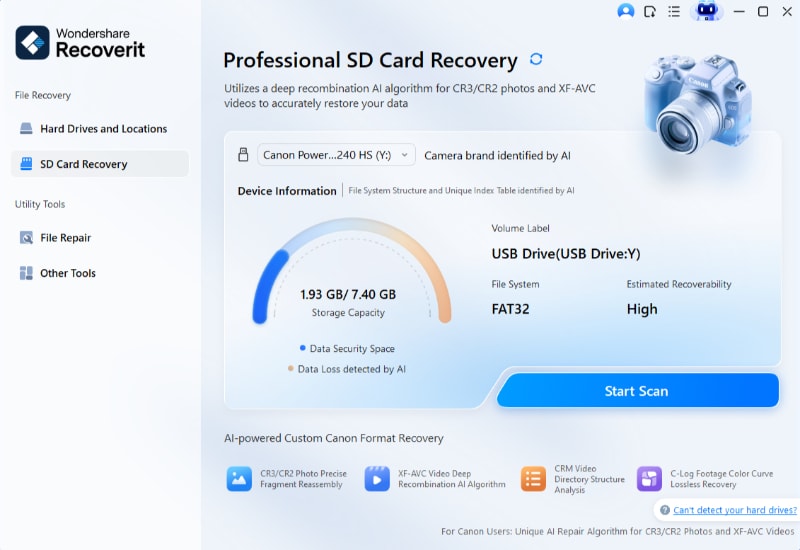
Step 1. Open Recoverit and select the connected SD card from the storage-device list. Choose the card itself rather than a folder on your computer.
Step 2. Start the scan. Keep the reader connected while Recoverit searches for deleted, formatted, or inaccessible files.
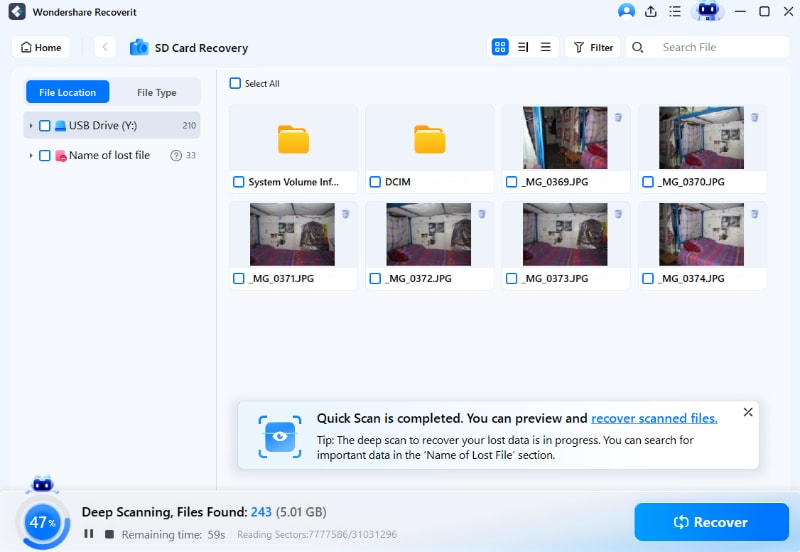
Do not save scan results, recovered files, or a new recording to the source card. If the card disconnects repeatedly or becomes unusually hot, stop the scan.
Preview And Save The Videos
Step 1. Filter the results by video type or search by a file name when available. Camera and phone clips may use formats such as MP4, MOV, 3GP, or other device-specific containers.
Step 2. Preview the files that matter. A visible file name alone is not proof that the entire video is intact.

Step 3. Select the videos you need and choose Recover. Save them to your computer's internal drive or a different external drive, never back to the source SD card.
Recoverit can scan readable removable storage for lost files, but it does not repair a failed controller, bypass encryption, restore overwritten data, or guarantee that every recovered video will play. If a recovered clip exists but will not open, keep the original recovered copy unchanged and continue to Part 6.
For a card that was formatted, use the dedicated formatted SD card recovery guide. For a card that became inaccessible or corrupted, follow the corrupted SD card recovery guide.
Recover Deleted Videos From An Android SD Card
 Security Verified. Over 7,302,189 people have downloaded it.
Part 4. Restore Videos From Google Photos Or Drive
Use the cloud path before scanning a phone or SD card. If the video was backed up, you can restore a copy without touching the storage area where the local file was deleted.
Restore A Video From Google Drive Trash
Step 1. Open Google Drive in the app or at drive.google.com and sign in to the account that stored the video.
Step 2. Open Trash from the navigation menu. Search the list or sort by the date the file was moved to Trash.
Step 3. Select the video, open its menu, and choose Restore. If you only need a separate copy, download it to a computer or another safe device.
Google Drive files remain in Trash for 30 days under Google's current guidance. After permanent deletion, a recovery app cannot scan Google's servers to restore the file.
Restore A Video From Google Photos Trash
Step 1. Open Google Photos on your Android device or visit Google Photos Trash in a browser.
Step 2. Sign in to the same Google account used for backup. Open Collections, then Trash or Bin, depending on the current interface.
Step 3. Select the video and choose Restore. Confirm that the restored clip appears in your library, then download or copy it to another location.
Google Photos says deleted photos and videos remain in Trash for 30 days before they are permanently deleted under its current Android help guidance. The exact option and retention state are controlled by Google Photos, not by a third-party video restore app.
Part 5. Recover Videos From Android Internal Storage
Check Gallery, Files, And App-Specific Trash
Before you try a scan, open the app that created or stored the video. Check the camera app's folder, Gallery, Files by Google, Google Photos, and the messaging or editing app that handled the clip.
- Open the Gallery or Photos app: Look for Trash, Bin, or Recently deleted, then restore the video if it is listed.
- Open Files by Google: Select Menu, then Trash, and restore the file if it is still retained.
- Check the original app: Review drafts, downloads, project folders, chat attachments, and the app's own backup system.
- Check external backups: Search your computer, USB drive, NAS, cloud account, or another phone where you may have copied the clip.
When a video was saved only in internal storage and is missing from every trash folder, recovery becomes device-specific. Avoid installing several apps and running repeated scans because each installation and download can reuse internal storage.
Understand Root, Encryption, And Access Limits
Android does not give every app unrestricted access to every file. Newer Android storage protections, app-private directories, encryption, trim behavior, and the device's security design can prevent a recovery app from seeing deleted video data. Root access may expose more storage on some devices, but it does not undo overwrite or guarantee a usable video.
Do not unlock the bootloader, root the phone, factory-reset the phone, or flash firmware while you still need the missing videos. Those actions can erase data or change the state of the source storage. When the video is business-critical, the phone is damaged, or the device cannot stay connected, stop experimenting and ask a professional lab about the model and storage condition.
If your missing video was stored on a removable card rather than internal storage, return to the SD card recovery steps. A removable card gives you a safer option because you can scan it from another computer without installing a recovery app on the phone.
Part 6. Verify And Repair Recovered Video Files
Recovery and video repair are different tasks. A recovery app locates and copies data from storage. A video repair tool works on a recovered file that exists but has damaged metadata, missing indexes, or playback errors.
After recovery, create a second copy before testing:
- Check the file size: A zero-byte file or an unexpectedly tiny file is unlikely to contain a complete video.
- Test the container: Try a trusted player and confirm that the clip opens, seeks, and plays through its important sections.
- Keep the original copy: Work on a duplicate if you need to repair a damaged MP4, MOV, 3GP, or other video.
- Compare several clips: Check resolution, duration, audio, and frame continuity instead of judging recovery from the filename alone.
If the recovered file is present but will not play, you can review Recoverit's guide to repairing recovered video files. Do not delete the original recovered file until the repaired copy has been verified.
For a broader workflow, use the Recoverit video recovery resources to choose instructions for cameras, memory cards, USB drives, and external storage.
Conclusion
The best video recovery app depends on where your video was stored. Use Google Photos or Google Drive when a backup exists, restore local files from your phone's trash folders when possible, and scan a removable SD card on a computer instead of installing recovery software on the phone.
When an Android SD card is detected with a stable capacity, Recoverit gives you a practical desktop workflow to scan for deleted, formatted, or inaccessible videos and save the results to another drive. No recovery tool can bypass encryption, restore overwritten data, repair failed hardware, or guarantee that every recovered file will play. Stop writing to the source, verify your recovered copies, and keep more than one backup of important videos.
FAQ
-
What Is The Best Video Recovery App?
The best option depends on the storage location. Use Google Photos or Drive when a backup exists, a phone's Trash folder for recently deleted local files, Recoverit for a detectable SD card, and a compatible Android recovery tool only when internal-storage access is supported. -
Can You Recover Permanently Deleted Videos On Android?
Sometimes, if the video was stored on a removable card and its data has not been overwritten. Recovery is much less predictable from encrypted internal storage. No app can guarantee recovery after overwrite or restore a video permanently removed from a cloud Trash folder. -
Can A Free Video Recovery App Restore Deleted Videos?
A free app may restore a video from a built-in Trash folder or find limited results on supported storage. Check the app's actual preview and export limits before paying, and do not install the app on the affected SD card or save recovered files to it. -
How Do You Recover Deleted Videos From An SD Card On Android?
Stop using the card, remove it from the phone, connect it to a computer with a card reader, scan it with recovery software such as Recoverit, preview the results, and save the recovered videos to a different drive. -
Does DiskDigger Recover Permanently Deleted Videos?
DiskDigger may find recoverable data on supported Android devices or removable media, but results depend on storage access, root status, file-system condition, and overwrite. Root access does not bypass encryption or guarantee a playable video. -
Where Do Deleted Videos Go On Android?
They may move to Google Photos Trash, a Gallery or Files trash folder, an app-specific recycle bin, or remain on storage as space marked available until new data reuses it. The exact behavior depends on the app, device, Android version, and backup settings. -
Why Does A Recovered Video Not Play?
The file may have missing metadata, an incomplete data stream, or a damaged container. Keep the recovered original, make a copy, and use a video-repair workflow on the duplicate. A zero-byte or heavily overwritten file may not contain enough data to repair.


