

 TL;DR:
Stop repeatedly attempting to format the SD card to prevent permanent data loss, and instead recover your inaccessible files before troubleshooting physical lock switches, testing alternative USB card readers, or clearing software-level write protections.
● Clear software read-only states using the DiskPart "attributes disk clear readonly" command, but you must verify the exact disk number by capacity beforehand to avoid accidentally modifying other connected drives.
● Perform the final format using Windows Disk Management or the official SD Memory Card Formatter 5.0.4, ensuring you unlock BitLocker To Go encryption first and select FAT32 for SDHC cards up to 32GB or exFAT for SDXC cards up to 2TB.
● Permanently retire the SD card if it continuously disconnects during error scans, fails across multiple known-good computers, or immediately reverts to a read-only state, as these symptoms indicate a failing flash media controller.
Ask AI for a summary
 ChatGPT
 Perplexity
 Gemini
 Claude
 Grok
Grok
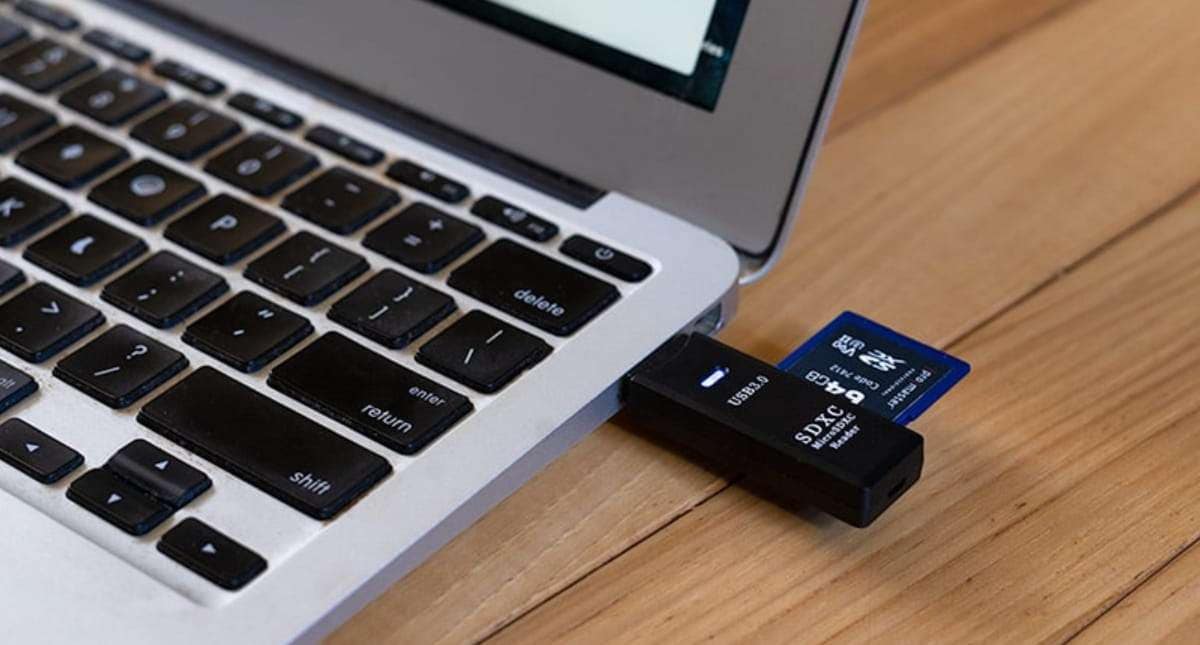
When Windows says “Windows was unable to complete the format” for an SD or microSD card, do not keep retrying the format if the card still contains files you need. The error can come from a locked card, a reader or USB connection problem, a read-only state, file-system corruption, or failing flash media. Start with the least destructive checks, protect the data, and format only after the files are safe.
Quick answer: Check the SD card lock switch and try another reader or USB port first. If Windows still detects the card, clear a software read-only attribute with DiskPart if necessary. If the files matter but are inaccessible, recover them before running repair or format operations. Then try Disk Management or the official SD Memory Card Formatter. If the card cannot complete a format on another reader or computer, replace it instead of trusting it with new data.
- Protect the data first: Copy readable files off the card. If files are inaccessible but the card is still detected, recover them before destructive formatting.
- Rule out simple causes: Unlock the card, use a dedicated card reader, and test another USB port or computer.
- Fix logical write blocks: Clear the read-only attribute only after confirming that you selected the correct SD card in DiskPart.
- Format only after recovery: Use Windows Disk Management or the SD Association formatter, then retire the card if formatting continues to fail.
In This Article
Part 1. Why Windows Was Unable to Complete the Format SD Card
The message does not point to one single failure. Formatting requires Windows to write a new file-system structure to the card. If the card is locked, the reader is unstable, the volume is read-only, the file system is damaged, or the flash memory cannot accept reliable writes, the format can stop before it completes.
SanDisk lists unsupported file systems, USB or reader problems, power loss, unsafe removal, file-system corruption, malware, and a locked SD or microSD card among common causes of this format error. Its current support guidance also recommends testing another port, computer, or reader before assuming the card itself is defective. See the SanDisk troubleshooting guide for the format error.
1.1 Diagnose the SD Card by Symptom
| What You See | Most Likely Direction | What to Do First |
| The SD card has a physical lock switch | Write protection may block formatting | Move the switch to the unlocked position and reconnect the card |
| The card works in one reader but not another | Reader, adapter, port, or connection issue | Use the working reader or a direct USB card reader |
| Windows shows the card as read-only | Software read-only attribute or controller-enforced protection | Check the physical lock, then inspect the DiskPart attributes |
| The card opens but reports file-system errors | Logical file-system corruption may be involved | Back up the files first, then run Windows Error Checking |
| The card appears as RAW or Windows asks to format it | The file-system metadata may be damaged or unsupported | Recover important files before creating or formatting a volume |
| The card disconnects, reports the wrong capacity, becomes read-only again, or fails on multiple computers | Media or controller failure is more likely | Stop repeated write attempts, recover what you can, and replace the card |
| The card is not detected anywhere | Reader incompatibility or hardware-level failure | Try one known-good reader and computer; if still absent, consider professional recovery for irreplaceable data |
Part 2. Protect Your Data Before Fixing the Format Error
Formatting is a data-destructive operation. Microsoft explicitly warns that formatting a volume destroys data on that partition. A quick format creates a new file table without fully overwriting the whole volume, but it still removes the file-system references Windows uses to access files normally. If the files matter, protect them before you repair or format the SD card.
2.1 Back Up Files That Still Open
If File Explorer still opens the SD card, copy the files you need to a healthy internal drive, external drive, or another storage location. Do not copy the backup back to the problem card until it has been successfully formatted and tested.
If the card disconnects during copying, becomes hot, or repeatedly changes between readable and unavailable, stop stressing it. Those symptoms can point to unstable media rather than a simple Windows formatting problem.
2.2 Recover Inaccessible Files Before Formatting
If the card is still detected by Windows but the files are missing, RAW, inaccessible, or affected by an interrupted format, a recovery scan is safer than repeatedly trying to format the card. Wondershare Recoverit Memory Card Recovery is designed for logical data-loss cases involving detectable SD and microSD cards, including formatted, RAW, corrupted, and inaccessible file systems. It does not repair a physically failed card and recovery is not guaranteed.

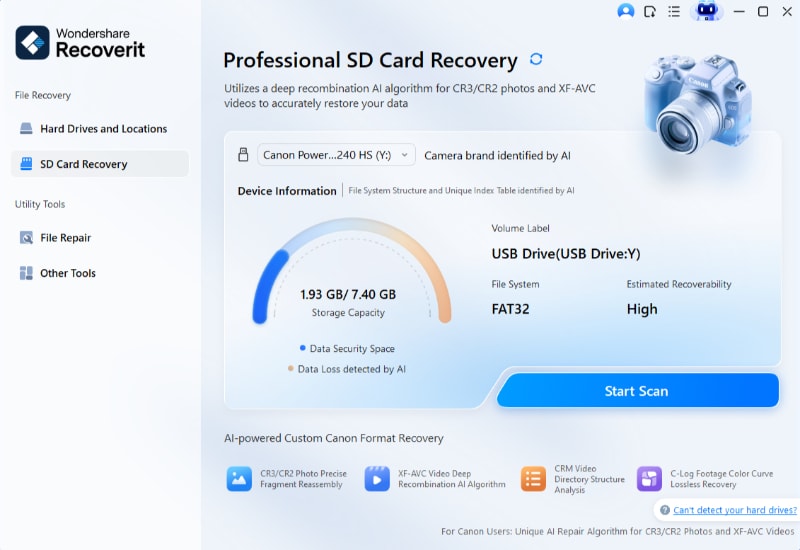
Step 1. Select the memory card.
Connect the SD or microSD card through a card reader, open Recoverit, choose the detected memory card, and start the scan.
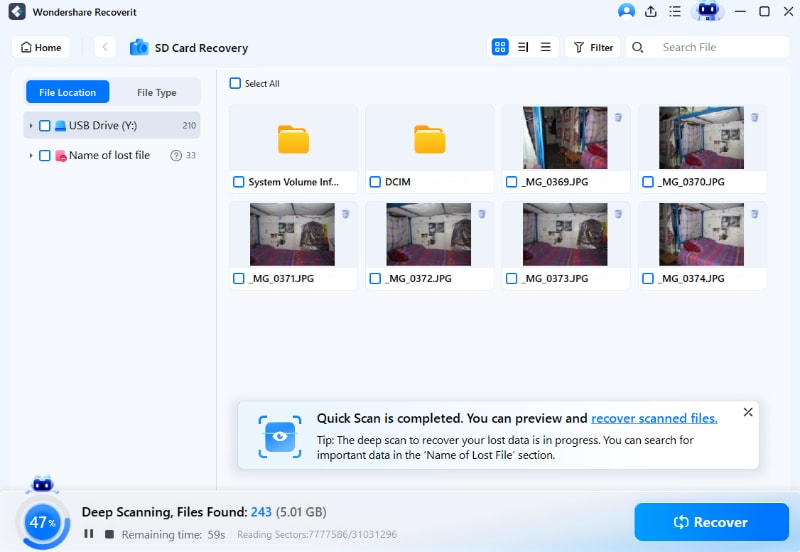
Step 2. Scan and preview the recoverable files.
Let the scan run and use the available file-location or file-type filters to narrow the results. Preview important photos, videos, or documents when preview is available.
Step 3. Recover to a different drive.
Select the files you need and save them to a healthy drive, not to the SD card you are troubleshooting. Writing recovered data back to the source card can overwrite other recoverable content.
Recover Inaccessible Files Before Formatting
 Security Verified. Over 7,302,189 people have downloaded it.
Part 3. 6 Fixes for “Windows Was Unable to Complete the Format”
Use these fixes in order. The first two are intended to rule out connection and write-protection problems. The later steps can modify or erase the card, so use them only after important files have been copied or recovered.
Fix 1. Unlock the SD Card and Test the Reader
A full-size SD card has a small lock slider on its side. Move it to the unlocked position before reconnecting the card. If you are using a microSD card, test it in a dedicated card reader instead of repeatedly using a questionable adapter.
- Safely remove the card from Windows.
- Check the lock switch on a full-size SD card and move it away from the locked position.
- Reconnect the card using a different card reader or another USB port.
- If possible, test the card on another Windows computer.
Expected result: If the problem was the lock switch or reader, Windows should be able to write to the card again. If the card stays read-only, continue to Fix 2.
Fix 2. Clear the Read-Only Attribute With DiskPart
Windows DiskPart can display and clear the read-only attribute on a selected disk. Microsoft notes that the correct disk must be selected before the attributes disk command can work. This step does not format the card, but selecting the wrong disk in DiskPart can lead to serious mistakes later, so identify the SD card by its capacity before you continue.
Step 1. Search for Command Prompt or Windows Terminal, right-click it, and choose Run as administrator.
Step 2. Enter these commands one at a time:
- diskpart
- list disk
- select disk N - replace N with the SD card's disk number
- attributes disk
- attributes disk clear readonly
- exit

Expected result: DiskPart reports that the disk attributes were cleared successfully, and the card becomes writable. If the card immediately returns to read-only or the command cannot clear the state, the card controller may be protecting failing flash memory. Do not keep forcing writes to it.
For the command definition and supported Windows versions, see Microsoft's attributes disk documentation.
Fix 3. Check File-System Errors Before Formatting
Use this method only if Windows still mounts the SD card and you have already protected important files. Windows Error Checking can repair some logical file-system errors, but it cannot repair cracked media, failing flash cells, or a failing controller.
Step 1. Open File Explorer, right-click the SD card, and choose Properties.
Step 2. Open the Tools tab. Under Error checking, choose Check.
Step 3. Follow Windows prompts to scan the drive. If Windows repairs a logical error, safely eject and reconnect the card before trying the format again.
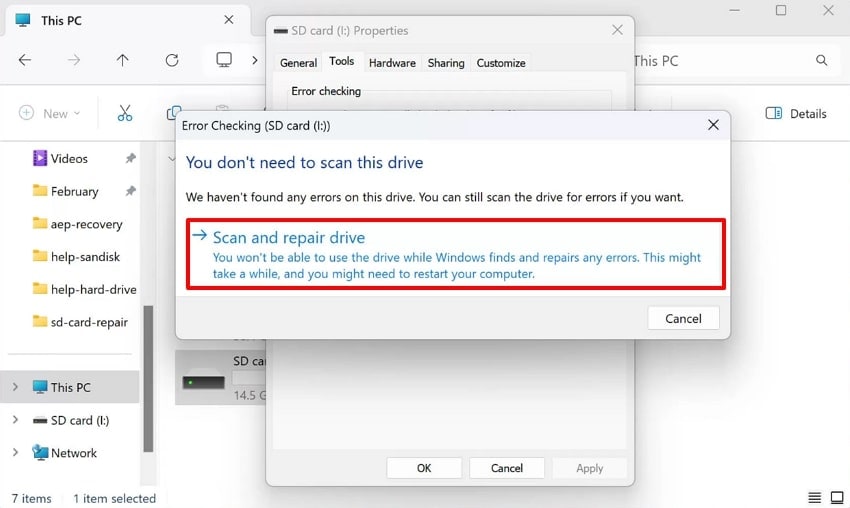
Failure branch: If the card disconnects during the scan, reports persistent I/O errors, or becomes read-only again, stop repair attempts and move to Fix 6.
Fix 4. Format the SD Card With Disk Management
Microsoft Disk Management is built into Windows 10 and Windows 11, and Microsoft states that it works the same in both versions. Use it when File Explorer formatting fails but the SD card still appears as a disk or volume.
Warning: This step erases the selected volume. Confirm that your important files are backed up or recovered before continuing.
Step 1. Right-click Start and choose Disk Management. You can also press Windows + R, enter diskmgmt.msc, and select OK.
Step 2. Identify the SD card by its capacity. Do not select the Windows system drive.
Step 3. If the card has an existing volume, right-click that volume and choose Format. If the space is unallocated, right-click the unallocated area and choose New Simple Volume.
Step 4. Choose a file system that matches the SD card standard and the device that will use the card. The table in Part 4 gives the standard SD, SDHC, SDXC, and SDUC mapping.
Step 5. Keep the default allocation-unit size unless a device manufacturer requires something else. Use Quick Format for a normal reformat, then confirm the warning.

Microsoft's current Disk Management guide confirms that formatting an existing volume destroys its data and that Quick Format creates a new file table without fully overwriting the volume.
Fix 5. Use the Official SD Memory Card Formatter
For an SD, SDHC, SDXC, or SDUC card, the SD Association provides a dedicated formatter and strongly recommends it over generic operating-system formatters because it follows the SD File System Specification. As of September 2026, the official Windows release is SD Memory Card Formatter 5.0.4.
Step 1. Download the formatter from the SD Association's official formatter page. Administrator rights are required.
Step 2. Insert the SD card into a compatible card reader and open the formatter.
Step 3. Confirm that the selected drive is the SD card. Choose Quick format for normal reformatting. Use Overwrite format only when you intentionally want a longer overwrite operation and no recovery is needed.
Step 4. Start the format and wait for it to finish. If the official formatter also fails, test one other known-good reader or computer instead of repeatedly retrying the same card.
Note: The SD Association states that its formatter does not format SD cards that are still locked with BitLocker To Go; unlock encrypted media first.
Fix 6. Replace the SD Card if Formatting Still Fails
A card that cannot complete a format after the lock switch, reader, read-only state, and software formatting path have been ruled out should not be treated as reliable storage. SanDisk's current troubleshooting guidance includes warranty replacement as the next step when a removable drive or memory card cannot be returned to a usable state.
- Replace the card if it repeatedly becomes read-only after you clear the attribute.
- Replace it if multiple readers or computers report the same format failure.
- Stop DIY attempts if the card disconnects, overheats, reports unstable capacity, or is physically damaged.
- If the only copy of valuable data is still on a card that is not detected anywhere, consider a professional data-recovery service before further write attempts.
A successful one-time format is not proof that a previously unstable card is trustworthy. For irreplaceable photos, videos, or work files, use a healthy card and keep a second copy elsewhere.
Part 4. Which File System Should You Use for an SD Card?
Do not choose FAT32, exFAT, or NTFS only from a generic “larger card equals a different format” rule. For standard SD cards, the SD Association defines the normal file-system mapping by card class. The target camera, drone, console, recorder, or other host device must also support that file system.
| SD Card Type | Capacity Range | Standard File System | Practical Guidance |
| SD | Up to 2 GB | FAT12 or FAT16 | Legacy cards; follow the host-device manual |
| SDHC | More than 2 GB to 32 GB | FAT32 | Common for older cameras and devices |
| SDXC | More than 32 GB to 2 TB | exFAT | Common for modern high-capacity SD and microSD cards |
| SDUC | More than 2 TB to 128 TB | exFAT | Use only with a host that explicitly supports SDUC |
The capacity ranges above come from the SD Association. If the card will be used in a camera or another dedicated device, check that manufacturer's documentation and consider formatting the card in the device after your data is backed up.
Part 5. What to Do When the SD Card Still Will Not Format
If every software method fails, the next decision depends on whether Windows still detects the card and whether the data matters.
| Current State | Best Next Step |
| Detected, files readable, format fails | Copy the files, test another reader, use the official SD formatter, then replace the card if failure repeats |
| Detected, files inaccessible, format fails | Recover important files first, then attempt formatting |
| Detected but permanently read-only | Recover readable data and replace the card; controller-enforced read-only behavior may indicate failure |
| Not detected in one reader only | Replace or bypass the reader and retest |
| Not detected in multiple known-good readers or computers | Stop DIY writes; use professional recovery if the data is irreplaceable, otherwise replace the card |
The goal is not to force every SD card back into service. The safer outcome is either a stable, correctly formatted card or a clear decision to retire unreliable media before it causes another data-loss event.
Conclusion
The “Windows was unable to complete the format” SD card error should be handled as a diagnosis problem, not a reason to keep forcing formats. Protect your files first, rule out the lock switch and reader, clear a legitimate read-only attribute when appropriate, and then format with Disk Management or the official SD Memory Card Formatter. If the card still fails across known-good hardware, replace it rather than trusting it with new data.
FAQ
-
How do I fix “Windows was unable to complete the format” on an SD card?
First protect any files you need. Then unlock the card, test another reader or USB port, clear a software read-only attribute if present, and try Disk Management or the SD Association formatter. If the card fails on multiple readers or computers, replace it. -
Why won't Windows format my SD card?
Common causes include a locked or read-only card, reader or USB problems, an unsupported or corrupted file system, malware, interrupted use, and failing storage media. The exact fix depends on whether the card is detected and writable. -
Can I force-format an SD card with DiskPart?
DiskPart can format a selected volume, but it is destructive and choosing the wrong disk or volume can erase the wrong storage device. Recover or back up important data first, verify the card by drive letter and capacity, and prefer Disk Management or the official SD formatter when possible. -
Does formatting repair a corrupted SD card?
Formatting can recreate a damaged logical file system, but it cannot repair cracked media, failing flash cells, or a failing controller. If formatting repeatedly fails or the card becomes read-only again, replace the card. -
Should an SD card use FAT32 or exFAT?
Under the SD standard, SDHC cards above 2 GB through 32 GB normally use FAT32, while SDXC cards above 32 GB through 2 TB normally use exFAT. Always check the target device's compatibility requirements. -
Can I recover files after a failed or quick format?
Recovery may still be possible when the card remains detectable and new data has not overwritten the old content. Stop using the card, scan it with a recovery tool, and save recovered files to a different drive. Recovery is not guaranteed.


