TL;DR:
Data is recoverable from an ADATA SD card following accidental deletion, quick formatting, or RAW filesystem errors, provided the physical storage blocks have not been overwritten by new data or subjected to a full format.
● Choose **Wondershare Recoverit** for a user-friendly GUI capable of extracting and stitching together fragmented high-definition videos, or opt for **TestDisk** if you are an advanced user needing a command-line utility to rebuild lost partition headers.
● Halt all use of the ADATA card immediately upon noticing data loss to prevent overwriting the invisible files, and strictly avoid running the Windows `chkdsk` utility, which can permanently destroy remaining raw file signatures during its repair attempts.
● If the card suddenly locks into a "Write Protected" or "Read-Only" state, its internal flash controller has detected that the NAND memory cells have reached their maximum write limits, meaning you must extract your existing files to a separate drive before the hardware fails completely.
Ask AI for a summary
 ChatGPT
 Perplexity
 Gemini
 Claude
 Grok
Grok
Recovering deleted files from an ADATA memory card is a simple process. Whether you accidentally erased the files or formatted the card, we can assist you in retrieving your lost data.
To begin, gather a computer, a card reader, and an ADATA SD card. While not all types of data loss can be easily fixed, most cases involving an ADATA memory card can be resolved. Here's a step-by-step guide on how to perform an ADATA SD card recovery.
Can I Recover Data From an ADATA SD Card?
Yes. Sometimes when you delete files from a digital storage device, they don't disappear right away. They stay on the device, hidden from view until they are overwritten by new data. This is why it's possible to recover lost data from a memory card. However, to know if data is truly lost from an ADATA memory card, you need to thoroughly scan the card.
Let's look at some common reasons for data loss on an ADATA SD card and the potential solutions:
🔍 Technical Overview: ADATA Memory Card File Vulnerabilities
Data storage on ADATA SD cards relies on flash memory chips controlled by a specialized firmware chip. When files are lost, the success of the recovery depends entirely on whether the physical storage blocks have been completely wiped or simply unlinked in the file allocation tables (FAT32/exFAT):
| Data Loss Scenario | Underlying Flash System Behavior | Recovery Feasibility | Recommended Tool Path |
| Accidental Deletion | The file directory flags are wiped, but raw clusters holding data blocks remain completely untouched. | 98% Success Rate | Wondershare Recoverit (Instant extension filter scan) |
| Quick Drive Format | Clears the file allocation index table. The flash memory blocks are not overwritten with zeros. | 95% Success Rate | Wondershare Recoverit (Deep raw file signature carving) |
| RAW File System Error | The master boot record (MBR) or partition definitions are broken by a sudden write disconnect. | 90% Success Rate | TestDisk (Direct partition header restoration) |
| Full / Low-Level Format | Every storage cell on the card is overwritten with zeros. | Impossible | None (Data blocks are permanently wiped from the NAND chips) |
| Severe Physical Damage | The NAND flash chip is cracked, snapped, or has suffered severe high-voltage shorts. | Hardware Expert Needed | Physical chip-off recovery via a specialized cleanroom service |
| Causes | Description |
| 🗑 File Deletion | Accidentally deleting files is the most common reason for data loss; Fortunately, it's usually easy to fix. If you stop using the ADATA card and haven't overwritten the deleted files, you can use data recovery software to retrieve them. |
| 🔄 Formatting | When you format a card with Quick Format, it erases the file table. However, the files are still present on the card. A good data recovery software can scan the formatted SD card and restore the files. If you perform a Full Format on the SD card, the data becomes irretrievable. |
| 🔨 Physical Damage | Software solutions can only fix slightly physical damage. In severe cases, you should contact a specialized SD card data recovery service that can attempt to retrieve the data using specialized methods. |
Remember, the data may become permanently lost if you continue using the card. New files can overwrite the invisible deleted files, making data recovery impossible. Therefore, stop using the card once you become aware of data loss.
Video Tutorial on How To Recover Data From an ADATA SD Card
Tools to Recover Data From an ADATA SD Card
From the above explanation, you now know that in most cases, you can use data recovery software to restore lost data from an ADATA SD card. In this section, we will introduce two types of SD card recovery tools: a graphical user interface (GUI) tool and a command-line (GLI) tool. Both tools have their pros and cons, so you can choose one based on your needs.
1. Wondershare Recoverit (GUI Tool)
When recovering data from an ADATA SD card, one highly recommended software solution is Wondershare Recoverit. This graphical user interface (GUI) tool is designed to help you retrieve lost or deleted files without the need for complex technical knowledge or extensive setup. This makes the process of retrieving lost files easier for both beginners and experienced users. Moreover, Recoverit is considered as the best SD card data recovery software.
Step-by-Step Manual: Deep-Scanning ADATA Flash Sectors via Recoverit
To extract lost data from an ADATA SD, SDHC, SDXC, or MicroSD card using an automated interface, insert your storage card into a stable card reader and follow these steps:
- Connect the ADATA Media and Select the Target Volume
Insert your ADATA SD card into your computer's built-in slot or an external USB card reader. Open Wondershare Recoverit. On the main dashboard, look under the SD Card Recovery section, select your connected ADATA drive icon, and click Scan.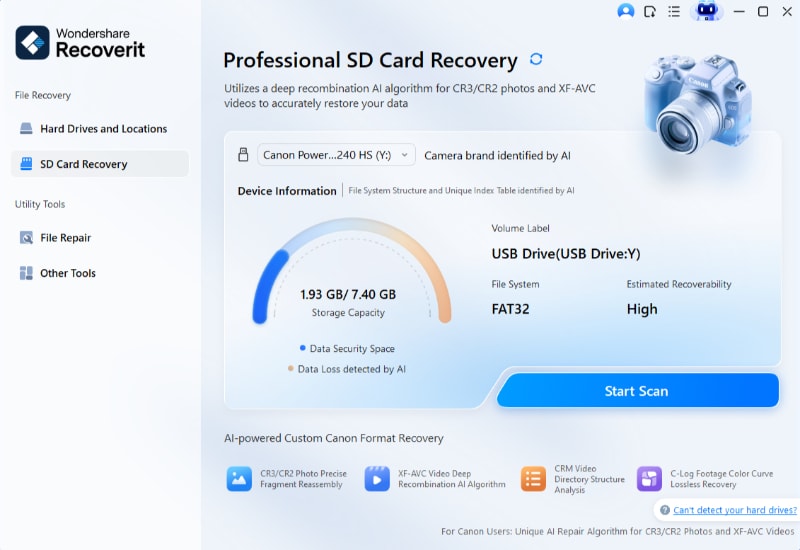
- Execute the Storage Scan and Apply Targeted File Type Filters
The software will run a simultaneous quick and deep scan across your card's raw clusters. To save time, navigate to the left-hand panel or search bar, click on File Type, and choose specific folders like Photos (JPEG, RAW, CR2) or Videos (MP4, MOV) to view the matching recovered files in real time.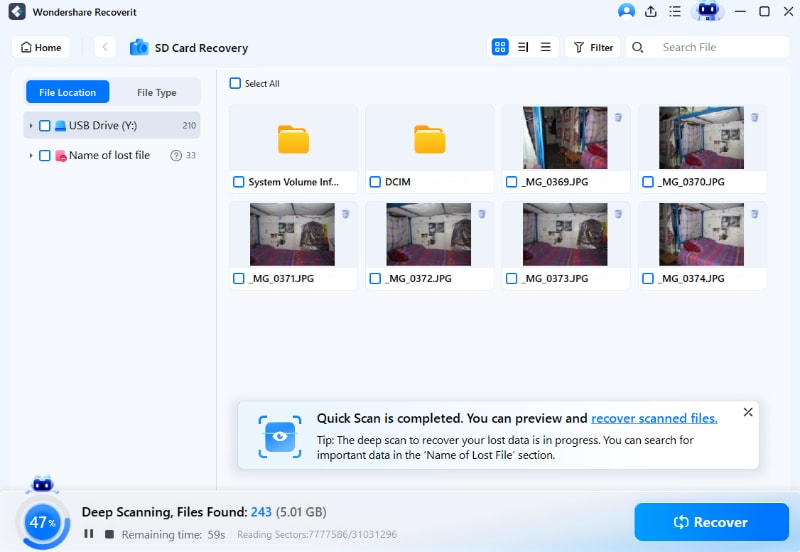
- Preview File Integrity and Extract Data to Your Computer
Once the scan completes, double-click any recovered file to open the built-in preview pane. This lets you inspect photos or play back video timelines to check for file corruption. Select the items you want to keep, click the Recover button, and choose a storage folder on your computer's internal hard drive (never save back to the source ADATA card).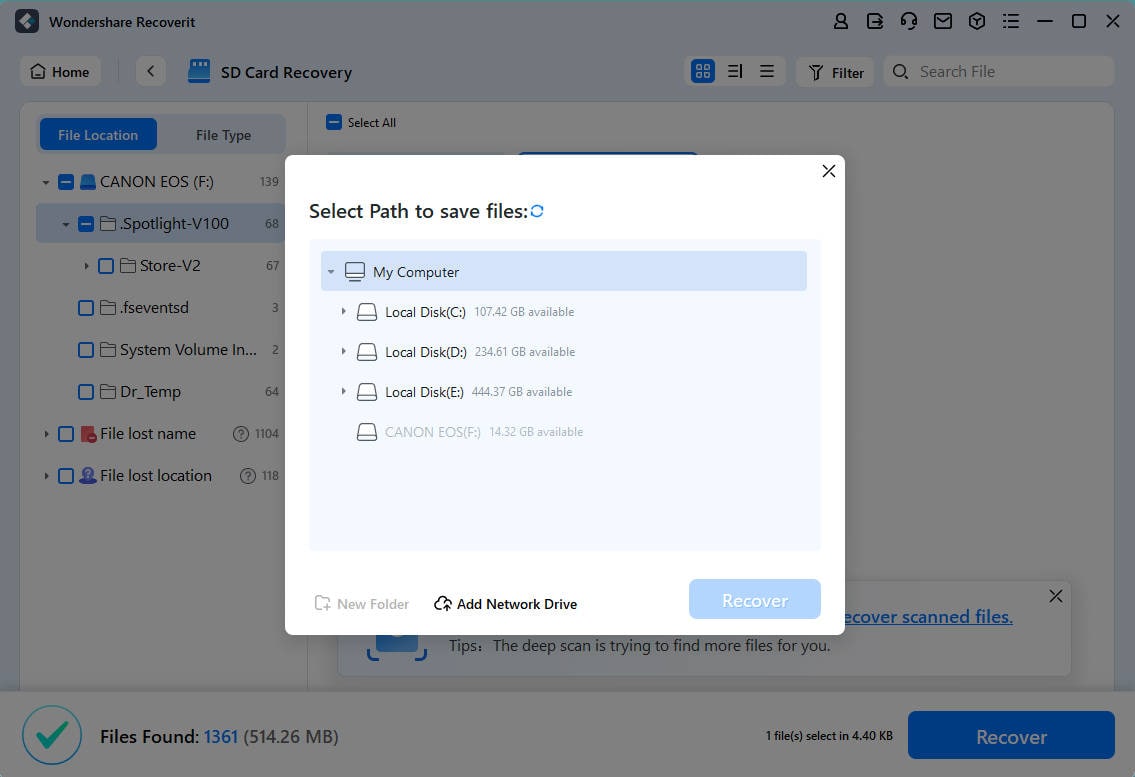
2. TestDisk (CLI Tool)
For those who prefer a command line interface (CLI) approach to data recovery from an ADATA SD card, TestDisk is an excellent choice. This powerful and versatile Adata SD card recovery and repair tool provides advanced functionality, allowing users to perform in-depth data recovery operations with precision and control.
Let's explore the notable features and benefits of using TestDisk for recovering data from an ADATA SD card:
- TestDisk is renowned for recovering lost or deleted partitions and files from various storage media, including ADATA SD cards. It supports many file systems, including FAT, NTFS, exFAT, ext2/ext3/ext4, and more.
- With a command line interface, TestDisk offers a flexible and customizable environment for executing data recovery operations. Advanced users can leverage the extensive command options and parameters to tailor the recovery process to their specific requirements.
- TestDisk specializes in repairing damaged or corrupted partition tables. It can rebuild and recover lost or damaged partitions, making it a valuable Adata SD card repair tool for scenarios where the partition structure of the ADATA SD card is compromised.
- TestDisk includes powerful features for file carving and filesystem analysis. File carving allows you to extract individual files based on their headers, even if the file system information is lost. Filesystem analysis provides insights into the health and structure of the ADATA SD card, aiding in the recovery process.
Step-by-Step Manual: Rebuilding Lost ADATA Partitions via TestDisk CLI
If your ADATA storage card has lost its partition structure or displays a RAW error message, you can use TestDisk's command-line tool to rebuild its allocation tables:
- Initialize the Tool and Generate a Clean Execution Log
Download and extract the TestDisk binaries onto your local drive. Right-click the application executable file and choose Run as Administrator. At the initial text screen prompt, use your keyboard arrow keys to highlight the Create option to open a new execution log file, and press Enter.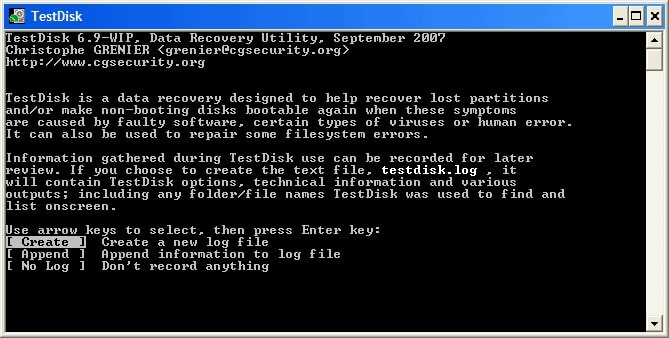
- Identify the ADATA Disk Path and Select the Partition Table Format
Review the list of connected storage drives displayed in the terminal window. Highlight your ADATA SD card volume based on its matching storage size capacity, and press Enter. The application will automatically recommend the correct partition table type—usually Intel for standard SD cards or EFI GPT for larger modern high-capacity media. Select it and press Enter.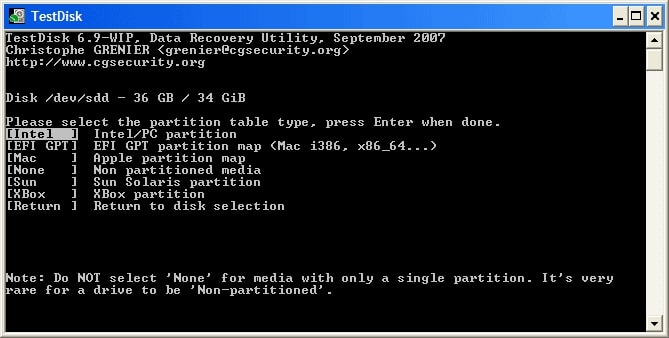
- Analyze the Current Storage Allocation Layout
Select the Analyse option from the terminal menu list and hit Enter to evaluate the current sector layout of the ADATA card. Once the initial check finishes, highlight the Quick Search command and press Enter to scan the storage sectors for old, deleted, or corrupted partition structures.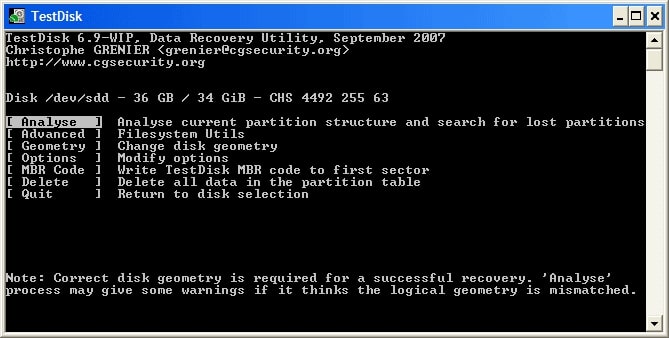
- Browse the Internal Directories and Copy the Data Blocks Out
Review the discovered partition rows listed on your screen. Press P to view the underlying files and folders contained within that partition layout. Use the arrow keys to find your missing files, press the C key to copy them, and select a folder directory on your local computer to save the data. When the terminal displays Copy Done!, your files are safely recovered.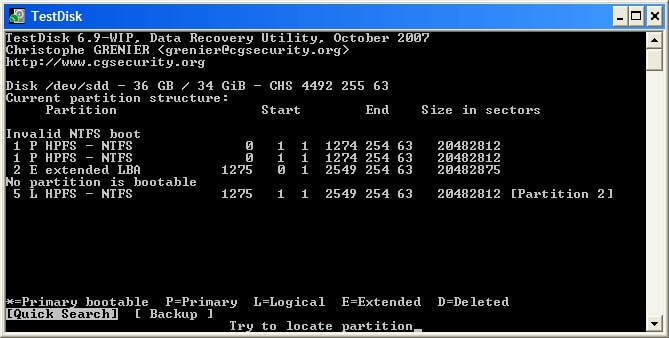
3. What ADATA SD Card Recovery Tool Should I Use?
Wondershare Recoverit offers a user-friendly graphical user interface (GUI), making it easy to use for recovering lost files from ADATA SD card with just a few clicks. However, it is a freemium tool, and while the free version allows users to scan and preview files, upgrading to a paid version is necessary to save the recovered files.
📊 Choosing Your Path: Wondershare Recoverit vs. TestDisk
Both utilities can read raw sectors on an ADATA flash card, but they are built for entirely different data loss situations. Use this comparison table to choose the right tool for your specific recovery scenario:
| Operational Feature | Wondershare Recoverit (GUI Tool) | TestDisk (CLI Tool) |
| Primary Use Case | Recovering deleted, lost, or corrupted photos, videos, and documents. | Rebuilding lost partition tables and repairing raw filesystem errors. |
| User Interface | Visual graphical dashboard with simple point-and-click navigation. | Text-only terminal interface requiring precise keyboard commands. |
| Media Previews | High-fidelity interactive preview window for pictures and video clips. | Plain text file metadata listing with no visual or audio preview options. |
| File System Support | Comprehensive decoding for FAT32, exFAT, NTFS, APFS, HFS+, and RAW data. | Focused support for rebuilding major partition tables (FAT/NTFS/EXT). |
| Video Recovery Capacity | Advanced multi-tier deep scanning that automatically puzzles fragmented video files together. | Basic linear file carving; often struggles with fragmented or out-of-order video sectors. |
Conclusion
The words "formatting" or "deleting" can be confusing when dealing with digital memory. Even if your ADATA SD card appears empty, there's usually a way to retrieve your lost data.
If the files haven't been replaced and the ADATA memory card isn't physically broken, a data recovery tool like Wondershare Recoverit can help recover the data. Follow the comprehensive steps in this guide, and you'll have your files back quickly.
FAQs
-
Why does my ADATA SD card display an "I/O Device Error" when connected to my computer?
An Input/Output (I/O) device error typically means that your computer's operating system is unable to read the data sectors or flash controller on your ADATA card. This can be caused by dirty metal contacts on the card, a faulty USB cable, or a broken card reader slot. Before running any data recovery software, clean the gold contacts on your card using a lint-free cloth and try a different card reader or USB port. If the error persists across multiple computers, it usually indicates that the card's internal flash controller chip has suffered physical failure. -
Can I recover video files from an ADATA card that was formatted inside a DSLR camera?
Yes. When a DSLR or mirrorless camera formats an ADATA card, it typically performs a "Quick Format." This process clears the file indexing system but leaves the actual video frames stored on the storage blocks. However, because modern cameras write high-definition video in fragmented fragments across the card, standard file recovery tools may restore broken, unplayable video files. Wondershare Recoverit resolves this by using an advanced video recovery engine that automatically matches and stitches scattered video fragments back into a single, working file. -
How do I fix an ADATA MicroSD card that shows up as "Write Protected" or "Read-Only"?
When an ADATA memory card switches into an unchangeable read-only mode, it is usually because the card's built-in flash controller has detected that the NAND memory cells have reached their maximum write limit. The card locks itself to prevent data corruption. If you are using a full-sized SD card adapter, make sure the tiny mechanical lock switch on the left edge is pushed all the way up. If the card remains locked, you can still use **Wondershare Recoverit** to pull your existing files off the card and save them to a safe location before replacing the card. -
Is it safe to use Windows Chkdsk utility to repair a corrupted ADATA SD card?
No, using the `chkdsk` command on a corrupted or RAW memory card before recovering your files can be risky. While Chkdsk will try to fix the card's file allocation tables, it does so by forcibly cutting off or correcting any damaged indexing data that it cannot read. This process can overwrite or delete your remaining raw file signatures, making it much harder for recovery software to find them. Always use a secure tool like Wondershare Recoverit to scan and extract your files *before* attempting any system command-line repairs.