
 TL;DR:
Wondershare Recoverit offers the best guided media recovery workflow for readable Mac SD cards, whereas PhotoRec provides a completely free but technical alternative that recovers data without preserving original filenames or folders.
● Use Disk Drill, Stellar, R-Studio, or DMDE to create a byte-to-byte disk image before scanning if the SD card reads slowly or reports errors, reducing the stress of repeated direct reads on unstable media.
● Verify exact export limits before starting deep scans, as commercial tools vary widely; EaseUS limits default free recovery to 500 MB, while the DMDE free edition caps batch recovery at 4,000 files from a single directory per operation.
● Consult a professional data recovery lab rather than using software if the SD card is cracked, overheating, or fails to appear in macOS Disk Utility, as no application can bypass physical hardware failure or restore overwritten data.
Ask AI for a summary
 ChatGPT
 Perplexity
 Gemini
 Claude
 Grok
Grok
TL;DR:
- Best Guided Mac Workflow: Wondershare Recoverit. It combines a dedicated SD Card Recovery mode, card and camera recognition, file filters, preview, and a clear save-to-another-drive workflow for deleted, formatted, RAW, or inaccessible cards that are still detectable.
- Best Completely Free Option: PhotoRec. It uses read-only file carving and can work after file-system damage, but its text interface is less approachable and recovered files may lose their original names and folders.
- Best For Unstable Cards And Advanced Work: Disk Drill, R-Studio, Stellar, Or DMDE. Their imaging or cloning features matter when repeated direct scans could stress a card with read errors.
- Stop DIY Recovery For Physical Failure. No Mac app can recover a card that is cracked, overheating, electrically damaged, or invisible to every reader and computer. Use a recovery lab for irreplaceable data.
The best SD card recovery software for Mac is not simply the app that finds the most filenames. It should read the source safely, recognize the file types you actually recorded, preview usable results, explain what its free edition can export, and save recovered files somewhere other than the affected card.
For most cameras and portable devices, file-system support should start with FAT32 and exFAT. The SD Association’s capacity standard specifies FAT32 for SDHC and exFAT for SDXC and SDUC cards. APFS and HFS+ support can still matter when someone deliberately reformats a card for Mac-only storage, but those are not the typical camera-card formats.
Try Wondershare Recoverit to Perform Data Recovery
 Security Verified. Over 7,302,189 people have downloaded it.
In this article
-
- Recoverit: Best Overall Guided Workflow
- Disk Drill: Best For Disk Imaging And Mac Usability
- EaseUS: Best Free GUI Allowance
- Stellar: Best For Custom Scans And Drive Imaging
- PhotoRec: Best Completely Free File Carving
- R-Studio: Best For Advanced File-System Recovery
- DMDE: Best Free Batch Recovery For Technical Users
Part 1. Which Mac SD Card Recovery Software Fits Your Case?
Choose by failure mode, not by the longest feature list. A healthy card with accidentally deleted photos needs a different first tool from a card that disconnects during reads. Use this matrix before downloading anything.
| SD Card Situation | Best First Choice | Why | What To Avoid |
| Deleted photos or files; card is stable and detected | Recoverit, Disk Drill, EaseUS, or Stellar | A visual scan, filters, and preview make selective recovery easier. | Saving new files to the card or restoring to the same card. |
| Quick-formatted SDHC or SDXC card | Recoverit for a guided scan; PhotoRec for a fully free technical scan | Both can search beyond the new file-system records when old data has not been overwritten. | Formatting again, recording test footage, or running a repair first. |
| Original filenames and folders are important | Start with a file-system-aware GUI tool or R-Studio/DMDE | File carving can recover content while losing original metadata and paths. | Using PhotoRec as the only first attempt when directory structure matters. |
| Large or fragmented camera video | Recoverit Professional SD Card Recovery | Its current Mac workflow identifies supported camera media and offers device-specific photo and video scanning profiles. | Assuming every signature scanner can reconstruct fragmented video. |
| Card is slow, unstable, or reports read errors | Create a disk image with Disk Drill, Stellar, R-Studio, or DMDE | Scanning an image reduces repeated reads from the original media. | Running several deep scans directly against the failing card. |
| No budget and technical interface is acceptable | PhotoRec; DMDE for limited folder-based batches | PhotoRec is open source and unrestricted; DMDE’s current free edition permits limited batches. | Assuming every “free download” permits free file export. |
| Card is cracked, hot, badly corroded, or not detected anywhere | Professional data recovery lab | Software needs a readable device and cannot repair broken flash hardware. | Repeated insertion, bending, cleaning with liquid, or DIY chip work. |
If you want a complete multi-method tutorial rather than a software comparison, follow the dedicated guide to recover data from an SD card on Mac. Keeping that procedure separate helps this page answer the software-selection query without competing with Recoverit’s how-to content.
Part 2. How We Evaluated Mac SD Card Recovery Software
Every tool in this list has a current Mac edition or an official Mac-compatible build. We checked vendor documentation, current operating-system statements, recovery restrictions, file-system support, imaging features, and the actual workflow a Mac user encounters. We did not assign synthetic scores or claim a universal recovery rate.
| Evaluation Factor | Why It Matters For An SD Card On Mac |
| Source safety | The scan should not repair, format, or write recovered data back to the affected card. |
| FAT32 and exFAT handling | These are the standard file systems for most SDHC, SDXC, and SDUC cards. |
| Photo, RAW, and video recognition | Camera cards commonly store JPEG, HEIF/HEIC, DNG, CR2/CR3, NEF, ARW, RAF, MOV, MP4, MXF, and related sidecar files. |
| Preview and file condition | A successful preview is stronger evidence than a filename alone, although it still cannot guarantee every recovered byte is intact. |
| Metadata and folder retention | Professional shoots are harder to rebuild when original names, capture dates, and camera folders are lost. |
| Disk-image support | An image lets you scan a stable copy instead of repeatedly reading an unstable card. |
| Current Mac support | Users should verify both the macOS release and Intel or Apple silicon compatibility before purchase. |
| Free export policy | “Free download,” “free scan,” and “free recovery” are not the same thing. |
| Learning curve | A command-line or disk-editor interface can be powerful but increases the risk of choosing the wrong device or destination. |
Prices and free limits can change by region, promotion, and edition. This article therefore emphasizes the restriction that affects recovery decisions and links to each official product page for the current terms.
Part 3. Best SD Card Recovery Software For Mac: 7 Picks
No single Mac SD card recovery app wins every case. Recoverit is our first pick for a guided, media-focused workflow; PhotoRec is the strongest zero-cost option; and the imaging and file-system tools become more relevant as card instability or technical complexity increases.
| Tool | Best For | Free Use | Disk Image Or Clone | Main Trade-Off |
| Wondershare Recoverit | Guided photo, RAW, and video recovery | Free download, scan, and preview; check the current Mac edition for export limits | Supports disk-image workflows | Full recovery may require a paid license |
| Disk Drill | Mac-friendly interface and byte-to-byte backup | Free scan and preview; most recovery requires Pro | Yes | Paid upgrade for substantial export |
| EaseUS Data Recovery Wizard | Free GUI recovery for a smaller loss | 500 MB by default, plus 1.5 GB after the vendor’s sharing action, as currently documented | Edition-dependent | Promoted 2 GB allowance is conditional |
| Stellar Data Recovery | Custom file-type scans and disk imaging | Free download; verify the current edition’s save allowance | Yes, in supported editions | Features vary across several editions |
| PhotoRec | Fully free signature-based recovery | Unlimited and open source | Can scan supported image formats | Text interface; names and folders may be lost |
| R-Studio | Advanced file-system analysis and imaging | Restricted demo | Yes | Steep learning curve; verify support for the newest macOS release |
| DMDE | Technical recovery with a useful free batch policy | Up to 4,000 files from one chosen directory per operation, with repeat use, as currently documented | Yes | Dense interface and manual decisions |
1. Recoverit: Best Overall Guided Workflow
Wondershare Recoverit Memory Card Recovery is the best fit for Mac users who want a visual process rather than a Terminal or disk-editor workflow. Its current Professional SD Card Recovery screen can identify a connected card, display card information, prepare supported camera photo and video formats, and begin a read-only scan.
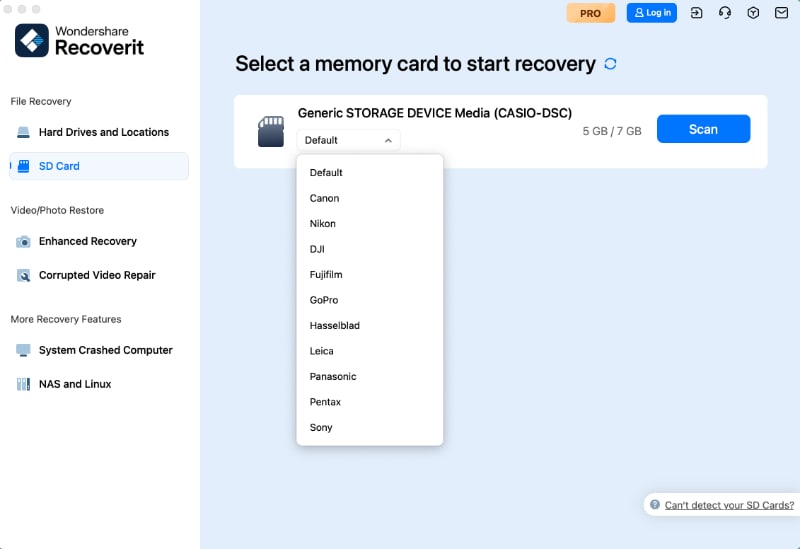
Why It Stands Out
- Supports SD, microSD, SDHC, SDXC, CF, CFexpress, and other camera memory cards.
- Handles common logical-loss scenarios such as deletion, quick formatting, RAW or inaccessible file systems, and interrupted transfers when the card remains readable.
- Supports more than 1,000 file types, including photos, camera RAW files, videos, audio, documents, archives, and project files.
- Provides file-type and path views, filters, scan progress, preview, and selective recovery.
- Offers a dedicated media workflow for supported camera profiles and fragmented photo or video cases.
Limits To Know
A free download does not mean unlimited free export, so verify the current Mac license before depending on it for a full card. Recoverit also cannot retrieve overwritten data or access a card that no reader can detect. For broad Mac-drive recovery rather than an SD-specific case, use the dedicated Recoverit for Mac product page.
2. Disk Drill: Best For Disk Imaging And Mac Usability
Disk Drill for Mac combines a polished visual recovery interface with byte-to-byte backup. That backup feature is the main reason to shortlist it when a card reads slowly or reports early errors but is still stable enough to image.
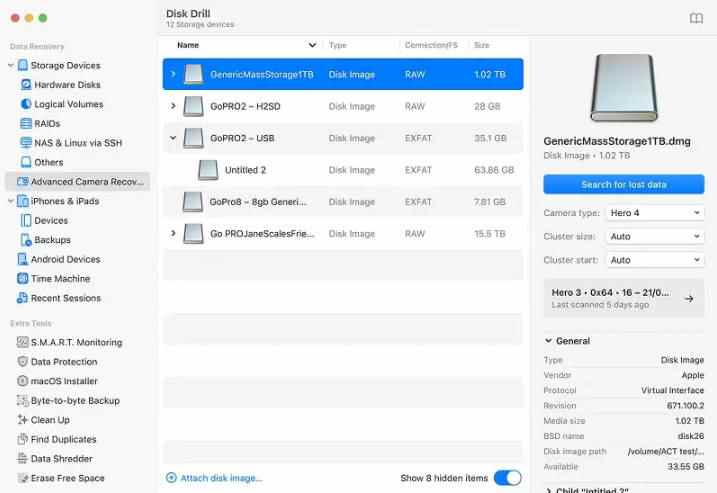
Why It Stands Out
- Creates a sector-level image that can be scanned instead of the original SD card.
- Offers preview, recoverability information, and broad signature support.
- Supports common SD card file systems and camera media.
- Its official guidance distinguishes healthy, lightly damaged, and substantially damaged storage before recovery.
Limits To Know
Substantial recovery normally requires a paid edition. A byte-to-byte image also needs free destination space at least as large as the source card, plus working room. Imaging is not appropriate when the card is overheating, repeatedly vanishing, or physically broken; those symptoms call for a lab.
3. EaseUS: Best Free GUI Allowance
EaseUS Data Recovery Wizard for Mac Free is useful when a small set of files can fit inside its current free allowance and the user wants search, filters, preview, and a conventional graphical interface.
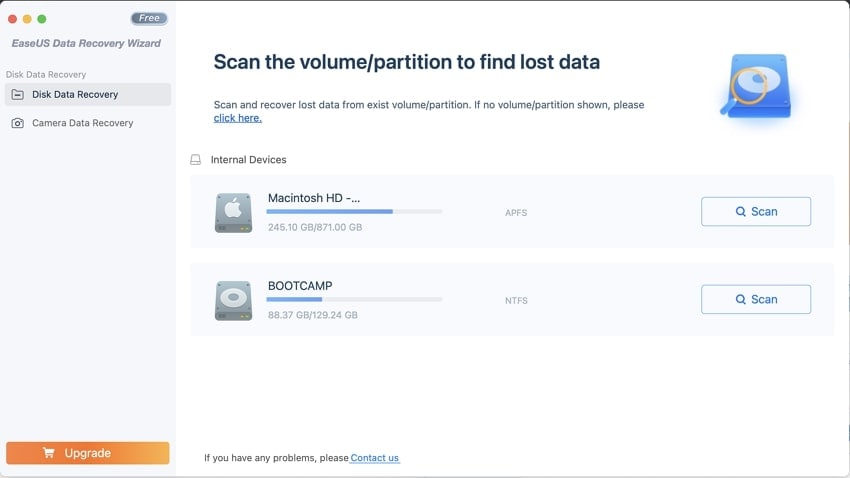
Why It Stands Out
- Supports memory cards, SD cards, SDHC, microSD, cameras, and common Mac-connected storage.
- Includes quick and deep scanning, search, filtering, and preview.
- The official page currently supports recent macOS releases and lists FAT, FAT32, exFAT, APFS, HFS+, and NTFS.
Limits To Know
The advertised 2 GB free recovery is conditional: the vendor’s current FAQ states that the default allowance is 500 MB and the additional 1.5 GB requires sharing the product. Check whether that action and edition are available in your region before starting a large recovery.
4. Stellar: Best For Custom Scans And Drive Imaging
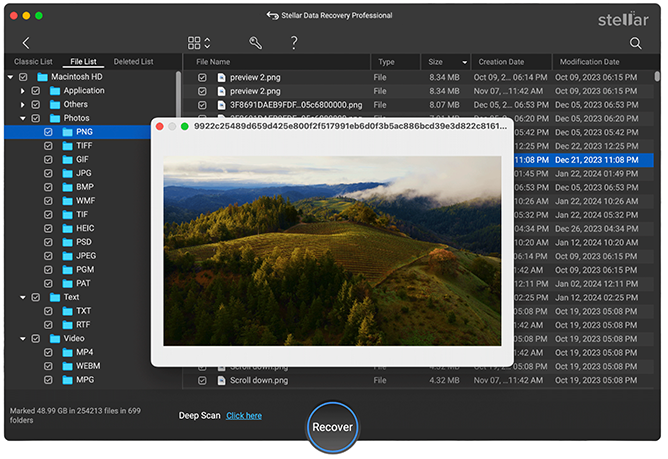
Stellar Data Recovery Professional for Mac is a mainstream option for users who want to select file types, pause and resume scans, preview while scanning, and work from a disk image in supported editions.
Why It Stands Out
- Supports custom file-type selection and on-the-fly file trees.
- Scans formatted APFS, HFS+, NTFS, and exFAT volumes through file-system and signature methods.
- Provides disk imaging for drives with bad sectors in supported editions.
- The current official Mac page lists macOS Tahoe 26 and Apple silicon through M5.
Limits To Know
Stellar separates features across multiple editions, so confirm that the Mac plan you choose includes imaging, the required media formats, and actual file export. Do not assume that a “Free Download” button defines the amount you can save.
5. PhotoRec: Best Completely Free File Carving
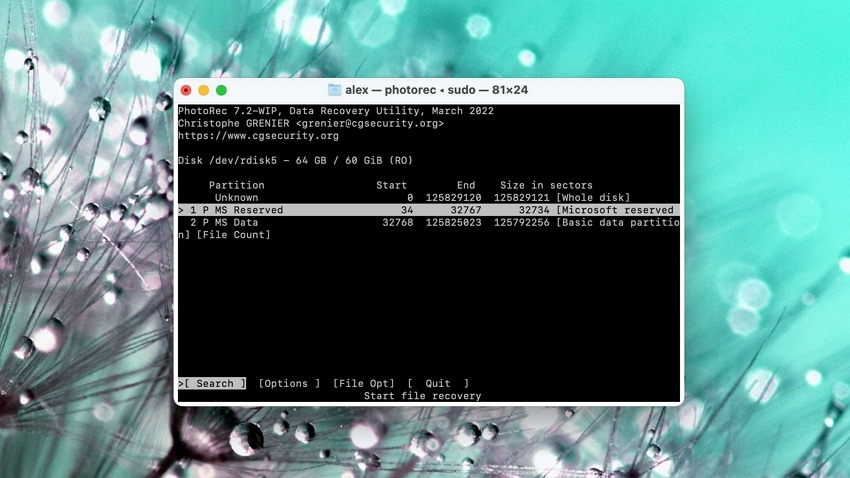
PhotoRec is an open-source file carver from CGSecurity. It ignores the damaged file system and searches the card for known file signatures, which makes it valuable after a quick format or severe logical corruption.
Why It Stands Out
- Free and open source under the GNU General Public License.
- Uses read-only access for the source drive or memory card.
- Supports SD cards, raw disk images, and more than 480 file extensions across about 300 file families.
- Works even when a file system is severely damaged or reformatted.
Limits To Know
PhotoRec’s Mac build uses a text interface, and signature recovery often cannot preserve original filenames or folder paths. Fragmented files, especially large videos, may be incomplete because file carving works best when a file’s data is contiguous. Download only from the official CGSecurity TestDisk and PhotoRec page and check its current Mac build notes before use.
6. R-Studio: Best For Advanced File-System Recovery
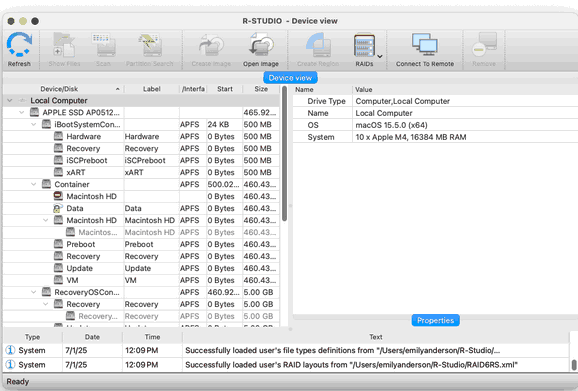
R-Studio for Mac is designed for technicians and experienced users who need detailed file-system analysis, known-file-type searches, recovery probability estimates, disk images, or reconstruction of damaged partitions.
Why It Stands Out
- Shows found FAT and NTFS records as well as APFS and HFS structures during scanning.
- Supports exact image and advanced multi-pass imaging workflows.
- Provides masks, known-file-type scanning, and extensive file-system controls.
- Can be useful when a basic consumer scan cannot reconstruct the remaining directory information.
Limits To Know
The interface exposes technical controls that can overwhelm a first-time user. Its current Mac page lists support through macOS 15 and Apple M1–M4, so anyone using a newer macOS release should verify compatibility directly before purchase or installation.
7. DMDE: Best Free Batch Recovery For Technical Users
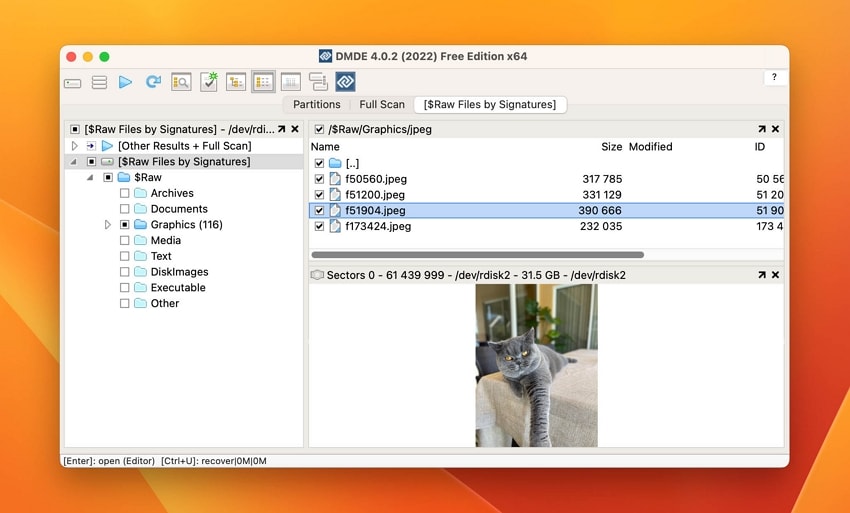
DMDE combines file recovery, partition analysis, a disk editor, disk images, and cloning in a compact Mac-compatible package. It is particularly attractive when a technical user wants meaningful free export without switching to a command-line file carver.
Why It Stands Out
- The current free edition can recover up to 4,000 files from one chosen directory per operation, with repeat use.
- Supports FAT32, exFAT, HFS+/HFSX, APFS, NTFS, ext, and other file systems independently of the host OS.
- Includes raw recovery, partition reconstruction, images, clones, and I/O error handling.
- May retain names and directory structure when enough file-system metadata survives.
Limits To Know
The free batch rule is not the same as one-click unlimited folder recovery, and the interface expects careful device and partition selection. Avoid write or repair functions during recovery unless you fully understand their effect; copy files to another drive first.
Part 4. How To Recover SD Card Files On Mac With Recoverit
Now that the comparison has narrowed the options, the next section shows the actual Mac workflow for the top guided pick. Use these steps only when the SD card is physically intact and appears in Recoverit or macOS. If it disconnects, reports the wrong capacity, or becomes hot, stop and move to an image-based or professional recovery path.
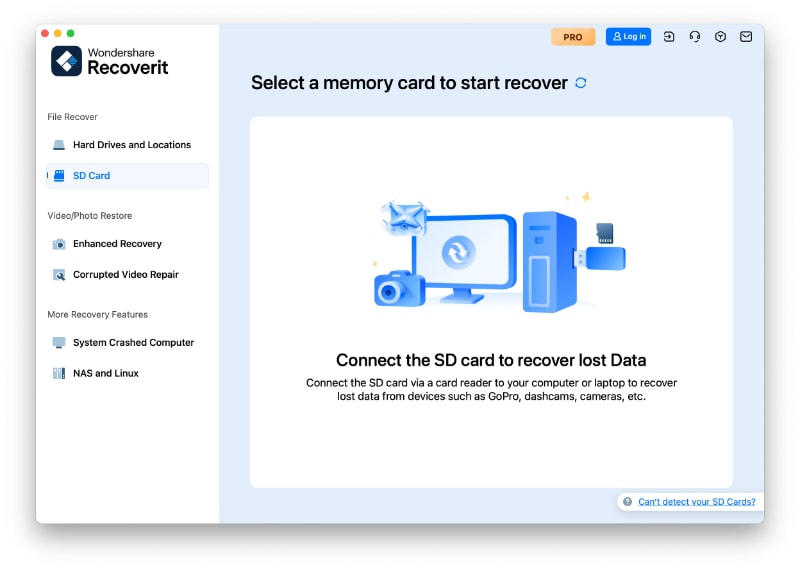
Method 1. Connect The SD Card And Open SD Card Recovery
Stop using the card in the camera, drone, phone, or recorder. Connect it to the Mac through a reliable card reader, launch Recoverit, and choose SD Card Recovery in the left sidebar. Do not format the card if macOS displays an erase or initialization prompt.
Method 2. Confirm The Card And Start The Scan
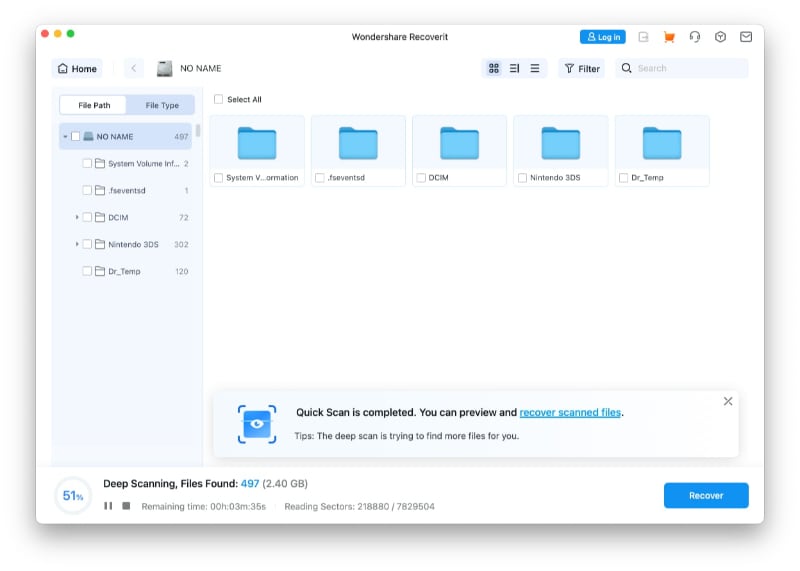
Confirm the detected device, card type, file system, and capacity so you do not scan the wrong storage device. The current interface displays supported photo and video formats for a recognized camera profile. Select Start Scan; the screen identifies the process as read-only, meaning the scan does not write recovered data to the card.
Method 3. Filter And Preview The Results
Let the deep scan run while results populate. Switch between File Path and File Type, use Filter or search, and narrow the list to extensions such as .jpg, .heic, .dng, .cr3, .nef, .arw, .mov, or .mp4. Preview representative files before selecting them; a usable preview is more meaningful than a recovered filename alone.
Method 4. Recover Files To A Different Drive
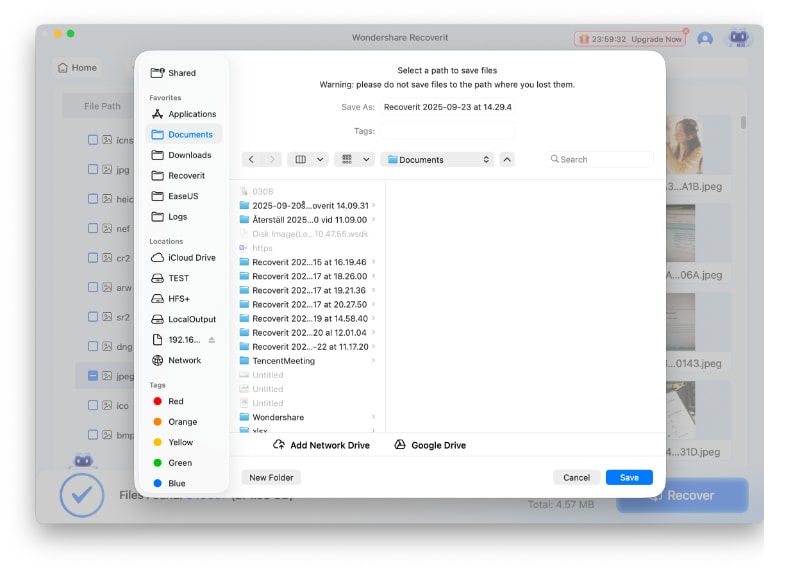
Select the files you need and click Recover. Choose the Mac’s internal storage or another healthy external drive as the destination. Never select the affected SD card: writing restored files to it can overwrite other recoverable data that the scan has not saved.
If the loss followed formatting, use the dedicated formatted SD card recovery guide to understand quick versus overwrite formatting. If the card is RAW or its partition information is missing, see the RAW card recovery guide before attempting any repair.
Part 5. Free Vs. Paid SD Card Recovery Software On Mac
Free SD card recovery software for Mac is real, but the word “free” describes three different things. Some apps are free only to download and scan. Some allow a small amount of file export. PhotoRec is fully free, while DMDE uses a per-directory batch restriction. Read the recovery allowance before committing time to a deep scan.
| Free Model | What You Can Do | Best Example | Risk Of Misunderstanding |
| Free scan and preview | Find files and inspect supported previews before deciding whether to buy. | Common among Recoverit, Disk Drill, Stellar, and other GUI tools. | Finding a file does not necessarily mean the free edition can export it. |
| Limited free export | Recover a defined amount or batch of data. | EaseUS and DMDE, under their current documented restrictions. | A headline allowance may require an extra action or apply per directory. |
| Fully free and open source | Scan and recover without a commercial export cap. | PhotoRec. | The trade-off is usability, metadata loss, and weaker handling of fragmentation. |
| Paid recovery | Unlock full export and, depending on the edition, imaging, media reconstruction, or support. | Recoverit, Disk Drill, Stellar, R-Studio, and other commercial tools. | A paid license still cannot recover overwritten or physically unreadable data. |
For a handful of documents or JPEGs, a limited free tier may be enough. For a full SDXC card of RAW photos or 4K video, preview first and compare the cost of a license with the value of the files. If the files are irreplaceable and the card is unstable, buying another app is not automatically safer than stopping for a professional assessment.
Part 6. What No SD Card Recovery App Can Fix
Software can address logical data loss only when the Mac can read the card as a storage device. It cannot reverse overwritten flash cells or repair a broken controller, cracked package, or destroyed memory chip.
- Overwritten Data: New photos, video, formatting writes, and restored files can reuse sectors that held deleted content. Once overwritten, the old bytes cannot be reconstructed by software.
- Overwrite Formatting: The SD Association explains that its overwrite format erases the user data area. This is fundamentally different from a quick format that resets file-system information while leaving file data until it is reused.
- Physical Failure: A card that is cracked, corroded, overheating, electrically damaged, or invisible in multiple readers may need chip-level laboratory work.
- Missing Encryption Key: Recovery software may find encrypted data, but it cannot make encrypted file content usable without the required password or key.
- Previously Corrupted Recording: Recovery retrieves the bytes that remain; it does not guarantee that a video or photo that was never written correctly will become valid. File repair is a separate process.
If the SD card is missing from Finder but still appears with the correct capacity in Disk Utility, software may be able to scan it. If it is absent everywhere, first rule out the reader and port, then follow the SD card not showing on Mac guide. For corruption symptoms, use the separate corrupted SD card recovery on Mac guide.
Recover before repair. Apple states in its Disk Utility First Aid guidance that the feature checks and fixes formatting and directory-structure errors; it does not recover deleted files and cannot repair every disk problem. Run First Aid only after important files are recovered or safely imaged.
Part 7. How To Improve Your SD Card Recovery Odds
- Stop Using The Card: Do not take test photos, record video, copy files, format, or let an app “repair” it.
- Lock A Full-Size SD Card: Moving the side switch to the locked position can reduce accidental writes through readers that respect the switch. It is a host-side request, not a substitute for careful software use.
- Use A Reliable Reader: A poor microSD adapter, loose cable, or incompatible reader can mimic card corruption. Test another reader or port without repeatedly reconnecting an unstable card.
- Check The Reported Capacity: A 128 GB card appearing as a few megabytes suggests a controller, reader, or hardware problem rather than ordinary deletion.
- Install Software Elsewhere: Install the Mac app on the Mac’s internal drive, never on the affected card.
- Image An Unstable Card: If reads are slow but stable, make one disk image and scan the image. Stop if the card becomes hot or disconnects repeatedly.
- Preview Representative Files: Check files from different dates, folders, formats, and sizes. A list of names alone does not prove the contents survived.
- Recover To Another Device: Save to the Mac or a separate healthy external drive with enough free space.
- Repair Or Reformat Only After Recovery: After the files are safe, test the card and replace it if errors return. For reusable cards, follow the device maker’s instructions or the SD Association Memory Card Formatter.
Try Wondershare Recoverit to Perform Data Recovery
Security Verified. Over 7,302,189 people have downloaded it.
Part 8. Final Verdict
Recoverit is the best overall recommendation for Mac users who value a guided SD card workflow, current visual controls, camera-media recognition, filters, preview, and selective recovery. It is especially appropriate for deleted, quick-formatted, RAW, or inaccessible cards that remain detectable, as well as photo and video workflows where a generic file list is not enough.
Choose PhotoRec when the budget must be zero and you can accept a technical interface plus possible loss of names and folders. Choose Disk Drill or Stellar when a visual disk-image workflow is central. Choose R-Studio or DMDE when you understand file systems and need deeper manual control. Stop using software altogether when the card is physically damaged or cannot be detected with the correct capacity.
The safest sequence is always the same: stop writes, identify the failure mode, scan or image the readable card, preview results, recover to another drive, and repair or reuse the card only after the files are safe.
FAQ
-
What Is The Best SD Card Recovery Software For Mac?
Recoverit is the best overall choice for a guided Mac workflow with a dedicated SD Card Recovery mode, media-focused scanning, filters, preview, and selective export. PhotoRec is the best fully free option, while R-Studio and DMDE suit advanced users. The right choice still depends on card condition, file type, budget, and whether original folders matter. -
Can I Recover Deleted SD Card Files On Mac For Free?
Yes. PhotoRec is fully free and open source. DMDE currently allows up to 4,000 files from one chosen directory per recovery operation. EaseUS currently documents 500 MB by default and an additional 1.5 GB after a sharing action. Confirm current terms before scanning because free limits can change. -
Does Mac Have Built-In SD Card Recovery Software?
No. macOS can show files in Finder, restore existing backups, and use Disk Utility First Aid to check file-system structure, but it does not include a built-in utility that scans an SD card for permanently deleted files. First Aid is a repair tool, not undelete software. -
Can Software Recover An SD Card That Does Not Show In Finder?
Possibly. If the physical card appears in Disk Utility or the recovery app with the correct capacity, a tool may be able to scan it even when Finder cannot mount the volume. If no Mac, reader, or computer detects it, software has no readable source and a professional lab may be required. -
Can A Quick-Formatted SD Card Be Recovered On Mac?
Often, if the card has not been reused. A quick format resets file-system information but may leave old file content until new data overwrites it. An overwrite format erases the user data area and has much worse prospects. Stop using the card and scan it before any repair or second format. -
Can Mac SD Card Recovery Software Restore RAW Photos And 4K Video?
Many current tools recognize camera RAW and video formats, but recognition is not the same as complete reconstruction. Large fragmented videos are harder to recover than contiguous photos. Check the exact camera format, preview the result, and use a media-focused tool when footage is the priority. -
Is PhotoRec Safe To Use On An SD Card?
PhotoRec uses read-only access for the source, according to CGSecurity. The main safety requirement is choosing a destination on the Mac or another drive. Never send recovered files back to the affected card. -
Should I Run Disk Utility First Aid Before SD Card Recovery?
No, not when important files are missing. Recover or image the card first. First Aid can modify formatting and directory structures while attempting repair, and Apple does not present it as a deleted-file recovery tool.


