
 TL;DR:
RAW video refers to specific sensor-oriented recording formats like BRAW, R3D, or ProRes RAW that require compatible decoders for post-production interpretation, rather than simply meaning unedited or uncompressed MP4 footage.
● Identify the exact codec and always preserve the entire original camera folder structure, as formats require specific tools—such as DaVinci Resolve for .braw, Final Cut Pro for ProRes RAW, and Adobe Media Encoder for RED R3D—to decode properly.
● When editing heavy formats like ProRes RAW in Final Cut Pro, strictly finalize source adjustments like white balance first, because altering RAW metadata later will discard any previously generated proxy media.
● If original recordings are deleted, immediately stop using the storage device and install recovery tools like Wondershare Recoverit on a separate healthy disk, noting that recovered files must be verified in their native decoders rather than relying on recovery app thumbnails.
Ask AI for a summary
 ChatGPT
 Perplexity
 Gemini
 Claude
 Grok
RAW video is a family of camera recording formats that preserves sensor-derived image data for interpretation during post-production, rather than committing every image-processing decision to a finished video. It is not one universal file extension, and it is not necessarily uncompressed.
There is also an everyday meaning: a client asking for the "raw video" may simply want the original, unedited takes. Those takes can be ordinary MP4 or MOV recordings, not camera RAW. Knowing which meaning applies is the first step toward opening the right file, editing it correctly and delivering what someone actually requested.
In This Article
Part 1. What RAW Video Means
The useful distinction is what the recording preserves and what the editor can still interpret, not whether the picture initially looks flat.
Camera RAW Is Not Always Unprocessed or Lossless
RAW workflows leave decisions such as sensor interpretation and some color or exposure adjustments to a compatible decoder. The available controls depend on the camera, format and recorded metadata. RAW offers flexibility; it does not guarantee perfect exposure or unlimited image recovery.
For example, Blackmagic RAW performs part of its demosaicing in the camera and offers different compression modes. This makes "zero processing" and "always lossless" poor definitions. Demosaicing is the process of reconstructing a full-color image from sensor color samples.
With REDCODE RAW recordings, image data is compressed and settings such as white balance and ISO are stored as metadata for later interpretation. That is different from treating a finished video frame as an untouched sensor reading.
In practice, RAW is valuable when color matching, visual effects or a demanding grade justifies the workflow. A quick interview or same-day event can be better served by a well-exposed, ready-to-edit recording. RAW cannot recreate detail the sensor never captured; missed focus, clipped channels and heavy noise still matter. Resizing a RAW-derived image also does not preserve unlimited resolution.
RAW, Log and Unedited Footage Are Different
These terms describe different things. Use the distinction below when a file arrives with an unclear name or someone requests "raw footage."
| Term | What It Describes | What to Check |
| Camera RAW video | A sensor-oriented recording and decoding workflow, such as BRAW, R3D or ProRes RAW. | The exact codec, camera mode and supported decoder. |
| Unedited footage or raw takes | Material that has not been cut or finished; it can already be processed video. | Whether the request means original takes or a specific camera RAW format. |
| Log video | Image encoding designed to retain tonal range for grading. | The camera's log curve, gamut and intended display transform. |
| ProRes 422, H.264 or HEVC video | Processed video codecs; these names alone do not indicate camera RAW. | The codec, not just the MOV or MP4 container. |
| Headerless rawvideo | A bare pixel stream used in technical processing, not a synonym for proprietary camera RAW. | Pixel format, frame dimensions and frame rate supplied separately. |
Sony's explanation of log shooting describes the flat image and subsequent grading requirement. A flat-looking clip is therefore not proof of RAW recording. Conversely, a RAW decoder can display a normal-looking image through a viewing transform.
The technical FFmpeg rawvideo format is another separate case. Renaming a camera file to .raw, or forcing a rawvideo input option, does not provide the decoder its original recording requires.
Part 2. Identify Your RAW Video File and Plan Storage
Before downloading a player or changing settings, find out what the camera actually recorded. Keep the original folder intact while you investigate.
Common RAW Video File Formats
There is no single RAW video file format that every application can open. Extensions are useful clues, but a container such as MOV or MXF can carry more than one kind of media.
| Recording Family | Common File Clue | Practical Starting Point |
| Blackmagic RAW | .braw, sometimes accompanied by a .sidecar file. |
DaVinci Resolve or Blackmagic RAW Player; confirm the installed decoder supports the camera mode. |
| REDCODE RAW | .r3d; a long clip may have multiple related segments. |
A compatible RED workflow or editor; keep the complete recording structure. |
| Apple ProRes RAW | Usually a .mov container with ProRes RAW identified in metadata. |
Final Cut Pro with support for that recording; ordinary ProRes MOV is not automatically RAW. |
| Canon Cinema RAW Light | .crm. |
A supported application and any required Canon RAW component. |
| Nikon N-RAW | .nev; a camera can also create a separate MP4 proxy. |
A decoder supporting the camera's N-RAW mode, not a Nikon still-photo RAW workflow. |
| ARRIRAW | ARRIRAW content in formats such as .mxf, depending on the recording system. |
An ARRIRAW-capable workflow; an MXF extension alone is not sufficient identification. |
Apple documents the additional Canon software required for Cinema RAW Light in Final Cut Pro. Similar support checks are necessary for other formats: application edition, operating system, plug-in and camera firmware can all change what opens. Avoid installing random codec packs in place of the correct vendor component.
Planning a shoot? Check the exact recording options on cameras that shoot RAW video, including whether an external recorder is involved. A camera offering RAW still photos does not, by itself, establish RAW video support.
How Large Is a 4K RAW Video File?
4K RAW video combines a resolution category with a recording format. There is no universal size per minute: frame rate, sensor area, bit depth and compression settings affect data rate. Budget with the selected recording mode's actual rate, not the word "4K."
For a simple estimate, multiply megabytes per second by seconds, then divide by 1,000 for decimal gigabytes. The following are illustrative rates, not specifications for any camera.
| Example Data Rate | One Minute | One Hour |
| 50 MB/s | 3 GB | 180 GB |
| 100 MB/s | 6 GB | 360 GB |
| 200 MB/s | 12 GB | 720 GB |
Do not confuse MB/s with Mb/s: eight megabits equal one megabyte. Allow additional space for another independent copy, proxies, caches, project files and exports. At an illustrative 100 MB/s, two one-hour source copies alone require about 720 GB, before working files or overhead.
Preserve Camera Folders and Find Genuine Practice Clips
Retain clip names, companion metadata, audio and all segments belonging to long takes. Use separate folders for each card rather than combining identically named camera folders. Apple's spanned-clip guidance explains why associated media must remain available for a complete import.
For practice, use actual camera originals. Nikon's Z6III sample downloads distinguish N-RAW recordings from their MP4 proxies. Check the accompanying license and technical notes before reuse. A stock video labeled "raw footage" may mean unedited MP4 rather than sensor RAW; the filename and codec settle that question. For stock providers rather than guaranteed camera originals, the stock-footage download guide lists additional options. Verify each download's actual format.
Part 3. How to Open and Adjust RAW Video
Choose the branch that matches your source. These are alternative workflows, not three consecutive tools you must use on every clip. Make adjustments on a working copy while retaining a separate original.
Method 1. Open and Inspect Blackmagic RAW in DaVinci Resolve
Use this route for a complete BRAW clip. The first objective is to establish whether the recording is recognized correctly, before interpreting a playback or color problem as damage.
Step 1. Import the copied .braw file into a Resolve project using "File > Import > Media". Retain any companion sidecar with its matching file. For simple viewing, Blackmagic RAW Player is another format-specific option.
Step 2. Select the imported clip and inspect "Metadata". Check the reported codec, dimensions, frame rate and audio against your recording notes. Camera fields such as ISO and white balance help identify the take; they are not recommended values to copy.
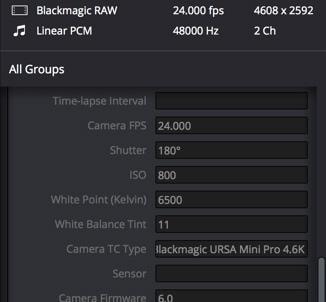
Step 3. Play several sections, including the end. Compare the actual duration and audio with the expected take. If the clip is readable but looks different from the camera monitor, investigate the decoding and display transform before re-exporting or attempting file repair.
A sidecar can override embedded BRAW metadata without replacing the recorded image data. Keep it when handing the clip to another editor. If import fails, test a known-good BRAW clip and confirm format support in the installed software; failure in one application alone does not establish corruption.
Method 2. Adjust ProRes RAW in Final Cut Pro
For this branch, confirm that the source codec is ProRes RAW, not just a MOV file. Apple provides a specific ProRes RAW camera-settings workflow.
Step 1. Import the source with "Create optimized media" and "Create proxy media" deselected. Adjusting RAW settings later discards earlier transcoding work.
Step 2. Select the source clip, press "Command-4", open "Info" and choose "Modify ProRes RAW Settings". For the standard conversion, select "Processing > Standard".
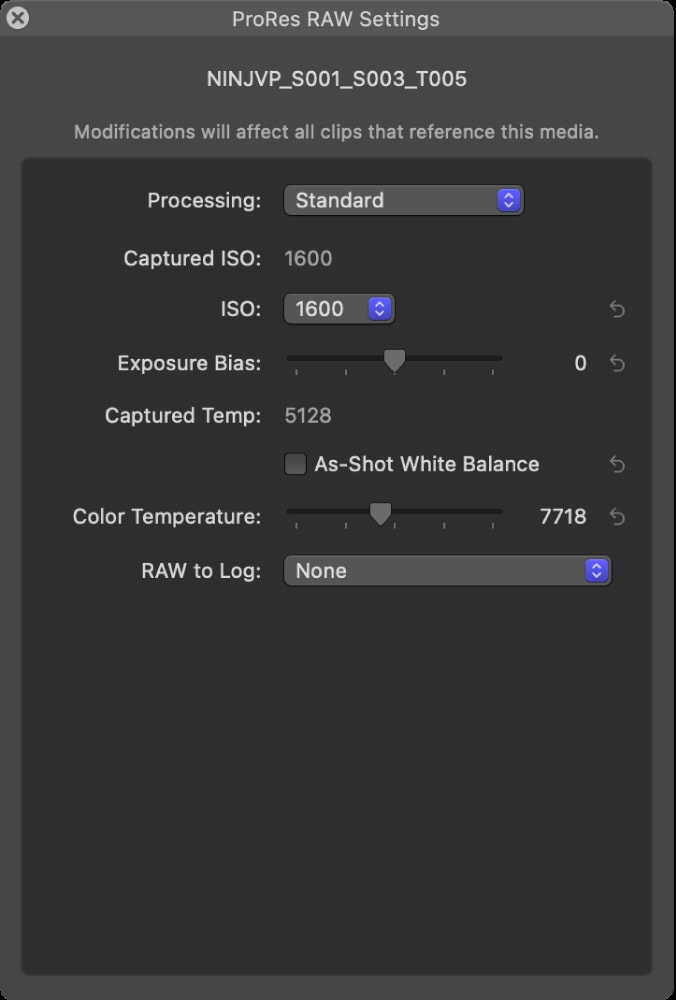
Step 3. Adjust only controls available in the clip metadata. Turn off "As-Shot White Balance" to change color temperature. If "RAW to Log" is "None", also set "Camera LUT" to "None".
Step 4. Check the picture, then generate proxies if needed. Missing controls can reflect metadata limitations; compound clips cannot be adjusted directly. Work with the underlying source rather than assuming the file is damaged.
Keep a record of the chosen interpretation with the project. For example, when two cameras filmed the same interview, compare a neutral reference and skin tones before applying a creative look. One numerical white-balance value is not a reliable recipe for matching every camera.
Method 3. Prepare RED R3D in Adobe Media Encoder
Adobe Media Encoder can interpret supported RED R3D sources and produce working or delivery copies. It is a transcoding application, not a substitute for an editing timeline. Its source settings differ by format; ARRIRAW and RED do not share identical controls.
Step 1. Add the R3D recording with "Add Source". In the queue, right-click that source and select "Source Settings".
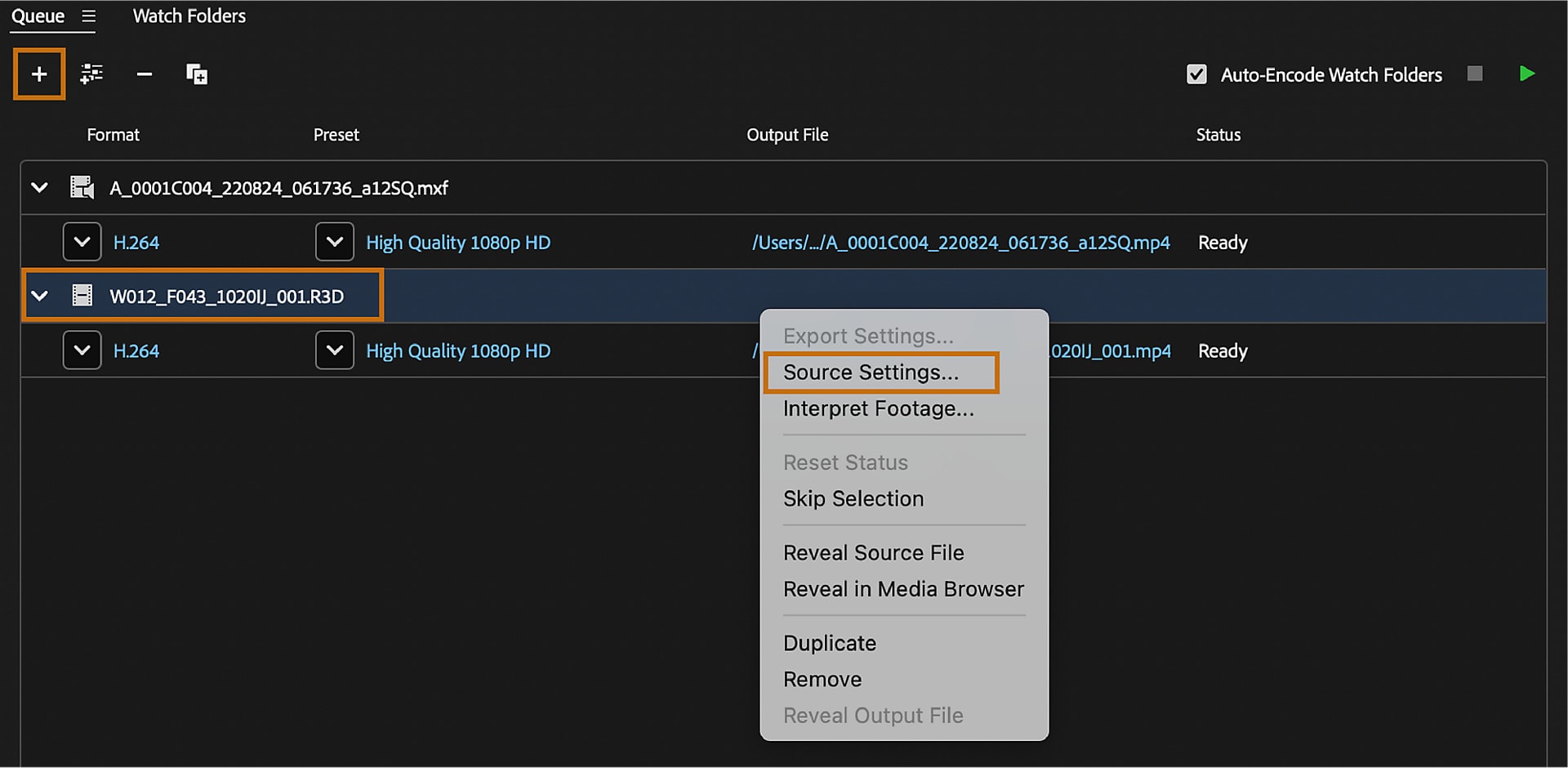
Step 2. Review the image pipeline, decoding and available color controls. Set them for the intended workflow, then select "OK". Do not copy another shot's ISO, temperature or LUT as a universal setting.
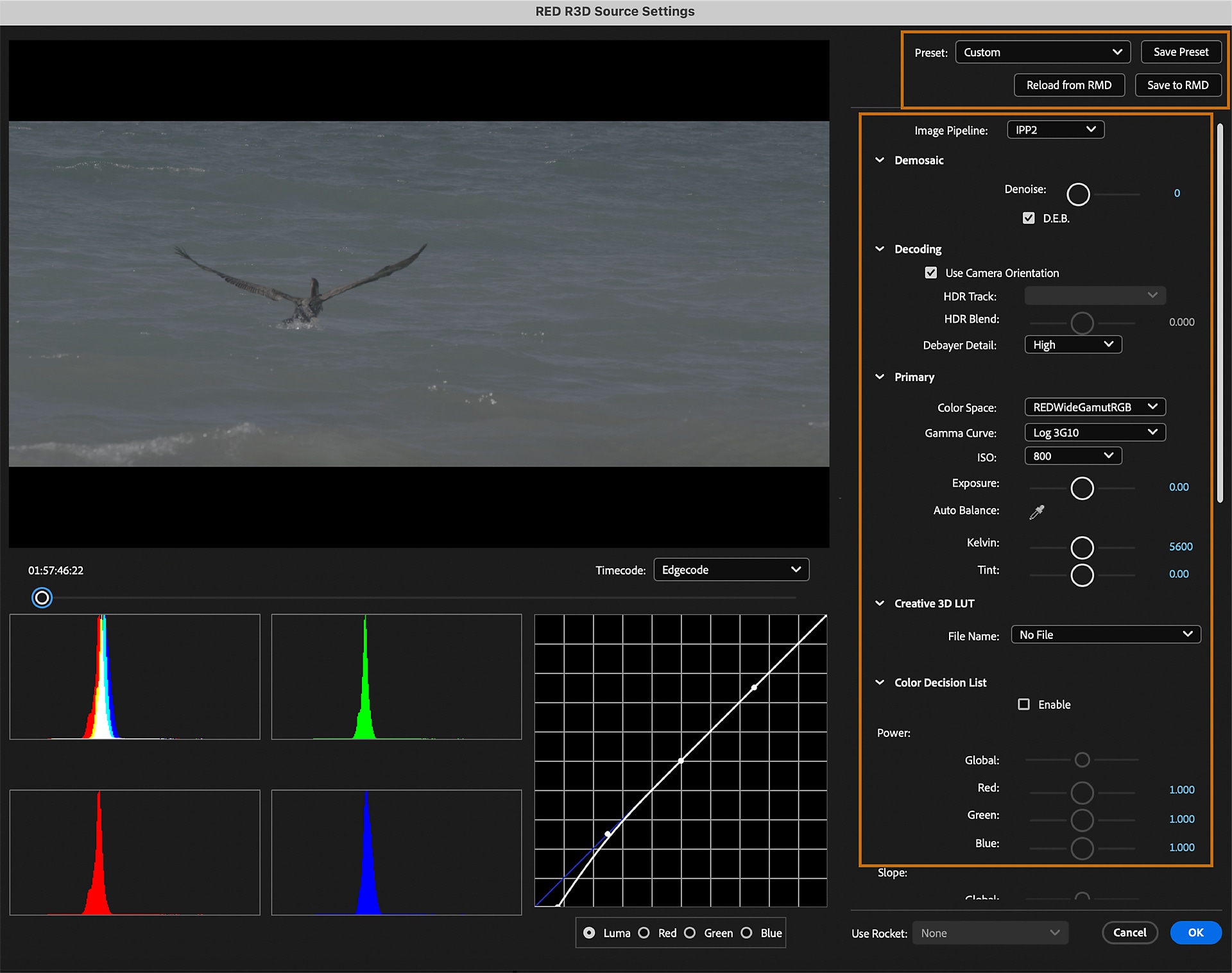
Step 3. Choose the output codec, location and quality separately in the queue, then encode a short sample. Verify the result before processing the entire shoot. Keep the R3D original; an H.264 viewing copy is not the original RAW recording.
For collaboration, specify whether the next editor needs camera originals or prepared media. Include relevant color decisions and identify which files are proxies. A technically playable export can still be the wrong handoff if the recipient expected adjustable RAW sources.
Part 4. Edit Smoothly and Deliver the Right File
Once the source opens, separate source interpretation from playback performance and final delivery. This avoids repeatedly converting originals to solve a problem that only needs lighter working media.
Method 4. Create Proxies for Editing RAW Video
In Final Cut Pro, proxies provide lighter editing copies while originals remain available. Follow the proxy-media workflow after settling ProRes RAW source adjustments.
Step 1. Select a browser clip, open "Info" and click "Transcode Media" near the bottom. The media-status indicators distinguish originals from generated representations.
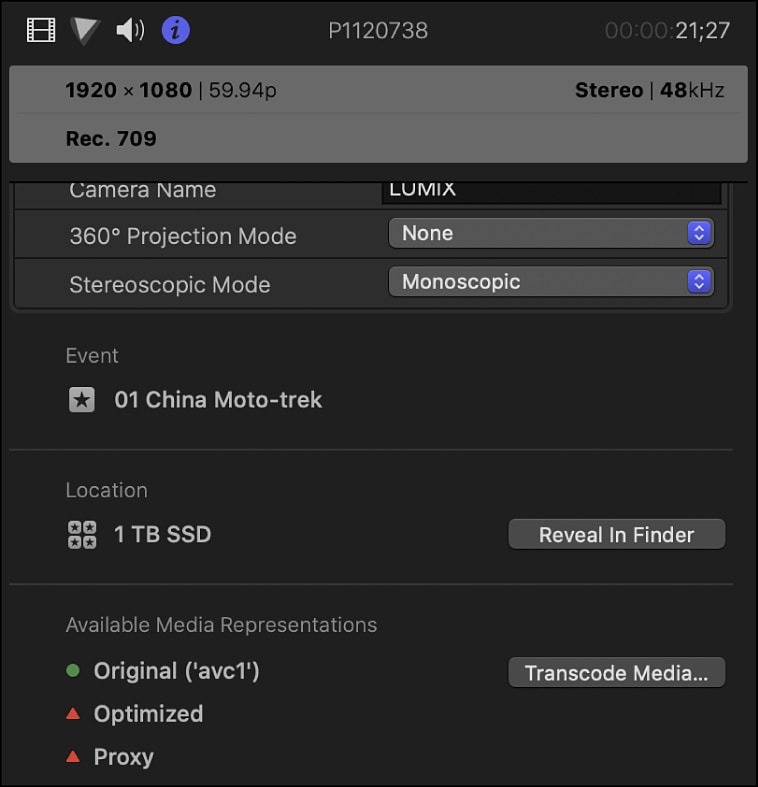
Step 2. Enable "Create proxy media", select an available format such as ProRes 422 Proxy and a frame size appropriate for editing, then confirm. Wait for background processing.
Step 3. Use the viewer's "View" menu to select proxy playback. A red proxy indicator with the original available means the proxy is missing, not necessarily the recording. Switch to original playback or regenerate the proxy.
Judge the workflow by the task: can you scrub, trim and review dialogue reliably? A proxy need not match the original's resolution to serve that purpose. Preserve the link to the original, and keep both storage locations documented when moving the project between computers.
Method 5. Export a Viewing Copy and Keep the RAW Originals
A viewing copy and a RAW handover are different deliverables. In Final Cut Pro, the Export File workflow provides a rendered output; it does not replace the source archive.
Step 1. Select the project or intended range. In the viewer, switch to "Optimized/Original" before final output rather than leaving proxy playback selected.
Step 2. Choose "File > Share > Export File". Review the duration and output information in "Info", then open "Settings".
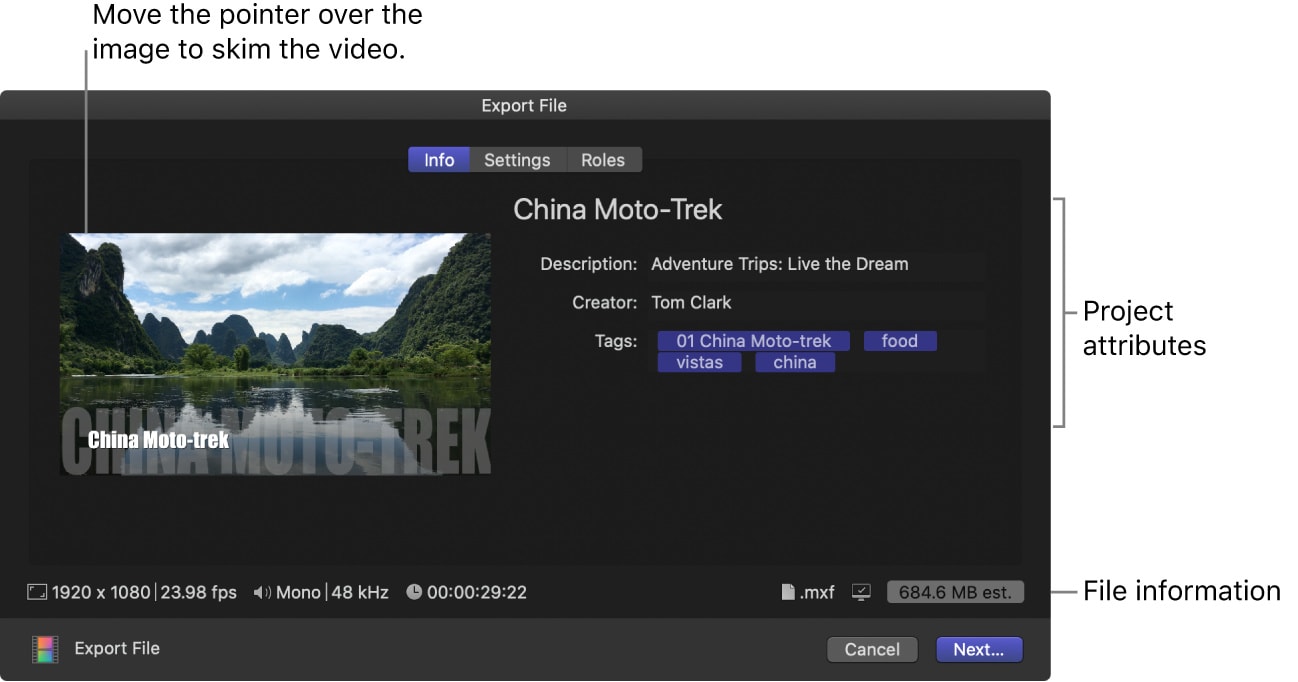
Step 3. Choose the format and codec for the recipient, confirm the output type, and save to a separate destination. Reopen the export and check the beginning, middle, end and audio.
Agree on SDR or HDR delivery before exporting. Test a sample on the receiving system instead of assuming every viewer interprets color identically. For an original-media handover, separately include complete camera folders, needed sidecars and the project or grading instructions. Clarify licensing and access expectations; an unedited take is not automatically approved stock footage.
Part 5. What to Do When RAW Footage Is Missing
Missing media can mean an offline drive, an absent proxy, a moved folder or a deleted original. Only the last case necessarily calls for deleted-file recovery.
| What You Find | Next Safe Action |
| The complete original opens in its native application. | Check the editor's source path, codec support and color interpretation. |
| The editor reports missing proxies but originals are present. | Switch representations or regenerate proxies. |
| A long take is incomplete after transfer. | Compare the preserved camera folder and all related segments. |
| The original was deleted from a card or drive. | Stop using that device; check backups and recovery options. |
| The storage device repeatedly disconnects or has physical damage. | Stop repeated scans and seek a professional recovery assessment. |
Method 6. Recover Deleted Originals from Detected Storage
Check the Recycle Bin or Trash, backup copies and the original camera card first. For deleted recordings on storage that the computer can still detect, Wondershare Recoverit Video Recovery provides a recovery option. Confirm support for the actual format and preview behavior; "RAW" is not one universal recoverable codec.
Step 1. Stop recording, copying or installing software on the affected device. Install Recoverit on another healthy disk and connect the source through a suitable reader or interface. A camera or phone connection does not always expose its internal storage as a scannable disk.
Step 2. Following the Recoverit Windows Guide, select the affected storage under "Hard Drives and Locations". Do not initialize or format a device just to make it appear.
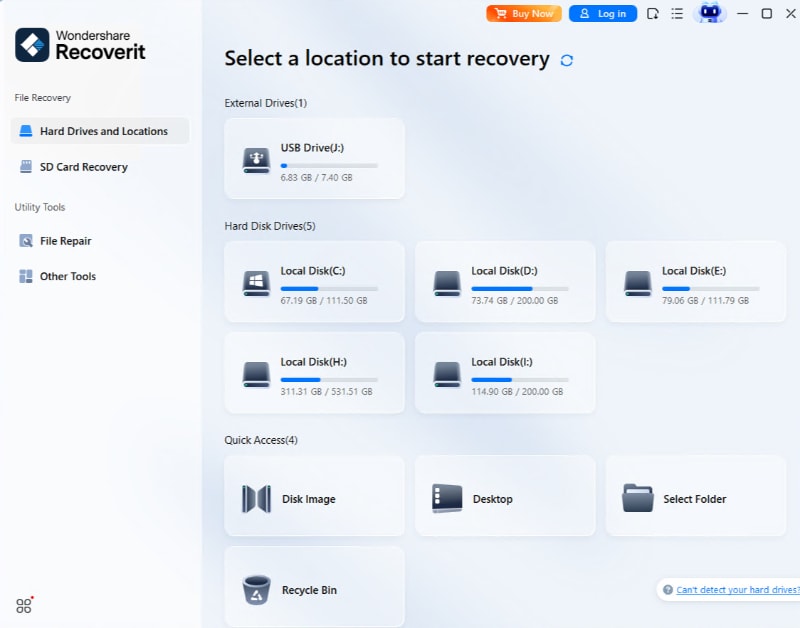
Step 3. Scan and inspect the results. Look for the recording folder, expected files and companion data. Do not assume every proprietary RAW format is included in a specialized video-format filter or can be previewed inside the recovery application.
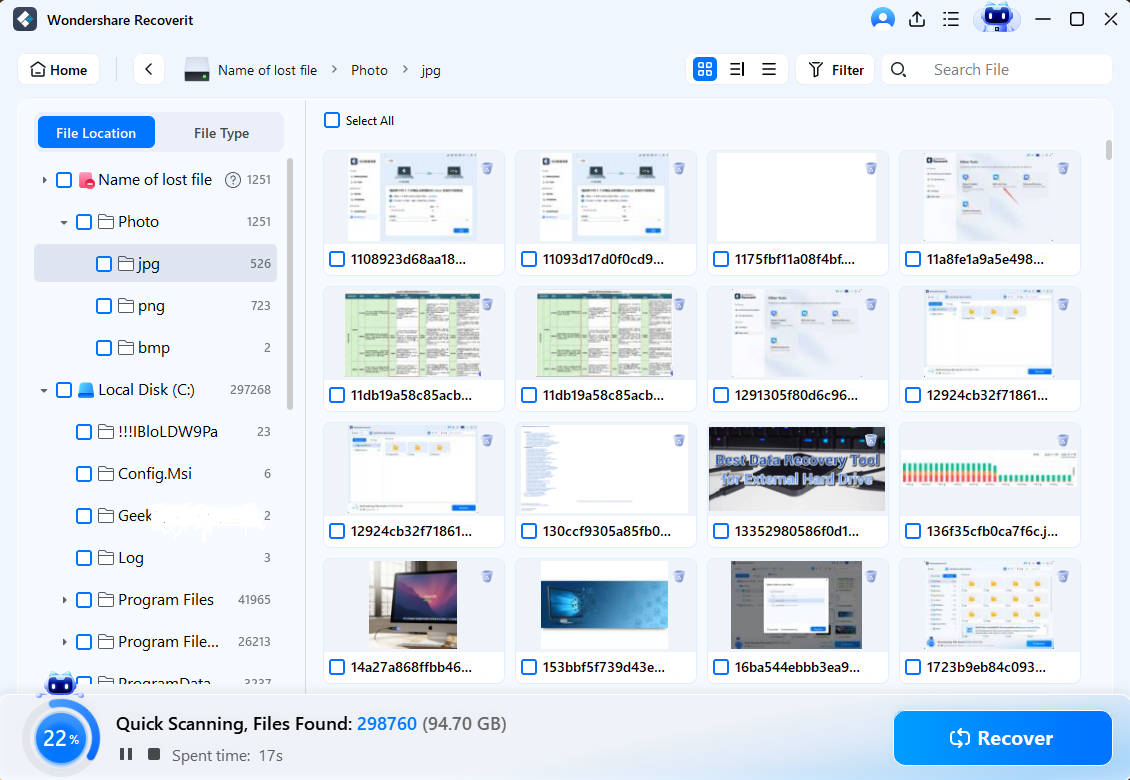
Step 4. Save selected results to a different healthy drive. Reopen recordings in their compatible native application and verify duration, audio and related segments, not just the thumbnail or filename.
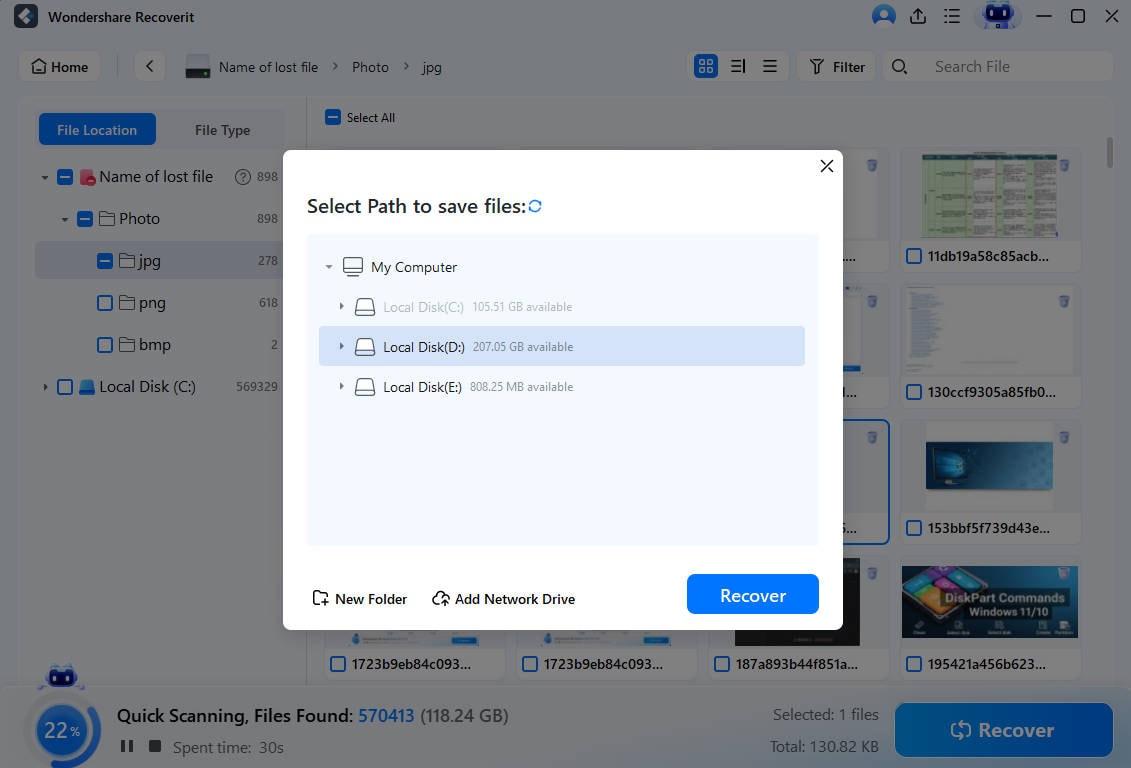
Recovered files may still be incomplete after overwrite or fragmentation. Keep the original recovery output before trying repair on a copy. Recovery software cannot guarantee reconstruction of overwritten data, and a successful file listing is not proof that an entire camera recording survived.
Conclusion
Start with the meaning of RAW and the actual recording codec, not the filename alone. Preserve complete originals, use the correct decoder, make source adjustments before generating proxies, and verify delivery copies separately. When footage disappears, establish whether originals are truly missing before scanning a storage device. This keeps editing decisions, playback problems and data recovery in their proper places.
FAQ
-
Is RAW video always uncompressed?
No. RAW families use different processing and compression approaches. A RAW recording can be compressed, and a claim of visually lossless quality is not the same as mathematically lossless storage. -
Is every unedited MP4 a RAW video file?
No. An unedited MP4 can be raw footage in the everyday sense, while already containing processed video. Camera RAW refers to the recording and decoding format, not whether an editor has cut the clip. -
Can converting MP4 to RAW restore camera sensor data?
No. A format conversion cannot recreate sensor information or reversible camera decisions absent from the source. It may produce an editing intermediate or raw pixel stream, but not the original camera recording. -
Can Photoshop or a standard video player open all RAW video?
No. Still-photo RAW support does not establish support for BRAW, R3D, ProRes RAW or another video codec. Choose software that supports the actual recording and camera mode rather than installing a generic photo editor. -
Why does a RAW clip look different on another computer?
Compare decoder versions, source settings, sidecars, LUTs and display color management. Different interpretation can change the appearance of identical source media. Confirm the files match before treating the difference as corruption. -
Is a drive shown as RAW the same as RAW video?
No. A storage volume reported as RAW concerns filesystem recognition; it does not identify a camera codec. Avoid formatting a drive containing needed recordings, and investigate the storage or recovery problem separately.


