 TL;DR:
To successfully recover deleted videos from a JVC Everio camcorder, immediately stop recording to prevent data overwriting and determine whether your specific model saved the missing .MOD, .TOD, or .MTS files to a removable SD card or internal storage.
● If the deleted footage was on a removable SD, SDHC, or SDXC card, connect it to a computer via a card reader, strictly ignore any OS prompts to format or initialize the media, and run a read-oriented scan using a tool like Recoverit Windows V15, saving the output to a separate healthy drive.
● For Everio models utilizing a built-in HDD or internal flash memory, deleted-file scanning is only possible if the camera's USB connection exposes the actual storage volume to the computer as a supported, readable drive rather than a restricted file-transfer interface.
● Never disassemble the camcorder, attempt speculative resets, or repeatedly power cycle the device if a built-in drive clicks, overheats, or fails to mount; these symptoms indicate physical failure requiring a professional recovery specialist.
Ask AI for a summary
 ChatGPT
 Perplexity
 Gemini
 Claude
 Grok
Deleted videos from a JVC Everio may still be recoverable if the original data has not been overwritten and the recording medium is readable. Stop recording and turn off the camcorder first. The recovery method depends on where that specific Everio saved your footage: a removable SD card, a built-in hard disk drive (HDD), or internal flash memory.
If the deleted clips were on a stable, computer-detectable SD card, you can examine the card with a reader and consider a recovery scan. For built-in HDD or flash storage, check your model's supported connection and access mode before using recovery software. A USB connection alone does not mean deleted internal files are scannable. Do not format, initialize, reset, or keep recording to test the camcorder.
In This Article
Part 1. Identify Where Your JVC Everio Videos Are Stored
Everio is a camera family, not a single storage specification. The JVC GZ-MG750 specifications list an 80 GB internal HDD and a microSD/SDHC slot. By contrast, JVC's GZ-E200 product information describes removable SD/SDHC/SDXC media, while the GZ-E220 variant also has 8 GB built-in memory in the manufacturer's model documentation. These are examples, not a universal Everio specification. First establish your exact model and the media selected when the clips were recorded.

Find The Storage Type And Recording Files
Step 1. Note the complete model number printed on the camera or its label. Consult the corresponding JVC instruction manual for the supported recording medium and USB transfer mode. A model's ability to accept an SD card does not mean every recording was saved there.
Step 2. If the camera and its storage are stable, check the playback index and the selected recording medium in the model's supported menu. With a removable card, switch off the camera before removing it and use a reliable reader. An Everio with both HDD and card storage may have saved the missing footage to either medium, so do not assume the SD slot holds the recordings.
Step 3. If the storage remains readable, look for the file types your particular model records. Some older Everio models produce .MOD or .TOD files; AVCHD models such as the GZ-E200/GZ-E220 can produce .MTS files, often under AVCHD/BDMV/STREAM. A folder path or extension from one Everio does not apply to every model. Preserve the original folder structure and unfamiliar sidecar files.
| Where recordings live | Safest next step | What not to do |
| Removable SD or SDHC card | Use a card reader and examine or scan the card from a computer | Do not take more videos, format, or save recovered files to that card |
| Built-in HDD | Follow the exact model's supported USB copying instructions; copy existing videos to another disk | Do not disassemble a sealed camcorder or repeatedly restart a clicking drive |
| Built-in flash memory | Check whether the camera exposes accessible recordings through its official transfer mode | Do not assume a PC recovery app can directly scan inaccessible internal memory |
Choose The Safest Recovery Route
If a clip is still visible, copy it to a healthy computer drive and verify the copy before considering a deleted-file scan. If a recording was deleted from a stable SD card that the computer detects, use the SD-card path below. If the recording was deleted from internal HDD or flash memory, ordinary SD-card scanning applies only when the actual source volume is exposed to the computer in a supported, readable form. When the internal medium is inaccessible or failing, stop and consult a qualified recovery specialist.
Part 2. Recover Deleted JVC Everio Videos From an SD Card
The following method applies when the lost video was actually stored on a removable, computer-detectable SD card. Recovering to a separate disk reduces the risk of overwriting data still on the card.
Check Existing Copies Without Writing To The Card
Step 1. Stop using the card immediately, turn off the camera, and remove the card according to the model's instructions. Avoid new photos, recording, formatting, repair utilities, and camera firmware operations on the affected storage.
Step 2. Look for files previously imported through a JVC transfer application or manually copied to your computer, NAS, external drive, or backup. Open candidate video files to check whether they are complete before attempting recovery.
Step 3. Connect the SD card to the computer with a reader. If Windows or macOS offers to initialize, erase, or format the card, cancel. Confirm the card is detected with roughly the expected capacity before opening recovery software. If it repeatedly disconnects or reports read failures, avoid repeated scans and consider professional diagnosis.
Scan The Card With Recoverit
Step 1. Install Wondershare Recoverit for memory card recovery on a healthy computer drive, never the affected card. Insert the card through a reader and launch the software. The following interface names reflect the current Windows V15 official guide; menus may differ on macOS and older versions.
Step 2. In the Windows V15 sidebar, open SD Card Recovery, select the detected card, check the displayed capacity, and click Scan. Do not choose the camera HDD or a different connected drive by mistake.
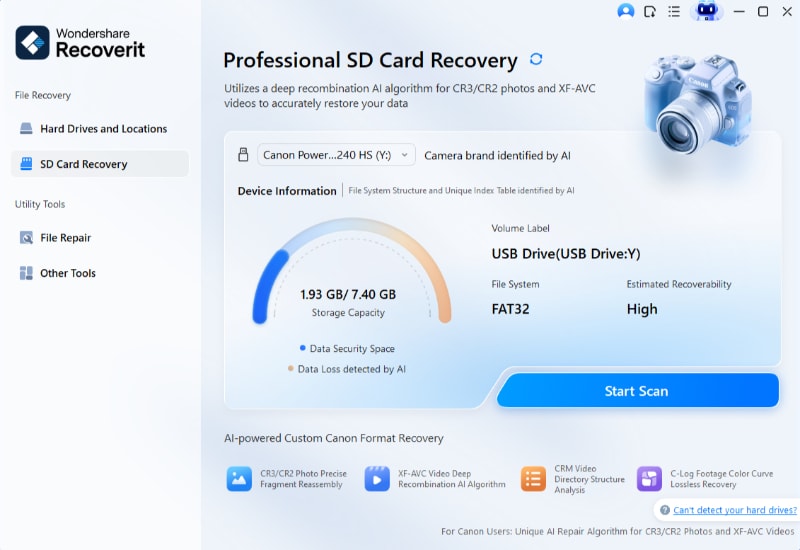
Step 3. Let the scan finish before exporting files; the official Guide recommends completion for more reliable parsing. Look for the actual model's formats, including MOD, TOD, MTS, or MP4 where applicable. Results may be incomplete or unplayable even when a filename or thumbnail appears.
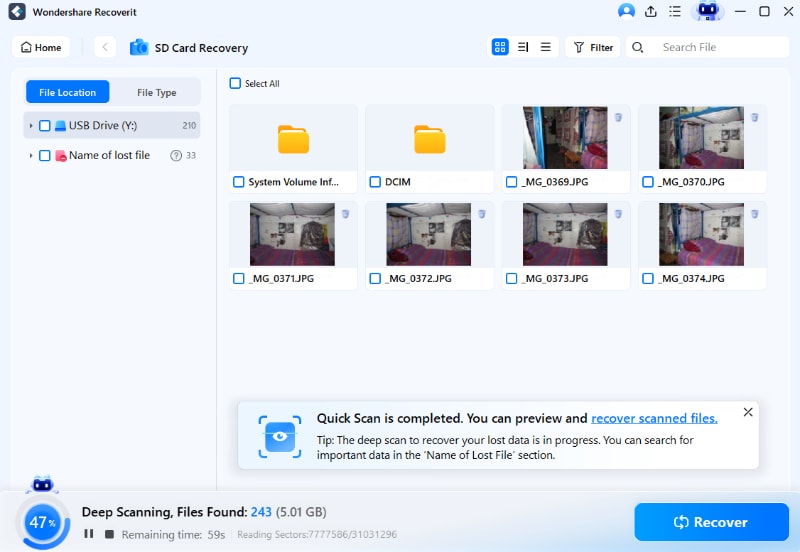
If the card is not detected, check another known-good reader or port without accepting any format prompt. If it continues to disappear or reports serious read errors, stop rather than retrying scans. The memory card recovery page covers removable-media loss scenarios and limits.
Preview And Save Recovered Files
Step 1. Preview detected recordings where supported, and compare likely filenames, file sizes, and available video content. Preview may be unavailable for some Everio formats; an unpreviewable item is not necessarily unrecoverable, and a visible thumbnail is not proof the full recording is intact.
Step 2. Select the items you need and click Recover. Choose another healthy internal or external drive as the destination, never the original Everio card.
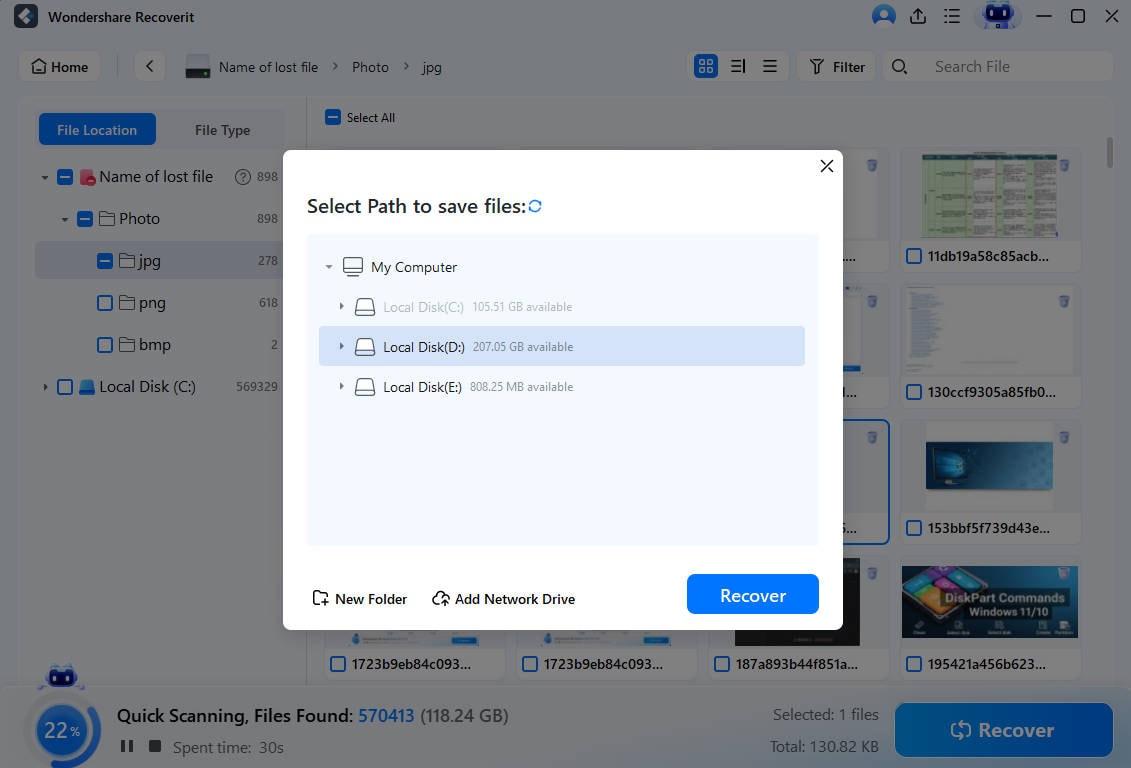
Step 3. Open saved copies in a compatible player. Check the opening, middle, and end of the video, including audio. If the scan finds no usable footage, leave the card unchanged; another recovery attempt cannot reconstruct overwritten content, and a failing flash controller may require professional service.
If the deleted clips were on a stable, readable SD card, Recoverit can scan that card for remaining file data and let you save recoverable results to another drive. It cannot guarantee a complete recording, access an unexposed internal Everio disk, or repair physical damage. Choose the appropriate official installer only after confirming that your camera's source medium qualifies.
Part 3. What If Your JVC Everio Uses a Built-In HDD or Memory?
Many Everio owners searching for hard-drive recovery cannot remove an SD card containing the lost video: their recording may reside inside the camera. The safe method is therefore model-dependent.
Access Files Safely On A Recognized Camcorder
Step 1. Find the exact JVC model manual and use its recommended USB connection and file-copying procedure. Use stable power; an interrupted connection can complicate access to the recording medium.
Step 2. If the camera displays existing videos and the computer permits ordinary file copying, copy every accessible original to a different disk first. Check the copies in a compatible player.
Step 3. If recordings were deleted from internal storage, first confirm whether its actual storage volume is accessible to the computer as a supported drive, not merely as a camera transfer interface. Only then consider a read-oriented scan that explicitly selects that volume. When only files are listed through a camera app or transfer mode, there may be no block-level access for deleted-file scanning.
For connection and file-transfer instructions, search the exact model at JVCKENWOOD manuals or check JVC support. Do not assume a working playback menu means an undeleted file can be recovered through USB.
Handle An Inaccessible Or Failing Built-In Drive
If the camera clicks, overheats, disconnects, or cannot expose its built-in HDD, stop repeatedly powering it on. Do not disassemble the drive, initialize it, or attempt speculative camera resets. Seek a recovery specialist familiar with camcorder storage. The same caution applies to inaccessible internal flash memory; a standard USB transfer mode is not proof that raw deleted-file scanning is available.
Part 4. What to Do When JVC Everio Videos Still Cannot Be Found
Some seemingly lost videos are still present under a different file extension or have been copied without the folder structure needed for convenient playback. Check these cases separately from genuine deletion.
Check Formats And Recording Folders
Older Everio SD and HDD models may use .MOD or high-definition .TOD; AVCHD Everio models can use .MTS inside the camera's folder tree. If you cannot find .MP4 files, that alone does not mean the footage is missing. Use the original model's manual to identify the expected format and browse the readable copy rather than modifying the source.
If an .MTS recording was deleted from a readable card, the MTS video recovery workflow covers that specific file type. If a clip is already present but fails in compatible players, check why recovered videos do not play before attempting any repair on a copy.
Distinguish Missing, Damaged, And Unplayable Files
| Symptom | Likely next action |
| Expected file is absent after deletion | Stop writing and perform read-oriented recovery from an accessible source |
| File exists but player reports an unsupported format | Use a player that supports the camera's original codec or container |
| File was recovered but freezes or ends early | Verify another copy and consider file repair only after safeguarding the original |
| Camcorder HDD clicks or disappears repeatedly | Stop power cycles and seek professional help |
Do not convert, trim, reformat, or overwrite the only remaining copy of a video just to test playback. Work from a separate copy whenever possible.
Part 5. Prevent Further Video Loss
Once the recordings are safe, use a repeatable transfer and backup routine rather than leaving a single copy on an aging camera or frequently reused SD card.
Protect The Camera And Storage Media
- After each shoot, copy videos to a computer and a separate backup destination, then verify a sample before clearing the card.
- Keep the original folder structure for older camcorder formats when practical.
- Do not remove storage while the camcorder is writing, and use an appropriate reader and stable power.
- Replace unreliable cards and have unusual HDD noises investigated rather than repeatedly formatting or retrying them.
- Check the exact Everio model manual before changing recording media or camera settings.
Conclusion
To recover deleted JVC Everio video safely, identify the exact model and the storage medium used for the missing clip first. A stable, detectable SD card may be scanned with recovery software, while built-in HDD and flash-memory cases depend on genuine computer access and hardware condition. Always save files to a different drive and test the recovered videos before reusing the camera or card.
FAQ
-
Can I recover deleted videos from a JVC Everio?
Sometimes. Recovery depends on the model, where the recordings were stored, whether the source can be read, and whether deleted data has already been overwritten. -
Where are JVC Everio video files stored?
It varies by model. Some Everio cameras use removable SD cards, others built-in flash memory or HDDs. Formats can include MOD, TOD and MTS; check your exact model manual. -
Can Recoverit scan an Everio's built-in hard drive through USB?
Only when a supported, readable storage volume is actually exposed to the computer. A camera connection by itself does not guarantee direct access to its internal drive. -
What if my JVC Everio card asks to be formatted?
Cancel the format prompt. Stop using the card, check it with a reliable reader, and preserve the original media. Formatting can change data needed for recovery. -
Why do my recovered Everio videos not play?
The original format may be unsupported by the player, or the recovered file may be incomplete or damaged. Keep the original recovered copy and check compatibility before attempting repair. -
What if I deleted a JVC Everio video after copying it to my computer?
If the clip existed on the computer when it was deleted, check that computer's Recycle Bin, Trash, backups, and original storage before scanning the camcorder card. Scan the device where the deletion actually happened; do not write new files to that source.


