 TL;DR:
Pick an external SSD for your Mac by workload and port: Thunderbolt 3/4/5 drives (LaCie Rugged SSD Pro, SanDisk PRO-G40) for 4K/8K video and boot drives; USB 3.2 Gen 2x2 drives (Samsung T9, ADATA SE880) for fast everyday transfers; USB 3.2 Gen 2 drives (Crucial X9 Pro, T7 Shield) for backups and Time Machine. For rugged field use, pick the SanDisk PRO-G40 (IP68) or T7 Shield; for large desktop backups, the SanDisk Desk Drive (8TB). Format as APFS (or exFAT for cross-platform), and recover accidental data loss with Wondershare Recoverit.
Ask AI for a summary
 ChatGPT
 Perplexity
 Gemini
 Claude
 Grok
External SSDs for Mac fix the upgrade problem — internal storage is sealed in, so a fast USB-C/Thunderbolt drive is the plug-and-play answer for extra space, Time Machine backups, and even boot drives. This guide covers what makes an SSD Mac-friendly and reviews the 8 best external SSDs for Mac in 2026.
Part 1. How to Determine an SSD Good For Mac?
Six criteria decide whether an external SSD for MacBook is worth buying. Check them before you choose:
| Criterion | Why It Matters | What to Check |
| APFS / HFS+ formatting | Plug-and-play without extra setup | Reformattable in Disk Utility — APFS on new models, Mac OS Extended on older ones |
| USB-C / Thunderbolt 3/4 support | The port decides real-world speed | USB4/TB3/4 for video editing and boot drives; USB 3.2 Gen 2 (10Gbps) is fine for backups |
| Time Machine ready | Much faster backup/restore than HDD | Dedicated drive or APFS volume so backups don't conflict with files |
| TRIM support | Keeps SSD performance and lifespan | macOS doesn't auto-enable TRIM for third-party external SSDs — check the vendor's tool |
| Heat dissipation | Prevents thermal throttling and early failure | Aluminum shell or heatsink; sustained transfers should stay cool |
| Encryption (FileVault / AES) | Protects data at rest | Hardware 256-bit AES or FileVault-compatible encryption |
| Interface Type | Max Theoretical Speed | Real-World Mac Performance | Best Use Case |
| USB 3.2 Gen 2 | 10 Gbps | ~950 - 1,050 MB/s | General backups, Time Machine |
| USB 3.2 Gen 2x2 | 20 Gbps | ~950 - 1,050 MB/s* | *Most Mac ports are 10Gbps — Gen 2x2 speeds need a compatible Mac or dock |
| USB4 | 40 Gbps | ~2,500 - 3,000 MB/s | Modern Macs (M1-M4) — backward compatible with TB3 and USB 3.2 |
| Thunderbolt 3/4 | 40 Gbps | ~2,500 - 3,200 MB/s | 4K/8K Video Editing, Boot Drives |
| Thunderbolt 5 (New) | 80 - 120 Gbps | Up to 6,000+ MB/s | High-end Studio Workflows (M4/M5) |
Part 2. Top External SSDs For Mac in 2026: An Overview
Read honest user reviews, check warranty periods and firmware updates, then pick from the eight leading options below:
1. Crucial X9 Pro
Known for portability and storage space, this Mac-friendly SSD offers up to 4TB capacity in a lightweight rugged anodized-aluminum body. It reaches up to 1,050MB/s read and write over USB 3.2 Gen 2, suiting Time Machine backup, file transfer, and portable macOS boot drives.
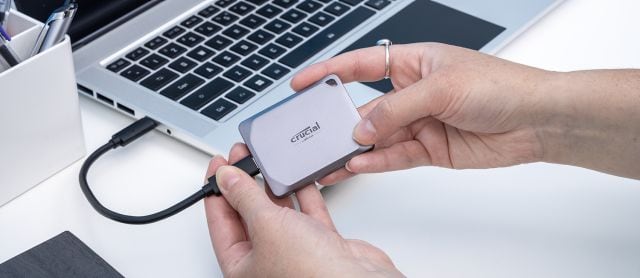
Top Points
- Native USB-C connectivity, reformattable to APFS or HFS+.
- 256-bit AES hardware-based encryption and a 5-year warranty.
- Built for all-weather shoots with IP55 water and dust resistance.
2. SanDisk Desk Drive
Designed for massive and fast desktop storage, the SanDisk Desk Drive holds up to 8 TB and serves best as a backup hub rather than a portable drive. With up to 1,000MB/s it accesses files about 4x faster than a desktop HDD.
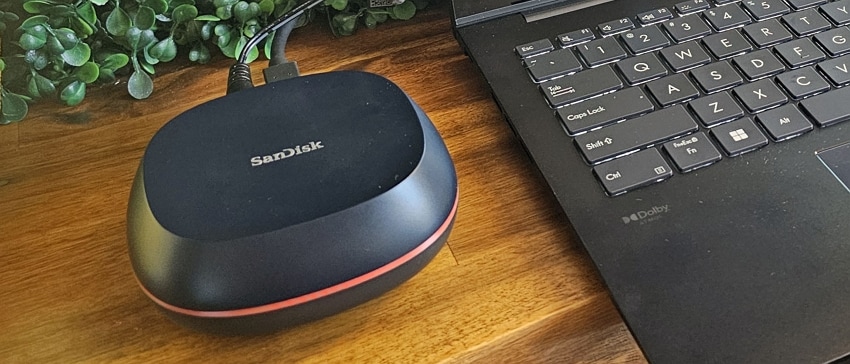
Top Points
- USB-C and USB-A ports, plus a Kensington-style cable lock slot and power jack.
- Free Acronis True Image for disk, file, and folder backup included.
- Silent, vibration-free operation compared with traditional hard drives.
3. LaCie Rugged SSD Pro Thunderbolt 3
Engineered for professionals needing speed and reliability, this portable SSD for Mac reaches up to 2,800MB/s — ideal for file transfer and 8K video editing. It carries a 5-year warranty and supports Thunderbolt 3 and USB-C for modern MacBooks.
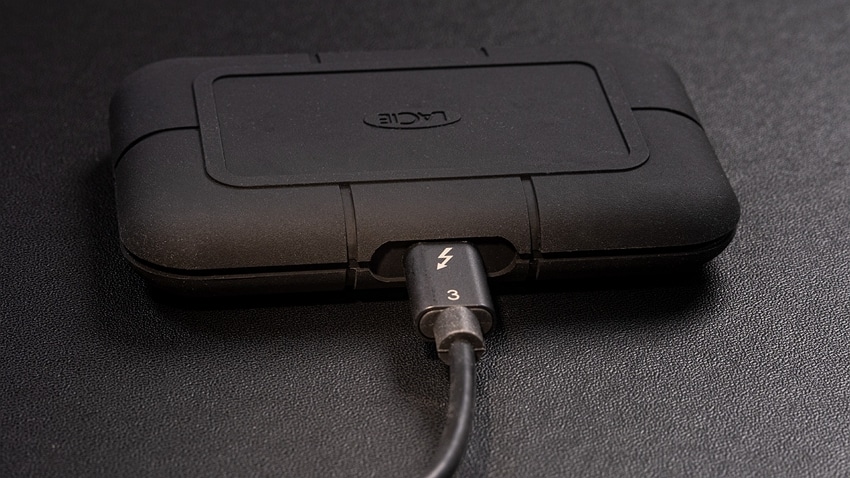
Top Points
- Silicone-coated, crush-resistant aluminum case resists dust and water.
- 1-month Adobe Creative Cloud membership included.
- Design reduces thermal throttling under heavy loads.
4. Samsung Portable SSD T9
A lightning-fast, tough, and affordable choice aimed at content producers. It's slightly bigger than rivals with a textured rubberized grip, but still pocket-sized, combining fast speeds, solid construction, and Samsung Magician software.
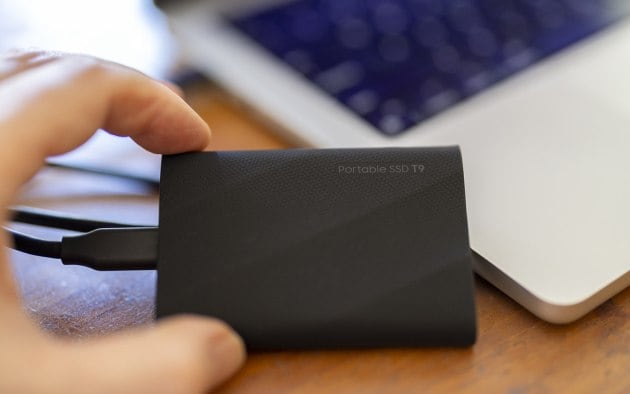
Top Points
- Samsung Magician software plus 256-bit AES hardware encryption.
- USB 3.2 Gen 2x2 on compatible Macs for up to 2,000MB/s.
- Up-to-date firmware, extra encryption, and drive-health monitoring.

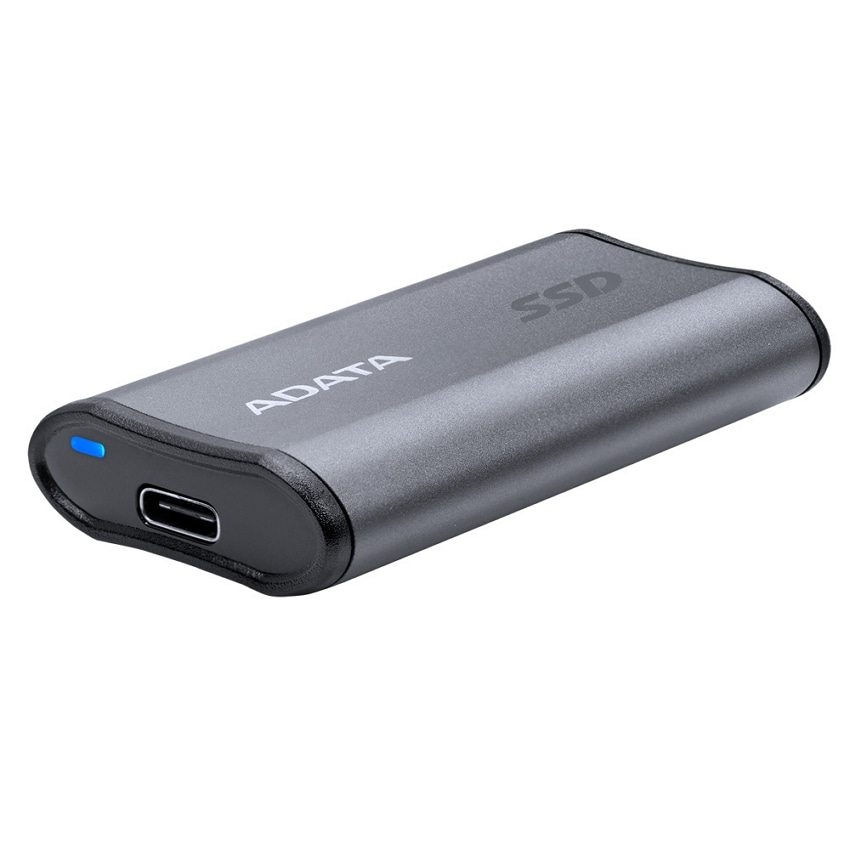
5. Adata SE880 SSD
Smaller than a credit card and lighter than a pen, this SSD for Mac supports new-generation consoles and multiple operating systems including Windows. It's a top performer in short bursts, though it has limits under sustained heavy use.
Top Points
- Aluminum-and-plastic chassis is sturdy and fingerprint-resistant.
- Software-based encryption (no hardware encryption).
- USB 3.2 Gen 2x2 (20Gbps) with peak speeds up to 2,000MB/s.
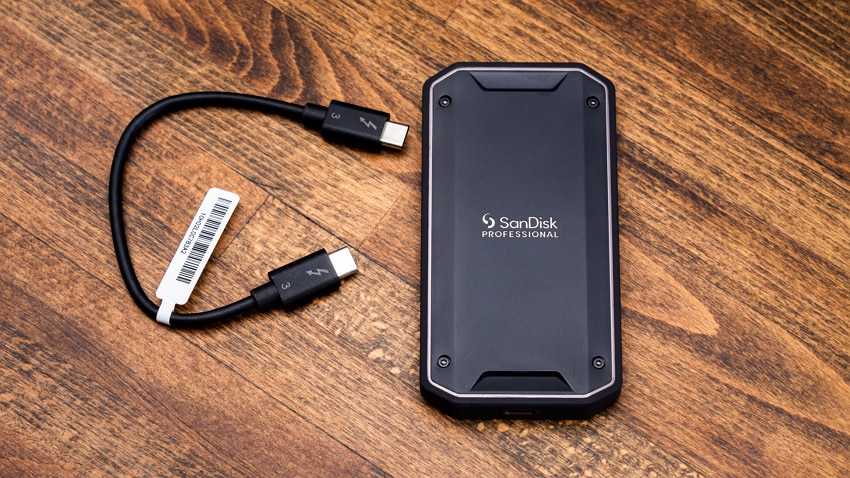
6. SanDisk Professional PRO-G40 SSD SDPS31H
The choice of photographers, this Mac-friendly SSD hits up to 2,700MB/s read and 1,900MB/s write. Over Thunderbolt 3 (40Gbps) it typically transfers 50GB in under a minute; cool aluminum draws heat away to keep speed stable, and password-enabled 256-bit AES encryption protects sensitive files.
Top Points
- Ultra-rugged: IP68 dust/water resistance and 4000lb crush resistance.
- 3m drop resistance measured on carpeted concrete.
- Dual-mode compatibility — also works over USB-C at 10Gbps.
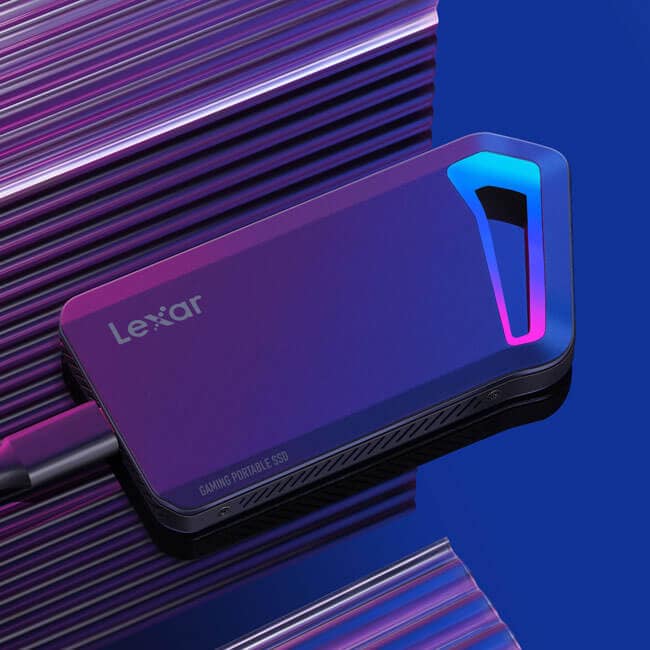
7. Lexar SL660 BLAZE Game Portable SSD
Built for gamers, the Lexar SL660 combines a rugged build, a detachable stand, and RGB LEDs. It delivers USB 3.2 Gen 2x2 performance of up to 2,000MB/s read and 1,900MB/s write.
Top Points
- Premium sandblasted aluminum enclosure with vibration resistance.
- 256-bit AES software encryption via Lexar DataShield.
- USB-C to USB-C and USB-C to USB-A cables included.
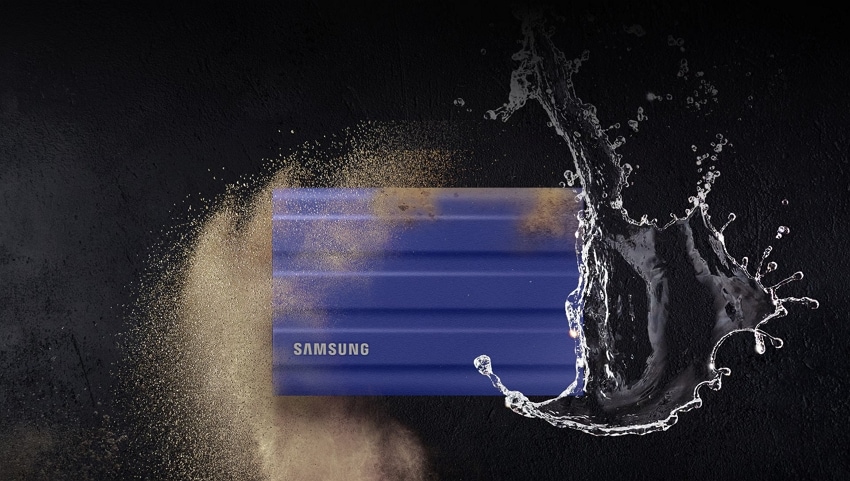
8. Samsung Portable SSD T7 Shield MU-PE
A rugged take on the renowned T7, this rugged external SSD for Mac suits outdoor professionals with its rubberized exterior and lightweight (~98g) build. It reaches up to 1,050MB/s read and 1,000MB/s write in 1TB, 2TB, and 4TB capacities.
Top Points
- USB-C to USB-C and USB-C to USB-A cables for broad compatibility.
- Samsung Magician utilities for drive management and optimization.
- Hardware-based 256-bit AES encryption with optional password protection.
Part 3. Comparison of the 8 Top External SSDs for Mac
Compare the eight leading solid-state external hard drives for Mac side by side (prices are approximate 2026 street prices for the 1TB tier and change over time):
| Tools | Interface | Max Speed | Weight | Size | Warranty | Capacity Options | Approx. Price (1TB) | Best For |
| Crucial X9 Pro | USB-C 3.2 Gen 2 | Up to 1050/1050 MB/s | About 38g | 65 × 50 × 10 mm | 5 years | 1TB, 2TB, 4TB | ~$95 | Portability, reliable backups |
| SanDisk Desk Drive | USB-C 3.2 Gen 2 | Up to 1000 MB/s | Nearly 370g | 116 × 114 × 42 mm | 3 years | 4TB, 8TB | ~$180 (4TB) | Large Time Machine backups |
| LaCie Rugged SSD Pro Thunderbolt 3 | Thunderbolt 3, USB-C | Up to 2800 MB/s | 100g | 97.9 × 65 × 17 mm | 5 years | 1TB, 2TB | ~$280 | High-speed video editing, field work |
| Samsung Portable SSD T9 | USB-C 3.2 Gen 2x2 | Up to 2000/2000 MB/s | 122g | 88 × 60 × 14 mm | 3 years | 1TB, 2TB, 4TB | ~$130 | Creators needing speed & portability |
| Adata SE880 SSD | USB-C 3.2 Gen 2x2 | Up to 2000/2000 MB/s | 31g | 64.8 × 35 × 12.25 mm | 5 years | 512GB, 1TB, 2TB | ~$100 | Budget ultra-compact fast SSD |
| SanDisk Professional PRO-G40 SSD SDPS31H | Thunderbolt 3, USB-C 3.2 Gen 2 | Up to 2700/1900 MB/s | 122g | 110 × 58 × 14 mm | 5 years | 1TB, 2TB, 4TB | ~$220 | Professionals needing rugged, fast Thunderbolt speeds |
| Lexar SL660 BLAZE Game Portable SSD | USB-C 3.2 Gen 2x2 | Up to 2000/2000 MB/s | 80g | 112.6 × 57.4 × 10.6 mm | 5 years | 512GB, 1TB, 2TB | ~$110 | Gamers needing portable RGB SSD |
| Samsung Portable SSD T7 Shield MU-PE | USB-C 3.2 Gen 2 | Up to 1050/1000 MB/s | 98g | 88 × 59 × 13 mm | 3 years | 1TB, 2TB, 4TB | ~$110 | General rugged fast storage |
Part 4. Accidentally Lost Data in SSD: Recover it on Mac With Ease!
If you lose data on your external SSD for Mac — formatted, dropped, or unreadable — Wondershare Recoverit restores files from Samsung, Lexar, SanDisk, and other SSD brands with a 99.5% success guarantee. It supports 1000+ file types across 2000+ devices, and works with T2/M1/M2/M3/M4 chip Macs.
What to do if your Mac says 'Disk Not Readable'
External SSDs, especially high-speed NVMe models, are sensitive to sudden power loss. If your Mac stops recognizing your drive after an unsafe ejection, the directory structure (B-Tree) might be corrupted. Wondershare Recoverit is designed to bypass macOS's mounting restrictions. It can communicate directly with the SSD's controller to reconstruct the file path and rescue your data, even when the drive refuses to appear in Finder.
Key Features
- Data & Storage Devices Support: From over 2000 storage media devices, this recovery solution can retrieve up to 1000 file types and formats.
- Data Loss Scenarios: Whether you have lost data because of a Mac system crash, improper operation, or virus attack, it supports over 500 data loss scenarios.
- Scanning Options: While giving you quick and advanced scanning options, Recoverit lets you scan an entire disk or a specific path.
A Quick Tutorial: How to Recover Lost Data from External SSD for Mac?
Follow this stepwise guide to recover files from SSD Mac with Recoverit:
Step 1. Set Up Recoverit and Specify External Drives
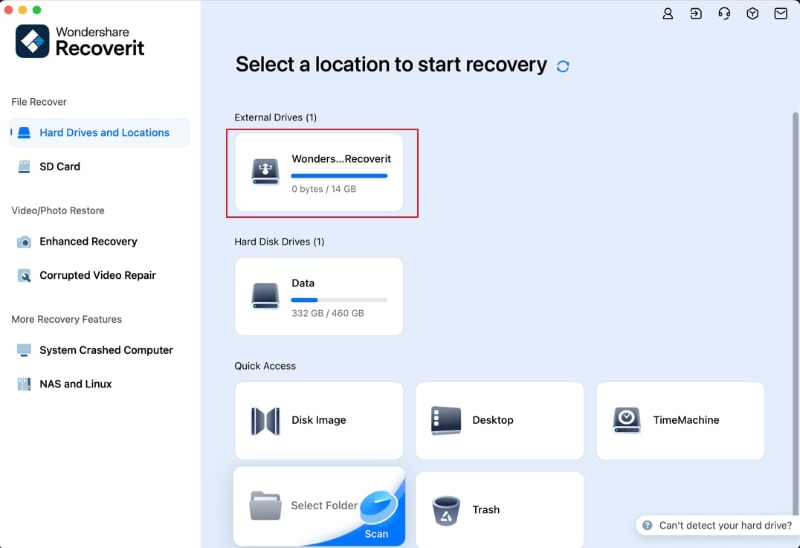
Connect your external SSD to your Mac and click the "Hard Drives and Locations" tab after launching the tool. Then, select "External Drives" from the relevant section and allow the software to begin searching.
Step 2. Witness Quick Scan or Specify Search
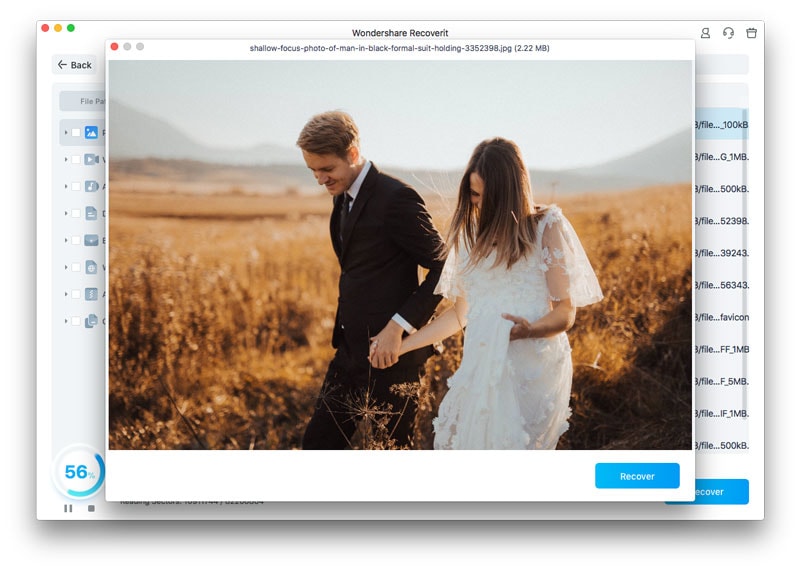
During scanning, apply filters and choose folders to specify the search; otherwise, observe the "Quick Scan" status below.

Step 3. Recover Data After Ensuring Their Integrity
Finally, get a preview of recovered files to confirm their integrity and click the "Recover" button to export them back to your device.
Part 5. Important Tips When Using External SSDs for Mac
Prevent the most frequent mistakes and get the most out of your external SSD on Mac:
| Habit | Why | How |
| Encrypt the drive | Protects sensitive data at rest | Create an encrypted volume at formatting, or encrypt in Finder afterwards |
| Always eject safely | Prevents directory corruption and data loss | Press Command + E, or drag the disk icon to the Trash before unplugging |
| Format before first use | A new SSD must be formatted for macOS | Disk Utility > select the external disk > Erase (APFS or Mac OS Extended) |
| Manage Time Machine backups | Avoids huge unnecessary backups | Create dedicated APFS volumes and exclude them from Time Machine |
| Check SSD health | SSDs degrade with age and disuse | Use the drive regularly; run Disk Utility First Aid when something feels slow |
Conclusion
Choose your external SSD for Mac in 2026 by workload: Thunderbolt for pro video, USB 3.2 Gen 2x2 for fast everyday transfers, and USB 3.2 Gen 2 for backups — and compare the price column above for value. Keep it healthy with safe ejection, APFS formatting, and First Aid — and if data goes missing, recover it with Wondershare Recoverit.
- Recovers data from 1000+ file formats across HDDs, SSDs, USB drives, SD cards and more.
- Handles 10000+ data loss scenarios, including deletion, formatting, corruption, and virus attacks.
- Recovers lost or deleted files like documents, photos, videos, music, and emails safely and completely.
- Restores full HD, Ultra HD, 4K and 8K videos without corruption.

FAQ
-
1. Can a faulty external SSD cause a Mac computer failure reboot?
Yes, a malfunctioning external SSD with corrupted firmware or hardware faults can cause kernel panics, leading to an unexpected computer reboot. If this happens, disconnect the drive immediately. If your Mac operates normally afterward, the SSD is likely the cause of the problem. -
2. What should I do if my Mac keeps restarting after connecting a new external SSD?
First, try connecting the SSD using a different cable and port to rule out a simple connection issue. If the Mac computer failure reboot continues, boot your Mac into Safe Mode with the drive connected. This allows you to check the drive for errors with Disk Utility without loading third-party drivers. -
3. How do I ensure an external SSD is fully compatible with my Mac?
To ensure compatibility, look for an SSD that supports Thunderbolt 3/4 or USB-C 3.1 Gen 2 (or higher) for the best speeds. It's also crucial to format the drive to APFS or Mac OS Extended (Journaled) using Disk Utility for optimal performance and stability with macOS. -
4. My external SSD is running slow on my Mac. What could be the cause?
Several factors could be at play. Ensure you're using a high-speed cable and connecting to the correct port (Thunderbolt/USB-C, not an older USB-A with an adapter). The drive could also be nearly full, which slows down performance. Lastly, check Activity Monitor to see if a process like Spotlight indexing is causing the slowdown. -
5. Which of the 8 external SSDs for Mac should I buy in 2026?
Match the drive to the job: LaCie Rugged SSD Pro or SanDisk PRO-G40 for 4K/8K video editing (Thunderbolt), Samsung T9 or ADATA SE880 for fast everyday transfers, Crucial X9 Pro or T7 Shield for reliable backups and Time Machine, and SanDisk Desk Drive if you need 8TB of desktop storage. All are Mac-compatible and can be formatted to APFS. -
6. Can I use an external SSD as the boot drive for my Mac?
Yes. Format the SSD as APFS with a GUID Partition Map, install macOS onto it, then on Apple silicon or T2 Intel Macs allow external booting in Startup Security Utility (you'll confirm with the side button / Touch ID on Apple silicon). A Thunderbolt 3/4 drive is strongly recommended — USB 3.2 Gen 2 speeds make a boot drive feel sluggish. -
7. Should I format my external SSD as APFS or exFAT?
APFS if the drive is used only with Macs — it supports snapshots, FileVault encryption, and better space management. exFAT if you need to move files between Mac and Windows — it's readable by both, but lacks snapshots and permissions. Avoid FAT32: its 4GB per-file limit blocks large videos and disk images.


