
If an accident clip or another important dashcam recording has disappeared, stop the camera from recording before doing anything else. Deleted footage may still be recoverable from a readable SD or microSD card, but loop recording continually reuses storage space. Once new video replaces the original data, recovery software cannot recreate those overwritten bytes.
Start by checking whether the footage was saved to a protected folder, companion app, or computer. If the video was actually deleted or the card was accidentally formatted, use a computer and card reader to scan it, then save any recovered files to a different drive. The right path depends on where the video was stored and what happened to it.
In This Article
Part 1. Can Deleted Dashcam Footage Be Recovered?
Sometimes. The most favorable case is an accidentally deleted clip on a card that remains readable and has not been used for new recordings. A missing video is not always deleted, however; many cameras keep saved incident clips separately from ordinary loop footage.
What Loop Recording Means for Recovery
Most dashcams split a drive into short recordings and reuse space when their loop-storage area fills up. This is why footage from yesterday may disappear even when nobody pressed Delete. On Garmin Dash Cam 47/57/67W models, for example, the oldest unsaved video is replaced when the space allocated to unsaved recordings fills up, while manually saved or event recordings use separate folders. See Garmin's official folder description.
Deleted is not the same as overwritten. A deleted file may still have recoverable data on the card. When the exact storage blocks holding a video have been replaced by newer footage, neither a normal recovery scan nor a paid license can bring the original bytes back. A partly overwritten clip may yield incomplete fragments rather than a playable full recording.
Choose the Right Next Step
Use what you see on the camera or computer to choose a safe path instead of trying every fix in a random order.
| What happened? | Best first action | What to expect |
| Clip missing from the normal gallery | Check saved, locked, event, parking, and companion-app folders | An intact copy may still be there |
| Video deleted; card still opens on a computer | Stop using the card and scan it | Some deleted files may be found if not overwritten |
| Card was quickly formatted | Do not record again; scan before any repair | Recovery depends on how the format and subsequent writes affected the data |
| Windows asks to format the card, or it appears RAW | Cancel the prompt; check a reliable reader without writing to the card | Logical recovery may be possible if the device is stable and detectable |
| Video plays on the camera but not the PC | Copy the original and check the player or video codec | There may be no deletion to recover |
| Card repeatedly disconnects, overheats, or shows no capacity | Stop scans and consult a recovery lab | Professional assessment may be safer than repeated reads |
| Footage was recorded over by loop recording | Search for a saved, exported, or cloud copy | Fully overwritten original data cannot be reconstructed |
Part 2. Protect the Card and Check Existing Copies
Before running recovery software, protect the source and look for a file that still exists. This is often faster than a scan, especially when the dashcam has separate folders for incident or locked recordings.
Stop Recording and Remove the Card Safely
Step 1. Pull over and park safely if you are driving. Stop recording using the controls supported by your dashcam model, then power it down according to its manual. Do not pull the card while the camera is still writing.
Step 2. Remove the SD or microSD card only after the device is off. If the dashcam stores video on built-in memory rather than a removable card, consult the manufacturer's export instructions before connecting or changing anything.
Step 3. Keep the card out of the dashcam until you have made a safe copy or finished recovery. If the clip is important evidence, preserve the original card and document when and how it was handled.
Success check: The card is out of active use, and no new loop recordings are being written. If it cannot be removed without damage, or the camera is physically damaged, stop and seek model-specific support.
Check Saved, Event, and Hidden Video Folders
With a readable card in a computer, first examine existing files without changing their contents. In File Explorer, enable View > Show > Hidden items if a folder you expect is missing. This displays files that were hidden; it does not restore deleted videos.

Check the folders named DCIM, Movie, Record, Event, Emergency, or Locked, as applicable to your camera. Folder names vary by manufacturer and model. For Garmin Dash Cam 47/57/67W, the documented DCIM folders include 100EVENT for incident recordings, 102SAVED for manually saved clips, 103PARKM for parked recordings, and 105UNSVD for temporary unsaved footage.
If you find the desired clip, copy it to your computer's internal drive and test the copy before doing anything else. Do not move, rename, or delete the original on the card. If none of these folders contains the missing video, continue to the recovery scan in Part 3.
Part 3. Recover Dashcam Videos with Recoverit
If footage was deleted or a readable card was accidentally formatted, Recoverit File Recovery can scan the storage device for recoverable files. For a removable dashcam card, use Recoverit SD Card Recovery. These steps apply to logical data loss on a card that a computer can detect; the software cannot recreate overwritten recordings or repair a physically failed card.
Connect the Dashcam Card to a Computer
Step 1. Connect the powered-off dashcam's SD or microSD card through a compatible reader. If the card uses a microSD adapter, make sure it fits securely. Open your computer's drive list and confirm that the card is detected at a plausible capacity.
Step 2. Open Recoverit on the computer and choose SD Card Recovery from the available recovery locations. Select the card you just connected, not the computer's system drive. The official Recoverit Guide shows this workflow.
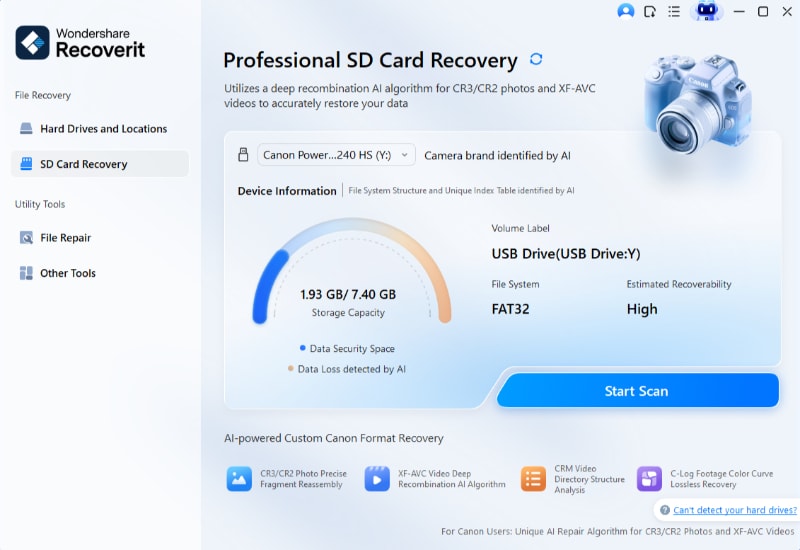
Success check: Recoverit shows the correct SD card as a selectable source. If the card is missing, try a known-good reader and port once without formatting or initializing it. If detection remains unstable or the card reports no capacity, stop rather than repeatedly scanning.
Scan the Card for Missing Video
Step 1. Select the card and start the scan. Let Recoverit search the device for deleted or lost files. If the interface offers video or file-type filters, use them to narrow the results to relevant clips, often MP4 or MOV files.
Step 2. Check recording dates, file size, folder paths, and preview availability as results appear. Allow the scan to finish before deciding that a clip is absent; some footage is reconstructed later in the process.
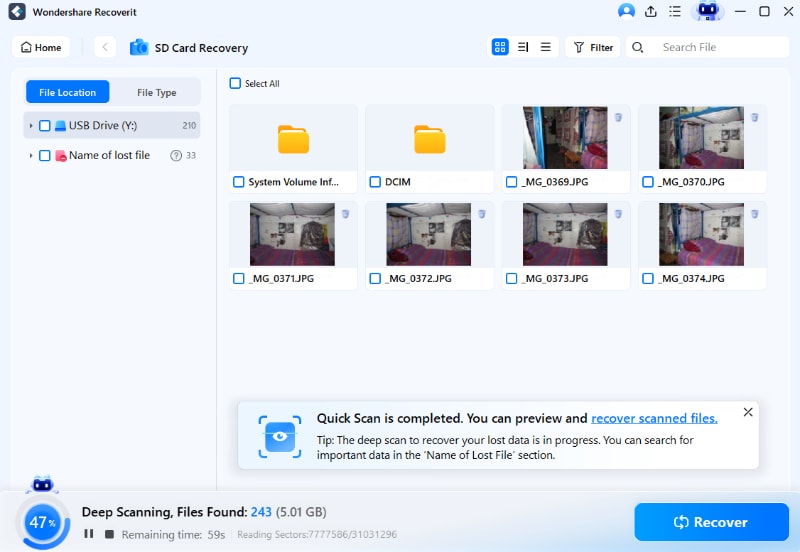
Success check: Files with plausible names, timestamps, sizes, or playable previews appear. If no relevant files are found after a completed scan, do not keep recording to test the card; check backups or consider a second non-writing recovery approach before further changes.
Preview and Save to Another Drive
Step 1. Preview any video candidate the software supports. A result merely appearing in a scan is not proof that all its video frames survived. Pay attention to playback, duration, and whether the time of the incident is present.
Step 2. Select the wanted files, choose Recover, and save them to a different healthy drive such as your computer or a separate external SSD. Never choose the source dashcam card as the recovery destination.
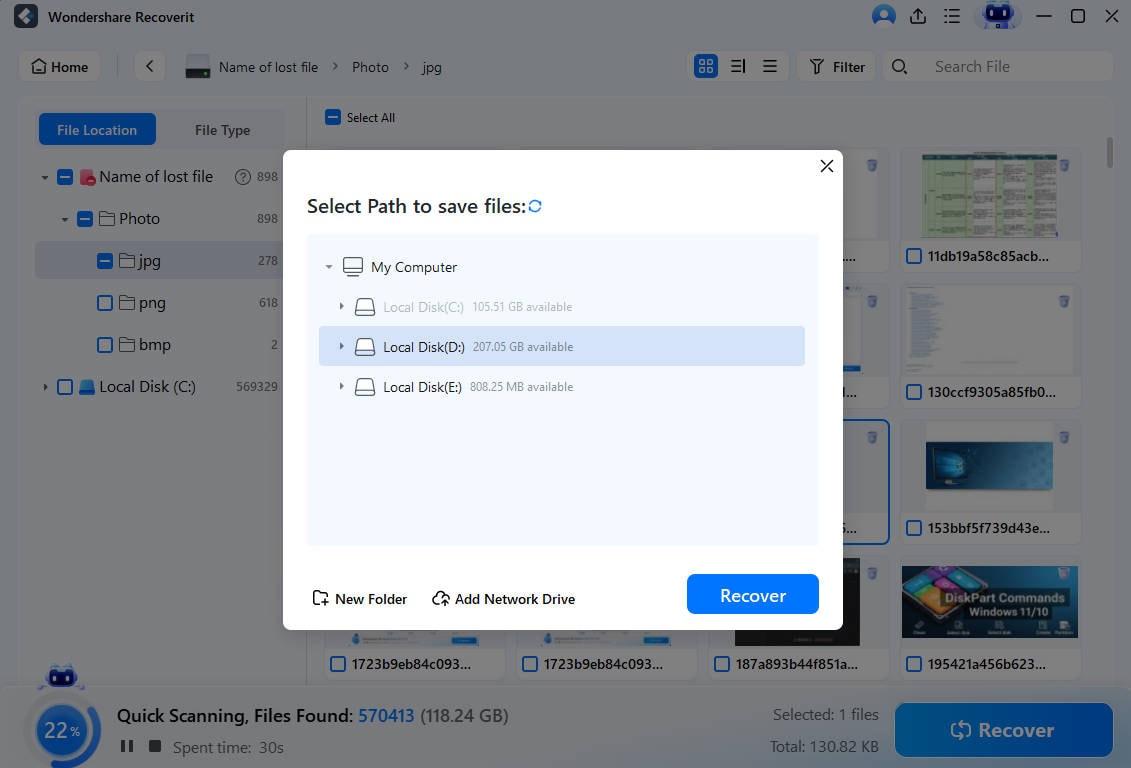
Success check: Open the saved copy from its new location and confirm the needed scene plays. If the file does not open, keep the original recovered bytes untouched and consult the video-checking advice in Part 6. A fresh scan cannot restore video blocks already overwritten by the dashcam.
If the card still reads normally and you want to check for deleted dashcam footage, you can review the scanning workflow in Recoverit File Recovery before choosing a download.
Part 4. Free Checks and Difficult Recovery Cases
A software scan is not the only option. Two situations deserve a different response: a video removed from a computer rather than the camera card, and a card whose data is inaccessible despite careful connection checks.
Check the Recycle Bin for Computer-Deleted Copies
This works only if the footage was copied to a Windows computer and then deleted from a location that uses the Recycle Bin. Deleting directly from an SD card often bypasses it. Opening the Recycle Bin is a safe check and does not alter the source card.
Step 1. Open Recycle Bin and search for the video name or the approximate deletion date.

Step 2. If the file is present, right-click and choose Restore. The file returns to its previous Windows folder. Open it there, then save a backup to a second location.
If it is not there: This does not tell you whether the SD card's original video can be recovered. Return to the card-specific scan instead of searching Recycle Bin repeatedly.
Consider a Read-Only Recovery Tool
For a card a computer can detect, PhotoRec is a free, open-source alternative that reads the source without intentionally modifying it. It searches for file signatures even when the file system is damaged. It may recover files without their original names or directory structure, and fragmented dashcam videos may remain incomplete.
Use the official PhotoRec documentation for platform-specific steps. Choose a destination on another drive and check the recovered videos afterward. If this approach returns fragments rather than the needed recording, do not interpret a large result count as proof of recovery.
Know When to Stop DIY Recovery
If the SD card is cracked, wet, very hot, repeatedly disconnects, or cannot be detected at a sensible capacity by a known-good reader, do not keep cycling through utilities. A professional lab can assess the media and explain the risks before further reads. A lab may help with physical failures or reconstructing surviving fragments, but it cannot retrieve bytes that were physically overwritten by newer video.
Similarly, if Windows offers to format the card, cancel. Do not run CHKDSK /f, reset the camera, or format the storage as a first recovery step. Microsoft's CHKDSK documentation confirms that /f changes file-system metadata to repair errors. Such repairs are a separate maintenance task after important data is safely copied or recovered.
Part 5. Recover Missing Tesla Dashcam Footage
Tesla Dashcam and Sentry Mode commonly use a USB drive rather than a removable microSD card. Before scanning the USB drive for deleted clips, check the folders and playback options available for your vehicle, as they differ from those on a standalone dashcam.
Check the TeslaCam Folders First
When the car is parked, consult the Dashcam Viewer for clips that are still saved. For a recording stored on the USB device, connect the drive to a computer only when it is safe to remove it under the vehicle's instructions, then look for the TeslaCam folder. Tesla's Model 3 owner's manual describes RecentClips, SavedClips, SentryClips, and, where supported, EncryptedClips.
| Folder | What to check |
| RecentClips | Temporary footage from the latest recording window; older portions may already have been overwritten |
| SavedClips | Footage explicitly saved from the recent recording buffer |
| SentryClips | Stored Sentry Mode events, subject to storage-management limits |
| EncryptedClips | Encrypted recordings requiring Tesla-supported playback or decryption rather than generic video repair |
Success check: The requested timestamp exists in a saved folder or the vehicle's viewer and plays. Copy ordinary playable video files to the computer without modifying the USB original. If no matching recording exists, determine whether the footage was actually saved before assuming deletion.
Handle Deleted and Encrypted Tesla Clips Correctly
If an ordinary, nonencrypted Tesla video file was deleted from a readable USB drive, stop using that drive and use a file recovery scan, saving the results elsewhere. If the footage is encrypted, do not rename it to MP4 or expect a recovery program to remove its encryption. Tesla documents a supported viewing and decryption path for eligible recordings; use the method specified for your vehicle.
Important limit: Video that was never saved, was automatically overwritten, or was never recorded cannot be recreated by scanning the USB drive. For detailed playback paths and model distinctions, see the Tesla dashcam viewing guide.
Part 6. Check Your Recovered Videos and Prevent Another Loss
Finding a file is only the first milestone. Before reusing the card or deleting a backup, confirm that the important footage can be opened and that you have preserved an unchanged copy.
Verify the Clip and Keep an Untouched Copy
Check that the copied file has a plausible duration and size, plays through the relevant moment, and contains any needed audio. Compare the camera's time setting with the actual event time; timestamps may be affected by time-zone or clock settings. If the video shows an error on the computer but still plays in the dashcam or its companion app, try a suitable player or codec before deciding that it is damaged.
If the saved recovered file is genuinely corrupted, work on a duplicate and consult dashcam video playback and repair guidance. File repair is not a substitute for recovering deleted storage blocks. Preserve the original video and its source if the recording might be used as evidence.
Protect Future Dashcam Recordings
Save important incident clips promptly using the camera's Save, Protect, or Lock feature when provided, and export them to another device. Replace a card that repeatedly shows errors or unstable detection. Choose storage that meets your dashcam manufacturer's capacity and endurance guidance, and make regular backups of footage you need to retain.
Only after recovering and verifying everything important should you consider formatting the card according to the camera maker's instructions. Formatting is maintenance, not an undelete method. For that separate task, see how to format an SD card for a dashcam.
Conclusion
To recover deleted dashcam footage, first stop loop recording and look for saved clips. If a removable card or Tesla USB drive is readable and the footage was deleted rather than overwritten, a non-writing recovery scan may locate surviving video. Save anything you recover to another drive, verify that the important moment plays, and leave the original storage untouched until you are done. If the media is physically failing, professional assessment is safer than repeated scans.
FAQ
-
Can I recover dashcam footage after loop recording overwrites it?
Only data that has not been overwritten may remain recoverable. Once new video has replaced the original storage blocks, software cannot reconstruct the missing bytes. Check saved folders, exports, and backups before assuming the whole event is lost. -
Does deleting a video on the dashcam send it to the Windows Recycle Bin?
Usually not. Recycle Bin helps when a file was deleted from a suitable location on a Windows computer. Deleting a clip directly from a removable camera card typically does not put it there. -
Should I format a dashcam SD card if Windows says it needs formatting?
No, not while you still need files from the card. Cancel the prompt, stop new writes, confirm stable detection, and recover or copy the footage first. Formatting may change the data that recovery tools could otherwise inspect. -
Why are recovered dashcam videos present but not playable?
The file may be incomplete, fragmented, overwritten in part, or encoded with a format your player does not support. Test a copy with the correct player first. If the recovered file itself is damaged, retain the original and consider a separate video repair workflow. -
Can Recoverit recover deleted videos from a Tesla USB drive?
It may find ordinary deleted files on a detectable USB drive if their data survives. It cannot recreate overwritten footage or bypass Tesla recording encryption. Check TeslaCam folders and Tesla's supported playback method first.


