


 TL;DR:
To safely diagnose and fix unplayable dash cam footage, immediately stop recording to prevent loop overwrites, copy the untouched MP4 or MOV files to a separate computer drive, and perform all playback or repair tests exclusively on those duplicates.
● If a video plays successfully in the camera or companion app but fails on a PC, the file is likely intact but requires a specific HEVC/H.265 codec, proprietary metadata support, or an official desktop player from brands like VIOFO, Garmin, Nextbase, or 70mai.
● Because VLC's built-in "Always fix" setting is limited to AVI indexes rather than MP4 or MOV formats, genuinely incomplete recordings interrupted by a sudden shutdown require dedicated file repair workflows like Recoverit 15, though software cannot guarantee reconstruction if essential video data was never written.
● Missing crash clips are often securely stored in separate Event, Protected, or Parking folders rather than deleted; if a file is actually lost, SD card recovery tools can only retrieve the footage if the physical card remains detectable and new loop recordings have not already permanently overwritten the data.
Ask AI for a summary
 ChatGPT
 Perplexity
 Gemini
 Claude
 Grok
Your dash cam video won't play on your computer, phone, or the camera itself. The file may be fine but encoded in a format your player cannot read; the copy may be incomplete; or a recording interrupted by power loss may genuinely be damaged. Do not format the SD card or keep recording over important footage while you investigate. First test the original clip and an untouched copy, then choose a fix for the symptom you actually see.
This guide covers MP4, MOV, and other dash cam recordings from devices such as Nextbase, Garmin, VIOFO, 70mai, and similar cameras. Menu names, video formats, protected folders, and compatible memory cards differ by model. If the video contains evidence of an incident, keep the original card unchanged and use copies for playback and repair tests.
In This Article
Part 1. Why Dash Cam Videos Fail to Play
Not every playback error means that a dash cam file needs repair. The fastest safe diagnosis is to compare how the same recording behaves in the camera, the companion app, and on a computer. That helps you separate a player issue from a missing or damaged recording.
Identify the Symptom Before You Repair Anything
Use these visible clues to choose a route rather than trying random SD card commands or downloading codec packs from unfamiliar sites.
| What you see | Likely explanation | Safest next step |
| Video plays in the camera or app but not on a PC | Unsupported player, codec, or proprietary camera metadata | Try VLC or the camera maker's player on a copy |
| Video plays from the card but the copied file will not open | Interrupted or incomplete transfer | Keep both copies and repeat a careful copy to a different healthy disk |
| One MP4 or MOV will not play anywhere, but neighboring clips work | Incomplete recording or file corruption is possible | Preserve the card; try file repair on a duplicate |
| The crash or parking clip is not in the normal folder | Protected/event folder, filtering, or missing/overwritten clip | Check other folders and the app before considering recovery |
| Computer requests formatting or repeatedly loses the card | Reader, card, or storage-layer fault | Do not format or run disk-repair commands; protect data first |
| Footage opens but skips or stutters | Storage or decoding performance, not necessarily damaged data | Test a local copy or follow the separate choppy video playback guide |
Important: The extension MP4 does not tell you which video codec is inside. For example, an HEVC/H.265 recording can require a different playback environment from an H.264 recording. A zero-byte file is not the same problem as a nonzero file with missing indexes after an abrupt shutdown.
Protect the Original SD Card and Recordings
Dash cams often use loop recording, so new trips can overwrite older recordings. Protect important footage before you try any corrective action.
- Stop new recordings: Power down the dash cam normally and remove the card only after recording has stopped and the device has finished writing.
- Preserve evidence: Keep the original card unchanged. If the footage is important for an accident, insurance, or a legal dispute, document the camera model and file times, and consider a forensic copy or professional help.
- Copy, do not move: When a card is readable, copy the footage to a separate healthy computer drive. Keep the card copy intact. Use duplicates for VLC or file-repair experiments.
- Avoid modifying the source: Do not format, initialize, run CHKDSK, rewrite the card partition, or perform firmware updates as a first response to missing footage.
- Watch for physical faults: A card that disconnects repeatedly or cannot be detected reliably may need professional assistance. Repeated scanning or file-system repair can make recovery harder.
After protecting your original recording, start with the playback checks below. They do not require changing the source file.
Part 2. Fix Dash Cam Video Playback Without Changing the Original
These three checks identify whether the issue is limited to an app, your computer's decoder, or the camera-specific playback software. Use an already-copied file for PC tests when the footage matters.
Method 1. Check the Recording in the Dash Cam or Its App
Best for: A recording that appears to be missing or cannot be opened on your phone. If the original plays in the camera, the PC error alone is not enough to call it corrupted.
Step 1. Stop the current recording safely. Open the dash cam's built-in playback menu or connect its official companion app using the manufacturer's instructions.
Step 2. Open the recordings list. Look for separate front/rear/cabin folders, protected or event clips, and parking recordings. Folder names depend on the camera.
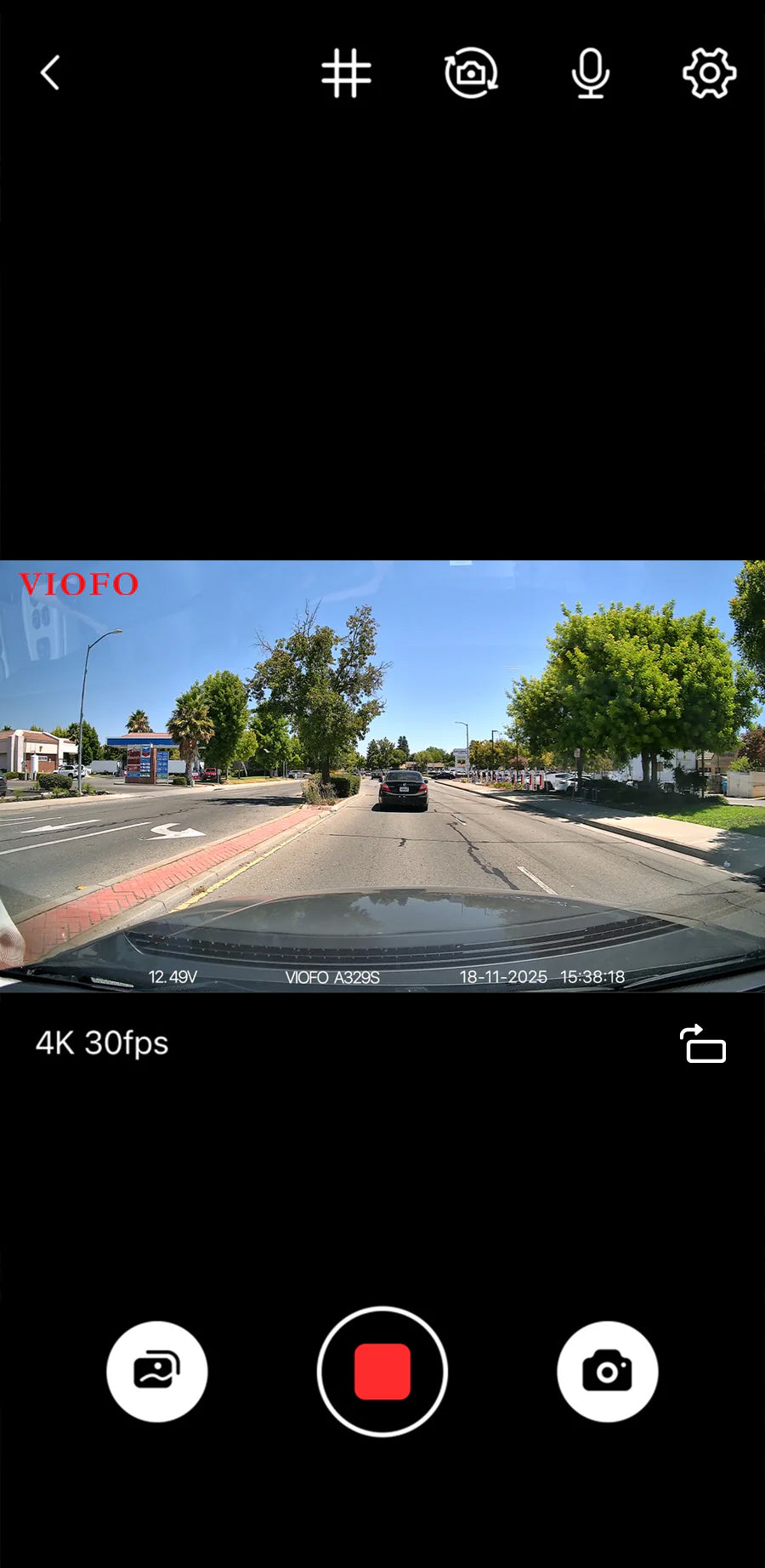
Step 3. Play the affected recording and a nearby working clip. If both work, copy the footage to your computer using the app's supported download/export function or a compatible card reader. If one clip fails in the dash cam as well, leave the original on the card and use Part 3 only after safeguarding it.
A real Reddit report about missing dash cam footage illustrates why the folder check matters: the user later found the clip in a protected or urgent folder. That is one user's experience, not proof of where every camera saves event files.
Method 2. Open a Copied Video in VLC
Best for: An MP4 or MOV file that exists and has a nonzero size but produces an unsupported-format or playback error in a default PC player. VLC is a compatibility test, not a guarantee of repair.
Step 1. Make a complete copy of the file from the SD card to a local drive. Compare its file size with the source if the card can still be read. Do not rename the original or assume that changing its extension changes its codec.
Step 2. Open VLC Media Player. Choose Media > Open File, select the copied video, and click Open, as shown in VideoLAN's playback instructions.

Step 3. Try a working clip and the problem clip in the same player. If VLC plays both but your default player fails, the problem is probably compatibility. You can keep VLC or install a necessary codec through your operating system's trusted store instead of downloading random codec packs.
Note: The VLC setting called Always fix addresses damaged or incomplete AVI files according to VideoLAN's Windows FAQ. It is not a general-purpose repair method for damaged MP4 or MOV dash cam recordings.
Method 3. Use the Dash Cam Manufacturer's Desktop Player
Best for: A clip that contains GPS, G-sensor, multi-camera, or other device-specific information and does not behave as expected in a generic media player.
Step 1. Check the camera brand and model, then get its official desktop player only when the manufacturer provides one for that model. For example, VIOFO offers an official PC player with video, GPS, and G-sensor views.
Step 2. Open the manufacturer's player and select Add Video or the equivalent import control. Choose a locally copied recording rather than editing a clip on the SD card.
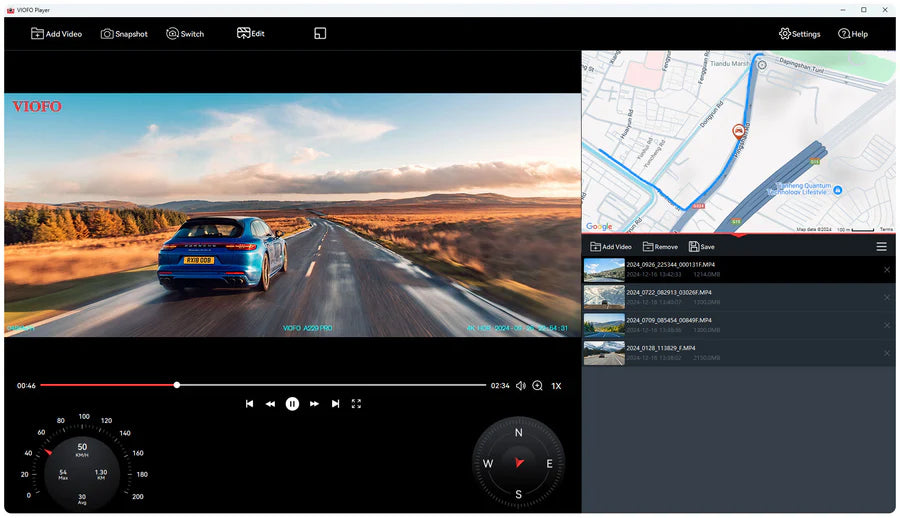
Step 3. Compare the problem clip with a working recording created by the same dash cam. If the manufacturer's player works, export an ordinary viewing copy if your model and software support it. If the file fails there too, check whether the original video itself is complete.
The example screenshot shows VIOFO Player, not a universal dash cam interface. Garmin, Nextbase, 70mai, and other manufacturers have their own app and software arrangements, so follow your exact model's documentation rather than borrowing menus from a different brand.
If your dash cam video is still unplayable after these compatibility checks, the next action depends on whether the file exists or has disappeared from storage.
Part 3. Repair Damaged Dash Cam Videos or Recover Missing Clips
Repair and recovery address different problems. File repair works on an existing but damaged file; data recovery looks for deleted or inaccessible video data on a detectable storage device. Recover a lost original before attempting to repair the recovered copy.
Method 4. Repair an Existing Damaged MP4 or MOV in Recoverit
Best for: A copied MP4 or MOV that fails in several appropriate players and may have been cut short during an unexpected shutdown or damaged during recording. This does not fix a defective SD card or recreate footage that was never recorded.
The current Recoverit 15 Windows guide documents a File Repair workflow. Work with a copy of the unplayable video on a healthy disk, never with the sole original on the camera card.
Step 1. Open Recoverit 15 and select File Repair, then Video Repair. Choose Add Video or the corresponding add-files control to select your copied damaged recording.
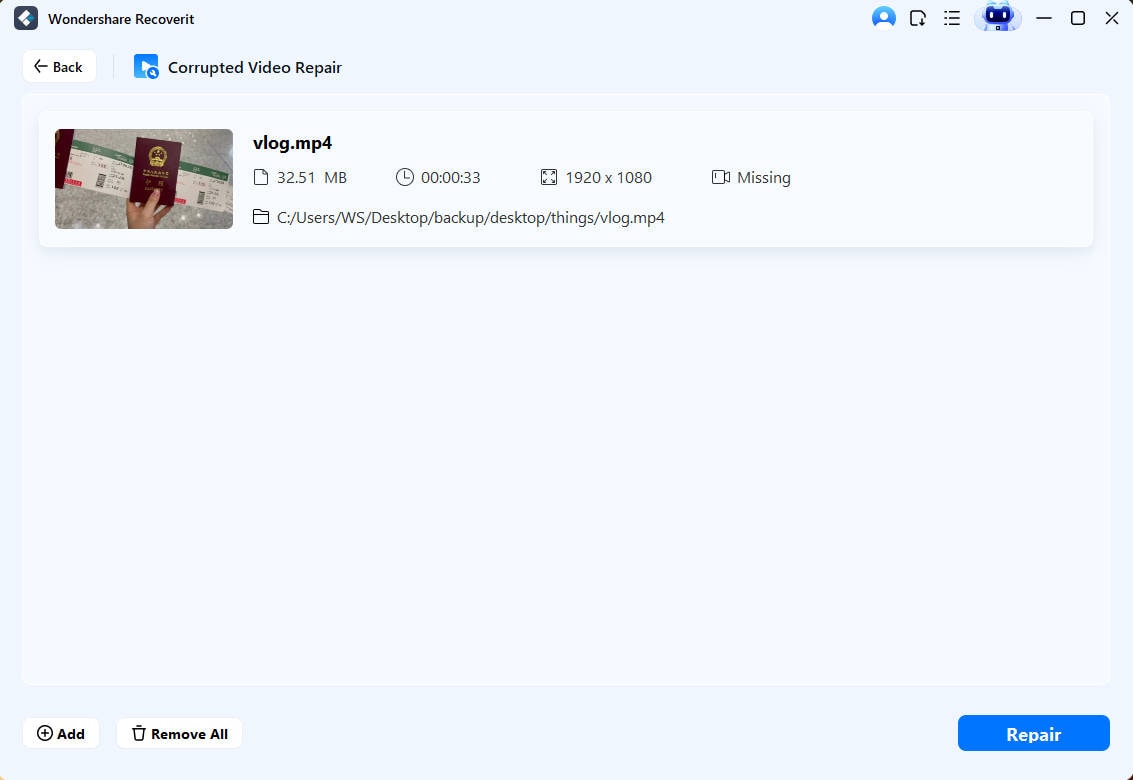
Step 2. Choose Repair. After processing, use Preview to check the actual video, including the part where playback originally failed. A successful processing message does not guarantee that every frame or audio segment is intact.
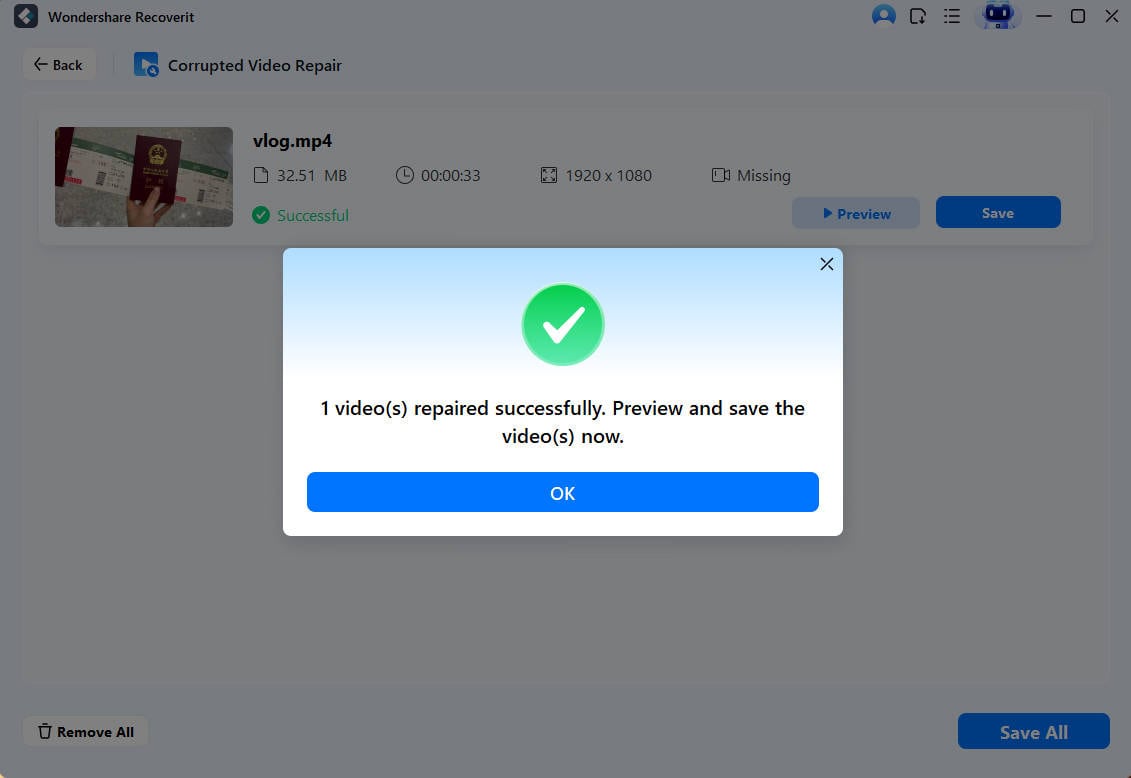
Step 3. If basic repair is insufficient, try Advanced Repair when offered, with a healthy sample recorded by the same device and preferably the same settings. Preview the results before saving.
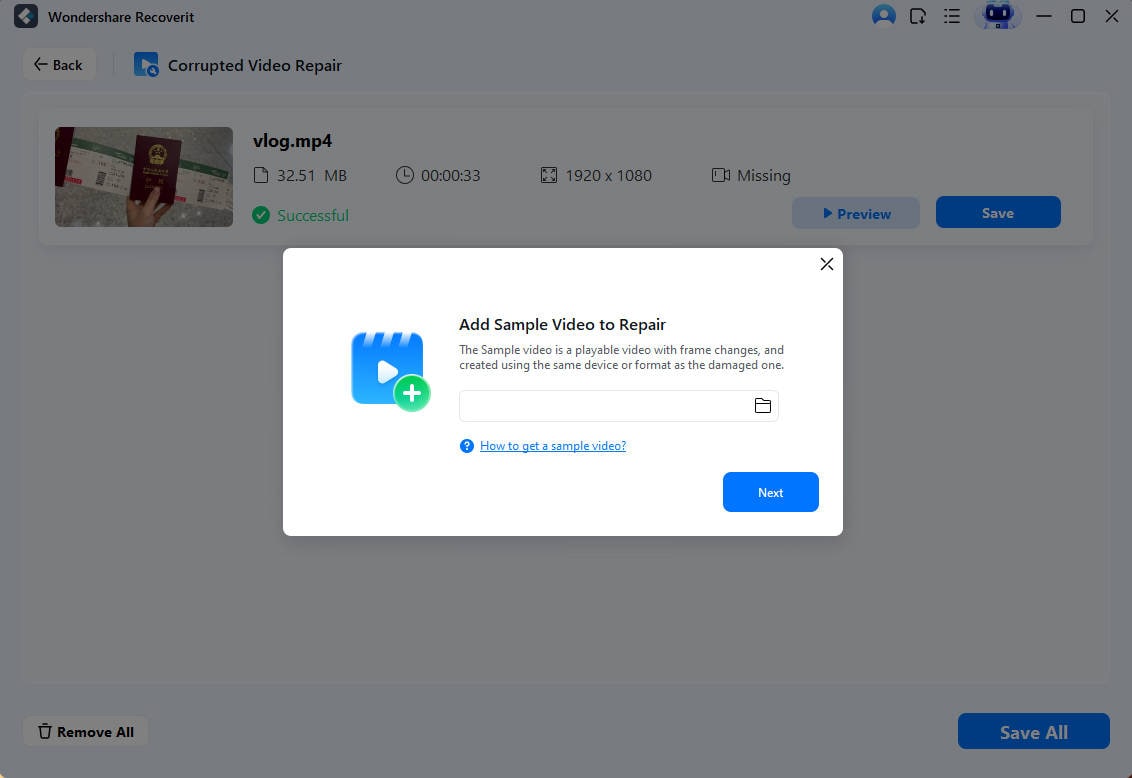
Step 4. Save an acceptable repaired copy to a different healthy drive or folder. Keep the original untouched. File repair can fail when essential video data is missing or overwritten; software cannot guarantee a complete reconstruction of accident footage.
Method 5. Recover Missing Dash Cam Videos from a Detectable SD Card
Best for: A recording that has been deleted, lost after transfer, or is inaccessible because of a logical storage problem. First check the camera's protected/event folders: an unseen file is not automatically deleted.
If an important clip is truly gone, stop loop recording. Do not format the source card, save new recordings, or install recovery software onto it. See the dedicated memory card recovery options for related card-loss scenarios.
Step 1. Insert the SD card into a dependable card reader, verify that the operating system can detect it, and open Recoverit 15 on a separate healthy drive. Choose SD Card Recovery and identify the correct card.
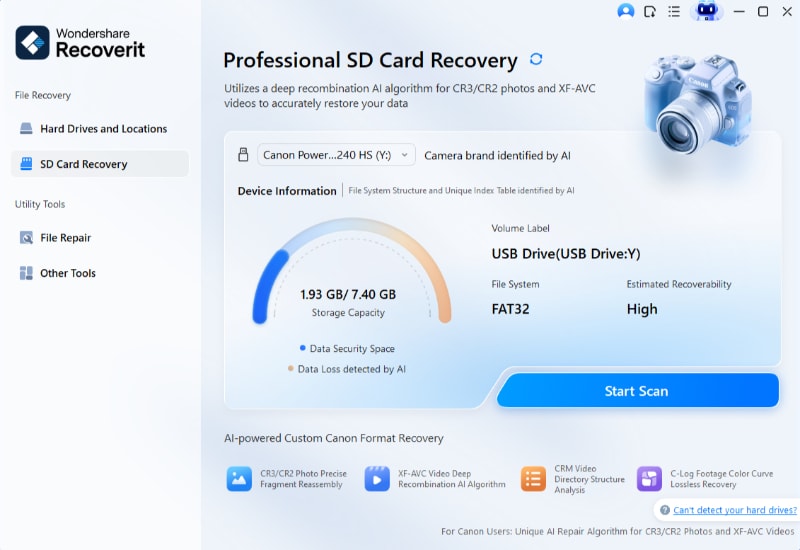
Step 2. Select the card and click Scan. Let Recoverit look for recoverable footage; avoid writing anything to the card while scanning. If the card disconnects, overheats, or is not detected reliably, stop and consider professional recovery.
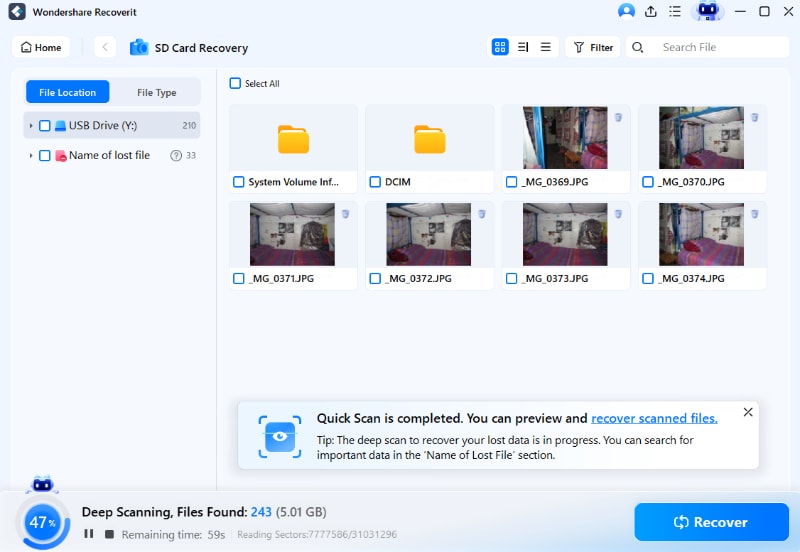
Step 3. Preview and select relevant recordings if available. Choose Recover and save the output to a separate drive, never back to the original card. Then test each recovered clip; if a recovered file remains structurally damaged, use the repair method above on that recovered copy.
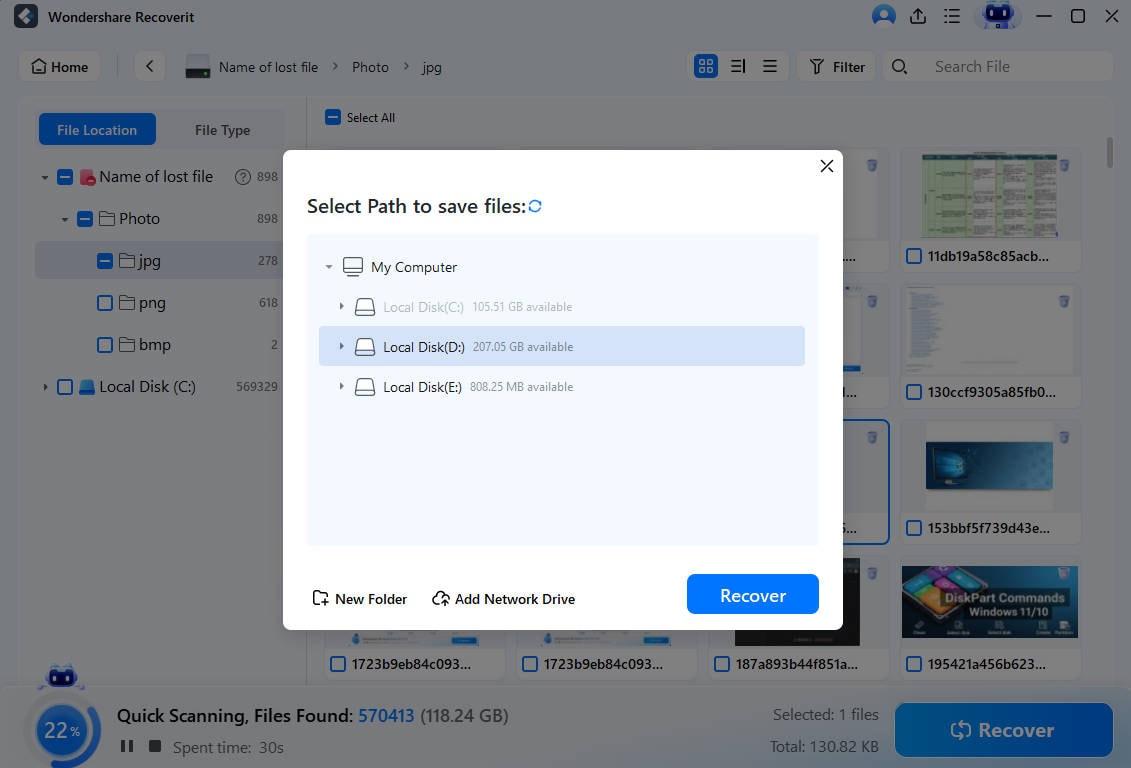
Results depend on what storage data remains. Loop recording can overwrite older footage permanently, and no recovery product can recreate video that was never written to the card.
Use this download option for lost or inaccessible footage, not for a video that is simply blocked by your computer's default media player. The software's preview, repair, save, and recovery capabilities can depend on file condition and license.
Once the valuable recording is safe, you can address the camera and SD card configuration that may have caused the problem in the first place.
Part 4. Prevent Unplayable Dash Cam Recordings
Prevention focuses on using a compatible card, completing recordings cleanly, and checking that event footage is actually being retained. These recommendations apply to future recording, not to a card holding missing evidence.
- Choose a model-compatible high-endurance microSD card: Required capacity, speed, and card models vary. For example, VIOFO's card guidance distinguishes camera-specific capacities, write speeds, and endurance rather than treating every Class 10 card as suitable.
- Test recordings regularly: Record a short ordinary clip, copy it to a computer, and check both picture and sound. Check front, rear, and parking channels separately if present.
- Use the camera's proper shutdown process: Allow time for files to close before removing the card or cutting power. Some devices use capacitors instead of a rechargeable internal battery.
- Keep an independent copy of important clips: Protect event recordings in the camera when that feature exists, then export them promptly to another drive. An event lock is not a substitute for a separate backup.
- Follow the exact camera manual for maintenance: When important footage is safely backed up, the manufacturer may recommend periodic in-camera formatting. Never perform that maintenance before data preservation.
- Replace failing media: Recurring card errors, missing recording intervals, and repeatably corrupt new files warrant testing a manufacturer-approved replacement card and checking camera power stability.
There is no universal SD card capacity, minimum battery type, or playback app that fixes every dash cam. Your camera's model-specific instructions take priority.
Conclusion
When dash cam videos won't play, start with the least destructive explanation. Check the original clip and protected folders, preserve the SD card, and test a copied recording in VLC or the camera manufacturer's player. If a file exists but is damaged, try file repair on a duplicate. If the footage is missing from a detectable SD card, recover it to a different drive before trying file repair. Protect the source throughout, especially when the recording could be needed as evidence.
FAQ
-
Why won't my dash cam MP4 play on my computer?
The player may lack support for the file's video codec, or the copy may be incomplete. Compare the file in the camera and in VLC before treating it as corrupt. If only one recording fails in several players, interrupted recording or file damage is possible. -
Can VLC repair a corrupted dash cam MP4?
VLC can play many formats and is useful for ruling out compatibility problems. Its Always fix setting is intended for AVI index problems; it is not a general MP4 or MOV repair tool. Keep the damaged original and attempt specialized file repair only on a copy. -
What if my dash cam video has a normal file size but will not open?
A nonzero file may contain incomplete recording metadata, missing frames, or an unsupported codec. Try another appropriate player, verify the copy against the SD card, and consider repair if the failure follows that specific file across devices. -
Where are protected dash cam accident videos saved?
The location varies by manufacturer. Check the camera playback menu and folders named Event, Protected, Emergency, Parking, Locked, or similar. Search all camera channels and the companion app before assuming that a clip was deleted. -
Can I recover dash cam footage after loop recording overwrote it?
Overwritten video data generally cannot be recovered by software. Stop recording immediately and check for protected copies, phone downloads, or backups. If data has not been overwritten and the card remains detectable, a recovery scan may find some clips, but success is not guaranteed. -
Should I format my SD card when the dash cam says the video cannot play?
No, not before saving or attempting to recover important footage. Formatting changes the source card and may reduce recovery options. Once files are secured, follow the camera manufacturer's maintenance instructions for that exact model. -
Why does the dash cam video play on my phone but not on Windows?
The phone app may use an appropriate decoder, a lower-resolution companion file, or a proprietary playback workflow. Export the original video using the app's supported process, try a compatible PC player, and check whether the camera uses HEVC or other specific encoding.


