
 TL;DR:
When separating storage on a modern Mac, add an APFS volume instead of a traditional disk partition to allow dynamic space-sharing, reserving traditional partitions strictly for fixed capacity boundaries or cross-platform file systems like ExFAT.
● Select View > Show All Devices in Disk Utility to correctly identify the physical target drive, and back up irreplaceable files beforehand because deleting a partition permanently erases its contents.
● To increase the size of a traditional partition, Disk Utility requires you to permanently delete the adjacent volume immediately following it, which prevents you from expanding the very last volume on any drive.
● Do not use Disk Utility to remove a Windows BOOTCAMP partition on an Intel-based Mac; you must strictly use Boot Camp Assistant to safely restore the disk to a single macOS partition.
Ask AI for a summary
 ChatGPT
 Perplexity
 Gemini
 Claude
 Grok
Grok
Partitioning a Mac drive is no longer the default way to separate storage. On modern Macs using APFS, Apple recommends adding another APFS volume in most cases because volumes share free space dynamically. A traditional partition is still useful when you need a fixed size, a different file system, or separate compatibility requirements on an external drive.
Quick answer: If your goal is simply to create another Mac-only storage area, add an APFS volume instead of repartitioning the disk. If you need a true Mac hard disk partition, back up the drive first, open Disk Utility, select the correct disk or volume, choose Partition, add the new partition, choose its format and size, then apply the change. Deleting a partition permanently erases the data stored on it.
In This Article
Part 1. APFS Volume vs. Partition: Which Should You Use?
The most important update for anyone searching for disk partition Mac OS instructions is that modern APFS storage works differently from older HFS+ disks. Apple states that with APFS you generally should not partition a disk just to create separate Mac storage areas. Instead, multiple APFS volumes inside one container can share the same available space dynamically. You can review Apple's current guidance in its Disk Utility partition guide.
That means the right first question is not “How do I partition my Mac?” but “Do I actually need a partition?” The table below helps separate the two use cases.
| Goal | Better Choice | Why |
| Create another Mac-only storage area | APFS volume | Volumes share free space within the same APFS container. |
| Run another supported macOS installation | Usually APFS volume | Apple supports multiple APFS volumes without fixed partition boundaries. |
| Use a different file system such as ExFAT | Traditional partition | A separate partition can use a different file system from the APFS container. |
| Create fixed storage boundaries | Traditional partition | Each partition receives a defined size. |
| Share an external drive between Mac and Windows | ExFAT partition or a dedicated ExFAT drive | ExFAT is supported by both macOS and Windows. |
| Install Windows with Boot Camp | Boot Camp Assistant on supported Intel Macs | Do not create or remove the BOOTCAMP partition manually in Disk Utility. |
When an APFS Volume Is the Better Choice
If the disk is already APFS and you only need another logical storage area for Mac use, an APFS volume is usually simpler and more flexible. Apple explains that APFS volumes in one container share available space automatically, and you can optionally set a reserve or quota for a volume. See Apple's APFS volume guidance for the current behavior.
This is especially useful for developers, users testing another supported macOS environment, or anyone who wants separate logical storage without locking unused capacity inside a fixed partition.
When a Traditional Partition Still Makes Sense
A physical partition remains useful when the sections of the disk need different file systems or fixed capacity boundaries. For example, you might create one APFS partition for Mac-only files and another ExFAT partition for exchanging files with Windows.
Before choosing a format, confirm how the drive will be used. Apple lists APFS as the default Mac file system for macOS 10.13 or later and identifies MS-DOS (FAT) and ExFAT as Windows-compatible formats. If cross-platform use is your main goal, see this Recoverit guide on using one external drive with Mac and Windows.
Part 2. Before You Partition a Drive on Mac
Partition changes alter the disk layout, so data protection comes before any resizing, deletion, or reformatting. Apple explicitly recommends backing up before creating partitions and warns that deleting a partition erases all data stored on it.
- Back up important files: Copy irreplaceable files to a separate healthy device or a verified backup before changing the partition map.
- Check the correct disk: If multiple drives are connected, confirm the model, capacity, and volume name before applying changes.
- Know whether the disk is APFS: If it is, decide whether an APFS volume would solve the problem with less disruption.
- Disconnect unnecessary external drives: This reduces the chance of selecting the wrong device.
- Do not continue if files are already missing: Avoid deleting, formatting, or repartitioning a drive when you still need inaccessible data from it.
If the disk already shows missing partitions, inaccessible folders, or unexplained data loss, move to Part 6 before making further changes.
Part 3. How to Partition a Hard Drive on Mac With Disk Utility
Disk Utility is the built-in tool for both internal and external storage management. The exact workflow depends on whether you are adding an APFS volume or creating a true physical partition, so the methods below keep those actions separate.
Method 1. Add an APFS Volume for Mac-Only Storage
Use this method when the existing container is APFS and you want another Mac volume without dividing the disk into fixed-size partitions.
Step 1. Open Disk Utility.
Open Spotlight, search for Disk Utility, and launch it. You can also open it from Applications > Utilities.
Step 2. Select the APFS container or volume.
Choose the APFS storage group that should contain the new volume. If the sidebar is unclear, choose View > Show All Devices first.
Step 3. Add a new APFS volume.
Click the add-volume control, enter a name, choose the appropriate APFS format, and optionally set reserve or quota values under size options.

Step 4. Click Add, then Done.
The new volume appears in Disk Utility and Finder. Because APFS volumes share container space, you normally do not need to predict a fixed size in advance.
Method 2. Create a Traditional Disk Partition on Mac
Use a traditional partition when you need a fixed size or a different file system. Apple's current Disk Utility workflow is the safest reference for this operation.
Step 1. Open Disk Utility and identify the correct device.
Choose View > Show All Devices if needed, then confirm the drive you intend to change.
Step 2. Select the relevant volume and click Partition.
Disk Utility shows the current layout. Click the add button below the partition chart.
Step 3. Choose Add Partition when prompted.
If macOS offers Add Volume instead, choose Add Partition only when you specifically need a traditional partition. Otherwise, return to Method 1 and use an APFS volume.
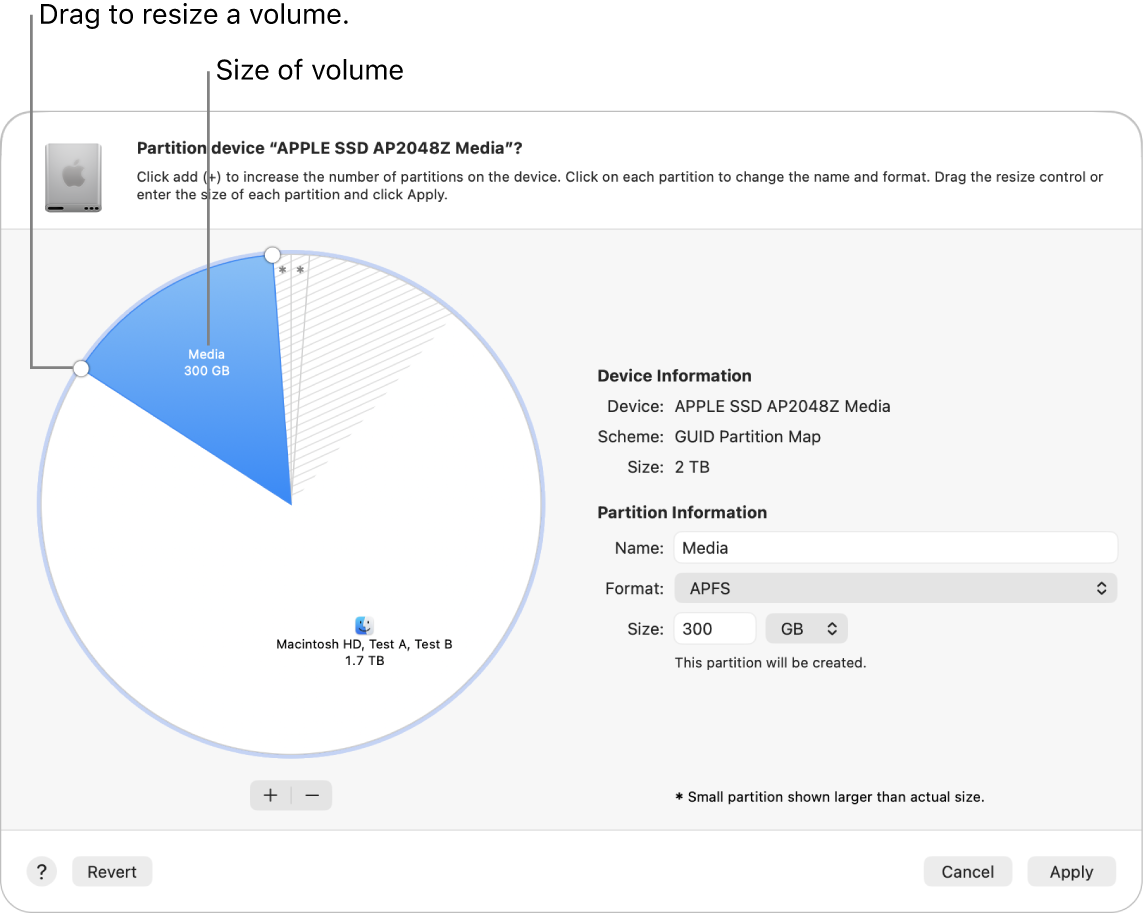
Step 4. Set the partition name, format, and size.
Choose APFS for modern Mac-only storage, or another supported format if your use case requires it. Apple's file system format guide explains the current choices in Disk Utility.
Step 5. Apply the partition change.
Click Apply, review the confirmation dialog carefully, and click Partition. If Disk Utility warns that resizing the startup volume may take a long time, do not interrupt the Mac while the operation is running.
Step 6. Verify the result.
After Disk Utility reports that the task is complete, click Done and confirm the new volume appears in both Disk Utility and Finder.
Method 3. Partition an External Hard Drive on Mac
The basic process for a Mac partition external hard drive task is similar, but external disks often have different compatibility requirements. First decide whether the drive will stay Mac-only or must also work with Windows.
- Connect the external hard drive directly to the Mac and confirm that it appears in Disk Utility.
- Choose View > Show All Devices and verify the physical drive by capacity and model.
- Back up any files you need before changing partitions.
- Select the appropriate volume, click Partition, then add a partition.
- Choose a format based on the destination: APFS for current Mac-only workflows, or ExFAT when both current macOS and Windows systems need read/write access.
- Set the size, click Apply, confirm the change, and wait for Disk Utility to finish.
If the external disk is missing from Disk Utility entirely, do not repartition it yet. First troubleshoot the cable, port, enclosure, power supply, and whether macOS can detect the device.
Part 4. How to Delete or Resize a Disk Partition on Mac
Deleting and resizing are more destructive than creating an additional APFS volume. Before you remove anything, identify whether the target is an APFS volume, a traditional partition, or a BOOTCAMP partition because each follows a different path.
Delete an APFS Volume
Deleting an APFS volume permanently removes its files and removes the volume from its container. If the volume is in use, Disk Utility may require you to start from macOS Recovery before it can be deleted.
- Open Disk Utility and select the APFS volume you want to remove.
- Confirm that no needed files remain on the volume.
- Click the delete-volume control.
- Follow the confirmation prompt, then click Done when the operation finishes.
Do not confuse Delete Volume with Erase. Erasing removes the contents but can leave the empty volume in its APFS container, while deleting removes the volume itself.
Delete a Traditional Partition and Reclaim Space
If your goal is to delete disk partition Mac and enlarge a neighboring partition, Apple's current Disk Utility guide notes an important limitation: to enlarge a volume, you must delete the volume that comes after it on the device, then move the endpoint of the volume you want to enlarge into the freed space. The last volume on the device cannot be enlarged using that sequence.
- Back up files from the partition that will be deleted.
- Open Disk Utility and select the volume on the correct device.
- Click Partition.
- Select the partition to remove in the partition chart and click the delete control.
- Click Apply, then confirm by clicking Partition.
- After the deletion finishes, resize the adjacent supported partition into the available space if Disk Utility permits it.
Remove a Boot Camp Partition on an Intel Mac
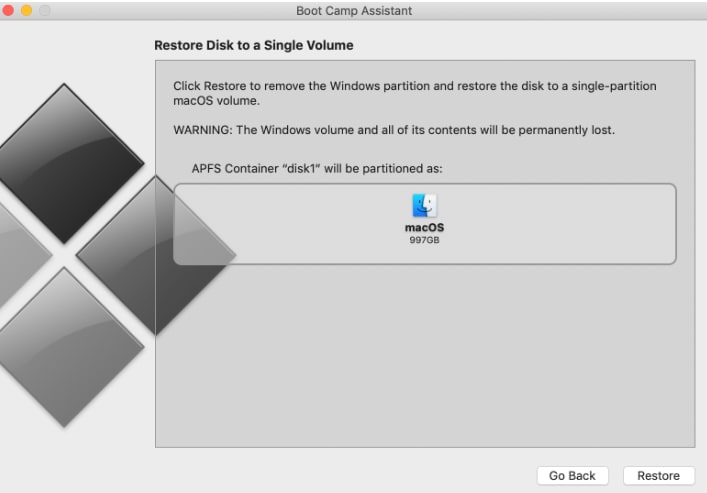
Boot Camp is a separate case. Apple's current documentation states that Boot Camp Assistant installs Windows 10 only on supported Intel-based Macs, and Apple instructs users to remove the Windows partition with Boot Camp Assistant rather than Disk Utility. Apple silicon Macs are not included in the supported Boot Camp Mac list.
If you have a supported Intel Mac, follow Apple's current Boot Camp removal instructions. Do not use Disk Utility to delete a BOOTCAMP partition that was created by Boot Camp Assistant. The exact interface can vary by Intel Mac and macOS version, but Boot Camp Assistant should provide a restore path for returning the disk to a single macOS partition.
Part 5. What If Disk Utility Cannot Partition the Drive?
A grayed-out Partition button or failed resize does not automatically mean the disk is damaged. The selected object, current disk layout, mounted state, active processes, free-space arrangement, or an in-use system volume can all affect what Disk Utility allows.
| Problem | What to Check First | Safe Next Step |
| Partition button is unavailable | Check whether you selected the correct volume/device | Use View > Show All Devices and re-check the target. |
| APFS disk only needs another Mac storage area | You may not need a partition | Add an APFS volume instead. |
| Delete Volume or Erase is dimmed | The selected volume may be in use | Review Apple's Recovery-based instructions before trying again. |
| External drive is not listed | Cable, port, power, enclosure, or device detection | Fix detection first; do not format or repartition an undetected drive. |
| Files disappeared after a partition change | Possible partition or file-system loss | Stop writing to the disk and recover data before further changes. |
If the drive itself is visible but a partition is missing, avoid repeatedly creating new partitions or reformatting the disk. Those actions can overwrite file-system metadata and file content that might otherwise still be recoverable.
Part 6. Recover Files After an Accidental Partition Deletion
Partition management becomes a data recovery problem only when files are missing, a partition was deleted by mistake, or a detectable drive becomes inaccessible after a partition operation. This is the point where recovery software can be relevant; it should not be positioned as a substitute for Disk Utility when there is no data loss.
When Recoverit Is Appropriate
Wondershare Recoverit can be considered when the affected HDD, SSD, or external drive is still detectable and files were lost because a partition was deleted, formatted, or became inaccessible. Recoverit has a dedicated partition data recovery workflow and a Recoverit for Mac product page.
Important: Stop using the affected drive as soon as you notice missing files. Do not recreate the lost partition, install software onto that same drive, or save recovered files back to it. No recovery software can guarantee files that have already been overwritten.
How to Scan a Lost or Deleted Mac Partition
The recovery process should remain separate from partition repair so that the source disk is modified as little as possible.
Step 1. Connect the affected drive without writing new data to it.
If it is an external disk, connect it directly and check whether macOS and Recoverit can detect it. If it disconnects repeatedly, makes unusual noises, smells burned, or has physical damage, stop software scans and use a professional recovery service.
Step 2. Select the affected disk or visible location in Recoverit.
Choose the storage device that contained the deleted or lost partition and start a scan.
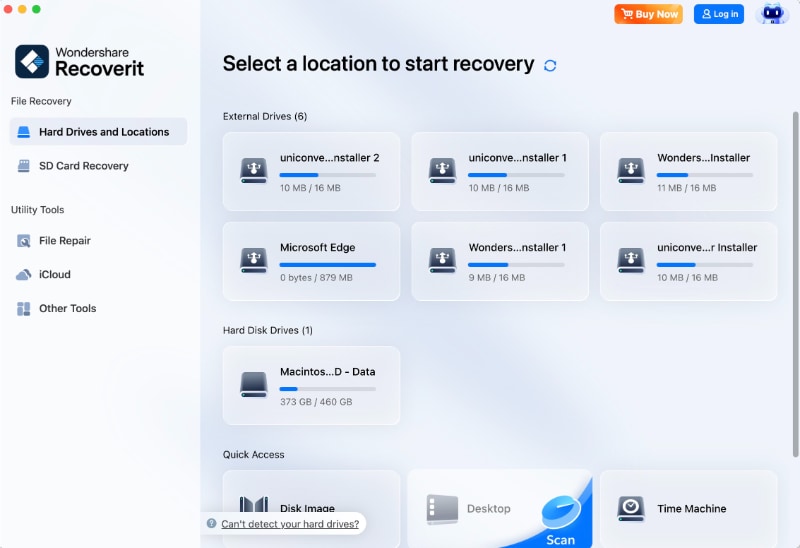
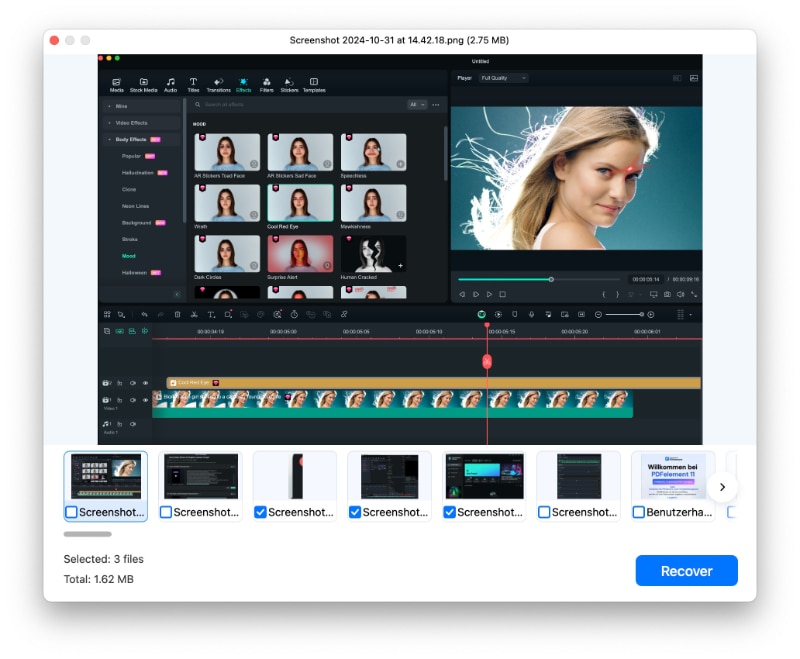
Step 3. Review the scan results and preview important files.
Recoverit scans the selected storage and lists discovered files while the scan progresses.

Use available filters and preview supported files before deciding what to recover.
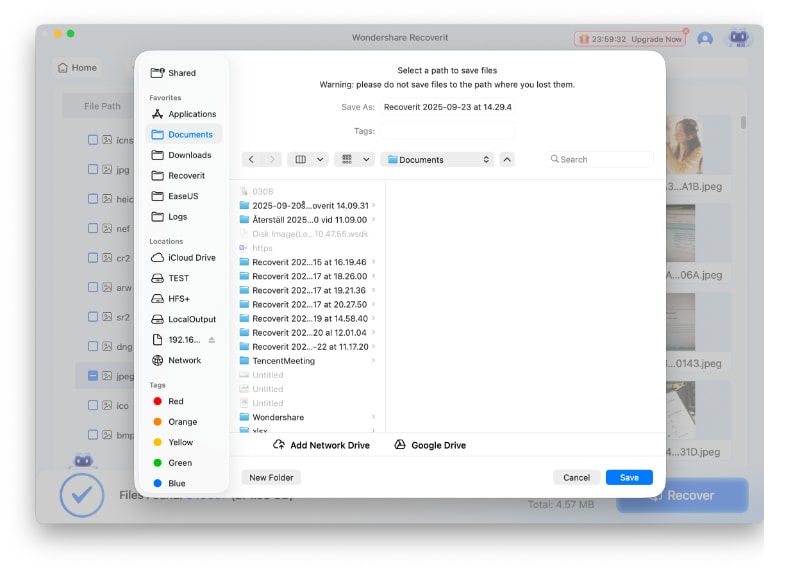
Step 4. Recover files to a different healthy drive.
Choose another physical storage device as the destination. After important files are safely recovered and verified, you can return to Disk Utility and rebuild or reformat the original disk if necessary.
Conclusion
For a modern disk partition for Mac workflow, the safest approach is to first decide whether you need a physical partition at all. APFS volumes are the better fit for most Mac-only storage separation, while traditional partitions remain useful for fixed-size layouts and different file systems. Back up first, follow the current Disk Utility workflow, and treat deletion or resizing as destructive operations. If a partition change has already caused file loss, stop writing to the disk and recover important files before rebuilding its partition layout.
The following questions cover the decision points that most often cause confusion when users partition a drive on Mac.
FAQ
-
Should I partition an APFS drive on Mac?
Usually not just to create another Mac storage area. Apple recommends adding APFS volumes in most cases because volumes inside one APFS container share available space dynamically. Create a traditional partition when you specifically need a fixed size or a different file system. -
Does partitioning a hard drive on Mac erase data?
Creating a new partition can resize existing disk structures, so you should back up first. Deleting a partition definitely erases the data stored on that partition. If files are already missing, recover them before making additional partition changes. -
How do I partition an external hard drive on Mac?
Connect the drive, back up important files, open Disk Utility, choose View > Show All Devices, select the correct storage device or volume, click Partition, add a partition, choose its format and size, then apply the change. Use APFS for current Mac-only use or ExFAT when both Mac and Windows need read/write access. -
Can I delete a Mac partition without losing files?
No. Apple states that deleting a partition erases all data on it. Copy or recover needed files to another storage device before deleting the partition. -
Why does Disk Utility suggest Add Volume instead of Add Partition?
On APFS storage, macOS often recommends another APFS volume because multiple volumes can share free space inside the same container. Choose a true partition only when your use case requires a separate fixed-size disk section or another file system. -
Can I use Boot Camp to partition an Apple silicon Mac?
No. Apple's current Boot Camp documentation supports Windows 10 installation on specified Intel-based Macs. Apple silicon Macs are not part of the supported Boot Camp model list.


