
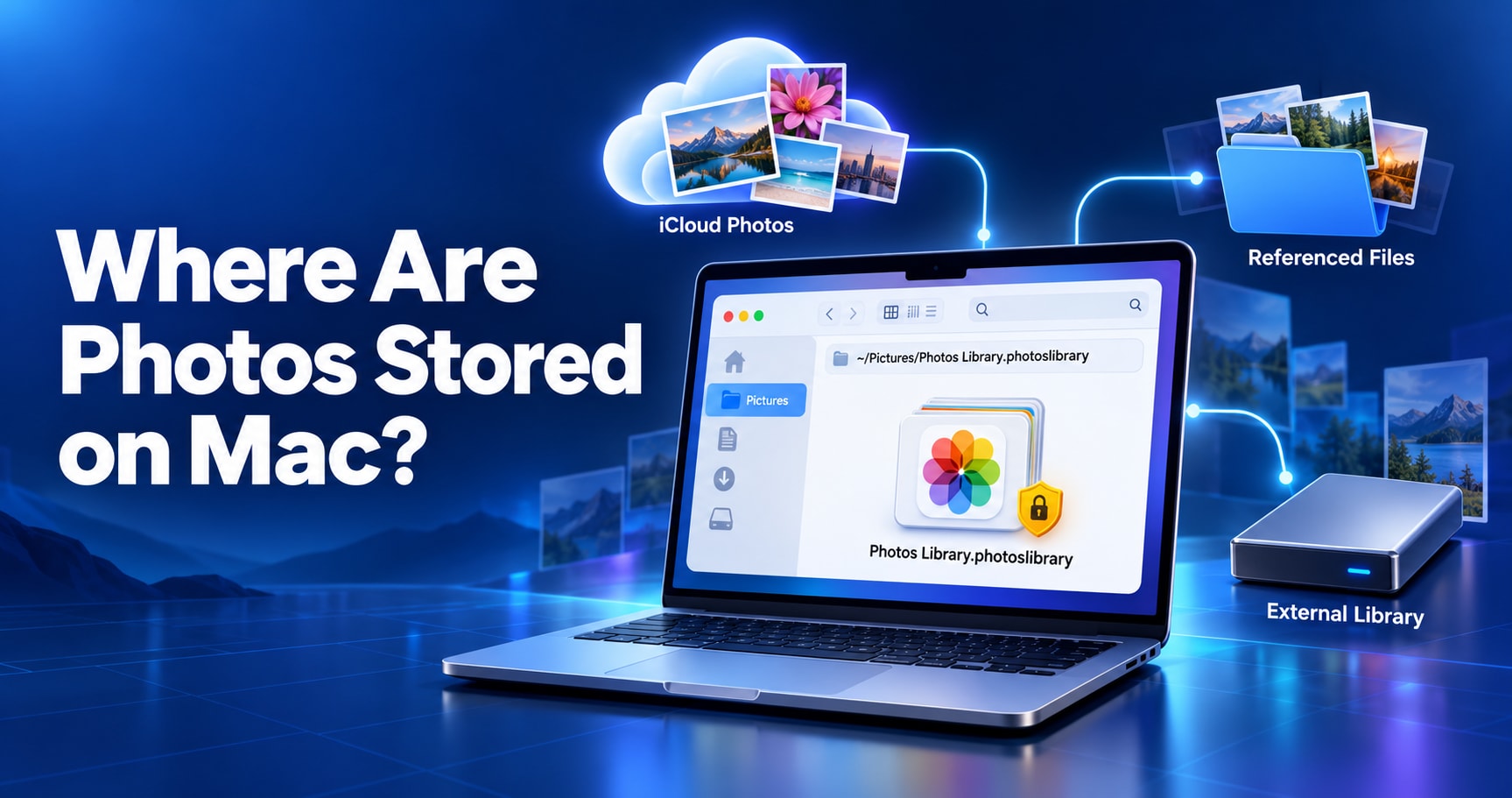

If you use the Photos app with its default settings, your Mac normally stores the active System Photo Library in your home Pictures folder as ~/Pictures/Photos Library.photoslibrary. That library is a package managed by Photos, not a normal folder that you should browse and edit manually.
The exact location of an individual picture depends on how it was added. Photos imported normally are managed inside the Photos Library, referenced files remain in their original Finder locations, and iCloud Photos may keep the full-resolution original in iCloud instead of permanently storing a full local copy when Optimize Mac Storage is enabled.
In this article:
Part 1. Where Are Photos Stored on a Mac?
The most useful answer is not a hidden folder inside the Photos Library. It is understanding which storage model your Mac is using, because different photos can live in different places even when they all appear together in Photos.
The Default Photos Library Location
Apple states that the System Photo Library is stored in the Pictures folder by default. In a standard setup, the library path is:
~/Pictures/Photos Library.photoslibrary
The tilde represents your home folder, so the full location is equivalent to /Users/your-username/Pictures/Photos Library.photoslibrary. The active System Photo Library is the library Photos routinely uses, and it is also the only library that can fully participate in iCloud Photos, Shared Albums, and iCloud Shared Photo Library.
Most importantly, do not rely on older instructions that tell you to open Show Package Contents and browse a fixed Masters folder. Apple now explicitly warns users not to manually access or alter the contents of a Photos Library package because doing so can delete or corrupt library data. If you need normal image files in Finder, export them from Photos instead. See Apple's current Photos library overview.
Where Different Types of Pictures May Be Stored
The table below helps distinguish photos managed by Photos from pictures that simply exist somewhere on your Mac.
| Picture Type | Where It Is Stored | What to Know |
| Photos imported normally into Photos | Inside the active Photos Library package, usually in ~/Pictures | Use Photos to view, organize, export, or delete them. Do not edit the library package in Finder. |
| Referenced files | The original Finder folder or external drive where the file was imported from | Photos points to the file instead of copying it into the library. Moving or disconnecting it can break the reference. |
| iCloud Photos with Download Originals to this Mac | Full-resolution originals are kept in the System Photo Library and in iCloud | This uses more local storage but keeps full originals on the Mac. |
| iCloud Photos with Optimize Mac Storage | Full-resolution originals stay in iCloud; the Mac can keep smaller local versions and download originals as needed | A photo visible in Photos is not proof that its full-resolution original is currently stored locally. |
| Exported photos | The Finder folder or external drive you chose during export | These are normal image files outside the Photos Library. |
| Pictures never imported into Photos | Wherever the app or user saved them, such as Downloads, Desktop, Pictures, or another folder | Photos does not automatically contain every image file on your Mac. |
Part 2. How to Find Photos on Mac Safely
If your goal is to locate photos rather than inspect the Photos Library package, use the Photos app and Finder-supported workflows below. These methods are safer and more reliable across current macOS versions.
Method 1. Find the Active Photos Library Location
This is the best method when you want to know which Photos Library your Mac or iMac is actually using, especially if you have more than one library or previously moved one to external storage.
Step 1. Quit Photos completely.
Step 2. Hold the Option key while opening Photos.
Step 3. In the Choose Library window, select the library you use. The path shown below the list tells you where that library is stored.

Step 4. Click Choose Library to open it. If the selected library is on an external drive, keep that drive connected whenever you use Photos.
Apple's current guidance for moving or opening a Photos Library also notes that a relocated library should be stored on an APFS or Mac OS Extended (Journaled) drive rather than a Time Machine disk, SD card, USB flash drive, network share, or cloud-synchronized folder.
Method 2. Browse All Photos in the Photos App
If you simply want to find where your photos are from a user's point of view, browsing the library is safer than trying to locate individual files inside the package.
Step 1. Open the Photos app.
Step 2. Click Library in the sidebar.
Step 3. Choose All Photos to browse the complete visible collection, or switch to Years or Months when you know approximately when the picture was taken.
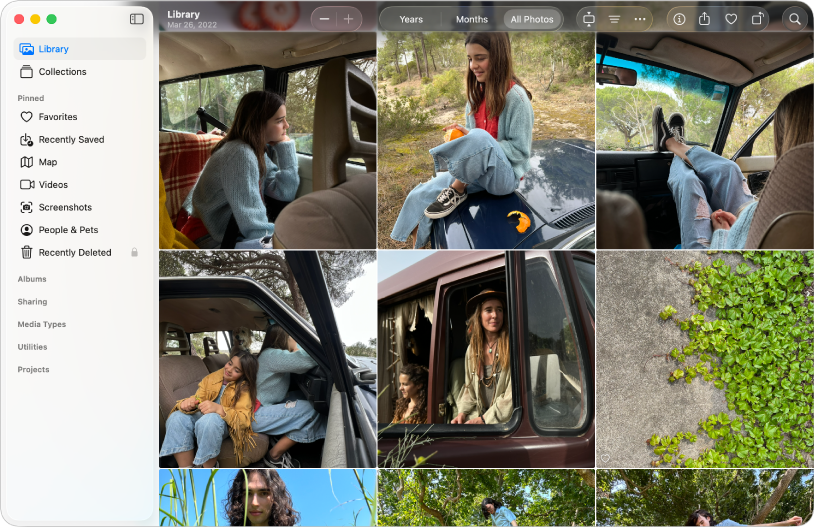
This view includes photos that Photos can access through the current library, including items synchronized through iCloud Photos. It does not mean that every full-resolution original is permanently downloaded to the Mac.
Method 3. Search for a Specific Picture
When you know something about the picture but not its exact file location, search is usually faster than browsing folders in Finder.
Step 1. Open Photos and click the Search field in the toolbar, or press Command-F.
Step 2. Enter a title, caption, keyword, date, location, person, object, or other descriptive term that Photos can recognize.
Step 3. Choose a suggested result to view the matching photos.
Apple's current Photos search guide also documents searches by multiple criteria, such as a location combined with a month.
Method 4. Export the Original Photo to Finder
If you need an actual JPG, HEIC, RAW, PNG, or other original file outside Photos, export it instead of opening the Photos Library package and moving files by hand.
Step 1. In Photos, select the picture or pictures you need.
Step 2. Choose File > Export > Export Unmodified Original.
Step 3. Choose your file naming and subfolder options. You can also export IPTC metadata as an XMP sidecar when needed.
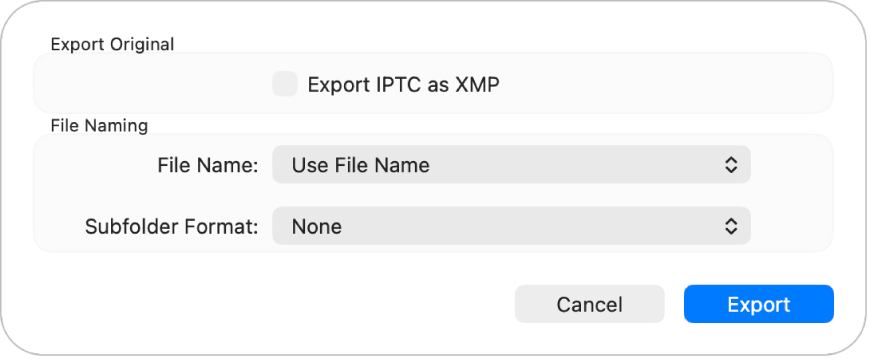
Step 4. Click Export, choose a destination in Finder or on a healthy external drive, and save the files there.
This workflow preserves the imported original format. Apple's Photos export instructions also explain the difference between exporting an edited copy and exporting the unmodified original.
Method 5. Check Recently Deleted for Missing Photos
If a picture is missing from the main library, check Recently Deleted before assuming the file has been permanently lost.
Step 1. Open Photos and select Recently Deleted under Utilities in the sidebar.
Step 2. Unlock the album if Photos asks you to authenticate.
Step 3. Select the photo you want and click Recover.
Items deleted from a Photos library remain in Recently Deleted for up to 30 days before permanent deletion. Apple documents this behavior in its Recently Deleted recovery instructions. This is different from Finder Trash.
Part 3. How iCloud Photos Changes Where Originals Are Stored
iCloud Photos is one of the main reasons people can see a picture on a Mac but cannot find a full-resolution original as a normal local file.
Download Originals to This Mac vs. Optimize Mac Storage
With iCloud Photos enabled, Photos offers two important storage modes. Download Originals to this Mac keeps the full-resolution originals in the System Photo Library on the Mac as well as in iCloud. Optimize Mac Storage can replace local originals with smaller device-sized versions when space is needed while keeping the full-resolution originals in iCloud.
So if you are asking, "where are my photos stored on my Mac?" and Optimize Mac Storage is enabled, the practical answer may be: the image appears in your Photos Library, but the full-resolution original may currently reside in iCloud and download when you open, edit, or export it. Apple's current iCloud Photos documentation explains both storage modes.
Referenced Files Are Different
Photos can also work with referenced files when the setting to copy imported items into the Photos Library is disabled. In that case, the file stays in its original Finder location and Photos points to it.
- Disconnecting the storage device: Photos may no longer be able to find the referenced picture.
- Moving or renaming the file in Finder: The reference can break.
- Using iCloud Photos: Referenced files are not uploaded to iCloud Photos as part of the System Photo Library.
- Backing up the Photos Library: Referenced files need their own backup because they are outside the library package.
Part 4. What If Your Photos Library Is Not in the Pictures Folder?
A missing library in ~/Pictures does not automatically mean your photos are gone. The library may have been moved, renamed, stored on another drive, or replaced by a different active library.
Common Reasons the Expected Library Is Missing
Use the clues below before creating a new library or moving files around.
| Situation | What It Usually Means | Safe Next Check |
| Photos opens but the library looks empty | Photos may have opened a different library | Quit Photos and use Option-open to check available libraries and their paths |
| The library used to be on an external drive | The drive may be disconnected or unavailable | Reconnect the drive before opening Photos |
| Photos are visible but originals are not fully local | iCloud Photos may be optimizing Mac storage | Check Photos > Settings > iCloud |
| Only certain imported items are missing | They may be referenced files stored outside the library | Reconnect the source drive or restore the original Finder path |
| The library will not open or behaves unexpectedly | The library database may have a problem | Back it up before using Apple's Photos Repair Library tool |
If the entire library has been removed, replaced, or damaged, this separate guide covers how to restore a Photos Library on Mac without turning this location guide into a full recovery tutorial.
Part 5. What to Do If Photos Are Missing
When the issue has moved from "where are my pictures stored?" to "the pictures are actually gone," the safest next action depends on whether a usable copy still exists in Photos, iCloud, Recently Deleted, or a backup.
Check Existing Copies Before Data Recovery
First check Recently Deleted, iCloud Photos on another synchronized device, exported copies, and any Time Machine backup. If you regularly back up your Mac, this guide explains how to use Time Machine for Mac backup and restore.
If the photos are no longer available from those sources and were deleted from a detectable Mac drive, SD card, USB drive, or external disk, data recovery software may be worth trying. Stop adding new files to the affected source because new writes can overwrite deleted data.
Recoverit for Mac can scan supported, detectable storage for deleted or inaccessible photos. Preview what can be found before recovery and save recovered files to a different healthy drive. No software can guarantee recovery after data has been overwritten, and a storage device with physical damage, unusual noises, repeated disconnections, water damage, or a burning smell should be handled by a professional recovery lab rather than repeatedly scanned.

Conclusion
For most Mac and iMac users, the default answer is simple: the System Photo Library is normally stored at ~/Pictures/Photos Library.photoslibrary. But that does not mean every full-resolution picture is a normal file you should browse inside the package. iCloud Photos, referenced files, exported copies, multiple libraries, and external libraries can all change where the actual data lives.
Use Photos to browse and search, use Option-open to confirm the active library path, and export originals when you need standalone files in Finder. Avoid old instructions that send you into a fixed Masters folder inside Photos Library, because Apple's current guidance is to let Photos manage the package.
FAQ
-
Where are photos stored on Mac by default?
By default, the active System Photo Library is in your home Pictures folder at ~/Pictures/Photos Library.photoslibrary. Photos manages the contents of that package, so you should use the Photos app rather than manually editing files inside it. -
Where are photos stored on iMac?
An iMac uses the same Photos Library structure as other Macs. The default System Photo Library is normally in ~/Pictures, but it may have been moved to another local or external location. -
Why can I see a photo in Photos but not find the full-size file on my Mac?
If iCloud Photos and Optimize Mac Storage are enabled, the Mac may keep a smaller local version while the full-resolution original remains in iCloud until Photos needs it. Referenced files can also live outside the Photos Library in another Finder location. -
Can I open Photos Library.photoslibrary with Show Package Contents?
Finder can technically expose a package, but Apple advises against manually accessing or altering Photos Library contents because doing so can delete or corrupt library data. Export photos from Photos when you need standalone files. -
Where do deleted photos go on Mac?
Photos deleted from the Photos Library go to Recently Deleted inside Photos, where they can normally be recovered for up to 30 days. This is different from Finder Trash. -
Does moving the Photos Library to an external drive move my photos too?
If Photos is managing the imported items inside that library, moving the library moves that managed library data with it. Referenced files stored outside the library stay in their original locations and must be moved or backed up separately.


