

 TL;DR:
To successfully recover lost files from an MMC card, immediately stop writing new data to the device to prevent overwriting, and proceed with either native OS repair utilities or dedicated data retrieval software based on the cause of data loss.
● For Windows systems failing to recognize the card or displaying read errors, reassign the drive letter via Disk Management or execute `chkdsk [drive letter]: /f` in an administrator Command Prompt to repair underlying file system faults.
● macOS users encountering unreadable partitions should insert the card using a compatible reader, launch Disk Utility from the Applications folder, and run the First Aid tool to automatically resolve minor logical corruption.
● If the data loss stems from accidental deletion or a formatted card, install Wondershare Recoverit (supported on Windows Vista-11 and macOS X 10.10+) to perform a deep sector scan, utilizing its preview feature to verify file integrity before saving the recovered contents to a separate drive.
Ask AI for a summary
 ChatGPT
 Perplexity
 Gemini
 Claude
 Grok
Grok
Files can disappear from an MMC (MultiMediaCard) after accidental deletion, formatting, an interrupted transfer, file-system corruption, a failing reader, or physical damage. Recovery may still be possible when the card is detected and the lost data has not been overwritten.
Stop using the MMC card as soon as you notice missing files. Do not copy new data to it, format it, initialize it, or run repair commands before important files are recovered or backed up. Connect the card with a compatible reader and check whether Windows or macOS can detect it.

This guide explains how to recover files from a detectable MMC card, when to use Windows or macOS repair tools, and how to distinguish a connection problem from a failing card.
Try Wondershare Recoverit to Perform Data Recovery
 Security Verified. Over 7,302,189 people have downloaded it.
Part 1. Why Did the MMC Card Lose Its Files?
The safest recovery method depends on what happened to the MMC card and whether the computer can still detect it.
| Possible Cause | Typical Sign | First Safe Action |
| Accidental deletion | Files disappeared after deleting them on the camera, phone, or computer | Stop using the card and scan it before new data is written |
| Accidental formatting | The card appears empty or shows a newly created volume | Do not format it again; recover data before reuse |
| File-system corruption | The card asks to be formatted, appears RAW, or folders will not open | Cancel the prompt and recover important files before repair |
| Reader, adapter, or device problem | The MMC card works in one device but not another | Test a known-good reader, adapter, port, or computer |
| Interrupted transfer or power loss | Files are incomplete, missing, or unreadable after copying | Protect the original card and avoid overwriting it |
| Physical or controller failure | The card is hot, cracked, unstable, repeatedly disconnects, or is invisible | Stop repeated attempts and consider professional recovery |
Can Deleted Files Be Recovered from an MMC Card?
Deleted files may remain recoverable when the MMC card is readable and the space used by those files has not been overwritten. The chance decreases after taking new photos, copying files, formatting the card, or repeatedly repairing an unstable file system.
- Card is detected and files were deleted: Use recovery software before any repair operation.
- Card was formatted: Stop using it and attempt recovery before creating new files.
- Card asks to be formatted or shows RAW: Cancel the prompt and protect the source card.
- Card works through another reader: Fix the original reader or adapter problem before changing the card.
- Card is not detected anywhere: Software cannot scan it; consider professional recovery if the files are important.
Part 2. Recover MMC Card Files with Recoverit
Recoverit Data Recovery can scan a detectable MMC card for deleted, formatted, or inaccessible files. It is most appropriate when the card appears in the operating system but the files are missing or the volume cannot be opened normally.
The recovery result depends on whether the data has been overwritten and whether the card can be read. Check the current supported operating systems and edition limits before starting a large recovery.
How to Recover Files from an MMC Card with Recoverit
- Stop using the card: Remove the MMC card from the original device and do not save new files to it.
- Connect the card: Use a compatible reader and connect it to the computer. Cancel any prompt to initialize or format the card.
- Select the source: Open Recoverit and choose the MMC card under the available drives or external devices. If the card is listed as an SD card or removable disk, select the entry that matches its capacity.
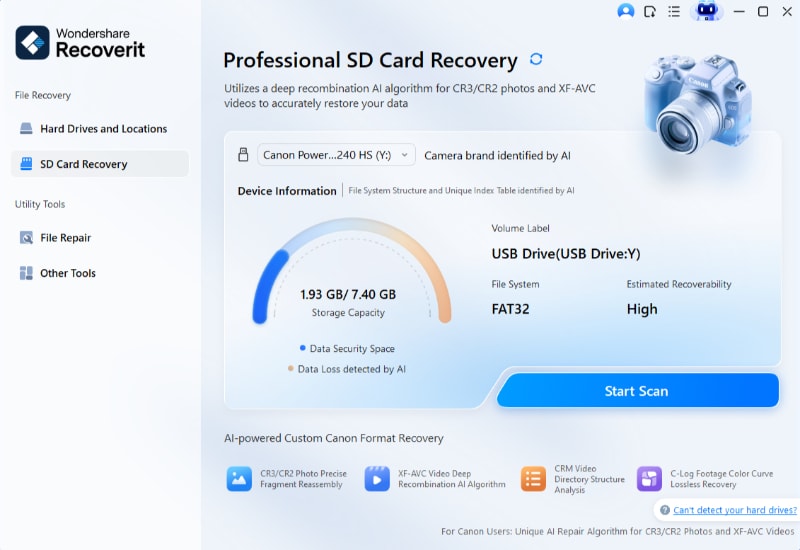
- Scan the card: Start the scan and avoid disconnecting the reader while it is running.
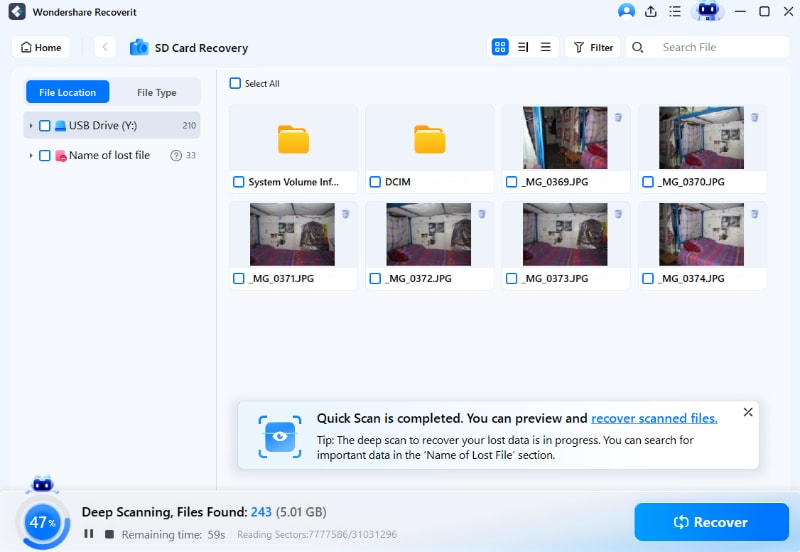
- Preview the results: Filter by file type or search for expected folders and filenames. Preview several items to check whether they are intact.
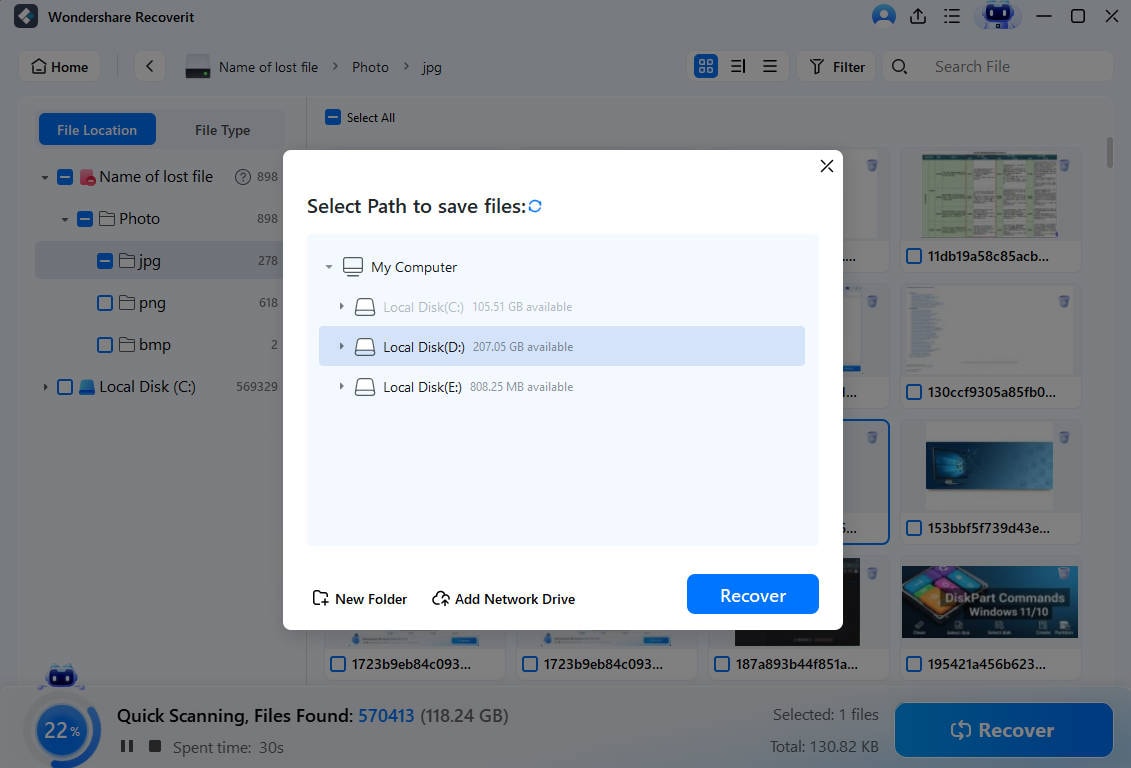
- Recover to another location: Select the needed files, click Recover, and save them to the computer or another healthy drive.
- Verify the files: Open a selection of recovered photos, videos, documents, or archives before considering the recovery complete.
What to Do If the MMC Card Is Not Detected
Recovery software can work only when Windows or macOS identifies the card. Use the following checks to separate a connection problem from a damaged card.
- Remove and reinsert the MMC card into a compatible reader. If an adapter is used, test another adapter.
- Try a different USB port, card reader, cable, or computer. Do not keep reconnecting a card that becomes hot or unstable.
- Check Disk Management on Windows or Disk Utility on macOS. If the card appears, do not click Format, Initialize, or Erase while files are unrecovered.
- If the card appears with a drive letter or readable volume, return to the recovery workflow and scan it before repair.
- If no known-good setup detects the card, or it is physically damaged, stop DIY attempts and consider professional recovery.
Part 3. Some Other MMC Card Recovery Solutions Worth Trying
While Recoverit is a powerful tool for this task, exploring alternative methods can also be beneficial. Highlighted below are 5 other solutions for MMC card recovery:
1. Changing Drive Letter For MMC Card
When the reason you suspect your card is lost is your system not recognizing it, there can be another cause. Sometimes, the drive letter of your MMC can be misconfigured, causing your computer to ignore it. Assigning a new one is a simple yet effective solution to restore access. These steps refresh the card's connection to your system, allowing it to appear in the file explorer to recover files from MMC:
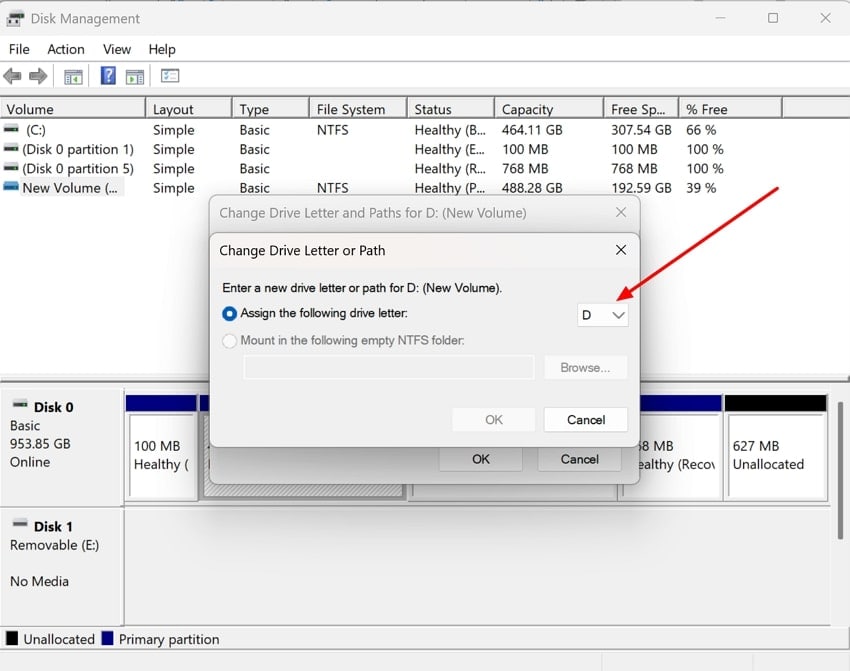
Step 1. Utilize a compatible card reader to link your multimedia card to the PC and Open the “Disk Management” tool via the “Win + X” menu. Within this utility, locate your MMC and right-click it to opt for the “Change Drive Letter and Paths” option.
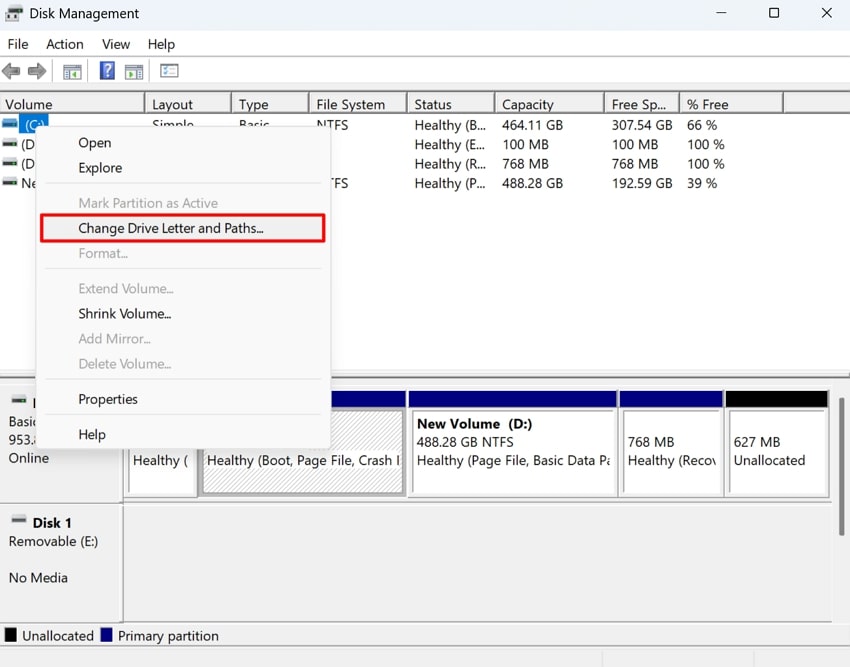
Step 2. Following this, click “Change” and choose a new letter on the following screen before pressing “OK.” Afterward, disconnect the card and reconnect it to check if your computer recognizes it.
2. Fix MMC File-System Errors with CHKDSK
CHKDSK can check and repair some Windows file-system errors when the MMC card is detected and has a drive letter. It may modify file-system metadata, so recover or back up important files before running it.
- Connect the MMC card with a reliable reader and confirm that Windows assigns it a drive letter.
- Open Command Prompt as an administrator by searching for
cmdand choosing Run as administrator.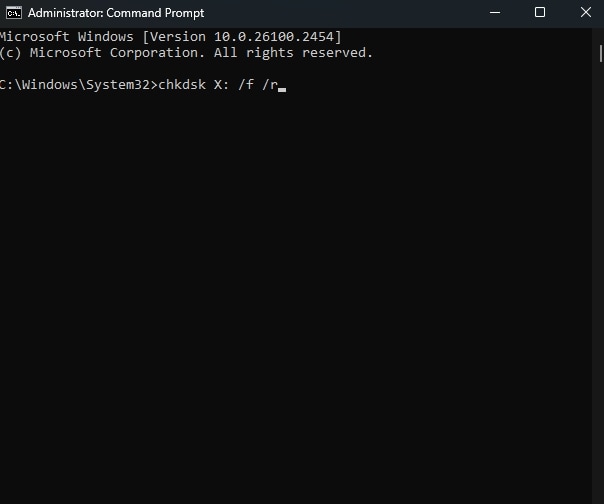
- Run
chkdsk X: /f, replacingX:with the actual MMC drive letter. - Wait for the scan to finish and do not remove the card during the process.
- Reconnect the card and check whether the volume is accessible. If important files are still missing, stop repair attempts and use a recovery workflow.
3. Repair an MMC Card with First Aid on Mac
Disk Utility First Aid can check and repair some logical errors on a mounted or detected card. It is not a deleted-file recovery tool, so use it only after important data has been recovered or backed up.
- Connect the MMC card with a compatible reader and open Disk Utility from Applications > Utilities.
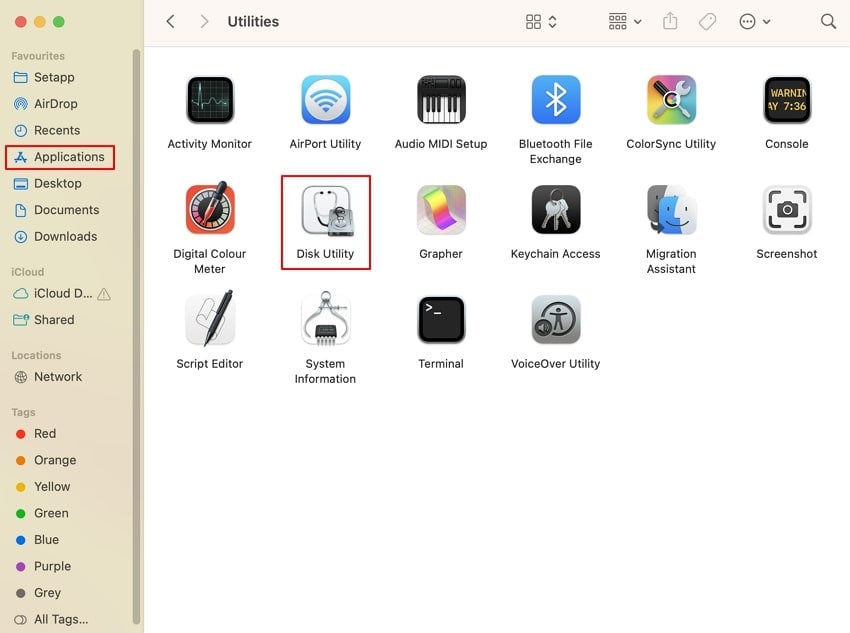
- Select the MMC card or its volume in the sidebar.
- Click First Aid and review the warning before choosing Run.
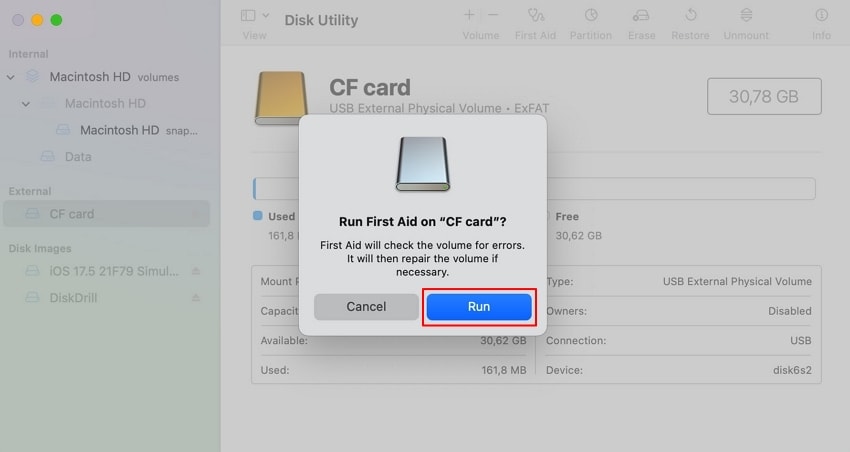
- Wait for the check to finish and verify whether the volume becomes accessible.
4. Check the Reader or Device Driver on Windows
Driver troubleshooting is useful when Windows does not detect the MMC card because of a reader, USB, or device-driver problem. It cannot restore files that were deleted or overwritten.
- Connect the reader and open Device Manager from the Windows power menu or search bar.
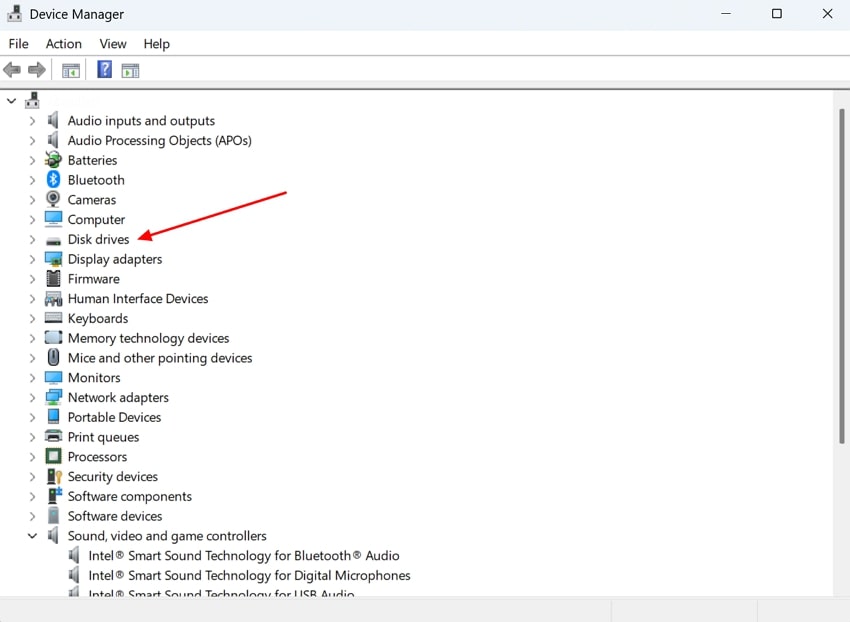
- Check Disk drives, Universal Serial Bus controllers, and any card-reader category for a warning icon.
- Right-click the relevant reader or storage device and choose Update driver, or test a different reader if no suitable driver is offered.
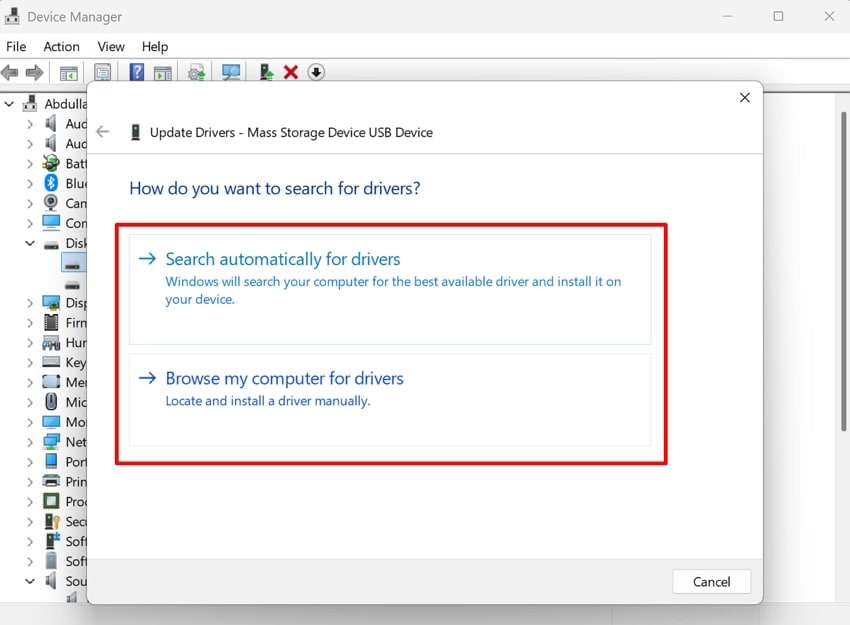
- Reconnect the MMC card and check Disk Management. If the card becomes detectable, recover the files before attempting repairs.
5. Show Hidden Files on the MMC Card
Files may appear to be missing when they are hidden by system settings or changed folder attributes. This check is safe when it only changes how files are displayed.
- Open the MMC card in File Explorer.
- Select View > Show > Hidden items.
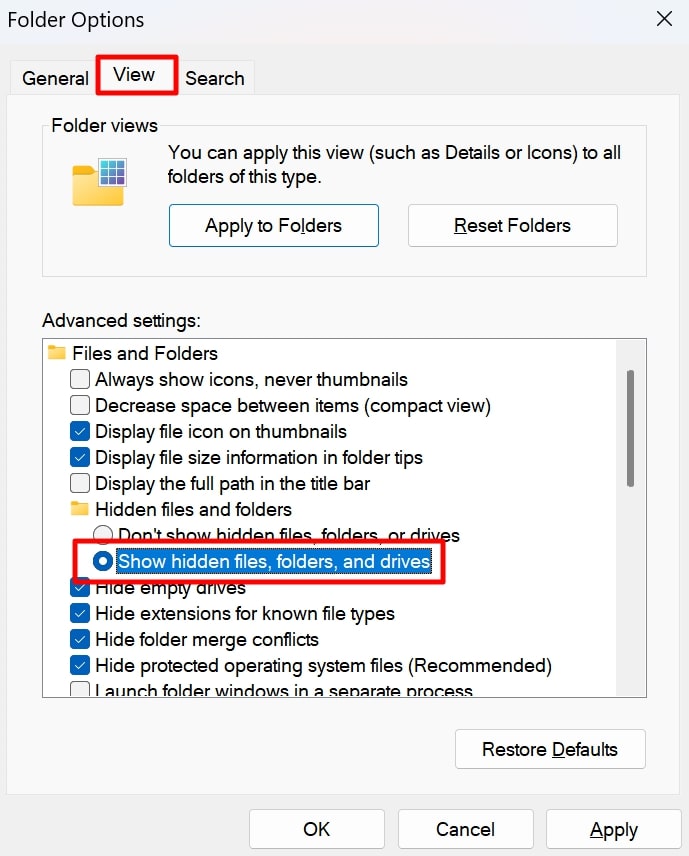
- If the files appear, copy them to a different drive and verify the copies.
- If the card is empty, asks to be formatted, or shows an unexpected file system, stop writing to it and use a recovery workflow.
Safe Recovery Order for an MMC Card
- Protect the source: Stop writing to the card and cancel format or initialization prompts.
- Check the connection: Test the reader, adapter, port, and computer.
- Recover first: Scan the detectable card and save files to another drive.
- Repair second: Use CHKDSK or First Aid only when important data is already safe.
- Replace or retire the card: Do not trust a card that repeatedly produces errors after recovery.
How to Prevent MMC Data Loss
- Back up important files to at least two locations.
- Eject the MMC card safely before removing it from a reader or device.
- Keep the card away from moisture, heat, bending, and impact.
- Do not fill the card completely and replace it after repeated errors.
- Use a reliable reader and avoid interrupting transfers.
Conclusion
MMC data recovery is more likely when you stop using the card immediately and the computer can still detect it. Start by checking the reader and connection, then scan the card with recovery software and save recovered files to another drive.
Use CHKDSK or macOS First Aid only after important data is safe and only for a card that the operating system can identify. Do not format an unrecovered card. If it is hot, cracked, wet, repeatedly disconnecting, or invisible to every reader, professional recovery is safer than repeated software attempts.
FAQ About MMC Data Recovery
-
Can I recover deleted files from an MMC card?
Often, yes, if the MMC card is readable and the deleted data has not been overwritten. Stop using the card and scan it before saving new files. -
Can I recover files from a formatted MMC card?
Recovery may be possible after a quick format when the card is still detected and new data has not replaced the old files. Do not format it again. -
Should I run CHKDSK before recovering files from an MMC card?
No. Recover or back up important files first. CHKDSK repairs some file-system errors and may change metadata; it is not a deleted-file recovery tool. -
What should I do if my MMC card asks to be formatted?
Cancel the prompt, test the card with a reliable reader, and recover data before formatting. Formatting can change or erase the current volume structure. -
Can a driver update recover deleted files from an MMC card?
No. Driver updates may fix a reader or detection problem, but they cannot restore files that have been deleted or overwritten. -
When should I use a professional MMC data recovery service?
Consider professional help when the card is physically damaged, hot, repeatedly disconnecting, or not detected by any known-good reader, especially when the files are irreplaceable.


