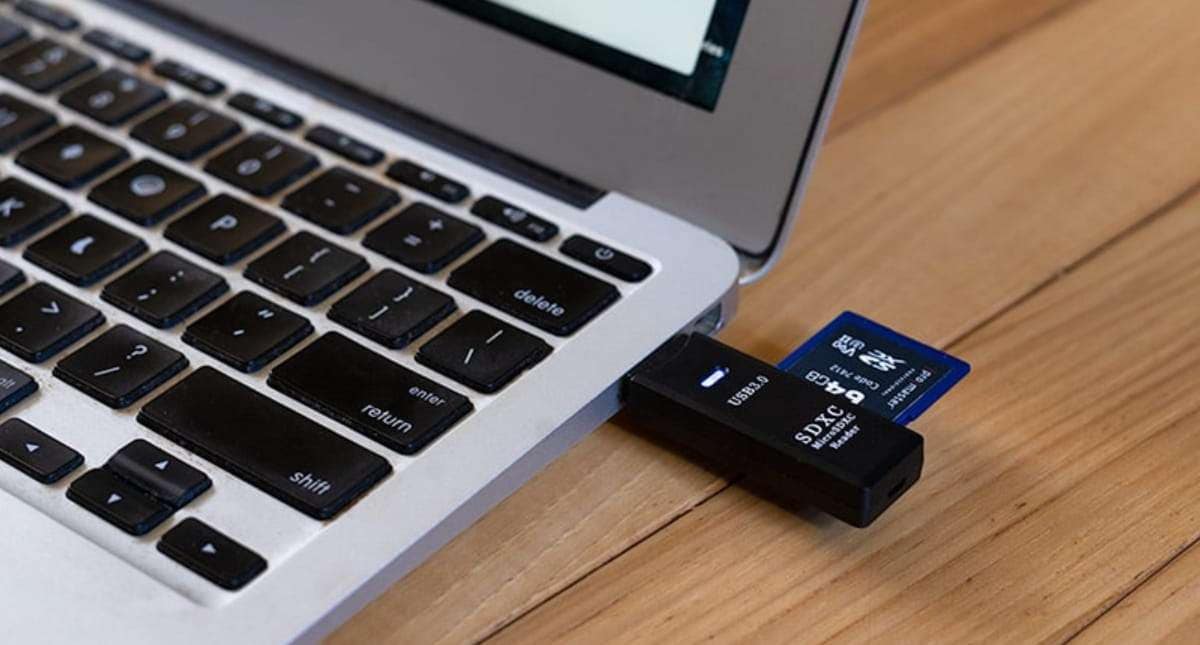


 TL;DR:
To safely recover files from a SanDisk Extreme PRO SD card, immediately stop using the device to prevent overwriting data, cancel all format prompts, and extract your files to a completely different drive.
● Choose Wondershare Recoverit for recovering mixed RAW files, formatted cards, or fragmented videos, or opt for RescuePRO Deluxe if your eligible card includes the two-year LC Technology entitlement and you need a basic category scan.
● Software recovery requires the operating system to still detect the card with its correct capacity; cracked, overheating, or totally invisible media must be sent to a professional recovery service.
● Never run file-system repair utilities like CHKDSK or First Aid prior to recovery, because these tools rewrite directory structures and can permanently destroy the remnants of your deleted files.
Ask AI for a summary
 ChatGPT
 Perplexity
 Gemini
 Claude
 Grok
Grok
Recover Files From A SanDisk Extreme PRO SD Card Safely
⚡ TL;DR: Quick Fix
Stop Using The Card: Turn off the camera, drone, action camera, or recorder and remove the SanDisk Extreme PRO card. New photos, videos, formats, and repair operations can overwrite recoverable data.
Recover Before Repairing: If Windows or macOS asks to format the card, cancel. Do not run CHKDSK, First Aid, or another format until important files have been recovered to a different drive.
Choose The Right Tool: Recoverit is the stronger guided option for mixed RAW photos, large or fragmented videos, and cards that have been deleted, formatted, or become RAW. Eligible SanDisk cards may include a two-year RescuePRO Deluxe offer.
Know When To Stop: If the card is cracked, hot, repeatedly disconnecting, or absent from every reader, software is not the safest first step. Use a professional recovery service for irreplaceable files.
Quick answer: To recover files from a SanDisk Extreme PRO SD or microSD card, stop using the card, connect it to a Windows PC or Mac with a compatible reader, scan it with recovery software, preview the recoverable photos or videos, and save them to the computer or another external drive. Keep the source card unchanged until the recovered files have been opened and verified.
SanDisk Extreme PRO recovery is usually possible when the loss is logical: accidental deletion, a quick format, damaged file-system records, an interrupted transfer, or a card that is still detected with the correct capacity. Recovery becomes less likely after new data overwrites the old blocks, and ordinary software cannot scan a card that no computer can detect.
Fact-checked on August 31, 2026: Current Extreme PRO SD and microSD product lines, capacities, speed classes, warranty terms, RescuePRO eligibility, and recovery support responsibilities were checked against SanDisk product data sheets and Support pages.
Try Wondershare Recoverit to Recover SanDisk Extreme PRO Files
 Security Verified. Over 7,302,189 people have downloaded it.
In This Article
Part 1. Can A SanDisk Extreme PRO Card Be Recovered?
Yes, but the result depends on what happened after the loss. When a file is deleted, the card's file system can mark its space as reusable without immediately replacing every underlying data block. A quick format may remove file references and folder records while leaving some photo or video data readable. Recovery software searches for those remaining records, file signatures, and media fragments.
That opportunity closes as the card is reused. A burst of RAW photos, a long 4K or 8K recording, another format, or a file-system repair can write into the same space. Recovery software cannot reconstruct the original bytes after they have been overwritten.
| What Happened | DIY Recovery Outlook | Safest First Action |
| Photos, RAW files, or videos were deleted | Often recoverable if the card was not reused | Stop shooting, remove the card, and run a read-only scan. |
| The card was quickly formatted | Possible, but filenames and folders may be lost | Do not format again or record new media; scan the entire card. |
| The camera or computer asks to format the card | Often a logical file-system problem rather than proof that files are gone | Cancel the prompt and recover before repair or formatting. |
| The card shows RAW or unallocated space | Possible if the storage remains detectable with the correct capacity | Recover or image the card before CHKDSK, First Aid, or partition changes. |
| Files disappeared during an interrupted transfer | The originals may still be on the card; incomplete destination files may also exist | Preserve both locations and scan the source card first. |
| The card was reused after deletion or formatting | Partial recovery may remain, but overwritten files cannot be restored | Stop all writes and assess what is still recoverable. |
| The card is cracked, hot, or not detected anywhere | Software recovery is unlikely or unsafe | Stop repeated attempts and consult a professional recovery laboratory. |
SanDisk's current data recovery guidance makes the same distinction: working cards can use third-party recovery software, while non-working cards may need a third-party recovery company. SanDisk does not perform the recovery itself, and its warranty does not reimburse recovery costs or cover damage caused by data loss.
Part 2. Identify Your Extreme PRO Card Before Recovery
“Extreme PRO” is a product family, not one card. Current products include full-size SD and microSD cards across UHS-I and UHS-II interfaces. Identifying the form factor, capacity, and interface helps you choose a reader that can expose the full card reliably. It does not change the basic rule: recover to another drive.
| Extreme PRO Product | Current Official Positioning | Recovery Consideration |
| SDXC UHS-I, V30/U3 | Current 2TB model lists up to 250 MB/s read and 150 MB/s write with compatible SanDisk QuickFlow hardware | Use an SDXC-capable reader and an operating system that can read exFAT. A basic UHS-I reader may work but not deliver the advertised proprietary transfer speed. |
| microSDXC UHS-I, V30/U3/A2 | Current 2TB model targets action cameras, drones, Android devices, and handheld systems, with up to 250/150 MB/s using compatible hardware | Prefer a direct microSD reader or a known-good adapter. A faulty adapter can look like a damaged card. |
| SDXC UHS-II, V60 | Up to 1TB, up to 280 MB/s read and 150 MB/s write on higher-capacity models, with a 60 MB/s minimum sustained video class | A UHS-II reader is preferable for a stable full-speed scan. The card remains backward compatible, but the host can limit speed. |
| SDXC UHS-II, V90 | 64GB to 512GB, up to 300 MB/s read and write, with a 90 MB/s minimum sustained video class for supported hosts | Long 4K or 8K files may occupy many fragments. A file-signature hit does not guarantee that the recovered video is complete. |
The speed printed on the label is a recording and transfer specification, not a recovery guarantee. UHS-I and UHS-II cards can both suffer deletion, formatting, logical corruption, controller failure, or physical damage. Capacity also matters operationally: scanning a 1TB or 2TB card requires adequate time and a destination with more free space than the data you intend to recover.
Most current Extreme PRO SD and microSD products include a two-year RescuePRO Deluxe offer, subject to registration and the terms supplied with the card. The current V90 SanDisk data sheet, for example, lists the offer alongside the card's recovery-related specifications. Check the exact package, region, and product page rather than assuming every used or counterfeit card includes an active license.
Part 3. Protect The Card Before Scanning
The card's condition before the scan usually matters more than which recovery app opens first. Complete these steps before trying to fix the card.
- Stop The Recording Device: Turn off the camera, drone, action camera, audio recorder, laptop, or handheld device. Do not take a test shot to see whether the card works again.
- Remove The Card Safely: Wait until every activity light stops. Remove the card without bending it or touching damaged contacts.
- Use The Adapter Lock When Available: A full-size SD adapter's lock tab can reduce accidental writes in ordinary workflows, although it is not a forensic hardware write blocker.
- Choose A Compatible Reader: Use a known-good SDXC or microSDXC reader. For UHS-II media, a UHS-II reader improves transfer speed and avoids relying on an unknown adapter.
- Cancel Format And Initialize Prompts: If Windows, macOS, a camera, or a console offers to format the card, cancel. A prompt does not mean formatting is the only repair.
- Avoid File-System Repair: Do not run CHKDSK, First Aid, partition repair, or a formatter before recovery. These tools can change metadata that a recovery scan may need.
- Prepare A Separate Destination: Use the computer or another external drive with sufficient free space. Never restore results onto the SanDisk card being scanned.
If the card disconnects during ordinary reading, freezes the computer, reports zero or the wrong capacity, or becomes unusually hot, stop. Repeated full scans can stress unstable media. For a paid shoot or irreplaceable archive, a professional service can image the card with hardware designed to handle read errors.
Part 4. How To Recover SanDisk Extreme PRO Files
Start with any verified backup, cloud copy, second camera slot, or completed offload. If no usable copy exists and the card is detected, choose one recovery tool and save its results away from the card. Repeated scans by different tools are less harmful than writes, but an unstable card should be imaged once rather than scanned repeatedly.
Method 1. Recover Files With Wondershare Recoverit
Recoverit Memory Card Recovery is the more suitable path when an Extreme PRO card contains a mixture of camera RAW files, JPEGs, large videos, audio, or project files. Its SD Card Recovery workflow scans a readable card, while Enhanced Video Recovery can search for recoverable fragments from large camera, drone, or action-camera recordings.
- Connect The Card: Insert the SanDisk Extreme PRO card into a compatible reader. Confirm that the operating system detects the expected capacity, but cancel any format or repair prompt.
- Select SD Card Recovery: Open Recoverit, choose SD Card Recovery, identify the Extreme PRO card by capacity and drive name, and click Start Scan. The displayed camera profile varies with the media and files detected.
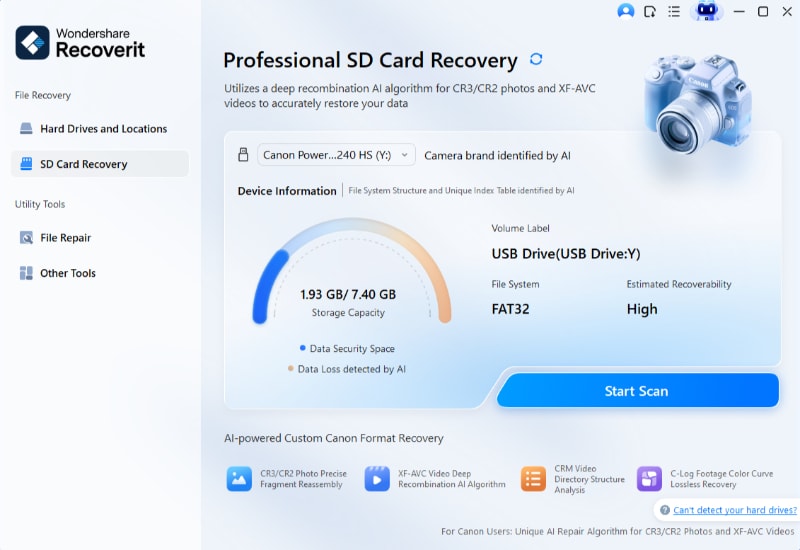
- Complete The Scan: Keep the reader connected while Recoverit searches file-system records and recoverable file signatures. Use file type, date, size, and status filters to narrow the results without ending the scan prematurely.
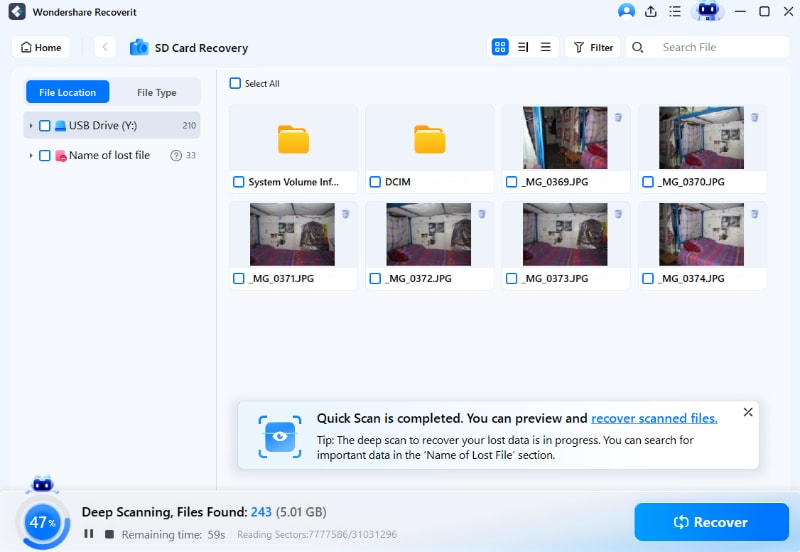
- Preview Supported Files: Open representative photos, RAW files, or videos when preview is available. Check more than thumbnails: a thumbnail may survive even when the full file is incomplete.

- Recover The Complete Shoot: Select the needed originals and related files. For video, include master clips, audio, proxies, and metadata when present.
- Save To Another Drive: Choose the computer or an external destination, not the Extreme PRO card. Keep the source offline until Part 7's verification is complete.
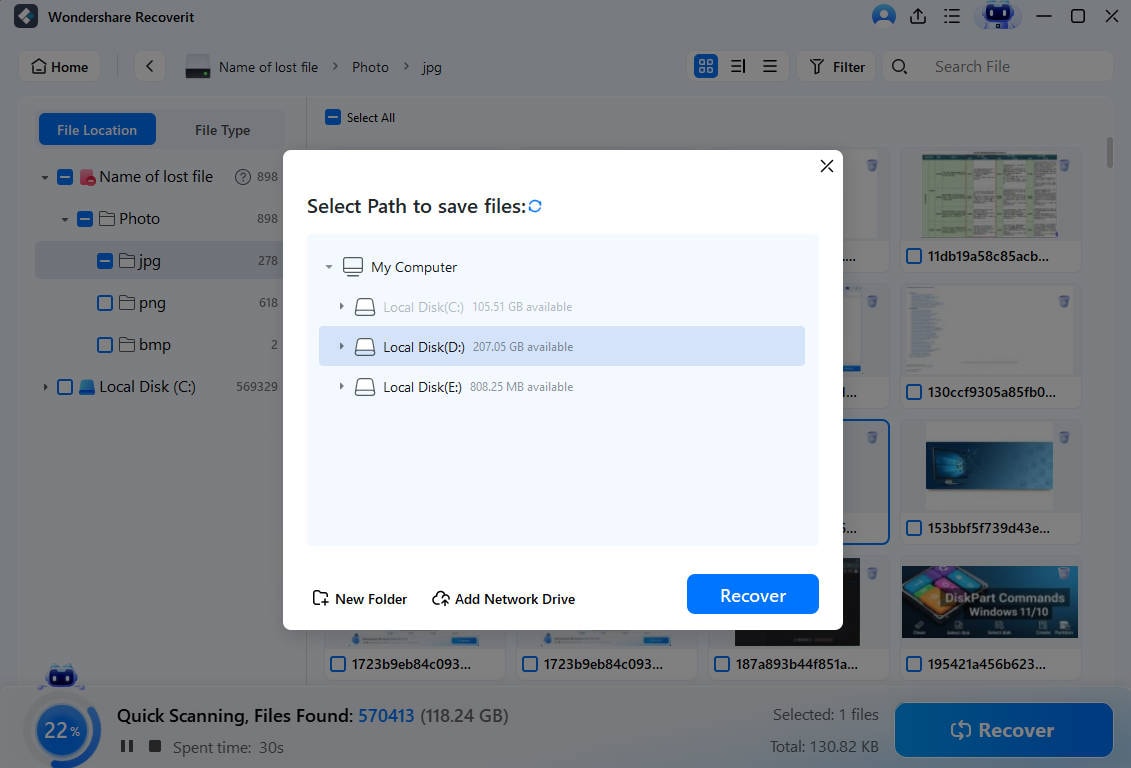
Recoverit can only work with data the computer can read and that has not been overwritten. If a large recovered MP4 or MOV opens but freezes, ends early, or lacks audio, preserve the original recovery result and try the video-focused scan before repairing a copied file.
Recover SanDisk Extreme PRO Files
Security Verified. Over 7,302,189 people have downloaded it.
Method 2. Recover Files With RescuePRO Deluxe
RescuePRO is a third-party recovery program supplied and supported by LC Technology. SanDisk bundles a two-year RescuePRO Deluxe offer with eligible Extreme PRO cards, but SanDisk Support explicitly directs software downloads, activation, instructions, and troubleshooting to LC Technology. Check the license key or redemption instructions on the original package.
- Verify The License And Download Source: Use the code supplied with an eligible card or obtain the current RescuePRO installer through SanDisk's support link to LC Technology. Install it on the computer, never on removable media being recovered.
- Select The Recovery Type: Start RescuePRO and choose Recover Photos, Recover Audio/Video, or Recover All Files according to the missing content.

- Select The Extreme PRO Card: Identify the source by its capacity and device name. Do not choose the computer's internal drive or another attached card. If the current build offers fragmented recovery and the loss involves large video, enable it only for the appropriate scan.
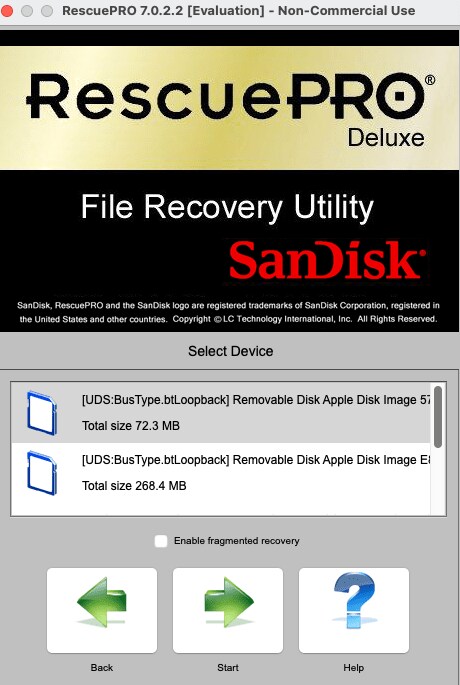
- Start The Scan: Run the scan and keep the card connected. RescuePRO may store found files in its configured output folder on the computer.
- Review The Output: Open the output folder, inspect the recovered files, and copy important results to a second safe location before closing the case or reusing the card.

The interface can vary between Windows, macOS, Standard, Deluxe, and later builds. Follow the current LC Technology help for the installed version. Do not rely on outdated claims that RescuePRO has no preview or cannot work with large-capacity media; exact features and limits depend on the current edition and license.
Part 5. Recoverit Vs RescuePRO
Both tools can scan readable removable media, but they fit different users. The comparison below avoids temporary prices and unverified recovery-rate claims.
| Decision Point | Wondershare Recoverit | RescuePRO Deluxe |
| Provider and support | Developed and supported by Wondershare | Provided and supported by LC Technology; SanDisk links to it but does not troubleshoot it |
| Best fit | Mixed photo, RAW, video, audio, and document recovery from deleted, formatted, RAW, or inaccessible cards | Eligible SanDisk owners who want to use the bundled recovery entitlement for common removable-media loss |
| Operating systems | Windows and macOS | Windows and macOS installers are linked from SanDisk Support |
| File selection | Browse by location or type; filter and preview supported results before choosing what to recover | Select photos, audio/video, or all files; current functions vary by edition and build |
| Large fragmented video | Enhanced Video Recovery is designed to detect and associate recoverable video fragments | Some RescuePRO builds expose a fragmented recovery option; check the installed version and supported format |
| License path | Free scan and preview availability depends on the current Recoverit edition; recovery limits depend on the license | Eligible Extreme PRO packages may include two years of RescuePRO Deluxe after registration; conditions apply |
| Physical failure | Not a substitute for a professional lab when the card is not detectable or physically unstable | Also requires readable media and is not a chip-level recovery service |
Which should you choose? Use the included RescuePRO entitlement if the card is stable, your target file types are supported, and you prefer its simpler category-based workflow. Choose Recoverit when you need a clearer result browser, mixed creator formats, RAW or formatted-card scanning, or a specialized path for fragmented video. If either tool detects the expected files, recover them to another drive before experimenting further.
Part 6. Handle Formatted, RAW, Unreadable, Or Encrypted Cards
Formatted Extreme PRO Card
Do not format it again. A quick format can remove directory records, so recovered files may lose their original names, dates, or folders even when the content survives. Scan the full card and group results by file type, size, preview, and shooting sequence. If new photos or videos were recorded after the format, expect gaps where old blocks were overwritten. See the full formatted SD card recovery workflow for additional cases.
RAW, Unallocated, Or Format Prompt
RAW describes how the operating system sees the file system; it does not identify one specific physical defect. If Disk Management or Disk Utility still shows the correct capacity, attempt recovery before file-system repair. Do not create a new partition or run CHKDSK first. After the files are safe, the RAW SD card guide can help with reuse decisions.
Card Not Detected
Test one known-good reader, one adapter if needed, another USB port, and a second computer. Check whether the card appears in Windows Disk Management or macOS Disk Utility without initializing it. If no device reports the correct capacity, ordinary software has no readable source to scan. Use the SD card not reading guide to separate reader problems from media failure, but stop if the card is unstable.
Encrypted Or Adopted microSD Card
A microSD card formatted as encrypted Android internal storage is tied to the original device and encryption key. A raw scan on a computer may find blocks but not usable plaintext files. Keep the original phone, avoid a factory reset, and move accessible data through the device before attempting card recovery. BitLocker, camera encryption, or other software encryption similarly requires the correct password or recovery key.
Recovered Photo Or Video Is Corrupted
Recovery and repair are separate. First extract the best possible copy from the unchanged card. Then duplicate the recovered file and repair only the duplicate. For long video, try Enhanced Video Recovery before repair because a file assembled from incomplete fragments may need a deeper source scan. No repair tool can recreate frames or RAW image data that have been overwritten.
Part 7. Verify The Recovered Photos And Videos
Do not format the Extreme PRO card after seeing a few thumbnails. Verify the actual deliverables first.
| File Type | Verification Check | Failure Sign |
| JPEG or HEIF photo | Open at full resolution and inspect the beginning, middle, and bottom of the image | Gray areas, color blocks, partial rendering, or a thumbnail that opens to a damaged original |
| Camera RAW | Open in a current RAW developer and confirm dimensions, camera model, exposure metadata, and full-resolution rendering | Unsupported-header errors, wrong dimensions, missing preview only, or decode failure |
| MP4, MOV, MXF, or other video | Confirm codec, resolution, frame rate, duration, audio, seeking, and the end of the take | Early ending, frozen sections, missing audio, black frames, or failure when seeking |
| Audio | Play the entire recording and inspect duration, channel count, sample rate, and synchronization | Noise bursts, silence, truncated duration, or timing drift |
| Whole card | Compare file counts, shoot notes, camera sequence numbers, dates, and total bytes with the expected job | Missing number ranges, unexpected generic names, or a much smaller total than the original shoot |
Create a second copy of the verified recovery on separate storage. For a client shoot, keep the original card offline until the editor or photographer confirms that all required masters, audio, sidecars, and metadata are present.
Part 8. Format, Replace, Or Claim The Warranty?
Only decide what to do with the card after recovery and verification.
- Format And Reuse: Reasonable when the loss was clearly accidental, the card remains stable, its full reported capacity tests correctly, and no errors return. Use the recording device's format function after backup.
- Replace The Card: Choose this when errors recur, the card disconnects, performance falls below the camera's requirement, capacity is inconsistent, or recovered files show unexplained corruption.
- Request Warranty Replacement: Current Extreme PRO SD and microSD lines commonly carry a limited lifetime warranty, with a 30-year term in Germany, Canada, and regions that do not recognize lifetime warranties. SanDisk says the exact term depends on the country, packaging, product page, and data sheet.
- Use A Recovery Laboratory: Appropriate when the card is physically damaged, invisible to all readers, or contains irreplaceable professional work that does not justify further DIY risk.
A warranty replacement is not data recovery. SanDisk's current warranty-period page explains the regional terms, while its recovery guidance states that the warranty does not reimburse data recovery and does not cover losses caused by missing data.
If the card is healthy enough for reuse, format it only after every important file exists in at least two verified locations. For the correct device and file-system choices, use this SanDisk SD card formatting guide.
Part 9. Prevent Another Extreme PRO Data Loss
- Use Genuine, Compatible Cards: Buy from an authorized seller, verify the capacity, and match SDXC, UHS interface, V rating, and maximum capacity to the exact camera or device.
- Label And Rotate Media: Divide a long shoot across multiple numbered cards instead of keeping the entire project on one 1TB or 2TB card.
- Never Delete In Camera To Make Space: Swap cards. In-camera deletion increases the risk of selecting the wrong clip and encourages continued writing after a mistake.
- Offload The Complete Card Structure: Copy every folder, sidecar, audio file, and proxy. Do not move the only copy from the card and call that a backup.
- Verify The Offload: Compare file counts and total bytes, open representative masters from the destination, and use checksum verification when the ingest tool supports it.
- Keep Two Copies Before Formatting: Store the working copy and a second copy on separate devices. Add an off-site or cloud copy for irreplaceable work.
- Eject Safely: Wait for camera activity lights and computer writes to finish before removing the card or reader.
- Retire Suspicious Media: Repeated errors, slow writes, hot operation, missing files, and incorrect capacity are reasons to remove a card from production.
SanDisk defines a backup as keeping a file in at least two places. Moving the only copy from an Extreme PRO card to one computer drive is a transfer, not a backup. For a complete workflow, follow this SD card backup guide.
Part 10. Conclusion
SanDisk Extreme PRO SD card recovery succeeds most often when the card remains detectable and no new data has overwritten the missing files. Stop the recording device, cancel format prompts, avoid repair tools, scan the card through a compatible reader, and recover everything to another drive.
Recoverit is the better fit for a guided mixed-media workflow and large or fragmented creator video. RescuePRO Deluxe is a useful option when an eligible Extreme PRO card includes the two-year entitlement and its supported formats match the loss. Neither replaces a professional laboratory for a physically failed card.
Finally, verify full-resolution photos, RAW decoding, video duration, audio, and the end of each take before formatting or replacing the card. Recovery is complete only when the files are usable and stored in more than one safe location.
FAQ
-
Can I Recover Deleted Photos From A SanDisk Extreme PRO SD Card?
Yes, if the card is still readable and the deleted photo data has not been overwritten. Stop taking photos, remove the card, scan it through a computer card reader, and save recovered files to another drive. -
Can I Recover Files After Formatting A SanDisk Extreme PRO Card?
Recovery may be possible after a quick format when the underlying blocks remain readable. Filenames and folders may be lost, and any new recording can overwrite old data. Do not format the card again before scanning it. -
Is RescuePRO Made And Supported By SanDisk?
No. RescuePRO is supplied and supported by LC Technology. SanDisk bundles a two-year RescuePRO Deluxe offer with eligible products and links users to LC Technology for downloads, activation, instructions, and troubleshooting. -
Does Every Extreme PRO Card Include RescuePRO Deluxe?
Do not assume it does. Many current Extreme PRO SD and microSD products list a two-year offer, but registration, package, product, region, and terms apply. Check the original packaging and exact product data sheet. -
Should I Run CHKDSK On A Corrupted SanDisk SD Card?
Not before protecting important data. CHKDSK changes file-system structures and can remove or relink damaged entries. Recover or image the card first, then repair or format it only after the files are verified. -
Why Are Recovered SanDisk Videos Unplayable?
A large video may be fragmented, partially overwritten, or never finalized after power loss. Repeat the deepest safe scan from the unchanged card, use fragment-aware video recovery, and repair only a duplicate of the recovered file. -
Can Software Recover A SanDisk Card That Is Not Detected?
Recovery software needs the operating system to expose a readable device. Test a known-good reader, adapter, port, and second computer once. If the correct capacity never appears or the card is physically unstable, consult a professional recovery service. -
Does The SanDisk Warranty Cover Lost Files Or Recovery Costs?
No. The warranty may replace an eligible failed product, but SanDisk states that it does not reimburse data recovery services and does not cover damages caused by data loss. Recover the data before sending or replacing the card.


