
 TL;DR:
To successfully recover lost files from a Mac hard drive, immediately stop writing to the affected disk and restore from Time Machine if available, or scan with software like Recoverit only if the drive remains detectable in Disk Utility and shows no signs of physical hardware failure.
● Recovery capabilities are heavily restricted by SSD TRIM functions that permanently clear deleted blocks, and by FileVault encryption or Apple silicon security protocols that mandate valid passwords or recovery keys to access the data.
● Do not execute Disk Utility First Aid, reformat the volume, or attempt to reinstall macOS before securing your files to a separate healthy drive, because these system procedures overwrite data and alter file-system structures.
● If a Mac cannot boot normally, utilize macOS Recovery features like Share Disk for Apple silicon models or Target Disk Mode for Intel Macs to access data, but seek professional lab services if the drive makes clicking noises, overheats, or completely disappears from macOS.
Ask AI for a summary
 ChatGPT
 Perplexity
 Gemini
 Claude
 Grok
Mac hard drive recovery can mean getting an accidentally deleted document back, retrieving data from a formatted external HDD, or accessing files on a MacBook that no longer starts. These situations require different approaches. If the files still exist in Trash or a Time Machine backup, restore those copies first. If the disk is detected and its original data remains readable, file recovery software may help. A disk that clicks, disconnects continuously, or is absent from macOS may require professional assessment instead.
This guide covers internal MacBook storage, external hard drives, and SSDs connected to macOS. It explains how to protect the source, check what the Mac can still detect, scan an accessible drive with Recoverit, and use Apple recovery tools without confusing file recovery with disk repair or reinstalling macOS.
In This Article
Part 1. Can You Recover Data From a Mac Hard Drive?
Yes, in some cases. Mac hard drive data recovery is possible when a usable file copy still exists or a recovery program can read enough of the affected storage to find missing data. A drive can be physically present but inaccessible because of file-system damage, permissions, or encryption. These conditions are not equivalent, and the first diagnostic step determines what to do next.
Recoverable Logical Loss vs. Physical or Access-Control Problems
Compare what you see on the Mac before choosing a method. In particular, a missing Finder volume does not necessarily mean that the physical drive is missing.
| What you see | Likely issue | Safer next action |
| File deleted, but still in Trash | Recoverable existing copy | Use Put Back; no scan is necessary |
| Files missing from a drive that opens normally | Deletion, relocation, hidden files, or permissions | Check Finder and backups; then scan if files are truly absent |
| Drive visible in Disk Utility, but the volume is unmounted or unreadable | Mounting, file-system, or partition problem | Protect files before First Aid or erase; scan only if the drive is accessible to the tool |
| Disk requires a FileVault password or recovery key | Access control or encryption | Use legitimate credentials; recovery software cannot bypass encryption |
| Drive repeatedly disconnects, clicks, or never appears in Disk Utility | Connection, controller, or physical failure | Try one careful cable or power check; stop if symptoms persist |
For a disk that is visible but fails to mount, the first objective is still to preserve its files, not to make the drive look healthy in Finder. A file-system repair can change information that recovery tools might otherwise inspect.
How Readability, Overwriting, TRIM, and Encryption Affect Recovery
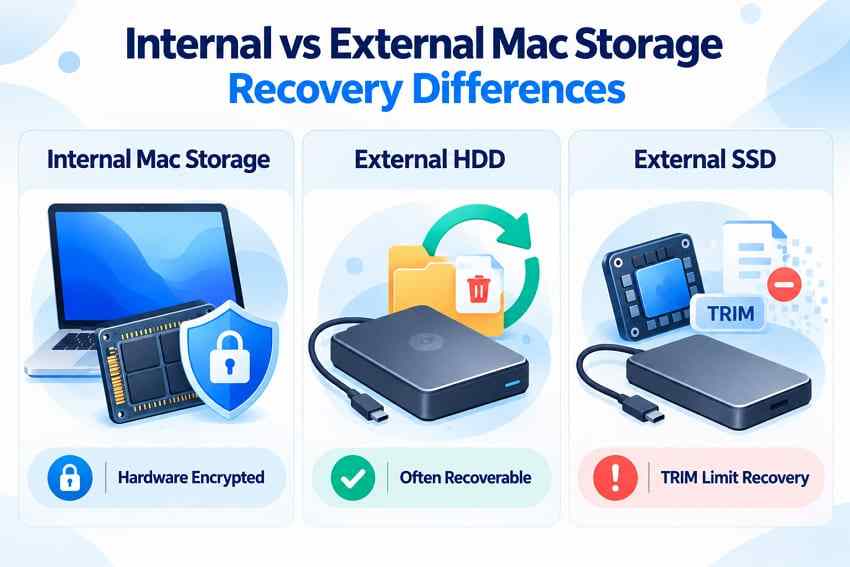
On a traditional magnetic HDD, deleted file contents may remain in unused space until later writes reuse that space. On an SSD, TRIM may allow the controller to clear deleted blocks even when little new data has been saved. Formatting, device erasure, and deleted encryption keys can make recovery much less likely. There is no universal recovery percentage or guaranteed window.
Apple silicon and T2-equipped Macs use hardware-backed protection for internal storage. With FileVault enabled, a valid password or recovery key may be required before data is accessible. Apple documents that removing the relevant cryptographic key can make an erased volume inaccessible even to its original Mac. For details, see Apple's FileVault and internal-storage encryption guidance.
Internal MacBook Storage vs. Connected External HDDs and SSDs
Internal MacBook or iMac storage: The operating system may continue writing caches, updates, and temporary files to the same disk where data was lost. On Apple silicon or T2 models, authentication and hardware security further shape what recovery software can read. Do not install recovery software onto the affected internal drive merely to test it; consider existing backups and a supported recovery environment.
External HDD: If the disk is consistently detected, logical recovery may be possible even when a volume does not mount. Mechanical clicking or repeated spin-up failure, however, is a reason to stop scanning. External SSD: Similar access checks apply, but SSD TRIM, controller behavior, and prior erasure can sharply reduce what remains recoverable. The original drive should not be the recovery destination.
Part 2. Protect the Mac Drive Before Recovery
Protecting the source is more important than finding the fastest scan button. These precautions apply whether the goal is MacBook hard drive recovery or retrieving files from an external HDD.
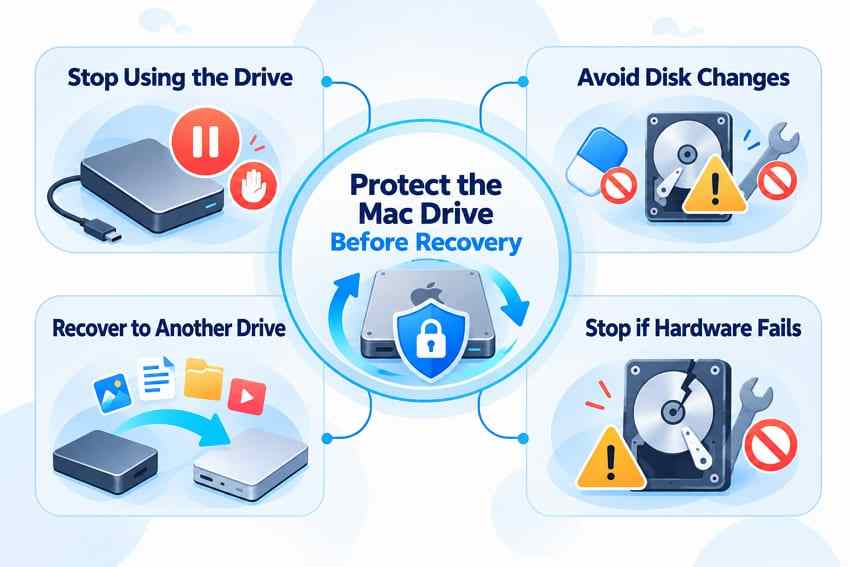
Stop Using the Affected Drive and Avoid New Writes
Stop copying, downloading, syncing, or editing files on the affected volume. For an external drive, stop routine use and disconnect it safely while preparing the recovery destination. For internal storage, avoid new application installations and large system updates; when irreplaceable files have just disappeared, continued normal use may work against recovery.
If an external HDD is producing mechanical noises, becoming unusually hot, or disconnecting repeatedly, do not keep reconnecting it or run multiple full scans. Such tests can increase stress on hardware already failing. If files are valuable, obtain an assessment from a specialist before further power cycles.
Do Not Erase, Initialize, Reformat, or Run First Aid Before Protecting Data
When macOS offers to Initialize or Erase a drive, cancel the prompt if important files are still needed. Formatting recreates storage structures and may render previous contents unrecoverable. Apple's Disk Utility First Aid instructions also advise having a current backup before disk repair; First Aid checks and can modify file-system or directory structures. It is not an undelete tool.
If the drive is accessible enough to copy openable files, copy those first. If not, use a suitable recovery method or obtain professional advice before repair. Do not try random Terminal repair commands, partition changes, or secure erase as a shortcut to file recovery.
Save Recovered Files to a Separate Healthy Device
Prepare another healthy disk with enough free space for recovered files, preferably a different physical storage device. Do not recover a folder back to the same disk or a different partition on the same affected physical drive. Check representative photos, documents, and videos after recovery before considering repairs or reuse.
Part 3. Choose a Mac Data-Recovery Route
There is no single Mac disk restore command that fits deleted files, lost partitions, failed SSDs, and a Mac that will not start. Select the least invasive option appropriate to the actual symptoms.
Quick Comparison: Trash, Time Machine, Recovery Software, Disk Utility, and a Specialist
| Recovery route | Use it when | What it cannot do |
| Trash | The deleted item is still in the Mac Trash | Restore an item already emptied or automatically removed |
| Time Machine | A usable backup or local snapshot contains the file | Recover files never captured in a retained backup |
| Recoverit or compatible file recovery software | The disk is detectable and lost file contents remain accessible | Recover overwritten data, bypass FileVault, or repair hardware |
| Disk Utility First Aid | Files are already safe and the volume has certain file-system errors | Undelete files or repair a physically failed disk |
| Professional data recovery | Physical failure, unstable devices, missing detection, or extremely valuable files | Promise recovery from destroyed media or lost cryptographic keys |
Also check application-specific history, iCloud Drive, or another computer if the file may have been moved or synchronized rather than deleted. Avoid running multiple recovery tools on an unstable drive just to compare result counts.
An External Drive Mounts but Files Are Missing: Check Finder First
If the external volume opens, it may be displaying a different folder, hiding certain files, or applying permissions that prevent access. Check what you can see without changing the disk.
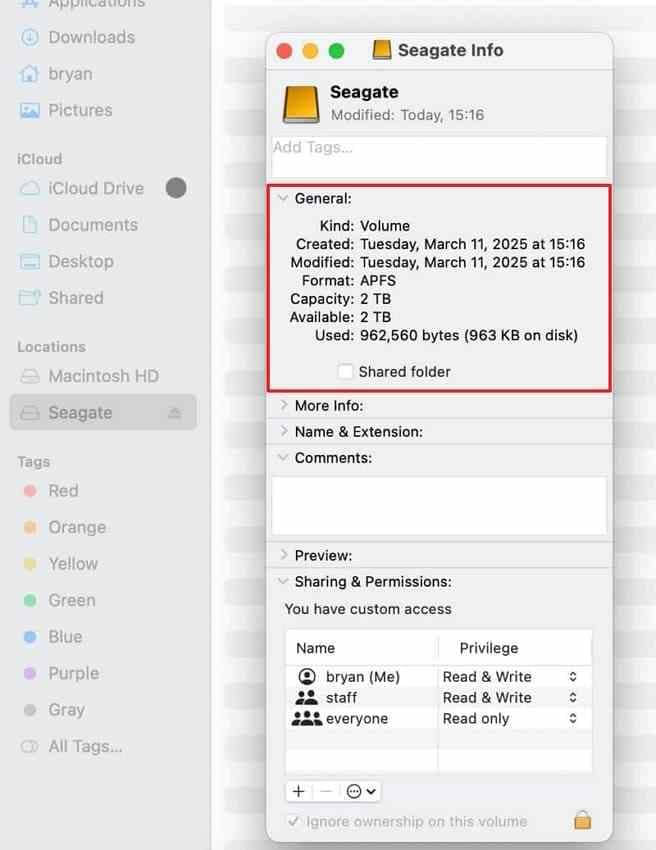
Step 1. Inspect the correct volume. In Finder, select the external drive under Locations, then press Command-I for Get Info. Verify the disk name, capacity, and used space. If permissions appear relevant, expand Sharing & Permissions; change ownership settings only if you understand the volume's configuration and the option is available.
Step 2. Search the external drive. In Finder, search for a distinctive filename or extension and select the external volume as the search scope, not This Mac. Check other folders and any available backup copies. If the missing files are not found, stop writing to the drive and consider a recovery scan.
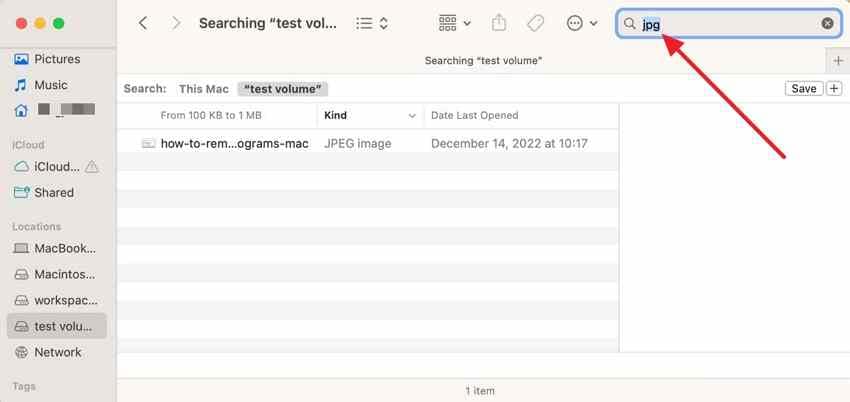
When the drive itself is missing from Finder, use the more specific external hard drive not showing up on Mac guide to distinguish a hidden volume from a detection failure.
What Changes When the Disk Does Not Appear in Disk Utility?
Open Disk Utility and choose View > Show All Devices. A visible physical disk with an inaccessible child volume is different from an entirely absent physical disk. Recovery software needs a source that macOS or the recovery environment can access. If the device is absent, check a compatible cable, direct port, enclosure power, and another Mac once. Continued absence, repeated disconnections, or a burning smell warrants specialist evaluation rather than another scan.
Part 4. Recover Files From a Detected Mac Drive With Recoverit
If Trash and backups cannot provide the missing files, Recoverit offers a graphical recovery workflow for supported, detectable internal and external drives. It can search for files affected by deletion, formatting, partition loss, or logical file-system problems. This is file recovery, not a way to repair a dead HDD or unlock a protected Mac without authorization.
Check the Current Mac, Drive, and File-System Compatibility
Wondershare's Recoverit for Mac product details list support for Mac HDDs, SSDs, external disks, and common formats including APFS, HFS+, exFAT, FAT, and NTFS. Support for the operating system and storage type does not imply that all erased, encrypted, or physically damaged files remain recoverable. Confirm the app's current macOS and hardware requirements before installing, particularly on an older Intel Mac or a newer Apple silicon Mac.
For an inaccessible volume, verify that macOS can detect the physical source and that any necessary authentication is available. If FileVault remains locked, do not interpret the lack of scan results as proof that all files are gone. Check access permissions and legitimate credentials instead of weakening startup security without a documented reason.
Select the Visible Source, Scan, Preview, and Recover Elsewhere
Follow Wondershare's current Mac recovery guide while keeping the affected drive out of the software installation and recovery destination paths.
Step 1. Select the detected Mac drive. Connect an external drive if needed. Open Recoverit and go to Hard Drives and Locations (the label can vary by version). Select the storage location where the files originally existed, checking the drive identity carefully before scanning.
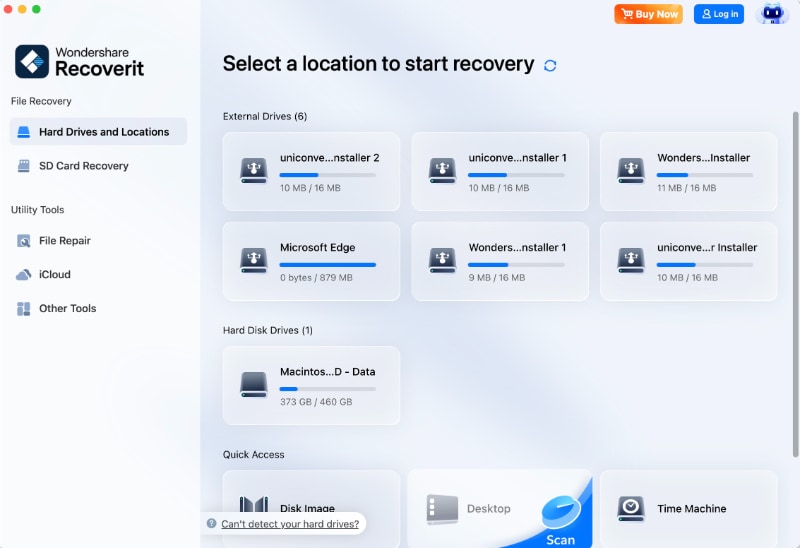
Step 2. Scan and narrow the results. Let the scan search for missing data. Use Filter, file type, size, location, or search controls to narrow a large result set. Do not assume a filename displayed in the results guarantees that the underlying file opens correctly.
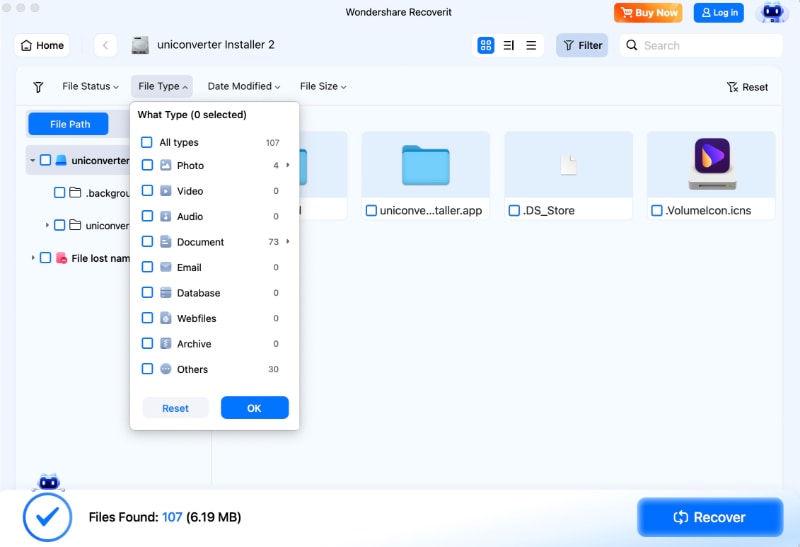
Step 3. Preview and recover to another disk. Preview supported photos, documents, or videos to check their contents, select the needed files, then click Recover. Choose a separate healthy drive. Open several recovered files before deciding whether to repair or reformat the original disk.

Note: Scans cannot bring back overwritten contents or blocks made unavailable by SSD TRIM. A physically absent disk will not become scannable simply because recovery software is installed.
Can Recoverit Recover Files From a Mac That Will Not Boot?
Recoverit documents a crashed-computer recovery workflow that creates bootable USB media, but support for the installed Mac edition does not automatically establish support for booting every Mac model from that USB. Its user guide describes an Option-key boot sequence associated with Intel Macs. Apple silicon Macs and Intel Macs with a T2 chip have different startup security requirements, so do not apply that procedure universally.
| Mac model | First non-destructive route | What to verify for Recoverit |
| Intel Mac without T2 | macOS Recovery, available backup, or supported Target Disk Mode | Whether the exact model and bootable media version are supported |
| Intel Mac with T2 | macOS Recovery and Apple-supported file transfer | Startup Security Utility requirements; avoid changing policy without vendor guidance |
| Apple silicon Mac | macOS Recovery and Share Disk to another Mac | Written confirmation that the exact Recoverit boot workflow supports the hardware and security policy |
If the compatible crashed-Mac feature is available, create bootable media on a healthy computer using a blank USB drive; that creation process erases the USB. Do not format the affected Mac drive. If the boot procedure is not explicitly supported for your model, use Apple's macOS Recovery startup instructions and the file-transfer options in Part 6 instead.

Part 5. Restore Files From Trash or Time Machine
Using a real backup or a file still in Trash avoids unnecessary scanning of the original Mac drive. These are the best starting points when the deleted file was not subsequently erased from every available copy.
Restore Files That Are Still in Mac Trash
Open Trash from the Dock. Select the missing item, Control-click, and choose Put Back (or use File > Put Back) to return it to its original location. Apple confirms this procedure in its guide to deleting and restoring Mac files.
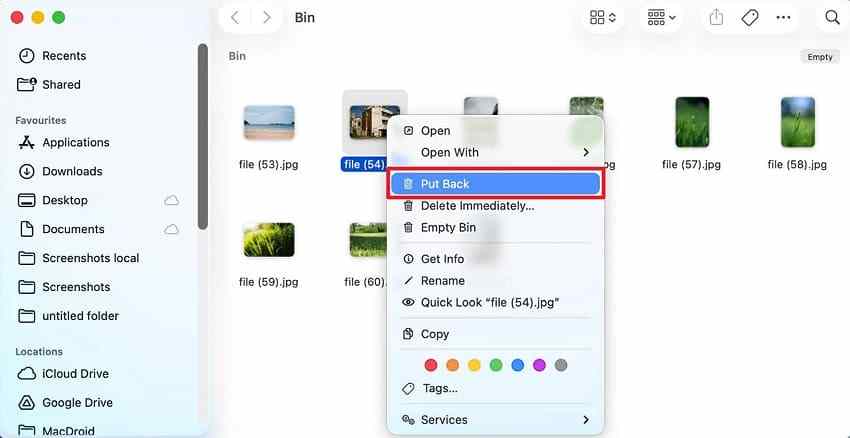
Note: Automatic removal after 30 days is a Finder setting, not a universal retention guarantee for all local Trash items. Files removed from iCloud Drive have separate cloud-related behavior. If the item is no longer in Trash, check Time Machine or another copy before scanning.
Restore an Earlier File or Folder With Time Machine
Time Machine restores earlier file versions only when they exist in the available backup set. Apple's Time Machine restore guide describes how to open the folder where the item used to live and browse available backup dates.
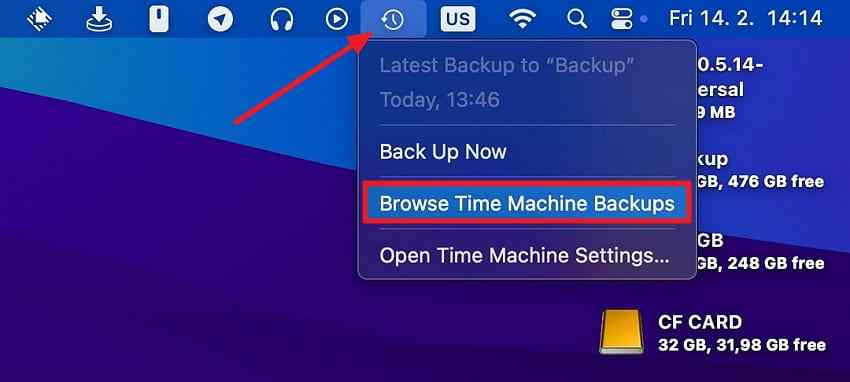
Step 1. Open the backup browser. Attach the backup disk if needed, open Finder in the missing file's original folder, then launch Time Machine via Spotlight or choose Browse Time Machine Backups from the menu bar when available. Older macOS menus may look different from the current interface.
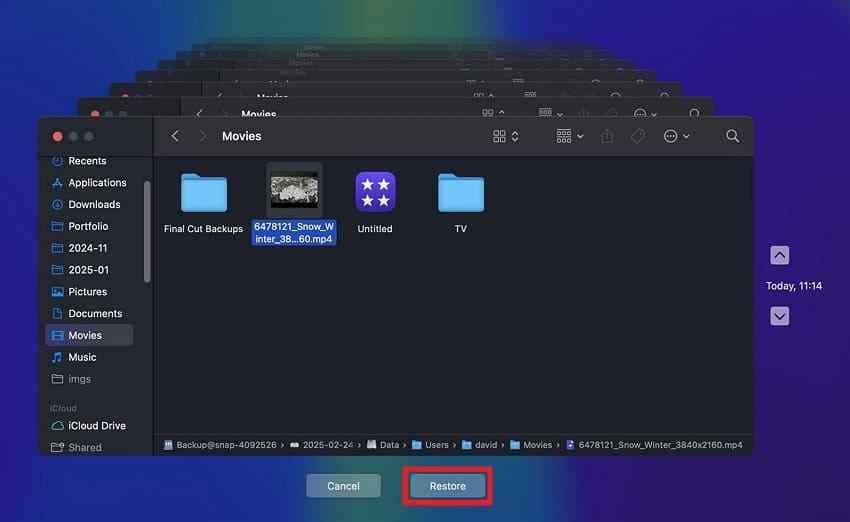
Step 2. Find and restore the saved item. Use the timeline and navigation arrows to find a backup containing the file. Select the item and click Restore. If a newer file currently occupies that name or location, check the replacement prompt carefully before proceeding.
When a File Was Never Backed Up
Time Machine cannot supply a file that was excluded or never captured. If Time Machine was configured, check retained local snapshots as well: Apple says it generally creates roughly hourly startup-disk snapshots and keeps them for about 24 hours, subject to available space and settings. These are not substitutes for an external backup. See Apple's Time Machine local snapshots guidance.
For other deleted-file cases already covered by dedicated tutorials, see Recoverit's deleted files on Mac guide rather than changing your disk configuration to force Time Machine to find nonexistent history.
Part 6. If the Mac Drive Will Not Mount or the Mac Will Not Start
When Finder cannot access a disk, first determine whether the hardware appears in Disk Utility. When the whole Mac will not start, use macOS Recovery to inspect available backups and copy accessible files before considering repairs or reinstalling the operating system.
Check the External Drive, Disk Utility Visibility, and Mount Status
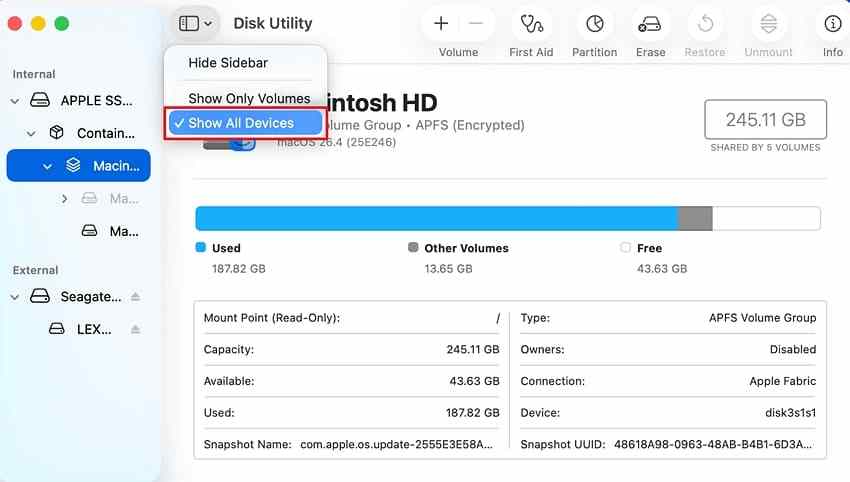
Step 1. Confirm detection. Check the cable, USB-C adapter, Thunderbolt connection, and external power supply. Open Applications > Utilities > Disk Utility and choose View > Show All Devices. Look for the physical external disk and any child volumes. If it remains absent even after one known-good connection test, stop and consider hardware evaluation.
Step 2. Check the volume without erasing it. If the disk is present but its child volume is unmounted, select the volume and use Mount when available. The source screenshot shows the physical disk and its child volume, so check the sidebar selection carefully. If macOS reports unreadable data or asks to initialize the drive, cancel the prompt and prioritize recovery.
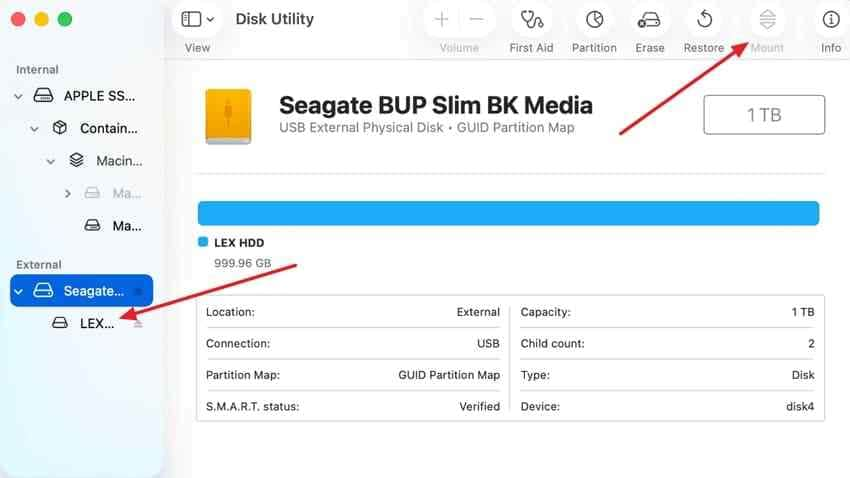
Mounting does not undelete files, and a disk missing from Disk Utility cannot be scanned by an ordinary desktop recovery tool. For the distinct detected-but-unmountable scenario, see Recoverit's guide to unmountable Mac drives.
Run First Aid Only After Important Files Are Safe
After copying or recovering the needed data, use First Aid if a remaining issue appears to involve directory or file-system structures rather than failing hardware. Apple instructs users to begin with the last volume, proceed through remaining volumes and any volume groups, then containers, and finally the physical device.
Instructions. Choose View > Show All Devices, select the last listed volume, click First Aid, and choose Run. Continue upward through the disk hierarchy as described in Apple's official First Aid sequence. If the app reports a failing disk or persistent repair errors, do not keep retrying on an unstable device.
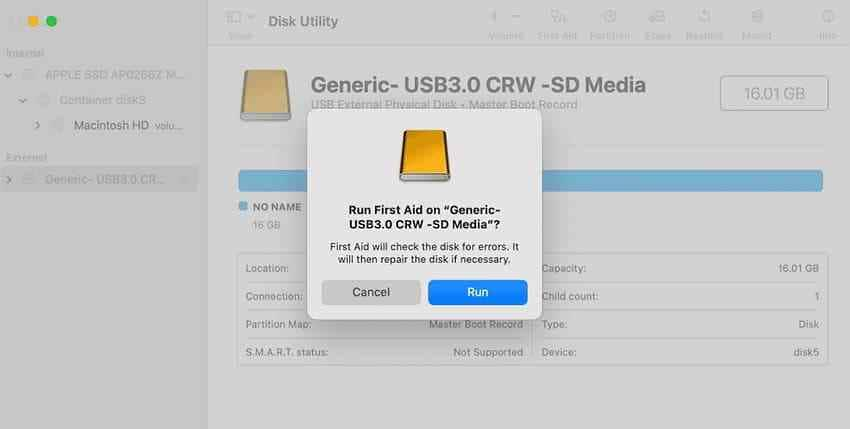
Important: First Aid is a file-system repair procedure. It does not reconstruct deleted personal files, repair a failing SSD controller, or make encrypted data readable without credentials.
Use macOS Recovery or Another Mac When Normal Startup Fails
Apple silicon: Shut down, then press and hold the power button until startup options appear. Choose Options > Continue. If the volume is accessible and another Mac is available, Apple provides Utilities > Share Disk to share a readable volume through a suitable cable and copy files to another Mac. Follow Apple's Share Disk instructions; availability still depends on storage health and authentication.
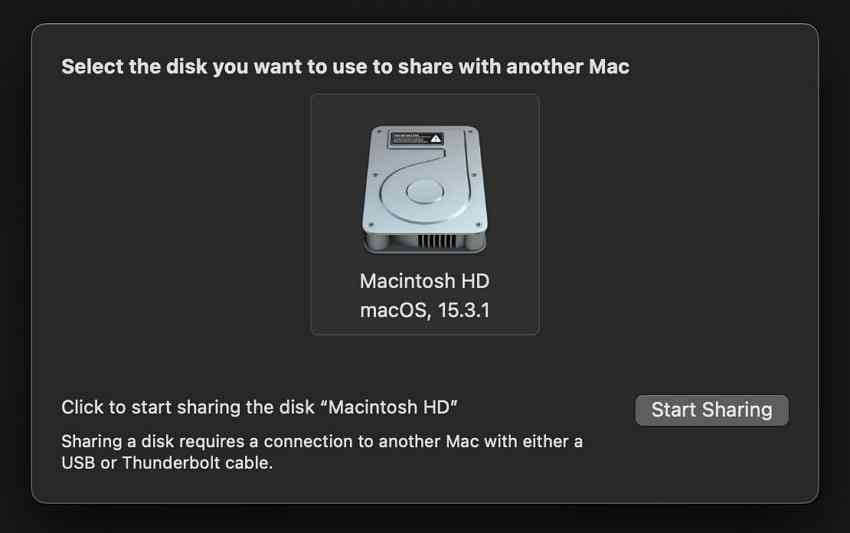
Intel Mac: Turn on the Mac and immediately hold Command-R to enter the built-in macOS Recovery system. Some Intel Macs also support Target Disk Mode when a compatible second Mac and cable are available. This is not the same procedure as Apple silicon Share Disk.
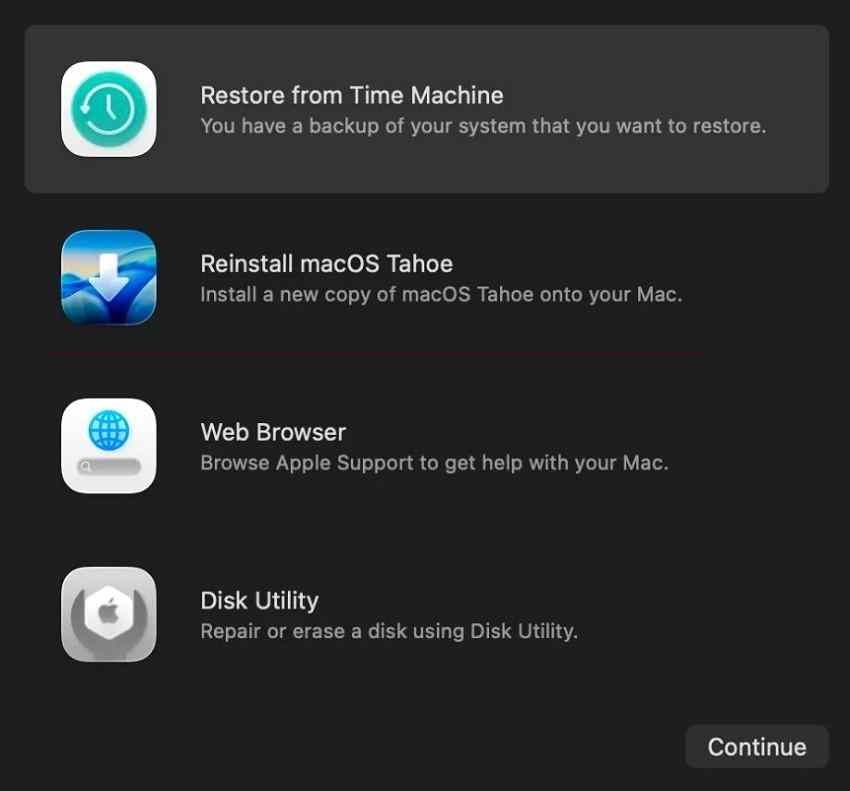
In macOS Recovery, use Restore from Time Machine if you have a suitable backup and have confirmed what it will replace. Merely opening Recovery does not recover deleted files. If Recovery cannot unlock the volume or the drive is missing, do not proceed with Erase to see whether it fixes detection.
Why Reinstalling macOS Is Not File Recovery
Reinstall macOS is intended to reinstall the operating system. It is not a scan for deleted files, and additional writes can reduce recovery chances. Reinstalling without erasing may preserve accessible personal data in normal circumstances, but it is not a guarantee against loss, especially when the disk is already damaged. Never select Erase Mac or repartition the source while the files still need to be recovered.
Part 7. When Professional Mac Recovery Is Necessary
Some failures are beyond the reach of Finder, Time Machine, Disk Utility, and ordinary recovery software. A professional lab may be safer when a device is physically unstable or when continuing the scan risks further damage.
Physical Damage, No Device Visibility, and Irreplaceable Data
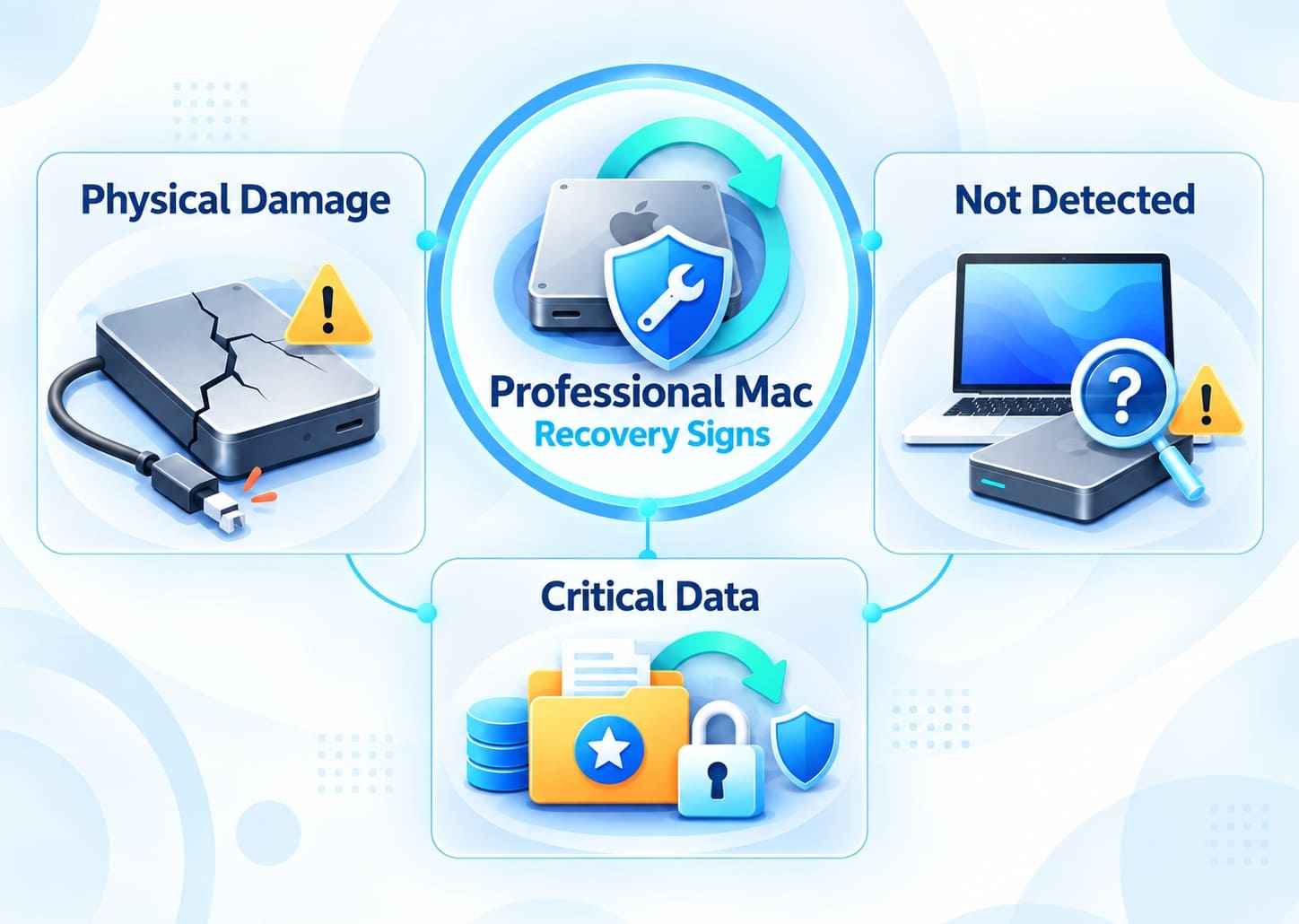
- Physical warnings: Clicking or grinding HDDs, liquid damage, electrical smells, severe heat, and repeated disconnects warrant stopping immediately.
- Detection failure: A device that remains absent from Disk Utility after one cable, power, or host check generally needs more than a file recovery app.
- High-value files: If the only copy is essential for work or family records, prioritize a professional evaluation before testing repair utilities or repeated scans.
Mac Model, FileVault, and Hardware Security Constraints
Tell the recovery provider the exact Mac model, storage type, macOS version, whether FileVault was enabled, which credentials or recovery key remain available, and what happened before access was lost. Modern Apple internal storage can be bound to Secure Enclave-backed keys, which means some erased or severely damaged systems cannot be decrypted even with specialist equipment. Physical recovery and authorized data access are separate questions; no reputable provider should guarantee that every encrypted or TRIM-affected file can be restored.
Conclusion
Successful Mac hard drive recovery starts with the storage state, not a repair command. Restore from Trash or Time Machine when a valid copy exists. If a Mac HDD, SSD, or external drive is detectable and the data is still accessible to software, Recoverit may help recover selected files to a different healthy destination. Avoid First Aid, reformatting, and macOS reinstallation until important data is protected. For undetected, unstable, or physically damaged hardware, stop DIY attempts and consider a recovery specialist.
FAQ
-
Can You Recover Permanently Deleted Files From a Mac Hard Drive?
Sometimes. A file removed from Trash may still be present in a Time Machine backup or an accessible HDD's unused space. Recovery software may locate surviving contents, but overwriting, SSD TRIM, and encryption can prevent recovery. -
Can You Recover Data From a Formatted Mac Hard Drive?
It depends on the device and erase method. Some logically formatted, detectable HDDs may still contain recoverable data. SSD TRIM, secure erase, cryptographic key deletion, and subsequent writes may make recovery impossible. Stop using the drive and check backups before scanning. -
How Do You Recover Data From an External Hard Drive on Mac?
First check whether the drive is visible in Finder and Disk Utility. Restore an available backup or copy readable files. If it is detected but files are missing, scan the supported source with recovery software and save the results to another drive. Stop if it clicks, overheats, or disconnects repeatedly. -
Can Recoverit Recover Files From a Mac That Won't Boot?
Recoverit offers a crashed-computer recovery feature, but boot-media compatibility depends on the exact Mac and current software version. Intel, T2, and Apple silicon Macs have different startup rules. Check Wondershare's current model-specific instructions and consider macOS Recovery, Time Machine, Share Disk, or Target Disk Mode where supported.