


 TL;DR:
Resolve GoPro Hero 4K playback issues on Mac by first copying the original .mp4 to your internal drive to avoid SD card bottlenecks and verifying macOS High Sierra 10.13 or later is installed for HEVC support before testing the file in VLC.
● Ensure you are opening the full-resolution .mp4 file instead of the low-resolution .lrv proxy that GoPro automatically generates in the same media folder.
● Convert healthy HEVC files to H.264 using the Greater Compatibility export option in QuickTime Player if the video plays but stutters, keeping in mind that the official GoPro Player requires macOS 10.14 Mojave and an HEVC-capable GPU.
● Use Recoverit Video Repair only if the .mp4 completely fails to open in QuickTime Player, VLC, and GoPro Player due to a failed recording or transfer, as repair software cannot fix outdated macOS codecs or rebuild files missing from the card.
Ask AI for a summary
 ChatGPT
 Perplexity
 Gemini
 Claude
 Grok
Grok
If a GoPro Hero 4K video will not play on a Mac, first decide which state you are seeing: the file opens but stutters, it has no audio, it will not open in any player, or you opened a small proxy file instead of the original. GoPro records video as MP4. Depending on the camera and settings, that MP4 is encoded as H.264 or HEVC (H.265).
Apple says viewing, editing, or duplicating HEVC media needs macOS High Sierra 10.13 or later, and older Macs can still struggle with high resolution or high frame rate. This guide starts with the codec and the original .mp4, then tests QuickTime Player, VLC, and GoPro Player. Convert a healthy HEVC file to H.264 if playback is too heavy. Use Recoverit Video Repair only when the file is damaged.

.mp4 plays correctly on the Mac. Do not format the card or record over the same clip first.Quick Diagnosis: Why GoPro 4K Videos Not Playing on Mac
| What You See | Likely Mac Cause | Best Next Step |
| The file opens but 4K playback is choppy | HEVC decoding load, a slow card, or an older Mac |
Copy the .mp4 to the internal drive, then test VLC or convert to H.264 |
| The clip looks soft or the file is much smaller than expected | You opened the .lrv proxy |
Open the matching full-resolution .mp4 in the same folder |
| The file plays in VLC but not in QuickTime Player | Player or HEVC support, not severe corruption |
Keep using VLC or export a H.264 copy |
| The file has video but no audio | Player limitation or an incomplete copy | Test VLC, then recopy the original from the GoPro card |
| The file will not open in QuickTime Player, VLC, or GoPro Player | File corruption after recording or transfer | Repair the MP4 with Recoverit Video Repair |
| The same file plays on a newer Mac but not this one | Older macOS or weaker HEVC support |
Update macOS, then convert to H.264 if needed |
Why GoPro Videos Not Playing on Mac?
A stock Hero 4K clip is an MP4 in H.264 or HEVC, not a CineForm camera original. CineForm and Apple ProRes show up when you export from GoPro Player. Match the symptom to the official cause before you convert or repair the file.
| Official Cause | What It Means on Mac | What To Check First |
HEVC needs a new enough macOS |
Apple says full HEVC support starts at macOS High Sierra 10.13. Older Macs still have limits at high resolution or high frame rate |
Update macOS, then inspect the codec in QuickTime Player |
| The player cannot decode the file smoothly | QuickTime Player may stutter on 4K HEVC. VLC plays most codecs without extra packs. GoPro Player needs macOS 10.14 and a GPU that can decode HEVC |
Test the same .mp4 in all three apps |
| You opened the proxy instead of the original | GoPro always writes a full-resolution .mp4 and a low-resolution .lrv in the same folder |
Play the .mp4 when you want the 4K original |
| The source drive is too slow or nearly full | A large 4K file can stall when it is played from a microSD card, USB hub, or a full disk | Copy the file to the Mac internal drive and free storage |
The MP4 itself is damaged |
A dead battery, unsafe card removal, or a stopped transfer can leave a file that no player can open | Repair the damaged copy with Recoverit Video Repair |
How to Fix GoPro Videos Not Playing on Mac?
Work in this order. First confirm you are opening the original .mp4 and that the file copied completely. Then test QuickTime Player, VLC, and GoPro Player. Convert a healthy HEVC clip to H.264 if the Mac can open it but cannot play 4K smoothly. Use Recoverit Video Repair only when the same file fails in multiple apps.
Method 1. Repair Corrupted GoPro Videos with Recoverit Video Repair
Use Recoverit Video Repair when the GoPro MP4 will not open in QuickTime Player, VLC, and GoPro Player, or when it freezes, shows a black frame, stops early, or has no usable audio after a failed recording or transfer. Repair does not replace a macOS update or an H.264 conversion.
- Launch Recoverit on your Mac and select File Repair from the left panel.
- Select Video Repair and click + Add and import the damaged GoPro files. You can add more than one file.
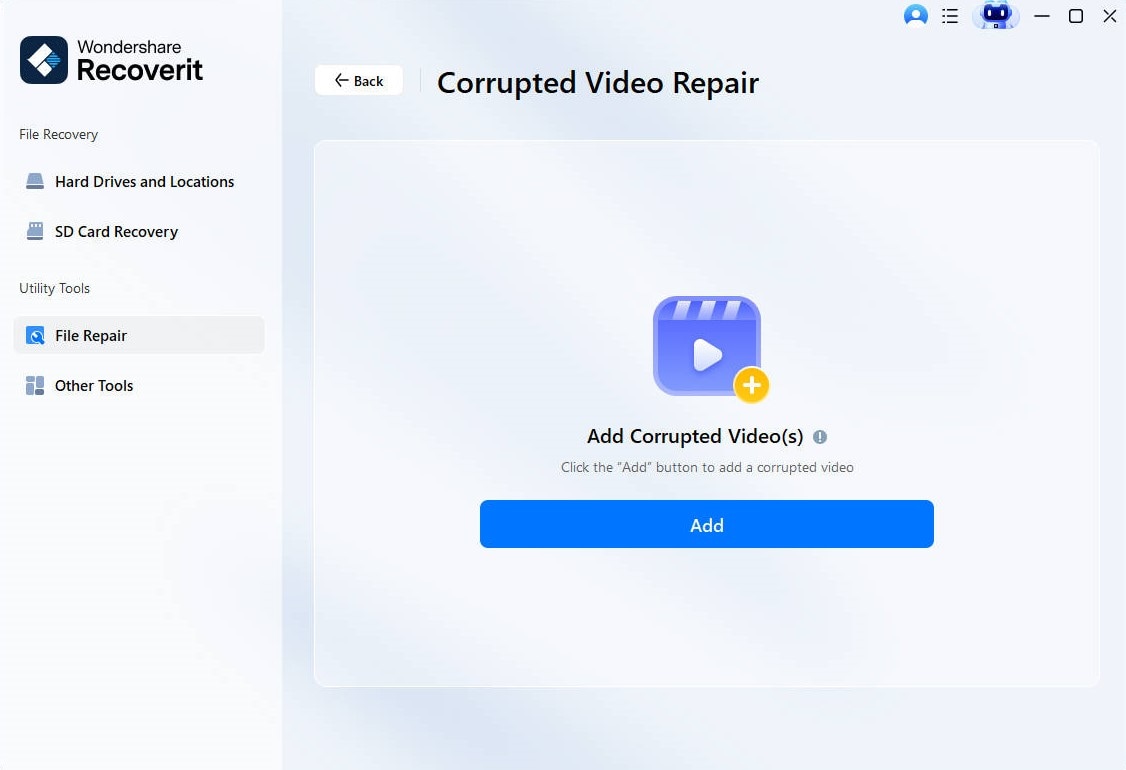
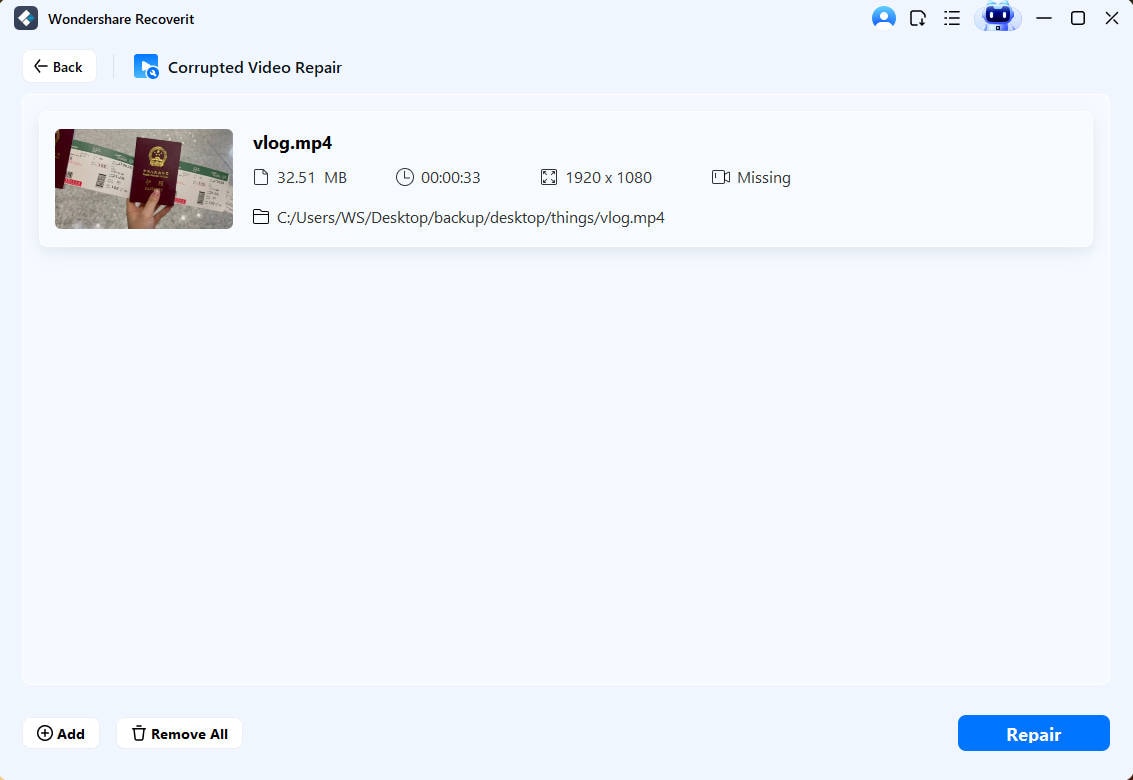
- Click Repair and wait for the standard repair to finish.
- Preview the repaired clip inside Recoverit.
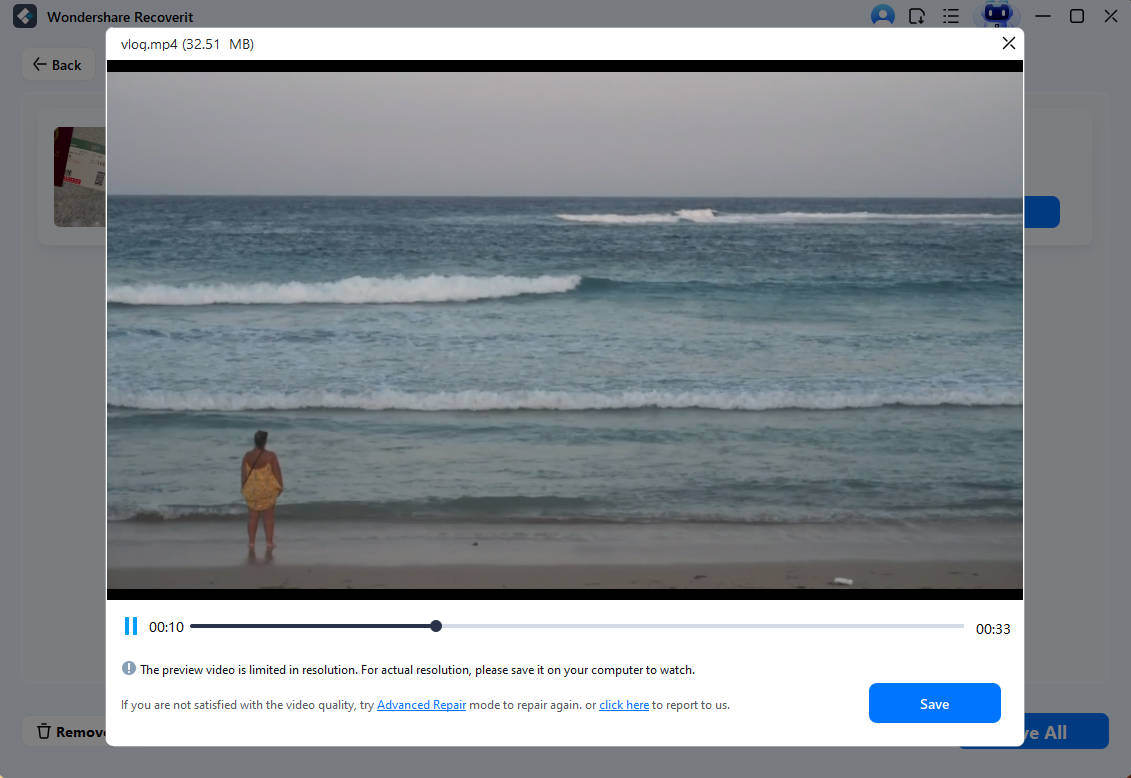
- Click Save All and store the result on the Mac, not back to the same microSD card.
- If the standard repair is not enough, use Advanced Repair with a healthy sample recorded on the same GoPro, in the same format and settings.
Method 2. Inspect the File in QuickTime Player and Test It in VLC
VLC is a playback test, not a repair tool. VideoLAN says it plays most multimedia files and codecs without extra codec packs. Use QuickTime Player to read the format, then use VLC to see whether the same .mp4 is healthy.
- Copy the GoPro
.mp4to the Mac internal drive. - Open it in QuickTime Player.
- Choose Window > Show Movie Inspector and check the format, resolution, and frame rate.
- If the file stutters or will not play, open the same
.mp4in VLC. - If it plays in VLC but not in QuickTime Player, convert a healthy
HEVCfile toH.264. Do not treat that result as file corruption.

Method 3. Update macOS and Try GoPro Player
On a Mac, you do not install a separate graphics driver pack to fix GoPro playback. Update macOS first. Apple needs 10.13 or later for HEVC. GoPro Player needs macOS 10.14 Mojave or later, and it expects a graphics card that can decode HEVC.
- On macOS Ventura or later, open System Settings and go to General > Software Update. On an older Mac, open System Preferences and choose Software Update.

- Install any available macOS update, then restart the Mac.
- Open the same GoPro
.mp4in QuickTime Player again. - If it still fails, install GoPro Player from the official GoPro site and test the file there.
- If Movie Inspector shows
HEVCand playback stays heavy, move to anH.264export.
HEVC, H.264, Apple ProRes, and CineForm. A Hero camera original is still an MP4. Use Player when you need GoPro's own decoder, not because the camera recorded CineForm.Method 4. Copy the Video to the Mac Internal Drive and Free Storage
A 4K GoPro MP4 can stutter when it is played straight from a slow microSD card, USB reader, or a nearly full disk. Copy the original to the Mac internal drive before you decide the file is bad.
- Eject the GoPro card only after the copy finishes.
- Copy the
.mp4into a folder on the Mac internal storage. - Confirm the copied file size matches the original on the card.
- Close other heavy apps, then play the local copy in QuickTime Player and VLC.
- If the disk is nearly full, free space and test the local copy again.
Method 5. Convert GoPro HEVC Video to H.264 on Mac
If the file is healthy but 4K HEVC is too heavy, convert it to H.264. Apple documents two built-in paths in QuickTime Player and Finder. HandBrake is a third option when you want more encoder control.
Use QuickTime Player:
- Open the GoPro
.mp4in QuickTime Player. - Choose File > Export As and pick a resolution such as 4K or 1080p.
- Change Smaller File Size (
HEVC) to Greater Compatibility (H.264). If you see anHEVCcheckbox, deselect it before saving. - Save the new file and test playback on the Mac.
Use Finder or HandBrake:
- In Finder, Control-click the video and choose Services > Encode Selected Video Files, then pick an
H.264setting. - Or open HandBrake, choose Open Source, import the GoPro
.mp4, set the video encoder to H.264, keep the frame rate the same as the source, then start the encode.
Method 6. Open the Original MP4, Not the LRV Proxy
Open GoPro says the camera always writes two video files: a full-resolution .mp4 and a low-resolution .lrv proxy. Both sit in the same folder, with a .thm thumbnail beside them. If you open the proxy, the clip can look soft, play more easily, or appear to be the wrong file.
- Open the GoPro media folder on the card or in the copied folder.
- Find the matching
.mp4,.lrv, and.thmfiles. - Play the
.mp4when you want the original 4K footage. - Use the
.lrvonly as a smaller proxy. Open GoPro notes that you can rename.lrvto.mp4if you need to play the proxy itself.
.lrv is still the low-resolution proxy. It is not a repaired 4K original.Related Videos on How to Fix Videos Not Playing in VLC Media Player
Conclusion
GoPro Hero 4K videos that will not play on a Mac usually come down to HEVC support, a slow source drive, the wrong file in the folder, or a damaged MP4. Apple needs macOS 10.13 or later for HEVC. GoPro Player needs macOS 10.14 and an HEVC-capable GPU. Start with the original .mp4, test QuickTime Player and VLC, then convert a healthy clip to H.264.
If the same file fails in every player, repair that damaged copy with Recoverit Video Repair. Recoverit can help when the MP4 itself is broken. It does not replace a macOS update or an H.264 conversion.
FAQ
-
1. Why is my Mac not reading my GoPro?
Your Mac may not read your GoPro due to unsupported HEVC or CineForm codecs, outdated software, inadequate storage, improper connection, or issues with the SD card. -
2. How do I fix a corrupted GoPro video?
To fix a corrupted GoPro video, install Wondershare Recoverit. Open the software, choose “Recover Video, Audio and Photograph,” scan your storage device, and select the corrupted files. Recoverit repairs and restores corrupted GoPro videos efficiently and quickly. -
3. What is the video format of GoPro?
GoPro cameras typically record videos in HEVC (High Efficiency Video Coding) format for both lower and higher resolutions. While not all devices support HEVC, converting it to H.264 improves compatibility without sacrificing video quality.


