

 TL;DR:
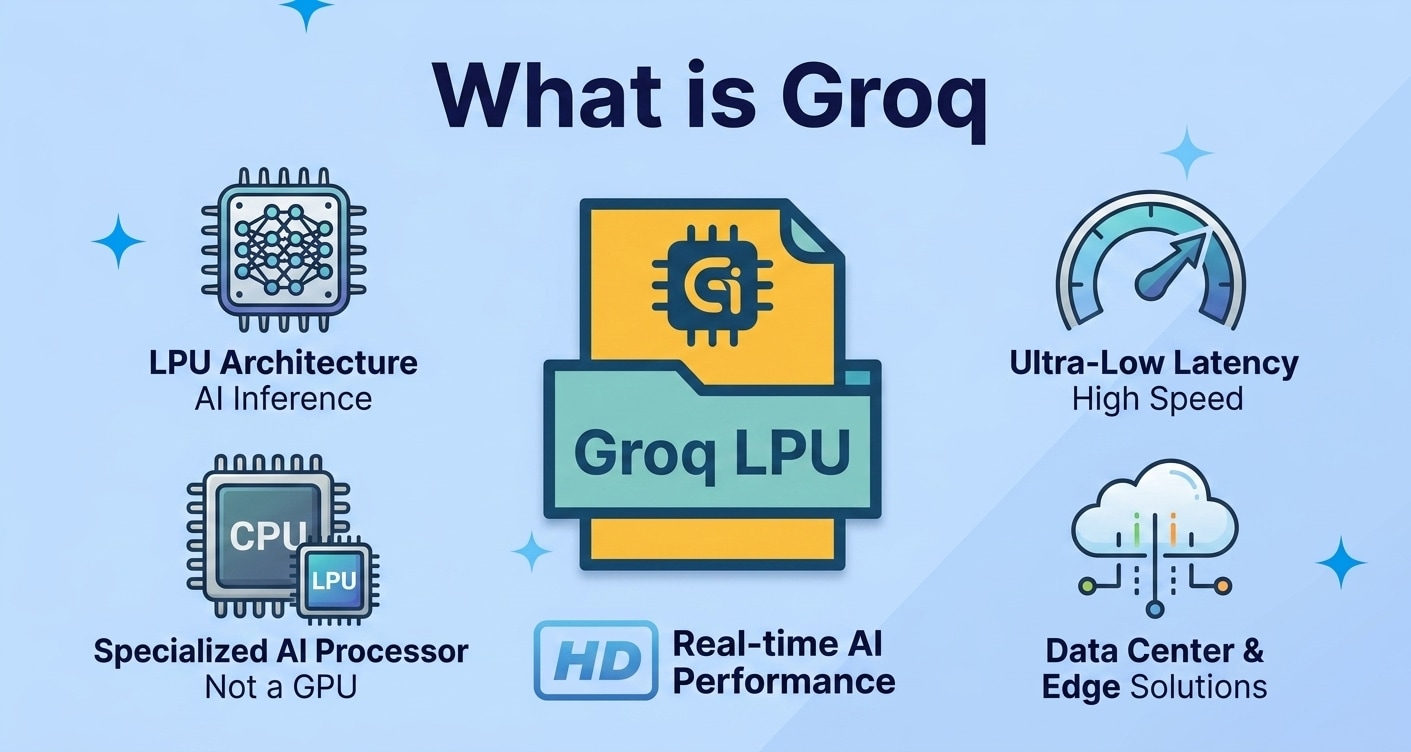
Groq is an AI infrastructure platform that utilizes a custom Language Processing Unit (LPU) architecture to execute trained AI models—particularly Large Language Models (LLMs)—with significantly faster token generation and more predictable latency than traditional general-purpose GPUs.
● Models must first be trained on standard hardware using frameworks like PyTorch or TensorFlow, then exported and compiled via Groq's software stack for deployment on physical Groq hardware or Groq Cloud APIs.
● Unlike GPUs adapted for mixed workloads and model training, the Groq LPU is strictly optimized for deterministic inference, making it highly effective for real-time applications with strict latency SLAs but unsuitable for heavy training loops or continuous architectural experimentation.
● To maximize tokens-per-second performance on Groq systems, developers should deploy right-sized distilled or quantized models, group multiple prompts into batch requests, and implement streaming outputs.
Ask AI for a summary
 ChatGPT
 Perplexity
 Gemini
 Claude
 Grok
Grok
Groq is a specialized AI hardware and software company focused on ultra-fast inference, using a unique Groq LPU (Language Processing Unit) architecture instead of traditional GPUs. Designed to process massive numbers of tokens per second with predictable latency, Groq AI aims to make large language models and real-time AI applications more efficient and responsive. Whether you are building AI chatbots, complex data pipelines, or research prototypes, understanding what Groq is and how it works helps you choose the right infrastructure for speed, cost, and scalability.
This guide explains what Groq is in simple terms, how its LPU-based AI accelerator works, where it fits compared with GPUs, and practical tips for developers. You will also learn how to protect and recover important Groq-related project files with Wondershare Recoverit if they are accidentally deleted or lost.
Try Recoverit to Perform Data Recovery
 Security Verified. 3,591,664 people have downloaded it.
In this article
What Is Groq
Groq is an AI infrastructure company that designs chips, systems, and software specifically for running AI models at very high speed. Instead of general-purpose GPUs, Groq uses its own Groq chip based on a Language Processing Unit architecture optimized for deterministic, massively parallel compute.
While GPUs were originally made for graphics and later adapted for AI, the Groq AI stack is built from the ground up to accelerate inference: the stage where a trained model answers questions, generates text, or analyzes data. This makes Groq especially attractive for:
- Large language models (LLMs) that need to generate thousands of tokens per second
- Real-time chatbots, copilots, and interactive tools that need very low latency
- Streaming analytics and decision systems that must respond predictably
- Cost-sensitive workloads where throughput per dollar really matters
In simple terms, Groq is like a race-tuned engine for AI inference: it focuses less on training models and more on running them extremely fast and predictably once they are trained.
How Does Groq Work
Groq works by combining custom hardware with a software stack tuned for deterministic performance. The heart of the system is the Groq LPU, which organizes compute in a way that avoids many of the scheduling and memory bottlenecks common on GPUs.
Three ideas explain how Groq achieves high AI inference speed and consistent latency:
- Deterministic execution: Workloads are scheduled so that model execution is highly predictable. This reduces jitter and makes response times more consistent, which is crucial for user-facing LLM applications.
- On-chip dataflow optimization: The architecture is designed so data moves through the chip in a controlled pipeline, minimizing costly off-chip memory access. This improves both speed and energy efficiency.
- Massive parallelism for tokens: Instead of only focusing on matrix math like a GPU, Groq structures computation so many tokens can be processed in parallel, translating directly into higher tokens-per-second.
The result is that a single Groq system can often outperform a comparable GPU setup on pure inference throughput, especially for transformer-based language models.
| Aspect | Groq vs GPU for AI inference |
|---|---|
| Architecture focus | Groq LPU is dedicated to deterministic, high-throughput inference; GPUs are general-purpose accelerators adapted from graphics workloads. |
| Latency behavior | Groq prioritizes stable, predictable latency; GPU-based systems can vary more under mixed or bursty workloads. |
From a developer perspective, you typically:
- Train or obtain a model using familiar frameworks like PyTorch or TensorFlow.
- Export or convert the model into a format Groq supports.
- Deploy the model on Groq hardware or Groq Cloud and integrate it via APIs.
What are the Types of Groq
When people talk about Groq, they can mean several related pieces: physical hardware accelerators, integrated systems, and Groq-hosted cloud services with a developer-friendly API layer. Understanding these categories helps you choose the right deployment model.
Groq hardware accelerators
At the hardware level, Groq provides chips and systems that implement the Groq LPU architecture. While specific product names and generations evolve, they typically share a few traits:
- Inference-first design: Groq hardware is engineered for running already-trained models at high speed, not primarily for training very large models from scratch.
- High token throughput: Systems are measured in tokens per second for LLMs, making it easy to compare real-world performance.
- Deterministic scaling: As you add more Groq accelerators, performance scaling tends to be more predictable than some GPU clusters with complex scheduling layers.
Organizations can deploy these accelerators in their own data centers or edge environments when they need on-premises control, compliance, or tight integration with existing infrastructure.
Groq software and cloud services
Beyond hardware, Groq AI is accessible through software and cloud offerings that hide some of the complexity of the underlying chips.
- Groq runtime and compiler stack: Tools that convert models into an optimized representation for the Groq LPU, handling graph transformations, memory layout, and scheduling.
- Groq Cloud APIs: Hosted services where you can send prompts or inputs to models running on Groq infrastructure, paying per usage instead of managing hardware yourself.
- Integrations with AI frameworks: Bridges and tooling that help you export models from popular ML frameworks with minimal code changes.
This software layer is what allows developers to treat Groq as an AI accelerator in their stack, similar to calling an LLM API, but tuned for high throughput and predictable latency.
Practical Tips for Groq
To get the best out of Groq performance for your AI workloads, focus on model selection, batching strategy, and observability. These factors strongly influence the latency and throughput you will see in production.
Choosing the right workloads for Groq
Groq AI shines in specific scenarios. You will generally see the largest benefits when:
- Your application is dominated by inference (LLMs, ranking models, recommendation systems).
- You need to serve many concurrent users with strict latency SLAs.
- Your cost is driven by tokens generated or queries served, not just raw GPU hours.
- You already have trained models and want to scale them efficiently.
Groq is less focused on heavy training loops or experimentation that requires constant architecture changes; those may still be done on GPUs or other training-oriented hardware, then exported to Groq for serving.
Optimizing models and requests for Groq
Even on high-speed hardware, how you structure your models and requests matters:
- Right-size models: Use models that match your latency and quality requirements. Smaller distilled or quantized models often perform extremely well on Groq while saving cost.
- Batch requests when possible: Group multiple prompts into a single batch to leverage parallelism. This can dramatically improve tokens-per-second in high-traffic systems.
- Stream output: For chatbots and copilots, use streaming responses so users see tokens as they are generated, improving perceived responsiveness.
- Monitor real performance: Track latency percentiles, throughput, and error rates. Adjust batch sizes and model settings in response to real traffic patterns.
Finally, always safeguard your code, configs, and test datasets. If a local disk or external SSD fails or files are deleted, a professional data recovery solution like Wondershare Recoverit can help restore your Groq-related work.
How to Use Recoverit to Recover Lost Data
Wondershare Recoverit is a professional data recovery tool that helps you restore lost or deleted files from computers, external drives, memory cards, and more. Whether you lose Groq-related source code, AI model assets, documentation, or test datasets, Recoverit offers an intuitive interface and advanced scanning to bring important data back. You can learn more and download the software directly from the Recoverit official website.
Key Features Offered by Recoverit
- Recovers documents, code files, images, videos, and archives from multiple storage devices, including HDDs, SSDs, USB drives, and memory cards.
- Supports quick scan and deep scan modes so you can balance speed and thoroughness when restoring Groq project files.
- Offers built-in file preview, allowing you to verify recovered code, configs, and datasets before performing the final restore.
Step-by-Step Guide on How To Recover Lost Data
1. Choose a Location to Recover Data
Launch Recoverit and select the exact drive or folder where you stored your Groq projects, such as the system disk, a secondary SSD, or an external NVMe enclosure. Confirm the target so the program can focus the recovery process on the area most likely to contain your missing code, configs, and datasets.

2. Deep Scan the Location
Start the scan and let Recoverit examine the selected location sector by sector. During the deep scan, the software will progressively list found files, so you can filter by file type (for example .py, .ipynb, .json, .csv, .ckpt) or search by name to quickly locate lost Groq-related assets such as deployment scripts or model binaries.

3. Preview and Recover Your Desired Data
When the scan finishes, preview important files like source code, documentation, and configuration files to verify their integrity. Select the items you want to restore and click Recover, then save them to a different safe location, such as another partition or external drive, to avoid overwriting any remaining recoverable data.

Conclusion
Groq introduces a specialized, deterministic approach to AI acceleration that focuses on extremely fast, low-latency inference. By replacing the traditional Groq vs GPU model with its own LPU architecture, Groq aims to power responsive language applications, real-time analytics, and scalable AI services with high tokens-per-second performance.
As you experiment with Groq AI-powered workloads, keeping your code, configuration, and datasets safe is essential. If files are mistakenly deleted, corrupted, or lost due to disk issues, Wondershare Recoverit gives you a reliable way to scan affected drives and restore critical AI project data so you can resume work quickly and with minimal disruption.
Next: Kimi
FAQ
-
What is Groq in simple terms?
Groq is a company that builds ultra-fast AI inference hardware and software using a custom Language Processing Unit architecture. Instead of relying on traditional GPUs, it focuses on running trained models, especially language models, with very high tokens-per-second and predictable latency. -
How is Groq different from GPUs for AI?
GPUs are general-purpose accelerators originally designed for graphics, later adapted for both AI training and inference. Groq, by contrast, is purpose-built for deterministic, high-throughput inference. Its architecture is optimized for predictable latency and efficient token processing rather than broad graphics and compute workloads. -
What are common use cases for Groq?
Typical Groq use cases include high-speed LLM serving for chatbots and copilots, real-time language translation, low-latency recommendation systems, streaming analytics, and financial modeling where fast, consistent response times are critical. -
Can I use Groq with existing AI frameworks?
Yes. You usually train models in popular frameworks such as PyTorch or TensorFlow, then export or convert them to formats that Groq's software stack supports. Groq provides tooling and integration layers so you can deploy many existing models without rewriting them from scratch. -
How can I recover lost Groq project files with Recoverit?
If your Groq-related code, configs, or datasets are deleted or corrupted, install Wondershare Recoverit on a different drive, select the disk or folder where the projects were stored, and run a deep scan. Once the scan completes, preview the found files and recover the ones you need to a safe location to avoid overwriting remaining recoverable data.


