


 TL;DR:
You can fix a logically corrupted SD card without formatting by resolving connection issues or running OS-level repair utilities, but you must recover your files to a separate drive first because tools like Windows CHKDSK and macOS First Aid modify file-system metadata and risk permanent data loss.
● Rule out hardware false alarms before software troubleshooting by testing a different known-good card reader, using a direct USB port, and verifying the physical lock switch on the SD card or adapter is in the unlocked position.
● Avoid using the DiskPart recover command to fix the card, as Microsoft explicitly restricts this function to resynchronizing dynamic disk groups or RAID volumes and it takes no action on basic removable storage.
● Android devices lack universal no-format repair features for portable storage, meaning you must connect the SD card to a computer to run non-destructive file-system repairs and bypass the phone's mandatory format prompt.
Ask AI for a summary
 ChatGPT
 Perplexity
 Gemini
 Claude
 Grok
Grok
Yes, a corrupted SD card can sometimes be fixed without formatting when the problem is logical, the card is still detectable, and the storage hardware is stable. The safest order is not to jump straight to CHKDSK or another repair tool. First stop writing to the card, rule out the reader or port, copy any files you can still open, and recover inaccessible files to another drive. Only then should you use repair tools that can change file-system metadata.
⚡ TL;DR: Fix a Corrupted SD Card Without Formatting
● Stop writes first: cancel any format prompt and do not take new photos, record video, copy files to the card, or run repair commands yet.
● Rule out the connection: test another reader, USB port, and computer before assuming the SD card itself is corrupted.
● Protect the files: copy readable files immediately; if files are missing or inaccessible but the card is detected, recover them to a different healthy drive before repair.
● Repair only after data is safe: use drive-letter or driver fixes first, then CHKDSK on Windows or First Aid on Mac. Android offers fewer universal no-format repair controls.
In This Article
Part 1. Can You Fix a Corrupted SD Card Without Formatting?
Sometimes. "Corrupted" can describe several very different failures: a bad card reader, a missing drive letter, a damaged file system, a stale driver, an Android storage mismatch, or a physically failing card. A no-format fix is realistic only when the underlying problem can be corrected without creating a new file system.
The most important distinction is between access repair and file-system repair. Changing a reader, USB port, drive letter, or card-reader driver does not intentionally rewrite the SD card's file system. By contrast, Windows CHKDSK with repair parameters and macOS Disk Utility First Aid can change file-system metadata while fixing errors. That is why important files should be copied or recovered before those tools are used.
If your main symptom is a Windows message that the card must be formatted, use the dedicated SD card needs to be formatted guide. If Windows shows the file system as RAW, the RAW SD card guide owns that more specific troubleshooting path.
What "Without Formatting" Really Means
Fixing an SD card without formatting means keeping the existing file system instead of creating a new one. It does not mean every repair is read-only or risk-free. For example, Microsoft states that CHKDSK without repair parameters reports the volume status, while /f, /r, and related repair options fix errors and can write changes. Microsoft also warns that repairs on FAT file systems can change the file allocation table and may sometimes cause data loss. See the current Microsoft CHKDSK documentation.
This leads to a simple rule: if the files matter more than the card, protect the files before repairing the card. If the card is cracked, scorched, unusually hot, repeatedly disconnects, reports wildly incorrect capacity, or is not detected by any known-good reader, stop software troubleshooting. Those symptoms are more consistent with a hardware or controller problem than an ordinary file-system error.
Choose the Safest Fix by Symptom
| What You See | Likely Layer | Safest Next Step | Does It Modify the Card? |
| The card works in another reader or computer | Reader, adapter, USB port, or host | Replace the failing connection hardware | No |
| Disk Management sees the volume, but File Explorer does not | Windows mount or drive-letter issue | Assign or change the drive letter | Does not reformat the file system |
| The card opens, but some files are missing or inaccessible | Logical file or file-system damage | Copy what opens; recover missing files before repair | Recovery scan should not save to the source |
| Windows shows RAW or repeatedly asks to format | Unrecognized or damaged file system | Recover files first, then attempt repair | Repair tools can modify metadata |
| The card is visible after a Windows update but the reader fails | Reader driver or host issue | Update or reinstall the reader driver | No direct SD file-system change |
| The card disconnects, becomes hot, shows no media, or is invisible everywhere | Possible hardware, controller, or severe connection failure | Stop repeated DIY attempts; consider professional recovery for critical data | No repair should be attempted |
Part 2. Protect Your Files Before Any SD Card Repair
Before changing anything on the card, decide whether your priority is the files or the card itself. A replacement SD card is inexpensive compared with irreplaceable photos, project files, or camera footage. If files are accessible, copy them first. If they are not accessible but the operating system still detects the card, data recovery should come before repair.
Copy Files If the Card Still Opens
If File Explorer or Finder can still open the card, create a folder on the computer or another healthy external drive and copy the important files there. Start with unique files that do not exist anywhere else. Avoid renaming, moving, reorganizing, deleting, or editing files on the SD card while making the backup because those actions create extra writes.
After copying, open a representative set of files from the destination: several photos, a long video, a document, and files from different folders. Do not assume a successful copy dialog means every file is usable. If the card freezes during copying, disconnects repeatedly, or becomes unusually hot, stop. Repeated reads can be a poor choice for unstable hardware.
Recover Inaccessible Files Before Repair
If the card is detected by Windows or macOS but folders are missing, files cannot be opened, or the volume is logically damaged, Wondershare Recoverit Memory Card Recovery can be used to scan a detectable SD or microSD card before you run write-based repair tools. No recovery software can guarantee files that have already been overwritten, and software recovery is not a substitute for a professional lab when the card is physically failing.

Step 1. Connect the card with a stable reader and select it.
Launch Recoverit, open the SD Card Recovery workflow, and confirm the card identity and capacity before scanning. If the wrong capacity is shown or the card repeatedly disappears, stop rather than forcing repeated scans.
Step 2. Scan the SD card for inaccessible or missing files.
Start the scan and let the results populate. Use file type, path, date, size, or search filters when available so you can focus on the files that matter.
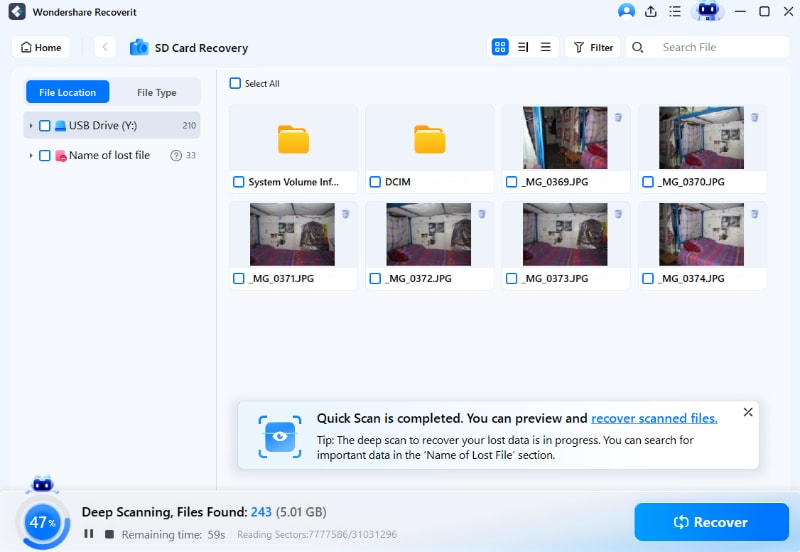
Step 3. Preview representative files before recovery.
Preview photos, documents, and supported media where possible. A usable preview is stronger evidence than a filename alone, although it still cannot guarantee that every byte of every recovered file is intact.

Step 4. Recover the files to a different healthy drive.
Choose the computer's internal drive or another healthy external drive as the destination. Do not save recovered files back to the corrupted SD card because those writes can overwrite other recoverable data.
If the card is readable but you need a more detailed recovery-only workflow, use the dedicated corrupted SD card data recovery guide. Recovery retrieves files; it does not make a failing card trustworthy again.
Recover Inaccessible Files Before Repair
 Security Verified. Over 7,302,189 people have downloaded it.
Part 3. Fix a Corrupted SD Card Without Formatting on Windows
Use the following Windows methods from least invasive to more invasive. Stop as soon as the card becomes stable and accessible. If you have not yet copied or recovered important files, do not skip ahead to CHKDSK or Error Checking.
Method 1. Test Another Reader, USB Port, and Computer
A failing reader, microSD-to-SD adapter, loose USB connection, or host port can make a healthy card appear corrupted. This is the lowest-risk place to start because it does not intentionally change the card.
- Safely disconnect the card from the current reader.
- Insert it into another known-good reader or adapter.
- Try a different USB port. Avoid an unpowered hub when possible.
- Test the same reader and card on another computer.
- If the card works normally in the second setup, replace the failing reader, adapter, cable, or port instead of repairing the SD card.

If the card suddenly stopped working and you need a deeper card-versus-reader diagnosis, use the SD card suddenly stopped working guide.
Method 2. Unlock the SD Card or Adapter
A full-size SD card or microSD-to-SD adapter can have a physical lock switch. If the reader respects that switch and it is in the locked position, Windows may allow reading but block writes. That is a write-protection problem, not proof of file-system corruption.
- Safely eject the card and remove it from the reader.
- Locate the small lock switch on the side of the full-size SD card or adapter.
- Move it to the unlocked position, then reinsert the card.
- If the card remains read-only, copy or recover important files instead of repeatedly forcing write access.

The SD Association also advises checking the write-protect switch before formatting an SD card. Its current SD Memory Card Formatter FAQ is useful when you later decide to reformat a card after the files are safe.
Method 3. Assign a Drive Letter in Disk Management
If Windows detects the volume in Disk Management but it has no usable drive letter, File Explorer may not present it normally. Microsoft documents Disk Management as the built-in Windows tool for managing volumes and changing drive letters. This is an access fix; it does not recreate the file system.
Step 1. Right-click the Start button and choose "Disk Management".
Step 2. Find the SD card by capacity and removable-media context. Be careful not to select an internal drive.
Step 3. Right-click the SD card volume and choose "Change Drive Letter and Paths".
Step 4. Select "Add" if there is no drive letter, or "Change" if the current letter conflicts with another device. Choose an unused letter and confirm.

Microsoft's current Disk Management guidance for Windows 11 and Windows 10 confirms that drive-letter changes are a normal volume-management function. If the volume itself is RAW, unallocated, or asking to be formatted, changing the letter alone will not repair the damaged file system.
Method 4. Update or Reinstall the Card Reader Driver
Use this method when the SD card works on another computer, when the built-in reader fails with multiple known-good cards, or when Device Manager reports a problem with the reader. Updating a host-device driver does not repair file-system corruption on the card, but it can restore communication between Windows and the reader.
Step 1. Right-click Start and open "Device Manager".
Step 2. Expand the relevant reader category, such as Disk drives, Memory technology devices, or USB controllers, depending on the hardware.
Step 3. Right-click the reader and choose "Update driver". Windows Update or the computer/card-reader manufacturer should be the preferred source for the current driver.
Step 4. If the reader driver is clearly malfunctioning, uninstall that device and use "Action > Scan for hardware changes" or restart Windows so the device can be detected again.

Microsoft documents both updating and reinstalling malfunctioning device drivers through Device Manager. A driver fix is appropriate for the reader or host, not as a claim that the SD card's file system has been repaired.
Method 5. Run CHKDSK Only After the Files Are Safe
CHKDSK can check a file system and file-system metadata for errors. However, the command behaves differently depending on its parameters. According to Microsoft, running CHKDSK without parameters reports status and does not fix errors, while /f performs repairs. The /r option includes repair behavior and also looks for bad sectors and readable information. Because repair can alter file-system structures, this should be a post-backup or post-recovery step.
Step 1. Check the card without repair first.
Open Windows Terminal or Command Prompt as administrator and enter the card's correct drive letter:
chkdsk X:
Replace X: with the SD card's drive letter. Read the report before deciding whether to proceed.
Step 2. If important files are already safe and CHKDSK reports repairable errors, run:
chkdsk X: /f

Do not describe CHKDSK as a guaranteed no-data-loss fix. Microsoft specifically notes that repairs on FAT file systems usually change the file allocation table and may sometimes cause loss of data. For a deeper explanation of parameters and failure messages, see the dedicated CHKDSK SD card guide.
When CHKDSK is not the right next step: if the card is repeatedly disconnecting, shows "No Media," reports an obviously wrong capacity, is physically damaged, or is not detected by the operating system, CHKDSK does not have a stable volume to repair. Stop repeated attempts if the files are important.
Part 4. Repair an SD Card on Mac Without Formatting
Run Disk Utility First Aid After Protecting Files
On macOS, Disk Utility First Aid checks and repairs errors related to a storage device's formatting and directory structure. Apple explicitly recommends having a current backup before using First Aid and notes that Disk Utility cannot repair every disk problem. That makes the same safety rule apply on Mac: recover or copy important files first, then repair.
Step 1. Connect the SD card through a reliable reader and open "Disk Utility" from Applications > Utilities.
Step 2. Choose "View > Show All Devices" so you can see the device hierarchy.
Step 3. Select the SD card volume in the sidebar, click "First Aid", and then click "Run".
Step 4. Follow the onscreen result. If First Aid reports the card cannot be repaired, do not immediately erase it if important files have not been recovered.

Apple's current Disk Utility repair guidance explains the volume-to-device repair sequence and advises reformatting only when repair fails and the data has already been backed up. If the card is absent from Disk Utility entirely, first rule out the reader, connection, and hardware before treating it as a file-system issue.
Part 5. Fix a Corrupted Android SD Card Without a Computer
Android users often search for an "SD card corrupted Android fix without formatting," but the safe options on the phone are narrower than on Windows or Mac. There is no single Android-wide file-system repair button that works across all phone brands and Android builds. The low-risk goal on the phone is therefore to stop writes, verify whether the card is portable or adopted/internal storage, and copy accessible files before doing anything destructive.
What You Can Safely Do on Android
- Stop using the card. Do not record new photos or videos, move apps, or download files to the card.
- Power the phone off before reseating a removable microSD card. Reinsert it carefully and restart the phone once.
- If the card is portable storage, test it in another compatible phone or an OTG card reader. If it becomes readable, copy important files immediately.
- Check whether the files already exist in cloud or computer backups. Restoring an existing copy is safer than repairing the only source.
- Decline a format prompt while files still matter. Formatting is a data-erasing setup action, not a recovery step.
Google's current Android guidance distinguishes portable storage, which can move between devices, from internal/adopted storage, which cannot simply be transferred to another device for normal use. Google also warns that formatting permanently deletes the card's data. See Google's Android SD card guidance.
When You Need a Computer or a Different Recovery Path
If an Android phone can detect the card but only offers Format, or files remain inaccessible, a computer provides better options for checking the reader, copying files, running recovery software, and only then attempting file-system repair. If the microSD card was configured as internal/adopted storage, do not assume another phone or a PC can read its contents normally; that storage mode is tied to the original device workflow.
For phone-specific branches, OTG testing, portable versus adopted storage, and Android UI differences, use the dedicated corrupted SD card on Android guide. Keeping those steps separate prevents this page from mixing a general no-format repair intent with brand- and phone-specific instructions.
Part 6. Methods to Avoid Before Your Data Is Safe
Do Not Use DiskPart Recover as an SD Card Repair
The older version of this article used the DiskPart recover command as if it could repair an ordinary corrupted SD card. That is not what Microsoft's DiskPart recover command does. Microsoft states that the command refreshes and recovers dynamic disk groups and resynchronizes mirrored or RAID-5 volumes. If used on a group with a basic disk, it can return no error while taking no action.
In other words, diskpart followed by recover is not a normal SD-card file-system repair workflow. See Microsoft's DiskPart recover documentation.
Do Not Clean, Initialize, or Format the Card Early
Commands and tools that create or replace storage structures can make later recovery harder. Avoid these actions until important files have been copied or recovered:
- DiskPart clean: removes partition information and is not a first-line repair for a card that contains needed files.
- Initialize disk: is for preparing storage structures, not recovering files from a corrupted card.
- Format in File Explorer or Disk Management: creates a new file system. Microsoft warns that formatting a volume destroys data on that partition.
- Repeated format attempts: add no value while the recovery decision is still unresolved.
If Windows refuses to format the card after your files are safe, use the dedicated Windows unable to complete the format guide instead of adding more destructive commands here.
Part 7. Verify the Repair and Decide Whether to Reuse the Card
A repair is not complete just because the card mounts once. Verify the result before trusting it again:
- Safely eject and reconnect the card once.
- Open files from several folders and different dates.
- After the backup is secure, copy a small non-critical test file to the card and read it back.
- Check whether the card keeps the correct capacity and remains connected during normal reads.
- If corruption, disconnects, I/O errors, or read-only behavior returns, retire the card rather than using it for unique data.
If the files are safe but the card still needs a clean file system, formatting may now be appropriate. The SD Association's SD Memory Card Formatter is designed for SD, SDHC, SDXC, and SDUC cards and is currently available for Windows and Mac. The SD Association recommends its formatter over generic operating-system formatters for SD cards. Formatting is a final reuse step, not a recovery step.
Even after a successful logical repair, do not use a previously unstable card as the only copy of important data. Keep a second copy on a computer, external drive, NAS, or approved cloud backup.
Conclusion
The safest way to fix a corrupted SD card without formatting is to separate data protection from card repair. Start with the reader, port, and detection layer. Copy files that still open. Recover inaccessible files to another drive if the card remains detectable. Only after the data is safe should you change a drive letter, repair a reader driver, run CHKDSK, or use Disk Utility First Aid. If the card is physically unstable or disappears from every known-good reader, stop software repair and consider professional recovery for irreplaceable data.
FAQ
-
Can a corrupted SD card be fixed without formatting?
Yes, when the problem is a reader, mount, driver, write-protection, or repairable logical file-system issue. First protect the files. Some no-format repair tools still modify file-system metadata, so "without formatting" does not mean "without write risk." -
Will CHKDSK delete files from an SD card?
CHKDSK without repair parameters reports status, but repair options such as/fchange file-system structures. Microsoft notes that FAT repairs can sometimes cause data loss. Copy or recover important files before running CHKDSK with repair parameters. -
How do I fix a corrupted SD card on Android without a computer?
Stop writes, power off and reseat the removable card, test it in another compatible phone or OTG reader if it is portable storage, and copy any accessible files. If Android only offers Format or the files remain inaccessible, a computer is usually the safer next step for recovery and file-system repair. -
What should I do if Windows says the SD card must be formatted?
Cancel the format prompt if the files matter. Test another reader, check whether Disk Management detects the card, and recover inaccessible files before any repair or format. A format prompt can reflect an unrecognized file system or logical damage, but it does not by itself prove physical failure. -
Can I fix a RAW SD card without formatting?
Sometimes, but RAW means Windows cannot use the current file system normally. Recover important files first if the card is detectable, then use the dedicated RAW-card workflow. Do not assume CHKDSK will work on every RAW volume. -
Why is my SD card not detected anywhere?
First rule out the reader, adapter, USB port, and another computer. If the card is still absent from every known-good reader or reports "No Media," the problem may be with the card controller or hardware. Software recovery generally needs a detectable source. -
Does DiskPart recover repair a corrupted SD card?
No, not in the way many tutorials imply. Microsoft's DiskPartrecovercommand is for dynamic disk groups and mirrored or RAID-5 states; on a basic disk it can take no action. It is not a general SD-card file-system repair command.


