 TL;DR:
Stop recording on your GoPro immediately and check your GoPro Cloud Trash or computer backups first, because deleted videos can only be recovered from the microSD card if the original data has not been overwritten by new footage.
● If your camera uses the Auto Clear setting, such as on the HERO12 Black, the missing video may have been automatically removed from the card after uploading and can be downloaded directly from the GoPro Quik app or GoPro.com without scanning the SD card.
● To scan a readable SD card, use Recoverit for a visual interface or Windows File Recovery for a free command-line option, ensuring you save all recovered files to a completely separate destination drive to avoid overwriting the source data.
● Prioritize restoring .mp4 and .360 files during your scan, never run CHKDSK or accept operating system format prompts on the card, and remember that retrieved .lrv and .thm files are only low-resolution proxies or thumbnails rather than playable full-resolution replacements.
Ask AI for a summary
 ChatGPT
 Perplexity
 Gemini
 Claude
 Grok
Accidentally deleted a video on your GoPro or formatted its microSD card? Stop recording immediately, turn off the camera, and remove the card. If the video was uploaded to GoPro Cloud, check the media library and Cloud Trash first. Otherwise, connect the original microSD card to a computer through a reliable card reader and scan it for recoverable files. Save every recovered video to a different drive.
Deleted GoPro video recovery may work when the card remains detectable and the missing data has not been overwritten. It cannot recreate video segments that have been overwritten, and a damaged or repeatedly disconnecting card may need a professional recovery service.
In This Article
Part 1. Can Deleted GoPro Videos Be Recovered?
Yes, GoPro video recovery is possible in some deletion, quick-format, and logical card-error cases. The result depends on where the video was stored, what happened afterward, whether the microSD card is readable, and how much original video data remains. These distinctions matter more than the GoPro model name.
| What happened? | Safest next step | What to expect |
| Clip removed from the GoPro camera | Stop using the card; check cloud and imported copies, then scan the card | Recovery may work if blocks were not overwritten |
| Card formatted but not reused | Avoid another format and scan the original card | Some videos may be recovered without original names |
| Clip remains in GoPro Cloud | Download it through GoPro Quik or your account | Already uploaded footage does not need an SD card scan |
| Video disappeared after a completed Auto Upload | Check whether Auto Clear was enabled on your GoPro model, then search the cloud library | Some cameras clear uploaded videos from the card automatically |
| Video deleted from the GoPro cloud library | Look in GoPro.com > Media Library > Trash, if available | Eligible cloud media may be restorable; this is not a camera SD card trash folder |
| GoPro MP4 was imported to a Windows PC, then deleted from the PC | Check that computer's Recycle Bin and backups first | A deleted imported copy may still exist outside the GoPro card |
| MP4 found but will not play | Preserve the file; test a complete copy, then assess repair | Missing video data cannot be recreated by a player alone |
| Card not detected or physically damaged | Stop repeated scans and seek specialist help | DIY software may be unsuitable |
A GoPro typically records its main video on removable microSD storage. Deleting a clip in the camera does not send that file to the Windows Recycle Bin. If you previously copied the clip to a PC and then deleted that computer copy, check the PC's Recycle Bin or backup before scanning the camera card.
On supported models such as the HERO12 Black, Auto Clear can clear SD card media after a completed GoPro cloud upload. For the HERO12 Black, the setting is under Preferences > Auto Upload > Auto Clear; other models may use different menu paths. If the missing clip was cleared after a successful upload, check your actual cloud copy before attempting SD card recovery. GoPro explains the behavior in its HERO12 Black media management guide.
Part 2. Protect the GoPro SD Card Before Recovery
The first few minutes after deletion can determine whether the original recording remains recoverable. New GoPro footage can occupy large amounts of storage, so even one new recording may overwrite useful video data.
- Power off the camera: Do not record a test clip to see whether the GoPro still works.
- Remove and set aside the microSD card: Connect it using a stable reader only when ready to inspect or recover.
- Cancel formatting and repair prompts: Do not initialize the card, run CHKDSK, or use Disk Utility First Aid before protecting the missing files.
- Confirm the reader and device: If the card is not recognized, check the reader and USB port without writing to the card.
- Prepare a separate destination: Have enough free space on a computer or a healthy external drive for recovered GoPro footage.
- Consider imaging unstable cards: When the card is still readable but returns errors, an experienced operator should prioritize a sector-level image rather than repeated full scans.
GoPro documentation describes copying footage to a computer with a microSD card reader and supports cloud upload for eligible devices and subscriptions. The camera manufacturer also cautions that formatting erases media, so an SD card error message is not a reason to format a card that still contains footage you need. See GoPro SD card error guidance.
Part 3. Three Ways to Recover Deleted GoPro Videos
Choose the method according to where a surviving copy could exist. Checking an existing cloud upload avoids unnecessary work on the card; desktop recovery is appropriate when the video was deleted or formatted from a readable microSD card; Windows File Recovery offers a free command-line option for Windows users.
Method 1. Restore Uploaded Clips From GoPro Cloud
Best for: Videos that finished uploading to GoPro Cloud before disappearing from the card, or eligible cloud videos still available in GoPro's Trash. You must use the original GoPro account; a clip that never uploaded cannot be restored from the cloud. Availability and menus depend on the account, subscription, and app version.
Step 1. Sign in with the same GoPro account used for uploading. Open the GoPro Quik app, go to your media library, and select the Cloud view if available.

Step 2. Look for your clip by date or thumbnail. Confirm that the item is actually stored in Cloud rather than only under locally saved App or Phone media.
Step 3. If the full-length video is in the Cloud view, use the available download or save action. Open the downloaded file to confirm it plays, then keep a second copy.
Step 4. Check GoPro Cloud Trash if the uploaded clip was deleted. Sign in to GoPro.com, open Media Library, and choose Trash from the sidebar. If the video is still listed, open its menu and select Restore, then return to the library and download it. This restores an eligible cloud item; GoPro Cloud Trash is not a Recently Deleted folder on the camera's microSD card.
If it fails: Confirm you used the correct GoPro account and that Auto Upload finished. A missing clip may not have reached the cloud, or a cloud item may no longer be available in Trash. In that case, preserve the original microSD card and continue with a local scan if it is still readable.
GoPro documents the GoPro Cloud Trash and Restore steps, as well as its Quik cloud-upload instructions.
Method 2. Recover GoPro Videos From the SD Card With Recoverit
Best for: GoPro videos deleted from a readable microSD card, a card accidentally quick-formatted before new footage was recorded, or a card with a logical file-system issue. If the lost data still exists on supported storage, Recoverit GoPro Recovery can scan the card for candidate files. It cannot recover data already overwritten by new recordings or repair physical card damage.
When cloud media and previously imported copies do not contain the video, a desktop scan is one possible next step. Recoverit's official guide describes choosing SD Card Recovery, scanning the card, previewing supported files, and saving recovered results to a different drive. Preview availability does not guarantee a complete, playable recovered video.
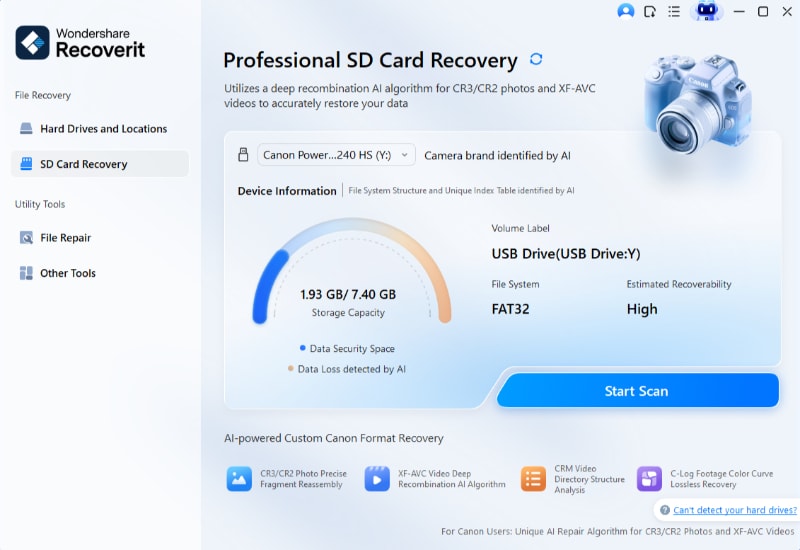
Step 1. Select the GoPro microSD Card
Insert the original GoPro microSD card in a reliable reader, launch Recoverit, and open SD Card Recovery. Select the card by device label and capacity rather than guessing which drive letter is correct. The interface image below illustrates selecting a camera card; the card brand shown may differ from yours.
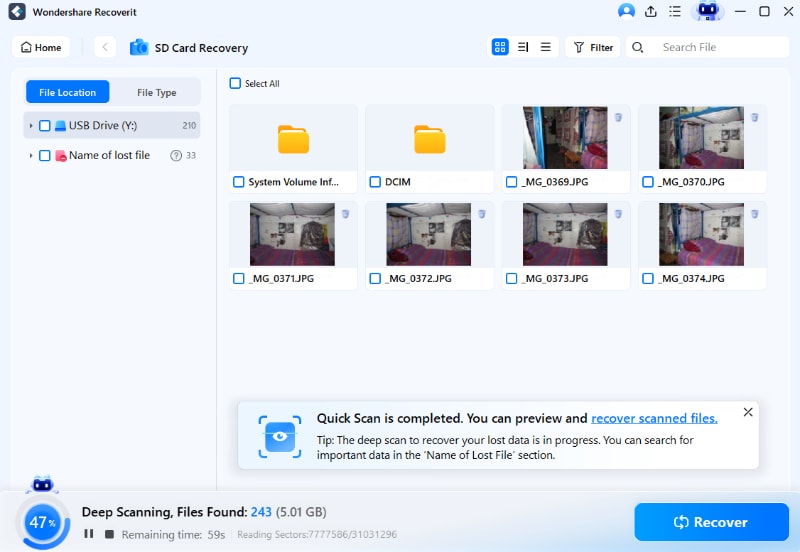
Step 2. Scan the Card Without Writing New Files
Start the scan and let it search for missing files. Keep the connection stable; if the card continually disconnects or generates read errors, stop and assess hardware risk instead of forcing repeated scans.
Step 3. Review GoPro Media Files
Use the available file-type and name filters to look for .mp4 first. For MAX-style 360 recordings, also look for .360 when applicable. Check file sizes and preview supported results when possible. Do not assume an LRV proxy or THM thumbnail is the original full-resolution footage.
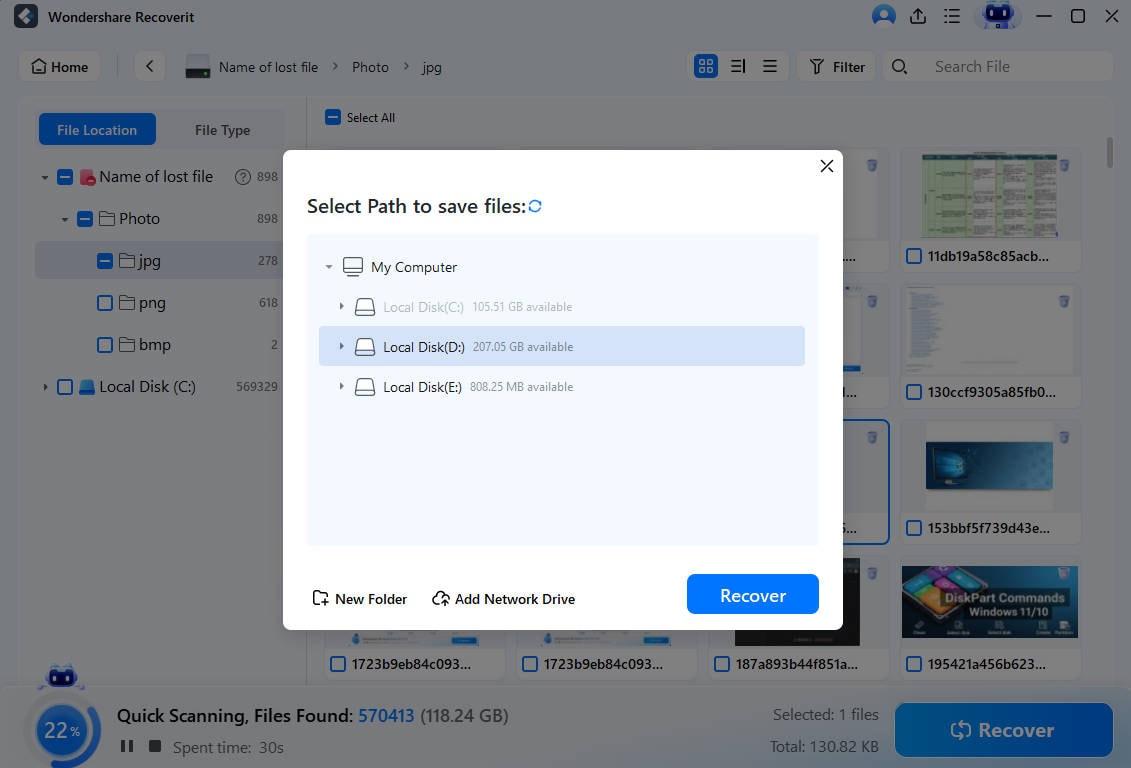
Step 4. Recover the Footage to a Different Drive
Choose the best available full-length clips, click Recover, and save them to your computer or another healthy drive. Never save recovered media onto the original microSD card. The destination selector is shown below.
Verify success: Play each recovered video from beginning to end, check audio and duration, and seek to several points. If a recovered file is incomplete, keep alternate scan results and consult the recovered video playback guide rather than modifying the original card.
Method 3. Use Windows File Recovery for Free
Best for: Windows users comfortable with Command Prompt, when the GoPro microSD card appears as a drive and a different destination drive has adequate free space. Microsoft Windows File Recovery supports FAT and exFAT removable storage through Extensive mode.
Step 1. Install Windows File Recovery from Microsoft. Use the Microsoft Store listing and open the installed application.

Step 2. Connect the GoPro microSD card through a reader and note its drive letter, for example J:. In File Explorer, open the card's Properties to check whether it uses FAT or exFAT. Prepare another drive, such as D:, with enough free space; the source and destination must be different, and a separate physical drive is the safer choice.
Step 3. Run Windows File Recovery with administrator permissions. The pictured command window shows the program and its available options.

Step 4. On a FAT or exFAT GoPro card, use Extensive mode. Replace the example letters with the drives shown on your computer and run winfr J: D: /extensive /n *.mp4 /n *.lrv /n *.thm. If your GoPro created .360 files, you can also try a separate /n *.360 filter. This is a Windows-only command and is not a substitute for recovering severely fragmented recordings.
Step 5. Confirm when prompted. Windows File Recovery creates a recovery folder on the destination drive. Review the results and test playback; filenames, original folder structures, and fragmented clips may not be preserved.
If it fails: Confirm that the source is visible to Windows, both letters point to different drives, and the destination has free space. A failed free scan does not mean every other read-only recovery strategy will succeed. Avoid formatting or repairing the source as a troubleshooting shortcut.
Part 4. Recover MP4, LRV, THM, and 360 GoPro Files
Many GoPro recordings produce more than one related file. During GoPro file recovery, identifying the original footage prevents you from spending time on small preview assets while a full-resolution clip is still missing.
| Extension | Purpose | Recovery priority |
| .mp4 | Main video file for many HERO recordings | Recover first when full-quality footage is needed |
| .lrv | Low-resolution preview proxy | Useful only as a fallback or reference |
| .thm | Thumbnail still image | Not a playable full-resolution video |
| .360 | 360 video media used by certain GoPro MAX workflows | Preserve the original format and use compatible GoPro software |
GoPro's Open GoPro documentation explains MP4, LRV, and THM companion media. If only an .lrv copy survives, duplicate it to a different drive before changing the extension to .mp4 for playback testing; that does not upgrade it into the original high-resolution video. For more detail, see Recover GoPro LRV files.
A recovered MP4 may have the right filename yet remain unplayable because pieces are missing or the container is incomplete. First compare alternative recovery results and keep the source unchanged. Only apply repair software to a copy of a retrieved file. Video repair cannot guarantee reconstruction of bytes that were overwritten or never recorded.
If you lost GoPro JPG photos or GPR RAW files rather than video, follow the separate GoPro photo recovery guide instead of using video-format filters.
Part 5. What to Do When GoPro Recovery Does Not Work
Use the failure symptom to decide whether another software attempt is reasonable. The goal is to protect the remaining footage, not to keep trying destructive quick fixes.
- The SD card is not shown in Recoverit or File Explorer: Check one reliable reader and port. If the card never enumerates or disconnects repeatedly, stop and seek a lab instead of formatting it.
- Windows asks to format the GoPro card: Cancel. This may indicate a logical file-system issue, not proof that the video bytes are gone. Attempt recovery or create an image first.
- Only THM or LRV files appear: Search the full card for MP4 and, when applicable, 360 media. A proxy or thumbnail is not the full-resolution video.
- Recovered MP4 has a size but no playback: Test another player using a recovered copy, inspect the duration and file size, and consider video repair only after preserving all available recovered versions.
- The video disappeared after an automatic cloud upload: On models with Auto Clear, check the finished upload in GoPro Cloud first. If the video was later removed from cloud storage, look in Cloud Trash while it is still available.
- The clip was never backed up and new recordings filled the card: Be prepared for unrecoverable overwritten data. No recovery application can guarantee otherwise.
Important: Windows CMD attrib can change hidden, system, and read-only file attributes; it does not undelete missing GoPro videos. Do not run attrib -h -r -s, CHKDSK, card initialization, or a GoPro format to recover footage. Such operations can write metadata or otherwise modify the source before it has been preserved.
Part 6. How to Prevent Losing GoPro Footage Again
A simple capture-to-backup routine is more effective than relying on a recovery app after every shoot. Use the steps below after the footage has been safely copied and verified; do not reformat a card that still contains missing recordings.
- Use microSD cards approved for your exact GoPro model, with the required capacity and speed class.
- Before deleting files, verify the actual full-length videos on a computer or in your confirmed GoPro Cloud library. On supported models, check the Auto Clear setting and confirm uploads before allowing automatic card cleanup.
- Keep an additional copy on a separate external drive or trusted cloud account.
- Safely eject the card or reader and avoid removing power during recording or transfer.
- When a card begins showing repeated file errors, retire or replace it after backing up important media.
- Only format the card in the camera after verified backups are complete and all necessary recovery has finished.
Conclusion
When a GoPro video disappears, stop recording and protect the microSD card. Check your GoPro Cloud library, Cloud Trash, and any earlier imports; Auto Clear may explain an apparently empty card if an upload finished. For a readable card that still holds missing data, Recoverit offers a desktop scan and Windows File Recovery provides a free command-line alternative. Save recovered results elsewhere and verify playback before reusing the card.
FAQ
-
Can you recover deleted GoPro videos after formatting the SD card?
Sometimes. If the card has not been reused extensively and is still readable, a recovery scan may find video data after a quick format. Avoid formatting again or recording new clips. No method can guarantee files whose data blocks were overwritten. -
Where do deleted GoPro videos go?
Videos deleted in the camera do not enter the Windows Recycle Bin; recoverable data may remain on the microSD card until overwritten. A video previously uploaded to GoPro Cloud may still be in the library or its Trash. An imported video deleted later on a Windows computer may be in that computer's Recycle Bin. -
Can I recover GoPro videos for free?
If you already uploaded the footage, restoring that cloud copy may not require recovery software. Windows File Recovery is a free command-line option for a readable SD card on Windows, but it cannot guarantee complete fragmented videos. -
How can I recover deleted GoPro HERO9, HERO12, or HERO13 videos?
The safe workflow is broadly similar for GoPro models that record to microSD: stop filming, remove the card, check backups, scan a readable card, and restore to a different drive. Follow the exact model manual for its card and cloud features. -
Can LRV files restore my full-resolution GoPro footage?
No. LRV files are lower-resolution proxies used for preview and editing. They may contain a viewable fallback when the corresponding MP4 is missing, but they are not an equivalent replacement for the master recording. -
Should I use CHKDSK or format my GoPro card before recovery?
No. Both can modify the source and risk losing recoverable data. Preserve or recover important footage first. Investigate card repairs only after you have verified copies on another device.


