
 TL;DR:
DiskGetor Data Recovery is a legacy, Windows-only utility that may still resolve simple deleted-file or formatted-drive scenarios, but due to its outdated architecture and weak update signals, Wondershare Recoverit is the safer and more modern alternative for most users in 2026.
● At a $69 single-user price point with public software listings dating as far back as 2012, you must verify the installer source and confirm actual file recovery capabilities using the limited free version before paying.
● To prevent permanent data loss during the recovery process, never install the software or save restored files directly to the affected source drive, and abort scanning immediately if the hardware clicks, disconnects, or triggers SMART warnings.
● DiskGetor is strictly for users who specifically require a lightweight legacy Windows program, while Wondershare Recoverit is the necessary alternative for users needing macOS compatibility, modern file filters, and actively maintained NAS recovery workflows.
Ask AI for a summary
 ChatGPT
 Perplexity
 Gemini
 Claude
 Grok
Grok
Quick verdict: DiskGetor Data Recovery is a legacy Windows recovery tool that may still help in simple deleted-file, formatted-drive, and partition-table cases, but it is hard to recommend as a first choice in 2026. Public listings are old or inconsistent, the interface is dated, Mac support is absent, the free version appears limited, and current support/update signals are weak. It is worth testing only if you specifically want a lightweight Windows tool and can verify the official download/payment pages first. For most users, Wondershare Recoverit is the safer and more modern alternative.
Searching for a DiskGetor Data Recovery review usually means you want a straight answer before downloading an old-looking recovery tool: does DiskGetor still work, is it free, is the $69 license worth it, and is it safe to use on a drive that may already be damaged?
This 2026 review answers those questions without treating DiskGetor like a current mainstream recovery suite. We reviewed the original Recoverit article, preserved its images and video, checked current public software listings, and rebuilt the page around what users actually need to know: Windows-only support, outdated version signals, free vs paid limits, file-system and file-type coverage, scan workflow, performance risks, user-review quality, and when Recoverit is a better fit.

Data safety first: stop using the affected drive immediately. Do not install DiskGetor or any recovery tool on the same drive where files were lost. Do not recover files back to the source drive. If the disk clicks, disconnects, overheats, shows SMART warnings, or freezes the PC during scan, stop and consider disk imaging or a recovery service.
Try Wondershare Recoverit to Perform Data Recovery
 Security Verified. Over 7,302,189 people have downloaded it.
In this article
Part 1. DiskGetor Data Recovery Review Verdict
DiskGetor is usable, but it feels like a tool from another era. It can scan Windows drives, look for deleted files, recover from formatted drives, and work with partition-table problems. That is enough for a narrow group of users who want a small Windows recovery program and do not need modern polish.
The bigger issue is confidence. In 2026, DiskGetor's public footprint looks dated. The official site is old, third-party listings disagree on versions, public review counts are tiny, and there is no clear Mac version. That does not automatically make the tool unsafe or useless, but it does raise the bar for caution. Before paying, users should run a scan, verify file previews or sample output where possible, check the installer source, and compare current alternatives.
Review Scorecard
| Review Area | Rating | 2026 Review Notes |
| Basic Windows deleted-file recovery | 3.2/5 | Can still be useful for simple Windows recovery cases if the files have not been replaced by new data. |
| Formatted drive and partition recovery | 3.1/5 | Offers formatted-drive and partition-table recovery features, but lacks the depth of modern pro tools. |
| Ease of use | 3.0/5 | Wizard-like flow is understandable, but the wording and design are dated. |
| Free version value | 2.2/5 | Public information suggests free/trial limits; do not assume full free recovery before testing. |
| Pricing value | 2.8/5 | $69 one-time pricing can look attractive, but it is harder to justify if support/update signals are weak. |
| Modern feature coverage | 2.0/5 | No clear Mac version, NAS recovery, polished preview workflow, modern filters, or current platform guidance. |
| Public reputation | 2.6/5 | Ratings exist on Softpedia, CNET, Soft112, and Software Informer, but review counts are small and old. |
| Recoverit alternative fit | 4.3/5 | Recoverit is a stronger fit for users who want a maintained tool, guided scanning, preview, filters, Windows/Mac support, and a clearer workflow. |
Who Should Try DiskGetor and Who Should Skip It?
| User Scenario | DiskGetor Fit | Reason |
| You need a small Windows-only recovery tool | Possible fit. | DiskGetor is lightweight and built for Windows recovery tasks. |
| You accidentally deleted files recently | Possible fit. | Deleted-file recovery is a core use case if the source drive has not been used much afterward. |
| You formatted a USB drive or hard drive | Maybe. | Formatted-drive recovery is advertised, but file names and folder structure may not always survive. |
| You need Mac recovery | Skip it. | Current public listings show no Mac version. |
| You want a modern interface with previews and filters | Skip it. | DiskGetor's interface and feature set are dated compared with current alternatives. |
| You are recovering data from a physically failing drive | Use extreme caution. | Repeated scans can worsen failing hardware. Image the disk or use a lab for important data. |
| You want a maintained everyday recovery tool | Choose Recoverit instead. | Recoverit has clearer current support, Windows/Mac workflows, and a more guided interface. |
Part 2. DiskGetor Data Recovery Overview
DiskGetor Data Recovery is a Windows data recovery program associated with DNSSOFT Technology Inc. It is commonly listed as a tool for recovering deleted, lost, damaged, and formatted data from hard disks and USB drives. Public listings also mention partition-table restoration and file-type-based scanning.
That gives DiskGetor a clear legacy niche: basic Windows data recovery for users who do not need cross-platform support. However, the tool should not be described as a modern recovery suite. It is not positioned like a current all-device, all-scenario product, and its public version history suggests a long update gap or at least poor public update visibility.

| Item | DiskGetor Details |
| Developer listed publicly | DNSSOFT Technology Inc. |
| Platform | Windows only in current public listings. |
| Latest public version signal | Software Informer lists version 4.0; Softpedia lists DiskGetor Data Recovery Free 2.15 from 2012; Soft112 lists 2.51. |
| License model | Free/trial and paid shareware signals; paid single-user price is commonly listed as $69. |
| Main recovery cases | Deleted files, formatted drives, damaged/lost partitions, USB and hard drive recovery. |
| Main concern | Outdated interface, limited public update evidence, small review pool, and unclear free recovery limits. |
Part 3. DiskGetor Key Features and Real Limits
The original article listed DiskGetor's main features, but several claims were too broad. Data recovery software can help only when recoverable file content still exists on the storage device. It cannot reliably restore content after new data has replaced it, and it cannot solve mechanical or electronic drive failure.
| Feature | What DiskGetor Can Help With | Limit to Know |
| Recover deleted files | Files deleted accidentally, including Shift+Delete and Recycle Bin-related cases. | Best chance is soon after deletion, before the drive is used again. |
| Recover formatted drives | Formatted hard drives, USB drives, and partitions where old data remains readable. | Folder names, file names, and damaged files may not always be restored cleanly. |
| Recover missing drives or partitions | Partition-table and lost partition scenarios are mentioned in public listings. | Do not write partition changes until important files are recovered or imaged. |
| Custom restoration by file headers | Can scan for selected file types or signatures. | Signature recovery can lose original names and paths, and fragmented files may be incomplete. |
| Preview and search | Softpedia mentions image preview, HEX viewer, and built-in search in the free edition review. | Not as polished as modern recovery tools with richer filters and previews. |
| Windows recovery | Public listings focus on Windows recovery. | No current Mac version is shown in public listings. |
DiskGetor's biggest missing feature is not one single checkbox. It is the overall lack of modern recovery confidence: no clear current roadmap, no broad cross-platform story, no strong recent review footprint, and limited visibility into support quality.
Part 4. DiskGetor Interface and User Experience
DiskGetor's interface is one of the clearest signs that it is a legacy tool. The layout is not impossible to understand. In fact, the basic wizard flow makes sense: choose a recovery mode, select a drive, scan, and recover selected files. The problem is that modern recovery users expect more context, clearer status, stronger filters, better previews, and safer warnings around source/destination drives.

For Windows users who have used older utilities, DiskGetor may feel familiar. For a beginner recovering family photos or business documents, the interface can feel dated and less reassuring. That matters because recovery mistakes often happen at the destination step: users accidentally save files back to the affected drive and reduce their own recovery chances.
Part 5. How to Use DiskGetor Data Recovery
Before using DiskGetor, connect the affected drive to a stable Windows computer if possible. If the lost files are on the internal system drive, avoid installing DiskGetor to that same drive. Downloading, installing, or saving anything to the source drive can replace data that might otherwise be recoverable.
DiskGetor Recovery Steps
Download and install DiskGetor only from a source you trust. Then follow this safer workflow:
- Choose the recovery mode. After DiskGetor starts, select Recover Deleted Files and click Next.

- Select the source drive. Choose the storage device where the missing files were stored, then click Next. Make sure you choose the affected drive as the scan source, not the destination.

- Scan and review results. Wait for DiskGetor to scan the drive. When the results appear, select the folders or files you need and click Recover.

- Save files to another drive. Choose an external drive, a different internal disk, or another safe destination. Never save recovered files back to the original source drive.
Performance and Recovery Limits
The source article claimed DiskGetor could scan a 500 GB drive in about 90 to 120 minutes and mentioned percentage-based recovery chances. Those numbers are not reliable enough to use as universal claims. Scan time depends on drive size, connection type, file system, bad sectors, CPU load, and the recovery mode selected.
A more practical performance view looks like this:
| Recovery Scenario | DiskGetor Outlook | Risk Level |
| Recently deleted files on a healthy HDD | Reasonable first test. | Low to medium if you stop using the drive quickly. |
| Formatted USB drive | May locate recoverable files. | Medium; file names/folders may be incomplete. |
| Damaged partition table | Possible recovery path. | Medium to high; recover files before partition repairs. |
| Deleted data on SSD | Uncertain. | High because TRIM can make deleted content unavailable. |
| Data replaced by new content | Very poor outlook. | High; no normal tool can rebuild file content that no longer exists. |
| Clicking or disconnecting drive | Do not keep scanning. | Very high; use imaging or a professional lab for critical files. |
Part 6. User Reviews and Trust Signals
DiskGetor has public ratings, but the review pool is small and old. That makes user feedback less useful than it is for actively maintained software with hundreds or thousands of recent reviews.
The source article included two short CNET user comments. Rather than treating those as proof, use them as context: one user praised the low price and intact results, while another liked the outcome but complained about slow recovery and payment friction. The following review/listing links were supplied in the original article and are preserved:
- Softpedia: older DiskGetor listing/review signals. Softpedia also lists DiskGetor Data Recovery Free 2.15 with a 2012 update date on a separate page.
- CNET: small review pool cited by the original article.
- Soft112: trial listing and small rating pool.
| Trust Signal | What It Suggests | How to Interpret It |
| Small installer size | Lightweight Windows tool. | Convenient, but not proof of modern quality. |
| Old public listings | Legacy software footprint. | Check compatibility and download source carefully. |
| Few recent reviews | Limited current user feedback. | Do not rely on star ratings alone. |
| Third-party download pages | Tool is still mirrored/listed. | Prefer official source, but verify installer safety before running. |
| HTTP official links in source | Old site infrastructure. | Be cautious with payment and downloads; confirm the URL and certificate/path before entering information. |
Part 7. DiskGetor Download, Free Limits, and Pricing
The source article says DiskGetor can be downloaded from the official website and links to the DiskGetor buy page. It also lists a free edition and paid licenses. Current public listings still point to shareware-style pricing, but because the official purchase path is old, users should confirm the final price and license terms before paying.
| Plan or Listing | Price or Limit Mentioned | Review Note |
| DiskGetor Free | Free in the source article and Softpedia free listing. | Free/trial limits are not consistently described. Test whether saving recovered files is allowed before relying on it. |
| DiskGetor single user | $69.00 one-time payment in the source article and Software Informer listing. | May be acceptable only if the installer, payment path, and recovery preview/test results look trustworthy. |
| DiskGetor 2-3 user license | $59.00 one-time payment in the source article. | The source wording appears unusual because the multi-user price is lower than the single-user price; verify before purchase. |
| DiskGetor unlimited users | $199.00 one-time payment in the source article. | Hard to justify for a legacy tool unless you have a confirmed need and valid license terms. |
Buying advice: do not pay only because scan results show file names. First confirm that the files can be previewed or recovered in a test, check that the download is from a trustworthy source, and avoid cracked registration codes. Recovery software needs deep storage access, so unofficial installers create unnecessary risk.
Part 8. DiskGetor Alternative: Wondershare Recoverit
DiskGetor may still work for narrow Windows cases, but most users will be better served by Wondershare Recoverit. Recoverit is a maintained data recovery tool with Windows and Mac workflows, guided scanning, file preview, filters, search, and broader current documentation.
Recoverit should still be positioned accurately. It can help recover files from readable storage in many common data loss situations, but it cannot restore file content after new data has replaced it, repair physically failed hardware, unlock encrypted drives without the correct key, or promise that every damaged file will open.
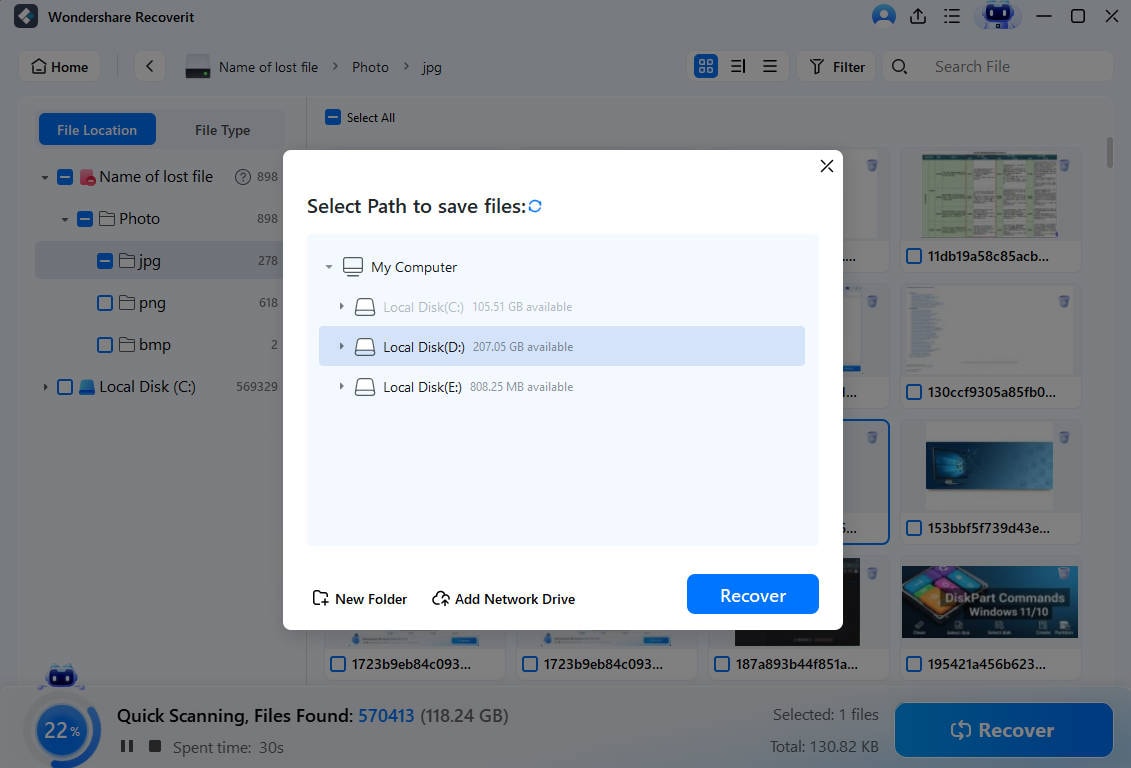
- Select the recovery location. Open Recoverit, click Hard Drives and Locations, then select the drive where your files were located.

- Scan and preview files. Recoverit scans the drive and displays discovered files in real time. Click files you need, use Preview where supported, then choose files for recovery.

- Save files safely. Select a destination on another drive and save the recovered files there.

Part 9. DiskGetor vs. Recoverit Comparison
The original comparison table used percentage-based recovery rates and broken symbols. Those claims are not reliable enough for a 2026 review. A safer comparison focuses on verifiable product fit and user workflow.
| Specs and Features | DiskGetor | Wondershare Recoverit |
| Best fit | Legacy Windows deleted-file and formatted-drive recovery. | Modern guided recovery for Windows and Mac users. |
| Supported OS | Windows in current public listings. | Windows and macOS apps, with additional Recoverit guidance for supported Linux/NAS workflows. |
| Current update confidence | Weak public update signals; listings are old/inconsistent. | Actively documented and maintained product pages. |
| Free trial | Free/trial limits are unclear across listings. | Free trial and current recovery allowance should be checked on the Recoverit product page. |
| File preview | Softpedia mentions image preview and HEX viewer in the free edition review. | Preview workflow is more visible and beginner-friendly. |
| Filters and search | Basic search/file-type options in public listings. | Search and filters are central parts of the workflow. |
| NAS recovery | Not a clear DiskGetor strength. | Recoverit has dedicated supported NAS/Linux workflows in current product positioning. |
| Pricing model | $69 single-user price commonly listed; old buy page should be verified. | Subscription/licensing varies by product page and promotion. |
| Ease of use | Simple but dated wizard interface. | Modern guided interface. |
| Best user | Windows users who specifically want to test a legacy lightweight tool. | Users who want a clearer, maintained, cross-platform recovery workflow. |
Part 10. Final Verdict
DiskGetor Data Recovery is not a bad historical tool, but it is a hard sell in 2026. It can still be tested for simple Windows recovery cases, especially if you already know the tool and trust your download source. But its old public footprint, unclear free limits, Windows-only positioning, small review pool, and dated workflow make it less attractive than current alternatives.
The practical recommendation is simple: if your data matters, use the safest workflow first. Stop using the affected drive, scan from a separate system if possible, recover files to another drive, and avoid paying for legacy software until you have confirmed that your files are recoverable. For most Recoverit readers, Recoverit is the more reliable everyday alternative because it gives a clearer current workflow and stronger usability.
FAQ
-
Does DiskGetor Data Recovery still work?
DiskGetor may still work for simple Windows recovery cases such as recently deleted files, formatted drives, and some partition issues. However, public listings are old or inconsistent, so test carefully before paying. -
Is DiskGetor Data Recovery free?
There are free/trial listings for DiskGetor, but the exact recovery limit is not consistently described across public pages. Do not assume full free recovery until you confirm that the software can actually save the files you need. -
Is DiskGetor Data Recovery safe to use?
It is safest only when downloaded from a trustworthy source and used in a read-only recovery workflow. Avoid cracked installers, and do not install or save recovered files on the affected drive. -
Is DiskGetor outdated?
Yes. Its interface and public version signals are outdated compared with modern data recovery tools. Softpedia lists the free edition as last updated in 2012, while other listings show different versions. -
Can DiskGetor restore files after new data replaced them?
No normal recovery software can reliably rebuild file content after new data has replaced the original bytes. If the file content no longer exists on the storage device, recovery may fail or return corrupted files. -
Does DiskGetor work on Mac?
Current public listings focus on Windows and show no Mac version. Mac users should choose a Mac-compatible recovery tool instead. -
Is Recoverit better than DiskGetor?
Recoverit is a better fit for most users who want a modern, maintained recovery tool with Windows and Mac workflows, preview, filters, search, and clearer current support. DiskGetor is mainly worth testing for narrow Windows legacy recovery cases.


