

 TL;DR:
To fix a corrupted Android SD card without formatting, immediately decline any format prompts, power down the phone completely to reseat the microSD card, test it in another compatible device or USB-C reader, and copy all accessible files first.
● The recovery path depends strictly on your storage mode: a portable card can be read on a Windows or macOS computer, but an adopted internal-storage card is encrypted by Android and must remain in the original phone to access data.
● If a computer detects a portable card as RAW or is missing files, run recovery software like Wondershare Recoverit before executing the chkdsk X: /f command, because Microsoft warns that FAT file system repairs can cause data loss.
● Stop DIY software recovery and disconnect the card if it becomes unusually hot, repeatedly freezes the computer, or drops connection, because continuous scans on physically unstable hardware reduce the remaining time available to read the device.
Ask AI for a summary
 ChatGPT
 Perplexity
 Gemini
 Claude
 Grok
Grok
To fix an Android corrupted SD card without formatting, stop using the card, dismiss any format prompt, power the phone off, reseat the card, and test whether it is readable in another compatible device or card reader. Copy every file you can still open. If a Windows PC or Mac detects a portable microSD card but the files are missing or inaccessible, recover them before running a repair command or formatting. Formatting is a destructive last step, not the first fix.
⚡ TL;DR: Protect the Files Before You Repair the Card
● Stop new writes: Do not take photos, download files, install apps to the card, accept a format prompt, or repeatedly reconnect an unstable card.
● Try the safe phone-only checks: Power off, reseat the microSD card, restart, test another compatible phone or USB-C reader, and copy any accessible files.
● Recover before repair: CHKDSK and formatting can change the file system. Use recovery software first when a portable card is detectable but its files are missing, RAW, or inaccessible.
● Identify the storage mode: A portable card can usually be read in another device. An adopted or internal-storage card is encrypted and tied to the original Android phone, so removing and scanning it like a normal card may not work.
In This Article
Part 1. Diagnose the Android SD Card Error
Android may call a card corrupted when it cannot mount the file system, but the same warning can also come from a loose tray, an incompatible card, a failing reader, an adopted-storage mismatch, or physical media failure. Choose the next step from the symptom instead of pressing Format immediately.
1.1 Start With the Symptom, Not the Format Button
| What You See | What It May Mean | Safest Next Step |
| The card opens, but some files are missing or will not open | Deletion, directory damage, interrupted writing, or unreadable sectors | Stop writing and copy readable files; recover inaccessible files before repair |
| Android says “SD card corrupted,” “unsupported,” or asks to format | The phone cannot mount the current file system or its metadata is damaged | Cancel the prompt and test the card in one other compatible device or reader |
| The card works in another phone or computer | The original phone, tray, compatibility, or Android mount state may be the problem | Copy the files immediately, then troubleshoot the original phone |
| Windows detects the card as RAW or asks to format it | The file system is unreadable even though the device is detected | Use the RAW SD card recovery path before CHKDSK or formatting |
| No phone, reader, or computer detects the card | Reader failure, controller failure, broken contacts, or physical damage | Try one known-good reader; for irreplaceable files, stop and use a recovery lab |
If the phone does not list the card at all, use the dedicated phone not reading SD card guide. This article focuses on a card Android identifies as corrupted, unsupported, unreadable, or intermittently accessible.
1.2 Check Whether the Card Is Portable or Adopted Storage
This distinction changes what you can safely do. Google's current Android SD card guidance separates portable storage from internal, also called adoptable, storage.
| Question | Portable Storage | Internal or Adopted Storage |
| Typical use | Photos, videos, documents, downloads, and moving files between compatible devices | Apps, app data, and added storage for one phone |
| Can it move to another device? | Usually yes, if the other device supports the capacity and file system | No. Android formats and encrypts it for the phone that adopted it |
| Can a PC recovery app scan it normally? | Usually, when Windows or macOS detects the card through a reader | Usually not as readable removable storage because the encryption key remains on the original phone |
| Safest response to corruption | Remove safely, connect through a stable reader, copy or recover files, then repair | Keep it with the original phone, avoid factory reset and formatting, and copy accessible data through that phone |
The Android Open Source Project explains that an adopted card is formatted and encrypted to work with one Android device, and its encryption key is stored on that device. The card therefore cannot normally be mounted elsewhere. See the official AOSP adoptable storage documentation. For a deeper comparison, use the Recoverit guide to format an SD card as internal storage on Android.
Samsung Galaxy note: Samsung's current U.S. support page states that adoptable storage is unavailable on Samsung devices. A Galaxy microSD card is normally used as portable storage. Device behavior still varies, so confirm the exact phone model before following a menu path.
Part 2. Fix a Corrupted SD Card on Android Without a Computer
Phone-only fixes can resolve a temporary mount or contact problem, but they cannot safely rebuild every damaged file system. Use the steps below in order, and stop as soon as the card becomes readable so you can copy the data.
2.1 Restart, Power Down, and Reseat the Card
Step 1. Cancel Any Format Prompt
Do not confirm formatting while needed files remain on the card. Google's Android Help warns that formatting permanently deletes the data on the card.
Step 2. Shut the Phone Down Completely
Wait until the phone is fully powered off before opening the microSD tray or battery compartment. Do not pull the card while the camera, Gallery, file manager, or an app is still using it.
Step 3. Inspect and Reseat the Card
Check for a cracked shell, bent edge, contamination, or damaged contacts. Use a dry, lint-free cloth only if the contacts are dusty. Do not use liquid cleaners, scrape the contacts, bend the card, or force a stuck tray.
Step 4. Restart and Check Storage
Reinsert the card correctly, power the phone on, and open Settings > Storage or the manufacturer's equivalent. If the files reappear, copy them immediately rather than assuming the card is healthy.
Samsung's official SD card troubleshooting guidance also starts with removing and reinserting the card, testing another device, and backing up before formatting.
2.2 Test Another Phone or USB-C Card Reader
Step 1. Try the card in one compatible Android phone, camera, or USB-C card reader. Confirm that the second device supports the card's capacity and type.
Step 2. If the second device reads the card, copy the important folders to internal storage, cloud storage, or another healthy drive.
Step 3. If the card disconnects, becomes hot, freezes the device, or alternates between detected and missing, stop repeated tests. Those signs can indicate unstable hardware.
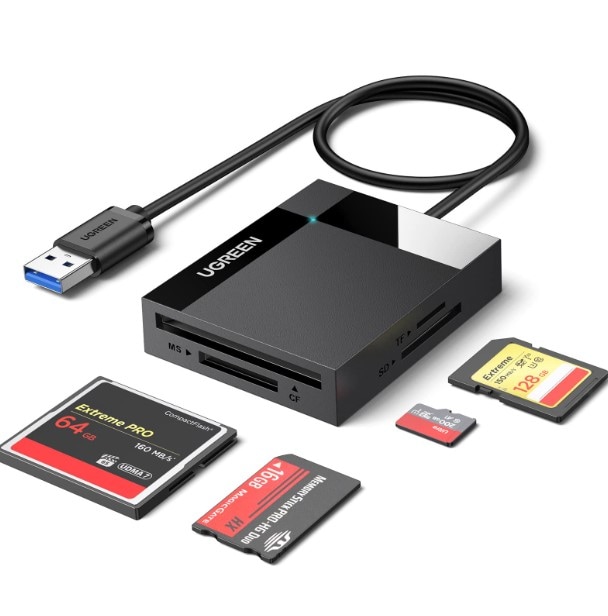
A successful test in another device does not prove that the card is reliable. It only gives you a safer opportunity to copy the data before further troubleshooting.
2.3 Copy Every Accessible File Before Repair
Open the card in Files by Google, My Files, or the phone's file manager and copy the folders you recognize. Prioritize irreplaceable photos, videos, voice recordings, documents, and exported app media. Copy to the phone's internal storage only if there is enough free space; otherwise use cloud storage or another external drive.
- Copy in small groups: Start with the most valuable folders instead of selecting the entire card at once.
- Verify the copies: Open several copied photos, play part of several videos, and check document sizes.
- Record failed files: Note folders or filenames that cannot be copied so you can target them during recovery.
- Keep the source unchanged: Do not delete the originals or move files off the card until the verified copy is complete.
For adopted storage, keep the card in the original phone and copy data through that phone. Removing the card and putting it in a PC may expose only an unreadable encrypted volume.
2.4 Know the Limits of Phone-Only Repair
Most Android storage menus offer mount, eject, or format controls; they do not provide a general file-system repair command comparable to CHKDSK. Therefore, the realistic SD card corrupted Android fix without computer is limited to restoring a stable connection, remounting the card, and copying accessible data.
| Phone-Only Action | When It Helps | Data Risk |
| Restart, power down, and reseat | Temporary mount, tray, or contact problem | Low when the phone is fully off |
| Unmount and remount through Storage settings | Card is listed and the option is available | Low, but copy files immediately if access returns |
| Copy files to internal or cloud storage | Card is partly readable | Low if the source is stable |
| Format on Android | Files are already safe and the goal is to rebuild the file system | High; formatting erases the card |
| Factory reset the phone | Not an SD card repair method | Very high; it can erase phone data and may remove access to adopted storage |
Do not install random “SD repair” apps that promise to repair physical damage or recover data after every failure. If the card remains corrupted and files matter, move to recovery on a computer rather than looping format prompts.
Part 3. Recover Data Before Repairing or Formatting
Use recovery software when a portable SD or microSD card is detected by Windows or macOS but its files are deleted, missing, RAW, formatted, or inaccessible. Recovery software is not the right tool for a physically broken card or for encrypted adopted storage that the original phone can no longer unlock.
3.1 Recover a Detectable Portable SD Card With Recoverit

Wondershare Recoverit Memory Card Recovery can scan a detectable portable SD card from an Android phone through a card reader on Windows or Mac. It does not recover the phone's built-in storage, and it generally cannot decrypt a card that another Android device formatted as adopted internal storage.
Step 1. Connect and Select the Android microSD Card
Power the phone off or eject the portable card safely. Insert the card into a reliable reader, launch Recoverit, and select the SD card by matching its displayed capacity. Do not select the computer's system drive by mistake.
Step 2. Scan Without Writing to the Card
Start the scan and leave the source card unchanged. Use file type, path, date, size, and filename filters to narrow the results instead of copying anything back to the card.
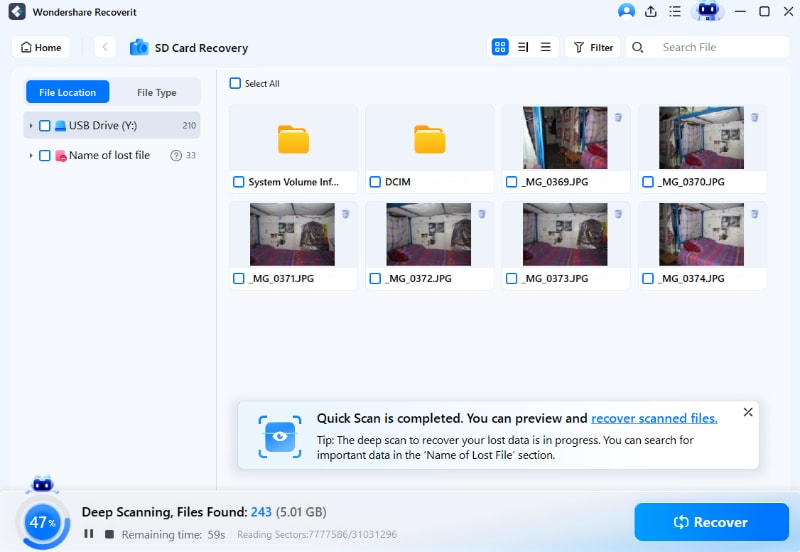
Step 3. Preview the Files You Need
Preview supported photos, videos, documents, and other files. Check the actual content, not only the filename, because directory damage can change names or folder structure.
Step 4. Recover to a Different Healthy Drive
Choose the computer's internal drive or another healthy external drive as the destination. Never save recovered files to the corrupted microSD card because new writes can overwrite other recoverable data.
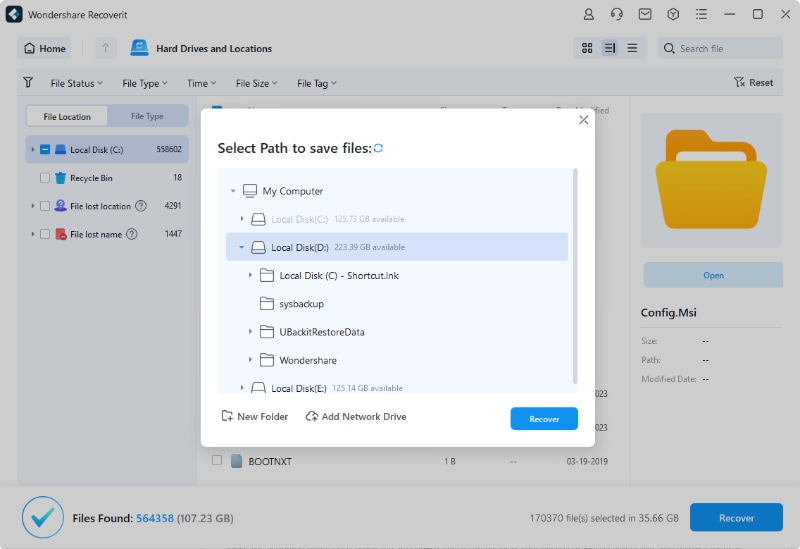
Limit: No software can guarantee recovery after data has been overwritten. A card that repeatedly disconnects, freezes the computer, or is not detected by any reader should not be subjected to repeated scans.
Recover a Detectable Portable SD Card With Recoverit
 Security Verified. Over 7,302,189 people have downloaded it.
3.2 Stop DIY Recovery When the Card Is Physically Unstable
Stop home recovery and consider a professional lab when the card is bent, cracked, burned, wet, unusually hot, or undetected in every known-good reader. Also stop when the card repeatedly disappears during scans or causes the computer to freeze. Repeated connection attempts can reduce the remaining time available to read an unstable device.
For a broader decision tree that separates logical corruption from physical damage, see the Recoverit guide to recover data from a corrupted SD card.
Part 4. Repair a Portable Android SD Card With a Computer
Repair only after accessible files have been copied or missing files have been recovered and verified. The steps below apply to a portable microSD card, not an encrypted adopted-storage card.
4.1 Check Windows Detection and the Drive Letter
Step 1. Connect the card through a stable reader directly to the computer rather than an unreliable hub.
Step 2. Right-click Start and open Disk Management. Match the card by capacity.
Step 3. If the volume has a recognizable partition but no drive letter, right-click it and choose Change Drive Letter and Paths, then assign an unused letter.
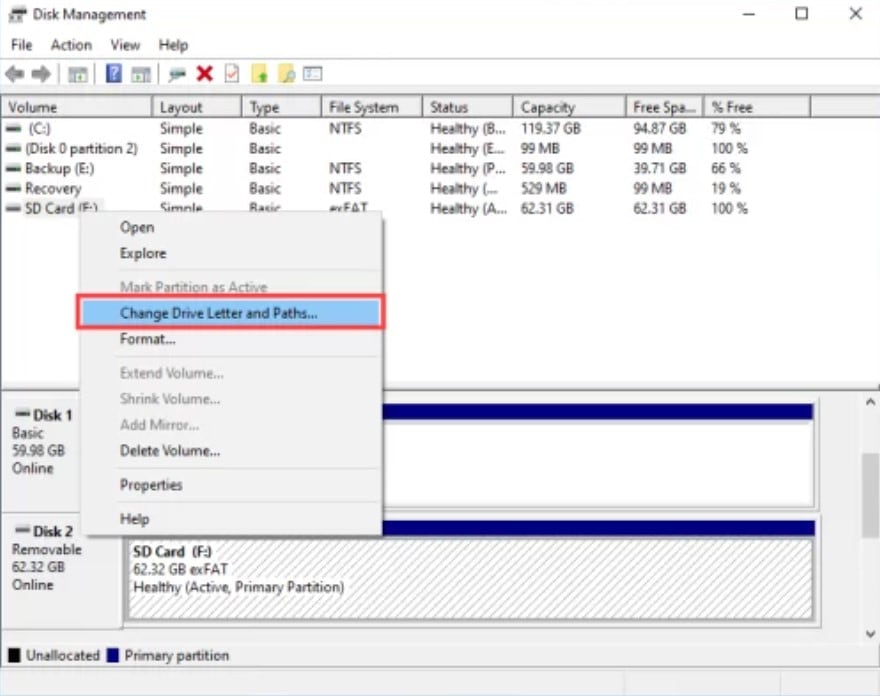
Do not initialize, create a new volume, or format an unallocated or RAW card while files still matter. If Windows cannot detect the device in Disk Management, follow the SD card not recognized troubleshooting path.
4.2 Run CHKDSK Only After Files Are Safe
Microsoft documents that chkdsk without repair parameters reports the volume's status, while /f fixes file-system errors. Microsoft also notes that repairs on FAT file systems usually change the file allocation table and can sometimes cause data loss. That is why CHKDSK belongs after recovery, not before it.
Step 1. Open Command Prompt as Administrator
Search for Command Prompt, right-click it, and choose Run as administrator.
Step 2. Run a Status Check First
Type chkdsk X: and replace X: with the SD card's drive letter. Without /f, this checks and reports status without asking CHKDSK to repair the volume.
Step 3. Repair Only After Recovery
If the card is stable, the important files are already safe, and Windows recognizes the file system, run chkdsk X: /f. Let the command finish without removing the reader.
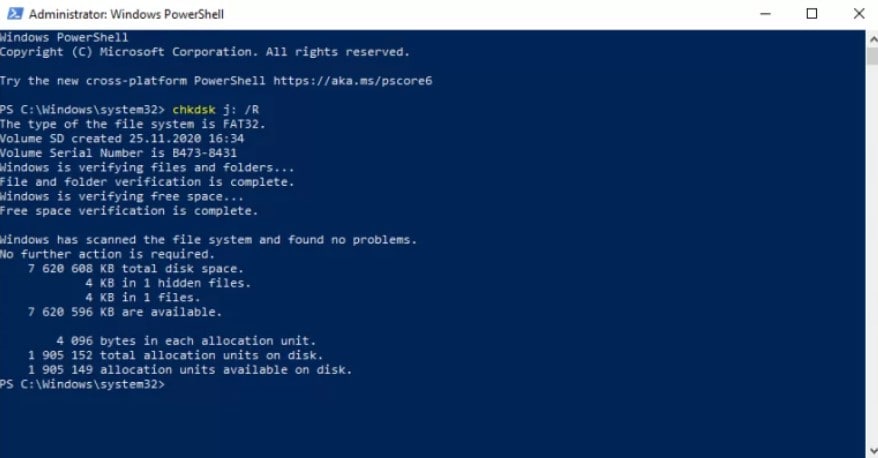
If CHKDSK reports that it is not available for RAW drives, stop using repair commands. Recover the data first, then format the card if it remains stable. Microsoft explains the parameters and repair behavior in its official CHKDSK documentation. For more detail, see the Recoverit guide to run CHKDSK on an SD card more safely.
4.3 Format Only After Recovery and Verification
Format only after you have opened a representative set of recovered photos, played recovered videos, checked documents, and stored a second copy of irreplaceable files. Formatting can rebuild a damaged logical file system, but it cannot repair worn flash memory, a failed controller, cracked contacts, or counterfeit capacity.
Option 1. Format on Android
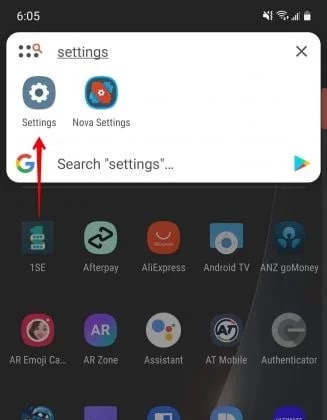
Google's general path is Settings > Storage > SD card > Menu > Storage settings > Format. Menu wording varies by manufacturer and Android version. Select portable storage unless you intentionally need adoptable storage and the exact phone supports it.
For brand-specific paths and storage-mode choices, use the Recoverit guide to format an SD card on Android safely.
Option 2. Use the Official SD Memory Card Formatter
If Android cannot complete the format, connect the card to a Windows PC or Mac and use the official SD Memory Card Formatter. The SD Association recommends it over generic operating-system tools because it is designed for SD, SDHC, SDXC, and SDUC cards. Verify the drive letter and capacity before confirming.

After formatting, copy a few noncritical files to the card, safely eject it, reconnect it, and open those files. If the error returns, the card disconnects, or the capacity is wrong, retire the card rather than trusting it with important data.
Part 5. Why Android SD Cards Become Corrupted
| Cause | What Happens | What to Do |
| Removal during a write or transfer | File-system records may not finish updating | Wait for transfers to finish and eject or power down before removal |
| Power loss, crash, or forced restart | An active file can remain incomplete and directory metadata can become inconsistent | Keep the phone charged during large transfers and do not interrupt formatting |
| Unstable tray, adapter, reader, or USB hub | The connection drops while data is being read or written | Use a known-good slot or reader and copy data at the first sign of instability |
| Worn, counterfeit, or failing flash memory | Files become unreadable, capacity appears wrong, or errors return after formatting | Recover files and replace the card |
| Unsupported capacity or file system | The phone cannot mount the card even though another device may read it | Check the exact phone manual, copy data elsewhere, then format for the target phone |
| Adopted-storage mismatch | An encrypted card is moved away from the phone that created it | Return it to the original phone and avoid formatting or factory reset |
Malware can hide, rename, or damage files, but do not assume every corruption warning is a virus. Connection failure, interrupted writes, unsupported storage, and aging media are common alternatives. Diagnose the detection layer first.
Part 6. Prevent Repeat Corruption and Know When to Replace the Card
- Eject or power down before removal: Do not pull the card while files are open or being copied.
- Keep two copies of important files: An SD card should not be the only location for photos, videos, or work documents.
- Use a stable reader and compatible card: Check the exact phone's supported capacity and avoid loose adapters or unreliable hubs.
- Verify after large transfers: Open several copied files before deleting originals or reusing the card.
- Do not trust recurring errors: If corruption, read-only mode, random unmounts, slow reads, or wrong capacity returns after a clean format, replace the card.
- Test before reuse: Use the SD card health-check guide after the data is safe, not while the card contains the only copy.
Conclusion
The safest way to handle an Android SD card corrupted warning is to separate connection problems, portable storage, adopted storage, logical corruption, and physical failure. Start with a full power-down, reseat the card, test one other compatible device, and copy anything readable. If a portable card is detectable but files are inaccessible, recover them to another drive before CHKDSK or formatting.
Do not factory reset the phone to repair a microSD card. Do not format an adopted card outside the original phone if needed data remains. Once the files are verified elsewhere, you can try a careful file-system repair or a standards-based format. Replace the card if errors return.
FAQ
-
Can I Fix a Corrupted SD Card on Android Without Formatting?
Sometimes. A restart, full power-down, reseating the card, remounting it, or testing another compatible device can resolve a temporary connection or mount problem. If the file system is actually damaged, protect or recover the files first; a computer repair or format may still be required. -
How Do I Fix a Corrupted SD Card on Android Without a Computer?
Cancel the format prompt, power the phone off, reseat the card, restart, test another compatible phone or USB-C reader, and copy every accessible file. Phone-only options are mainly diagnostic and protective. Most Android phones do not provide a general file-system repair command. -
Will CHKDSK Delete Files From an SD Card?
CHKDSK with repair parameters changes file-system structures. Microsoft notes that FAT repairs can sometimes cause data loss. If the files matter, copy or recover them first, then run chkdsk X: /f only on a stable, detected portable card. -
Why Does Android Say My SD Card Is Corrupted?
The phone may be unable to mount the card because of damaged file-system metadata, interrupted writing, an unstable connection, unsupported capacity or format, failing flash memory, or an adopted-storage mismatch. The warning alone does not identify the exact cause. -
Can Recoverit Recover an Android SD Card?
Recoverit can scan a portable SD or microSD card when Windows or macOS detects it through a reader. It does not recover the Android phone's built-in storage and generally cannot decrypt adopted storage tied to another phone. No software can guarantee files that were overwritten or lost to severe physical damage. -
What If the SD Card Was Formatted as Internal Storage?
Keep the card with the original phone. Android encrypts adopted storage and stores the key on that device, so another phone or computer normally cannot mount the card. Avoid factory reset, formatting, or replacing the phone before copying any accessible data. -
Should I Factory Reset My Phone to Repair the SD Card?
No. A factory reset is not an SD card repair method. It can erase phone data and may remove the keys or configuration needed to access adopted storage. Diagnose the card separately and protect the data first.


