


 TL;DR:
Partition Find and Mount version 2.31 is a legacy Windows freeware utility suited strictly for locating and read-only mounting missing NTFS/FAT partitions on stable drives, though a 512 KBytes/s transfer speed limit and lack of file preview restrict its modern utility.
● The software protects data by assigning a read-only drive letter to found partitions rather than rewriting partition tables, utilizing three scan methods that are safest when applied to disk images rather than physically failing drives.
● It operates exclusively on Windows with unverified compatibility for Windows 11, lacking the ability to recover overwritten data, extract individual deleted files from visible partitions, bypass BitLocker encryption, or function on macOS and Linux systems.
● Wondershare Recoverit serves as the necessary alternative when users need a guided preview workflow to verify individual files before saving, targeted deleted-file recovery, media-specific reconstruction, or verified compatibility with modern operating systems.
Ask AI for a summary
 ChatGPT
 Perplexity
 Gemini
 Claude
 Grok
Grok
Partition Find and Mount: The Quick Verdict
Is Partition Find and Mount worth using? Yes, but only in a narrow case: you have a readable Windows drive, the partition itself is missing or deleted, and you want a free tool that can mount the found partition as a read-only drive so you can copy files out. It is not a full modern data recovery suite. It does not repair damaged file systems, recover overwritten data, bypass encryption, or provide the guided preview workflow most users now expect.
- Overall rating: 3.2/5.0
- Best for: Legacy Windows users who need read-only access to a lost NTFS/FAT partition.
- Not ideal for: Windows 11 production machines, macOS, Linux, BitLocker-locked drives, SSD TRIM deletion, physically failing disks, and users who need file preview before recovery.
Consider this scenario: you organized important documents, project files, photos, or videos on a separate hard drive partition. Later, the drive is detected by Windows, but the partition has disappeared, turns RAW, or no longer has a drive letter. This is the type of problem that makes users search for Partition Find and Mount.
This updated Partition Find and Mount review explains what the tool actually does, where it can still help, where its age becomes a risk, how its scan and read-only mounting workflow works, what users report, and when a broader recovery tool such as Wondershare Recoverit is a better alternative.

Data safety first: stop writing new data to the affected drive. Do not initialize, format, repartition, run CHKDSK, or install recovery software onto the same disk. If the drive clicks, disconnects, overheats, or is no longer detected consistently, repeated scans can make recovery harder. In that case, image the disk first or contact a professional recovery lab.
In this article
Part 1. Partition Find and Mount Review Verdict
Partition Find and Mount is still useful for a specific recovery job: locating a lost partition and mounting it in read-only mode so users can copy files to another drive. That design is safer than tools that immediately write partition-table changes back to the source disk. However, its age, inconsistent current support information, limited file-system coverage, and lack of file preview keep it behind modern recovery tools.
In other words, Partition Find and Mount is closer to a lost partition access utility than a complete data recovery application. It can be helpful when the partition structure is recoverable, but it is not the right tool if you need to search deleted files inside an existing partition, reconstruct fragmented videos, scan NAS/Linux storage through a guided workflow, or recover files from a disk image with preview.
Review Scorecard
| Review Area | Rating | Review Notes |
| Overall rating | 3.2/5 | Useful for narrow lost-partition access cases, but dated compared with modern recovery software. |
| Partition detection | 3.5/5 | Three scan modes can locate partitions when MBR or partition records are missing, damaged, or overwritten. |
| Data safety | 4.0/5 | Read-only mounting is a major strength because it helps prevent accidental writes to the recovered partition. |
| Ease of use | 3.6/5 | The workflow is simple, but recovery success depends on choosing the right physical disk and interpreting found partitions correctly. |
| Performance | 2.7/5 | Fast scans can be quick, but thorough scans can take hours, and old freeware builds may limit transfer speed. |
| Compatibility | 2.4/5 | Windows-only, with conflicting third-party compatibility listings and no clear current support channel. |
| Modern recovery features | 2.2/5 | No polished preview system, no broad deleted-file workflow, no modern video recovery workflow, and no macOS application. |
How We Evaluated It
This review uses the original Recoverit article, the preserved interface screenshots, current public software listings, user feedback pages linked in the source article, and practical data recovery safety principles. Since the original official homepage could not be reliably verified during this update, we avoid claims such as "latest official release" or "fully compatible with Windows 11" unless a current, trusted source can confirm them.
| Evaluation Question | Why It Matters | Finding |
| Can it locate lost partitions? | The main user intent is missing partition recovery. | Yes, when the disk is readable and enough partition/file-system structure remains. |
| Does it write to the damaged partition? | Writing can overwrite recoverable data. | Mounted partitions are intended to be read-only, which is a strong safety point. |
| Is it current? | Legacy recovery software may not work reliably on modern hardware and OS versions. | It appears to be a legacy utility commonly listed as version 2.31, with no clearly verified active official support page. |
| Does it replace full recovery software? | Users may need file preview, deleted-file recovery, or modern device support. | No. It is best treated as a partition mounting tool, not a broad recovery suite. |
Who Should Use It?
| User Scenario | Should You Try Partition Find and Mount? | Reason |
| You deleted a partition by mistake, then stopped using the drive immediately. | Yes, cautiously. | The tool may locate the old partition structure and mount it read-only for copying files. |
| Windows asks you to initialize or format an external drive. | Maybe, but do not format first. | Try non-writing recovery steps first; if the drive is unstable, image it before scanning. |
| You need to recover individual deleted files from a visible partition. | No. | This is better handled by full data recovery software with file preview and deep scan. |
| You use macOS or Linux as your main system. | No. | Partition Find and Mount is a Windows utility. |
| The drive is physically failing. | No direct scan. | Repeated reads can worsen the situation; use a professional imaging workflow or a recovery service. |
| The lost partition is BitLocker encrypted and locked. | No bypass. | No legitimate recovery tool should bypass encryption. You need the correct key or recovery password. |
Part 2. Partition Find and Mount Overview and Current Status
Partition Find and Mount is a small Windows utility designed to find deleted or lost partitions and mount them as drive letters. Its most important idea is simple: instead of editing the partition table first, it scans for partition signatures and lets the user access found partitions in read-only mode. If the partition still contains usable file-system structures, you can copy files from the mounted volume to another safe location.

The tool is commonly listed as Partition Find and Mount 2.31. Older pages attribute it to A-FF Labs or Atola Technology, and public download libraries still describe it as freeware. The current issue is not whether the concept is useful; it is whether users should depend on an old utility with unclear official support for critical recovery work in 2026.
What Partition Find and Mount Does
Partition Find and Mount focuses on one recovery path: finding a partition that Windows no longer exposes correctly, then mounting that partition so files can be copied out. It is most relevant after partition deletion, damaged MBR information, accidental repartitioning, or cases where Windows shows a physical disk but not the expected volume.
- Lost partition scanning: scans the selected disk for possible partition starts and file-system signatures.
- Read-only mounting: assigns a drive letter to a found partition without allowing normal writes to that volume.
- Disk or partition image creation: can save a partition or disk image for later scanning and mounting.
- Simple interface: uses a direct scan, choose partition, mount, copy workflow.
- MBR-related cases: can help when boot records or partition records are missing, damaged, or overwritten, as long as enough structure remains.
That also defines its limits. Partition Find and Mount does not rebuild a complete recovery tree for every deleted file, does not preview files before recovery, and does not repair the underlying disk problem. If the file system inside the lost partition is badly damaged, a full recovery scanner may find more recoverable files than a mount-only workflow.
Compatibility, File Systems, and Device Support
Compatibility is the most important caveat in this Partition Find and Mount review. The original article lists support for Windows 2000, Windows 2003, Windows XP, Windows Vista, and Windows 7. Some third-party listings also mention Windows 8, 10, or 11, but those listings are not a substitute for a verified active vendor support page. For important data, treat modern Windows compatibility as uncertain and avoid using an unverified installer as your only recovery path.
| Item | What Is Commonly Listed | 2026 Review Notes |
| Software type | Lost partition finder and read-only mounting utility | Best for accessing a missing partition, not broad file recovery. |
| Commonly listed version | 2.31 | Use cautious wording because official release status could not be reliably verified. |
| License | Freeware/free for personal use | MajorGeeks notes a transfer speed limit for recovered mounted volumes. |
| Operating systems | Windows, especially older Windows versions | Modern Windows compatibility is inconsistently reported; no macOS or Linux version. |
| File systems | NTFS and FAT; some source material also mentions Ext2FS/Ext3FS | Do not assume broad modern APFS, Btrfs, XFS, ReFS, or encrypted-volume support. |
| Storage devices | Internal and external hard drives detected by Windows | It needs the physical disk to be readable by the system. |
| SSD recovery | Not a core strength | Deleted data on SSDs may be unrecoverable after TRIM; this is a storage behavior limit, not just a software limit. |
Part 3. Scanning Options in Partition Find and Mount
Partition Find and Mount provides three partition search modes: Fast Intellectual Scan, Normal Scan, and Thorough Scan. The right choice depends on how the partition was lost, how large the drive is, and whether the disk layout was created by standard Windows tools or a less common partitioning tool.

Which Scan Mode Should You Choose?
| Scan Mode | Best For | Expected Speed | Limitations |
| Fast Intellectual Scan | Recently deleted partitions, damaged MBR cases, and simple partition-table loss. | Usually the fastest mode. | May miss partitions created by unusual tools or located in unexpected disk areas. |
| Normal Scan | Partitions created by common partitioning tools such as Windows Disk Management. | Moderate. | May not find non-standard layouts or heavily damaged partition structures. |
| Thorough Scan | Harder cases where the first two modes find nothing. | Slow; large drives can take hours. | More read-intensive and not ideal for failing drives unless working from an image. |
Practical review take: start with the fastest non-destructive scan. If it finds the correct partition and the file list looks right after mounting, copy critical files to another drive immediately. If it finds nothing, use Normal Scan next. Reserve Thorough Scan for cases where the drive is stable and you can wait, or when you are scanning a disk image rather than a failing physical disk.
What Scan Results Mean
A found partition is not the same thing as guaranteed file recovery. It means the tool found enough structure to present a candidate partition. Before copying everything, check several folders and file types. If the mounted volume shows missing directories, strange file names, read errors, or repeated freezes, stop and consider a broader file recovery tool or a professional service.
| Scan Result | Likely Meaning | What To Do Next |
| The expected partition appears with a reasonable size and file system. | The partition structure may still be usable. | Mount read-only and copy important files to another drive. |
| Several similar partitions appear. | The scan found old or overlapping partition candidates. | Mount only one at a time and compare folder structure before copying. |
| No partition appears after Fast or Normal Scan. | The partition may be non-standard, overwritten, or severely damaged. | Try Thorough Scan only if the drive is stable, preferably from an image. |
| The drive freezes, disconnects, or makes unusual noises during scanning. | The drive may have hardware problems. | Stop direct scanning and seek a professional recovery workflow. |
Part 4. Mounting Capabilities and Disk Image Workflow
Mounting is the feature that makes Partition Find and Mount different from many partition repair tools. After a scan, found partitions can be assigned a drive letter and opened in File Explorer. This makes recovery feel familiar: browse the folders, choose files, and copy them to another disk.

Read-Only Mounting
All already mounted partitions have visible drive letters. A found but unmounted partition is shown as not mounted. You can select it, choose Mount As, and assign an unused drive letter. After that, Windows should show the mounted partition like a normal volume.

The important safety detail is that the mounted partition is read-only. You should be able to copy files from it, but not edit, delete, or save files back to it. This reduces the risk of Windows, another program, or the user accidentally overwriting recoverable data.
Recommended workflow after mounting:
- Open the mounted drive letter in File Explorer.
- Check whether the folder structure and file names look correct.
- Copy the most important files first, not the largest folders first.
- Save copied files to another physical drive.
- Verify several recovered files before assuming the whole partition copied correctly.
Do not copy recovered files back to the same partition. Do not use the mounted volume for editing. If Windows prompts you to format or repair the original drive, cancel the prompt until recovery is complete.
Creating and Using Disk Images
Partition Find and Mount can create a binary image of a selected partition or a whole disk. This is useful because a disk image lets you run additional scans without constantly reading the original drive. It is especially helpful when the original disk is old, unstable, or connected through a weak USB enclosure.
To create an image, select the drive or partition and choose Create Image. Save the image to a different healthy drive with enough free space.

Later, you can choose Open Image and scan the image like a physical disk. However, do not confuse this with professional forensic imaging. Partition Find and Mount does not replace advanced imaging tools that can handle unstable sectors, log read errors, resume failed imaging sessions, or clone a failing disk with hardware-level control.
| Image Use Case | Good Idea? | Notes |
| The drive is healthy, but the partition is missing. | Yes. | An image gives you a safer copy to rescan later. |
| The drive has a few read errors but stays connected. | Maybe. | Try imaging before deeper scans, but stop if errors increase. |
| The drive clicks, disconnects, or disappears from BIOS/Windows. | No direct software imaging. | Use professional recovery service; repeated software reads can increase damage risk. |
| You need to recover files from an existing image with preview. | Use a modern recovery tool. | Partition Find and Mount can mount images, but it lacks a rich file preview workflow. |
Part 5. Performance, User Ratings, and Real Feedback
Partition Find and Mount's performance depends heavily on scan mode, disk size, disk health, and how quickly files can be copied from the mounted volume. It can feel fast when the partition record is easy to find. It can feel painfully slow when Thorough Scan is needed or when the free personal-use build's transfer speed limit affects copying.
Speed and Practical Limits
Softpedia's review describes the tool as having three scan methods and notes that Thorough Scan checks every sector of the drive, which makes it the slowest option. MajorGeeks also notes that the free personal-use version has a 512 KBytes/s transfer speed limit from recovered mounted volumes. That limit is acceptable for a few documents, but it is a serious drawback when copying hundreds of gigabytes of photos, videos, or project folders.
| Task | Expected Experience | Review Comment |
| Finding a recently deleted small partition | Can be quick with Fast Intellectual Scan. | Best-case scenario for this tool. |
| Scanning a 1 TB or larger drive thoroughly | Can take hours. | Plan for a long uninterrupted scan and avoid using the disk during the process. |
| Copying many large videos from a mounted volume | Can be slow if transfer speed is limited. | Prioritize critical files first. |
| Scanning a failing drive directly | Risky. | Image first or use professional help instead of repeated direct scans. |
What Users Like and Dislike
The original article linked several user rating pages and comments. These links are useful context, but the ratings come from older software directories and should not be treated as current product-support proof. CNET, UpdateStar, Soft112, and Softpedia all provide historical rating or listing context.
Positive user sentiment usually centers on three things: the tool is free for personal use, the interface is simple, and read-only mounting lets users copy files without repairing the partition table first. Negative feedback usually centers on slow thorough scans, slow copying, crashes or hangs in some cases, and uncertainty around modern Windows compatibility.
Review interpretation: the feedback pattern matches the tool's design. It can be valuable when it finds a mountable partition quickly. It becomes less attractive when the drive is large, the file system is damaged, copying speed matters, or the user needs confidence before buying or using a modern recovery workflow.
Part 6. Pros, Cons, and Limitations of Partition Find and Mount
Partition Find and Mount has a clear advantage over risky partition repair attempts: it lets users access a found partition without immediately rewriting the partition table. That makes it a reasonable first look for simple lost-partition cases. Still, its limitations are significant enough that it should not be the only recovery plan for valuable data.
| Limitation | What It Means | Better Next Step |
| No file preview | You cannot easily confirm recoverability before copying. | Use recovery software that previews files before saving. |
| Mount-only recovery model | It depends on the partition being mountable. | Use deep file scan when the file system is too damaged to mount. |
| Legacy software status | Compatibility and support are uncertain. | Use a modern tool for Windows 10/11, macOS, NAS, Linux, or disk-image workflows. |
| Physical disk problems | Direct scans can stress the drive. | Use professional imaging or a recovery lab. |
Part 7. Best Alternative: Wondershare Recoverit
If Partition Find and Mount cannot find a mountable partition, if you need a modern Windows or Mac recovery workflow, or if you want to preview files before saving them, Wondershare Recoverit is a stronger alternative. Recoverit is designed for broader data recovery scenarios, including deleted files, formatted drives, lost partitions, external drives, SD cards, disk images, crashed computers, NAS, and Linux recovery where supported.
Recoverit should be used as a data recovery tool, not as a partition repair tool. It can help recover files from readable storage before formatting, repartitioning, or repairing a disk, but it cannot repair physical hardware, recover overwritten data, or decrypt locked drives without the legitimate key or password.
When Recoverit Is a Better Fit
- You need preview before recovery: Recoverit lets users preview many recoverable files before saving them.
- You are on a modern system: The Recoverit user guide lists support for Windows 11/10/8.1/8/7/Vista, Windows Server versions, and macOS X 10.10 through macOS 15 Sequoia.
- You need broader file-system coverage: Wondershare's support page lists FAT, exFAT, NTFS, NTFS5, ext2/ext3, HFS+, APFS, ReFS, and other supported file systems depending on platform.
- You need more than partition mounting: Recoverit can scan for files from deleted, formatted, RAW, external drive, disk image, NAS, Linux, and crashed computer scenarios where the storage is still readable.
- You are recovering media files: Recoverit has workflows for photos and videos, including enhanced video recovery features on supported plans.
Partition Find and Mount vs Recoverit
| Comparison Item | Partition Find and Mount | Wondershare Recoverit |
| Primary purpose | Find lost partitions and mount them read-only. | Recover files from common data loss scenarios, including lost partitions. |
| Best use case | Readable legacy Windows disk with a missing partition. | Deleted files, formatted drives, lost partitions, external devices, disk images, and broader recovery cases. |
| Operating systems | Windows-only; current compatibility is inconsistently listed. | Windows and macOS, with additional NAS/Linux recovery workflows where supported. |
| File preview | No modern preview workflow. | Preview is available for many recoverable files before saving. |
| Disk image support | Can create and open images for mounting. | Can recover data from disk images. |
| Read-only partition access | Yes, this is its strongest safety feature. | Scans storage and saves selected files to another location. |
| Physically damaged storage | Not recommended for direct scanning. | Also not a hardware repair tool; professional service is recommended for severe physical failure. |
| Encryption | Does not bypass encryption. | Does not bypass encryption; legitimate credentials or recovery keys are required. |
| Ease for non-technical users | Moderate; users must understand disks, partitions, and mount results. | More guided select, scan, preview, recover workflow. |
How to Recover Files From a Lost Partition With Recoverit
Follow these steps when the partition or files are missing but the storage device is still detected. Install Recoverit on a different drive from the one that lost data, and save recovered files to another physical disk.
- Select the affected drive. Launch Wondershare Recoverit and choose the disk or location where the lost partition or missing files were stored.

- Scan the storage device. Recoverit starts scanning the selected drive. You can filter scan results by file type, size, time, status, or tag to narrow the results.

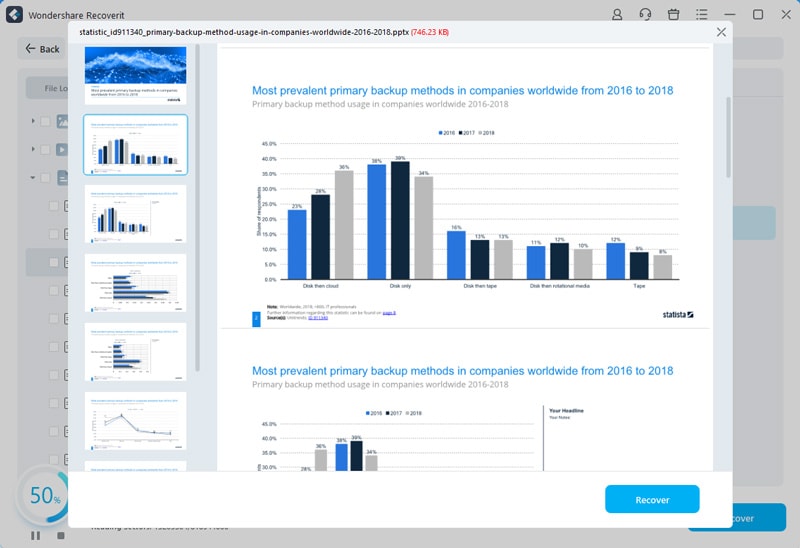
- Preview recoverable files. Open supported files in preview to confirm that names, thumbnails, and contents look correct before recovery.
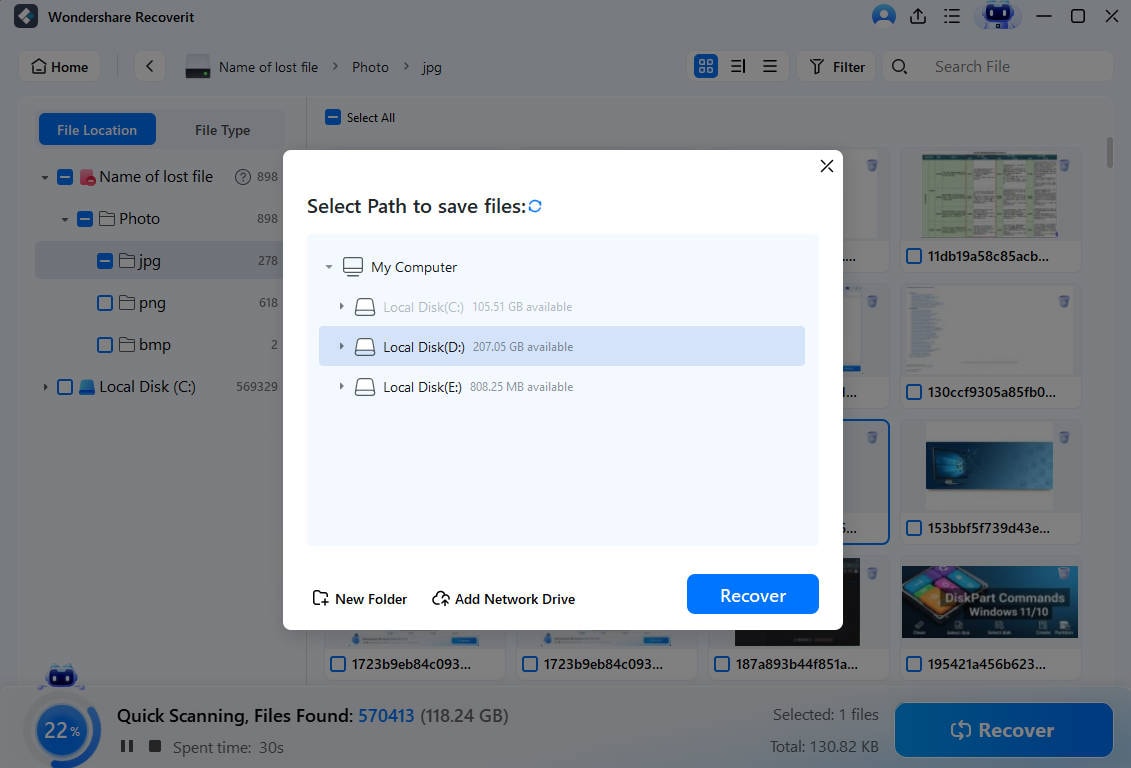
- Recover to a safe location. Select the files you need and save them to a different drive. Do not save recovered files back to the same partition or disk being scanned.
Try Wondershare Recoverit to Perform Data Recovery
 Security Verified. Over 7,302,189 people have downloaded it.
Part 8. Final Verdict
Partition Find and Mount is worth trying only when its narrow design matches your problem. If a partition has disappeared but the disk is still readable, the read-only mounting workflow can give you a low-risk way to copy files out before attempting any repair. Its simplicity is the reason people still remember it.
For 2026, the bigger issue is current confidence. The software is old, official support is unclear, modern Windows compatibility is not consistently documented, and the tool lacks file preview, broad file-system support, guided recovery, and modern media recovery features. For valuable data, use it only as a cautious first step on a stable drive, not as your whole recovery strategy.
If you need a more complete recovery workflow for deleted files, formatted drives, lost partitions, disk images, external devices, crashed computers, NAS, or Linux recovery scenarios, Wondershare Recoverit is a more practical Partition Find and Mount alternative. Recovery still depends on drive condition, overwriting, encryption, and whether the device remains readable.
FAQ
-
Is Partition Find and Mount free?
Public software listings describe Partition Find and Mount as freeware or free for personal use. Some listings also mention a transfer speed limit when copying data from mounted recovered volumes. -
Is Partition Find and Mount safe to use?
It is safer than tools that immediately rewrite the partition table because found partitions are mounted read-only. However, use only trusted installers, do not scan failing drives repeatedly, and never save recovered files to the same disk. -
Does Partition Find and Mount work on Windows 11?
Some third-party listings mention Windows 10 or Windows 11, while older source material lists legacy Windows versions. Because active official support could not be reliably verified, treat Windows 11 compatibility as uncertain for important recovery work. -
Can Partition Find and Mount recover deleted files?
Not in the same way full recovery software does. It is designed to find and mount lost partitions. If the partition mounts correctly, you can copy files from it. If you need deleted-file scanning and preview, use a full data recovery tool. -
Can Partition Find and Mount repair a partition table?
No. Its safer role is to locate and mount found partitions in read-only mode so you can copy files. Repairing or rewriting the partition table should wait until important data has been recovered or backed up. -
Can Partition Find and Mount bypass BitLocker?
No. Partition Find and Mount should not be used to bypass encryption. You need the correct BitLocker password or recovery key to access encrypted data. -
What is the best Partition Find and Mount alternative?
For most modern users, Wondershare Recoverit is a better alternative because it offers a guided scan, preview, and recover workflow for common file loss scenarios, lost partitions, external drives, disk images, and supported Windows and Mac systems.


