 TL;DR:
You can potentially recover deleted .MTS videos from AVCHD camcorders by immediately stopping all recording to prevent data overwrite and scanning the readable SD card using a tool like Wondershare Recoverit.
● Before attempting software recovery, verify if the missing clips are actually deleted or simply located inside the specific PRIVATE/AVCHD/BDMV/STREAM or AVCHD/BDMV/STREAM directory structures.
● Always export any recovered .MTS files to a separate computer or external drive, as writing data back to the original camera card will overwrite remaining unrecoverable video blocks.
● If a standard scan retrieves a video that freezes during playback due to fragmentation, utilize Recoverit's Enhanced Recovery mode to locate missing segments, provided the SD card hardware remains physically stable.
Ask AI for a summary
 ChatGPT
 Perplexity
 Gemini
 Claude
 Grok
Can you recover deleted MTS videos? Sometimes. If your Sony, Panasonic, or other AVCHD camcorder recorded to a memory card that is still recognized and the deleted video data has not been overwritten, scanning that original card may recover all or part of the footage. Stop recording immediately, keep the card out of the camera, and save any recovered videos to a different drive.
Before scanning, check whether the clip is genuinely deleted or simply stored inside the camera's AVCHD folders. This guide explains where to find MTS files, when recovery software can help, and what to do when a recovered video will not play. It focuses on missing .mts camera files, not converting an intact video into MP4.
In This Article
Part 1. Can You Recover Deleted MTS Files?
MTS recovery depends on the condition of the original storage, not just the file extension. Recoverability is most plausible after accidental deletion or some logical file-system problems on a readable SD card, provided the original data blocks have not been reused. A new recording, a full overwrite, or damaged storage electronics can change the outcome. A recovery program cannot recreate data that no longer exists.
MTS is commonly associated with AVCHD (Advanced Video Coding High Definition) recordings. It uses an MPEG transport stream container for video and audio. Sony documents AVCHD camera clips using .MTS within the BDMV/STREAM hierarchy; Panasonic also documents the BDMV, CLIPINF, and PLAYLIST folder structure on supported camcorders. See Sony's AVCHD file-location guidance and Panasonic's SD card folder documentation.
These locations and extensions depend on the camera model and recording mode. Some cameras record MP4 or other video formats instead of MTS, even when the media is the same type of SD card.
Where MTS and M2TS Videos Are Stored
An AVCHD recording is not necessarily in the DCIM folder you might normally check for photos. A supported Sony or Panasonic card can contain an MTS clip at PRIVATE/AVCHD/BDMV/STREAM/00000.MTS, or an AVCHD/BDMV/STREAM folder at the card root. The exact directory depends on the recording device.
The neighboring CLIPINF and PLAYLIST folders hold supporting AVCHD information. If the card's files are still accessible and you need to preserve an editing project, copy the complete original AVCHD folder structure to a separate drive rather than moving only individual STREAM clips. Copying accessible files first is different from writing anything back to the source card.
You may also encounter .M2TS videos in an AVCHD or Blu-ray-oriented workflow. MTS and M2TS are closely related transport-stream formats, but a change of extension does not restore missing footage. For playback or conversion of an intact file, use the dedicated MTS format and playback guide.
Deleted, Missing, or Unplayable?
The correct action depends on what still exists on the storage medium. Use the symptoms below before starting a lengthy scan.
| What you notice | What it may mean | Best next action |
| Footage is absent from the expected folder but the card opens normally | AVCHD folder not checked, incomplete transfer, or deleted file | Check BDMV/STREAM and existing copies; if absent, scan the original card |
| Clips were deleted in-camera or from the computer | File-system references may be removed while data remains | Stop writing to the exact source device and perform a recovery scan |
| Windows or macOS asks to format the card | File system may be inaccessible; formatting can change recoverability | Cancel the prompt; protect data before any repair or reformat |
| An MTS clip exists but freezes or does not play | Playback support, incomplete copying, or damaged video data | Preserve the file, test a compatible player, then evaluate recovery versus repair |
| Card reports no media, repeatedly disconnects, or overheats | Possible hardware or controller failure | Stop DIY scanning; consider a professional data recovery lab |
Important source distinction: If the clip was successfully copied to a laptop and later deleted from that laptop, examine the laptop's original storage and backups. Scanning the camera card will not restore a file that only existed on the computer. Conversely, if the missing file was never transferred, the original camera card is the most relevant recovery source.
Part 2. Protect the Camcorder Card Before Recovery
Before any MTS file recovery attempt, the goal is to prevent further writes to the source. A camcorder may continue generating clips, index files, or thumbnails when used, so stop recording rather than testing the camera with more footage.
- Stop using the affected card: Power off the camcorder and remove the card when it is safe to do so. Do not shoot test clips or delete additional files.
- Do not accept a format prompt: If a computer asks to initialize or format the SD card, cancel. Formatting is not a prerequisite for scanning a readable device.
- Do not repair the source first: Avoid CHKDSK, file-system repair, and camera database repair until important video data has been copied or recovered and verified elsewhere.
- Check detection safely: Use a stable SD card reader and confirm the card appears with approximately the expected capacity. Try another reader or port if needed, without writing to the card.
- Keep another drive ready: Recovered MTS videos must be saved to the computer or another healthy external drive, never to the original camera card.
If the card is unstable, disconnects repeatedly, or shows physical damage, do not continue software scans. The Recoverit memory card recovery page covers logical recovery from readable media; it does not repair a physically failed card.
Part 3. Recover Deleted MTS Files with Recoverit
A missing MTS clip doesn't always mean it's gone. Recoverit searches readable camcorder SD cards for deleted AVCHD footage, with Enhanced Recovery for supported fragmented recordings. Preview possible matches before saving your footage to another drive.


For a readable Sony, Panasonic, or other AVCHD memory card with missing clips, Recoverit provides a guided scan on Windows or macOS. The following workflows use the genuine Recoverit interfaces shown in its official recovery guide. Use the standard card scan first, then consider Enhanced Recovery if a large MTS recording is missing or a normal result is incomplete.
Recover MTS Videos from a Readable SD Card
Best for: Deleted or formatted MTS footage on a card that remains detected and stable. The process scans the storage device; it does not require you to overwrite or format the card.
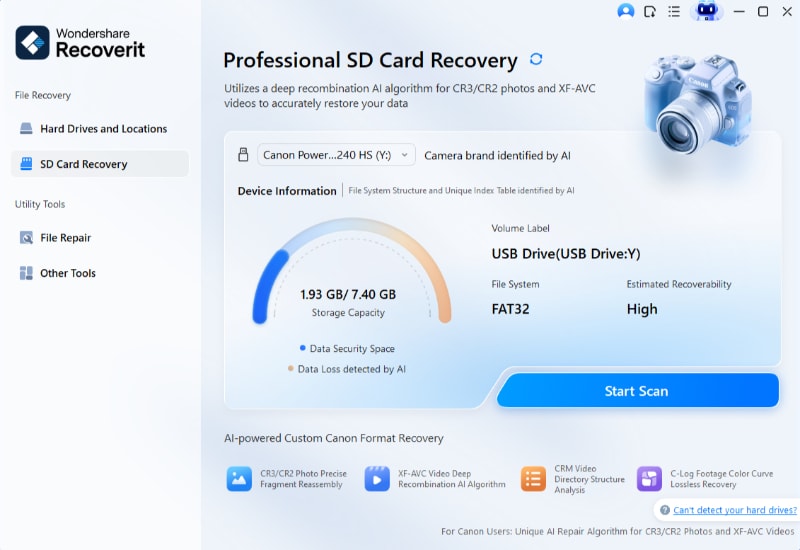
Step 1. Connect and select the source card. Insert the removed SD card into a reader attached to your computer. Launch Wondershare Recoverit, open its SD Card Recovery area, and select the camera card. Match the device name and capacity to avoid scanning the wrong drive.
Step 2. Scan for MTS and related video files. Start the scan and keep the reader connected. Inspect the video file category, available path results, and any MTS or M2TS entries. Video filters, file size, and file path are more useful than looking only for a familiar clip name when original filenames have been lost.
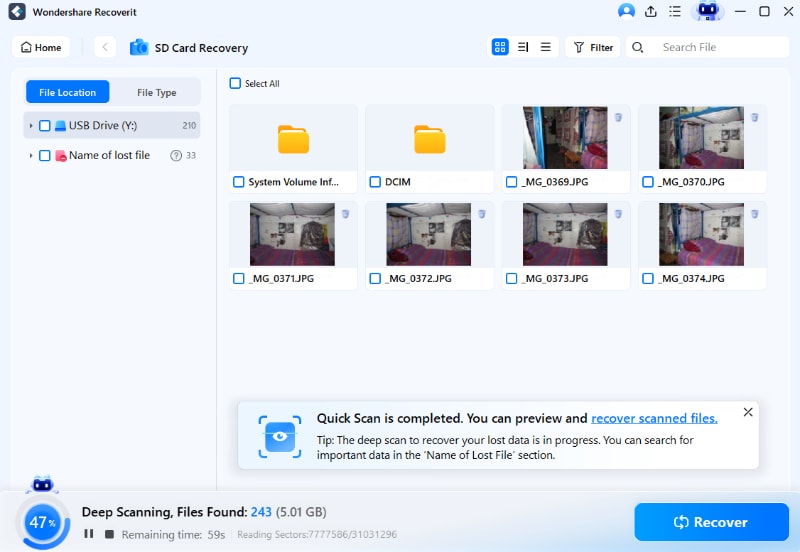
Step 3. Preview the result when supported. Select a likely MTS video and check its size, duration, and preview. If the tool shows more than one candidate, retain alternatives rather than discarding a larger or more complete version.

Step 4. Recover to a different drive. Click Recover, choose the computer or a separate healthy storage device, and finish exporting. Confirm the destination has enough free space for the expected recording length. Never select the original camera memory card.
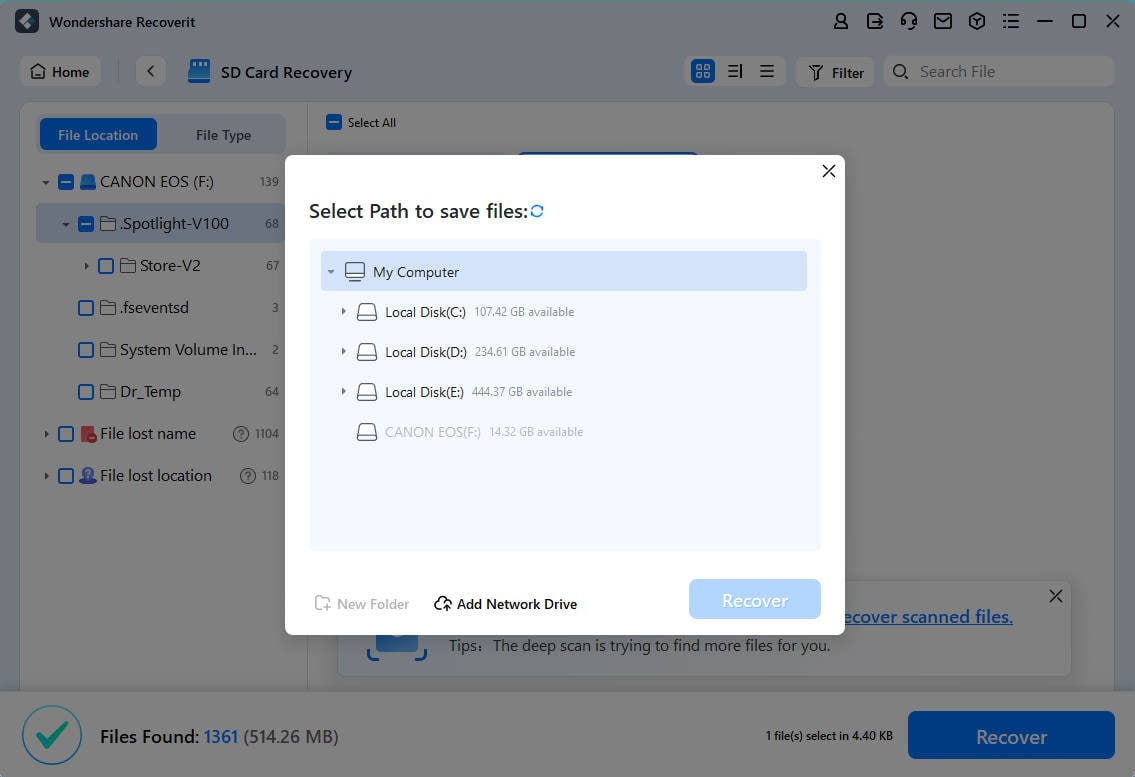
Expected result: You have a recovered MTS or related video file stored away from the camera card. Open it in a compatible video player and seek through several points of the recording; a visible thumbnail alone does not prove that the complete footage was restored. If the clip is missing or incomplete, retain the card unchanged and evaluate Enhanced Recovery.
Note: The free download lets you evaluate the software and its available features. Preview and export limits may depend on the current product plan and the file; do not assume an entire large MTS recording can be exported for free.
Use Enhanced Recovery for Large or Incomplete MTS Videos
Best for: Long or fragmented camcorder recordings that are not found intact by a normal scan. Recoverit offers a separate Enhanced Recovery workflow designed to search for supported video fragments. Whether a particular MTS clip can be reconstructed still depends on the remaining original data.
Step 1. Open Enhanced Recovery and choose the device. In the current Recoverit Windows guide, find Enhanced Recovery under Other Tools and select the camera card or other original source drive. Its label or position may differ across older software versions and macOS.
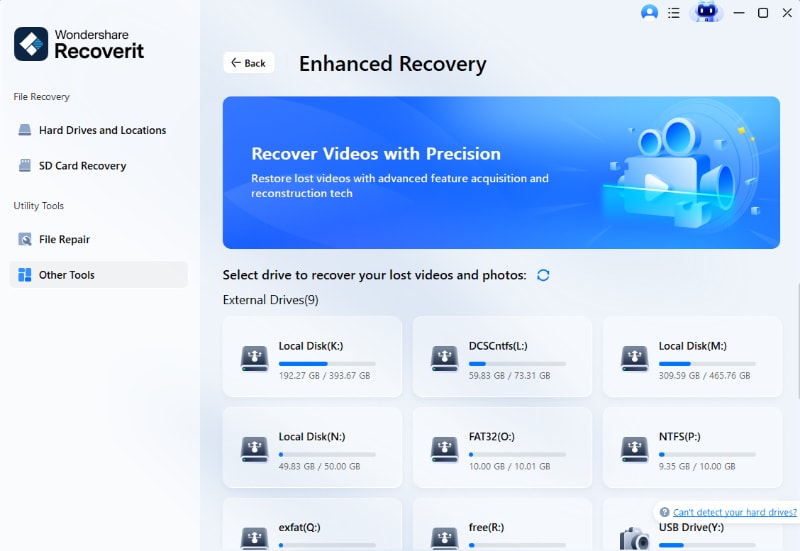
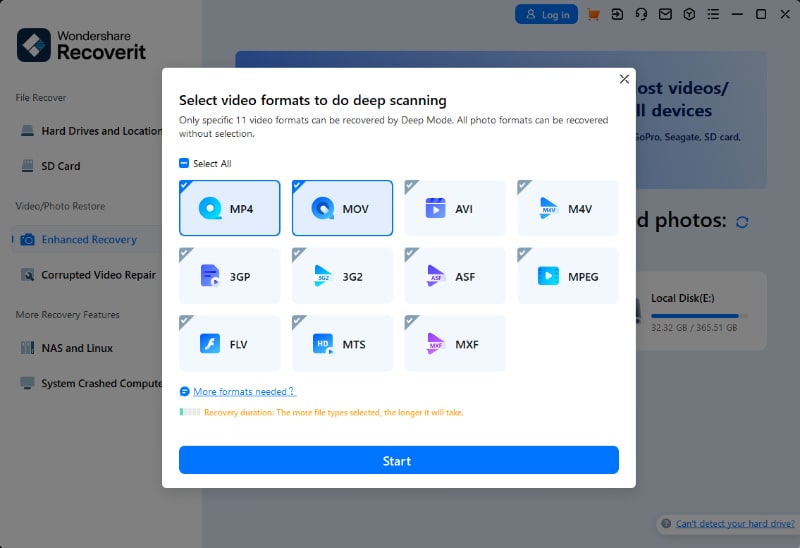
Step 2. Choose the recording format. In the format selection screen, choose MTS when available. If the camera recorded in a different mode, select the actual video format instead. Avoid assuming every camera stores its footage as MTS.
Step 3. Let the deeper scan finish. Start the scan and keep the source connected. Review available video results, preview likely clips when possible, and recover promising candidates to another healthy drive. Deeper recovery can take longer, and a found item may still be missing unrecoverable segments.
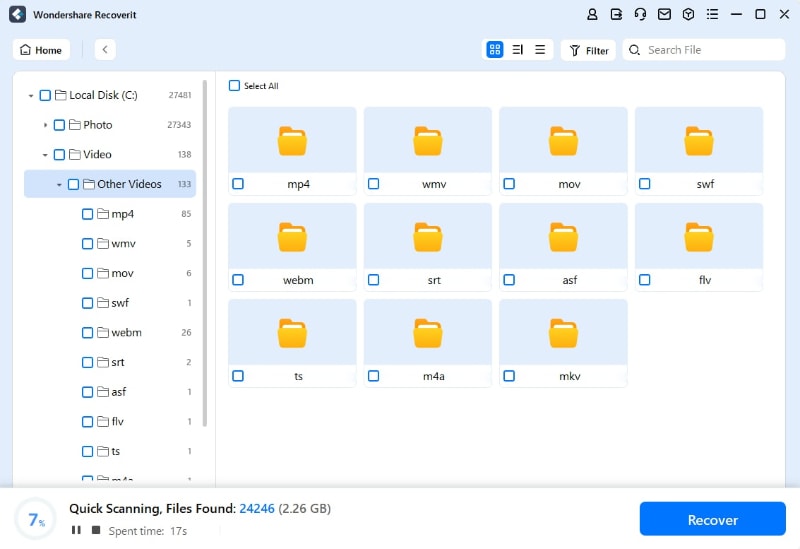
Expected result: A longer or more complete recovered video may be found if the necessary data still exists. Compare recovered alternatives by playback and duration rather than file name alone. Enhanced Recovery is not a guarantee against overwrite, physical media damage, or unrecoverable fragments.
Part 4. What If an MTS File Is Missing or Won't Play?
A recovery scan and a video player solve different problems. Use the following checks to decide whether you need another recovery attempt, a playback-compatible app, or a repair workflow on a copied file.
| Result | Likely issue | Safer next action |
| The scanner finds no MTS files | Wrong source selected, file recorded under another format, overwritten data, or damaged file system | Confirm the actual source, AVCHD folder, and recording mode; inspect the deep or enhanced scan before further writes |
| The recovered MTS file is very small or 0 bytes | Only a directory entry or incomplete data may remain | Search for another version or deeper scan result; a rename cannot reconstruct missing bytes |
| The file has normal size but a basic player rejects it | Codec or AVCHD playback compatibility may be the problem | Test a copy in an MTS-compatible player and check whether audio, video, and duration are present |
| The recovered clip starts and then freezes | Incomplete or overwritten segments may be present | Return to the original card for a different recovery result before attempting repair on a duplicate |
| The card is no longer detected or repeatedly disconnects | Possible physical or controller fault | Stop DIY attempts and request professional assessment |
For an intact file that simply does not play in your default app, a compatible media player may be sufficient. A video converter changes packaging or codecs; it does not undelete missing footage or restore overwritten data. If the recovered file is present but damaged, first look for a more complete recovered version. Then consider the separate guide to repairing recovered videos that will not play.
When to stop: If the card overheats, disappears during a scan, is physically cracked, or reports no usable media capacity, a software tutorial is not a safe substitute for professional recovery. Do not keep repeating scans in hopes that the card will become readable.
Part 5. Prevent Future AVCHD Video Loss
Once your MTS footage has been recovered or safely copied, protect future projects before formatting or reusing a card.
- Preserve the full AVCHD folder: For camera imports, copy the complete directory structure, including video streams and supporting metadata, to your editing or archive drive.
- Verify copies before clearing media: Check that important clips open, have the expected duration, and play from beginning to end on the destination.
- Keep a second independent backup: Use another local drive or a trusted backup destination so one failed transfer is not your only copy.
- Wait until recording and writing finish: Power down or safely remove a card only after the camcorder has finished saving the clip.
- Retire unreliable memory cards: Repeated write errors, unexpected disconnects, and missing files are reasons to replace media after its data is secured.
- Format only after verification: Once footage is backed up, follow the camcorder manufacturer's model-specific formatting instructions rather than repairing or formatting a card that still contains irreplaceable files.
Conclusion
For deleted MTS camcorder videos, first stop using the card and check the correct AVCHD/BDMV/STREAM folder. If the files truly are missing but the storage remains readable, use an MTS-capable recovery scan, consider Enhanced Recovery for incomplete clips, and always export to another drive. Verify real playback before reusing the card. Recoverit offers the guided recovery workflow, but the final outcome depends on whether the original video data remains intact.
FAQ
-
Can I recover permanently deleted MTS files?
Possibly. Recently deleted MTS clips can sometimes be recovered from a readable SD card when their data has not been overwritten. Stop recording, scan the original source, and save any recovered files elsewhere. There is no guaranteed result. -
Where are MTS files stored on a Sony or Panasonic camcorder?
On supported AVCHD models, clips are commonly under PRIVATE/AVCHD/BDMV/STREAM, or AVCHD/BDMV/STREAM at the card root. Exact folder paths depend on the recording device and selected recording format. -
Can I recover deleted MTS videos after formatting an SD card?
Recovery may still be possible after some logical or quick formatting scenarios, especially if the card has not been reused. Do not format again or record new video before scanning; overwriting can make recovery impossible. -
Is MTS the same as M2TS?
Both names are associated with MPEG transport-stream video and AVCHD workflows, but the exact file packaging and context can differ. Changing a filename extension is not a data recovery method and does not repair missing video data. -
How can I recover MTS video files for free?
Start by checking copies already transferred to your computer or backup storage. Some free recovery tools can scan readable cards, but their handling of large fragmented camera footage may vary. Check current free export limitations before choosing any recovery software. -
Why won't my recovered MTS video play?
The file may require a compatible player or may be incomplete, fragmented, or overwritten. Try a compatible player on a copy, compare alternate recovery results, and consider video repair only after a more complete recovery is no longer available. -
Will Recoverit recover an MTS file from a camera that shows no storage on my computer?
Not necessarily. Desktop recovery depends on access to the source storage. Check the removable card in a stable reader; if the media is physically damaged, repeatedly disconnects, or reports no capacity, stop DIY scans and contact a professional recovery service.


