

 TL;DR:
Start an Acer laptop from a USB by connecting a compatible bootable drive before powering on, then repeatedly tapping F12 at the Acer logo to access the one-time boot menu and select the UEFI USB entry.
● If pressing F12 does nothing, restart the laptop, tap F2 to access the BIOS settings, navigate to the Main tab to set the F12 Boot Menu to Enabled, and press F10 to save.
● A flash drive will not boot by merely copying an ISO file onto it; you must write the image using a dedicated utility like Microsoft's Media Creation Tool, which permanently erases the target USB during creation.
● Loading a recovery or installation environment from the USB leaves internal files intact, but proceeding with a Windows reinstall, system reset, or partition change will erase the Acer's internal storage.
Ask AI for a summary
 ChatGPT
 Perplexity
 Gemini
 Claude
 Grok
Grok
⚡ TL;DR: Quick Steps
Use F12 For A One-Time USB Boot: Shut down the Acer laptop, insert a correctly created bootable USB, power on, tap F12 at the Acer logo, select the UEFI USB entry, and press Enter.
Enable F12 If It Does Nothing: Restart, tap F2, open Main, set F12 Boot Menu to Enabled, and press F10 to save. Acer notes that the option is unavailable on some models.
Do Not Reformat The Wrong Drive: Microsoft's Media Creation Tool erases the selected USB. Booting from USB alone does not erase the Acer's internal drive, but a clean install, reset, or partition change can.
Recover Important Files Before Reinstalling: If Windows will not start and the internal drive still contains needed files, use a separate recovery USB and save recovered data to another drive before repair, reset, or installation.
Quick answer: The Acer boot menu key is usually F12. Connect a bootable USB while the laptop is off, switch it on, repeatedly tap F12 when the Acer logo appears, select the entry labeled UEFI: USB name or USB HDD, and press Enter. If F12 does not open the menu, press F2 at startup and enable Main > F12 Boot Menu, then save with F10.
A USB flash drive does not become bootable when an ISO file is merely copied onto it, and DiskPart formatting alone does not create Windows installation media. Use Microsoft's Media Creation Tool for a Windows 11 installer or follow the recovery-tool provider's writing instructions. Before you boot, identify what the USB will launch and whether the next action could erase the internal drive.
Fact-checked on September 2, 2026: The F12, F2, and boot-order paths were checked against Acer's current knowledge base. Windows installation media, Windows Recovery Environment, Secure Boot, and BitLocker guidance were checked against current Microsoft documentation.
In This Article
Part 1. Acer Boot Menu Key And The Best USB Boot Path
For most Acer laptops and netbooks, F12 opens the one-time Boot Menu and F2 opens BIOS/UEFI Setup. These two screens are not interchangeable. F12 lets you choose a device for the current startup without changing the normal priority. F2 opens persistent firmware settings, including the switch that enables F12 and the Boot tab that controls the saved order.
| Key Or Route | What It Opens | Best Use | Does It Persist? |
| F12 at the Acer logo | Boot Menu or Boot Manager | Boot from a USB once | No |
| F2 at the Acer logo | BIOS/UEFI Setup | Enable F12 or change firmware settings | Saved changes persist |
| F10 inside Acer BIOS | Save and Exit | Apply a firmware change and restart | Yes |
| Windows 11 Advanced startup | Windows Recovery Environment | Choose an EFI USB device or enter UEFI settings while Windows still works | No, unless you save a firmware change |
Acer's official F12 Boot Menu instructions say some notebooks ship with the feature disabled, and not every model offers it. That explains why repeatedly pressing F12 may do nothing even when the keyboard works. The correct response is to check the model's BIOS for the option, not to assume the USB or laptop has failed.
Use the F12 menu whenever it is available. Changing the permanent boot order adds no benefit for a one-time repair or installation and can make the laptop return to the USB installer on every restart. Acer's boot-order guidance explicitly separates the one-time F12 choice from the saved BIOS sequence.
Part 2. Prepare The Bootable USB And Protect Your Data
Before learning how to boot from USB on an Acer laptop, make sure the media is actually bootable and matches your goal. A flash drive containing documents, an ISO copied as one file, or an empty FAT32 partition will not start a computer by itself.
| Your Goal | Correct USB | Main Data Risk |
| Repair Windows startup | Windows installation media or a previously created Windows recovery drive | Repair tools are usually non-destructive, but Reset or reinstall choices may remove files. |
| Install Windows 11 | Official Microsoft installation media | The USB is erased during creation; deleting or formatting internal partitions during Setup can erase Acer data. |
| Run Acer or hardware diagnostics | Media created exactly as the diagnostic provider specifies | Firmware updates and storage tests may carry separate risks; read the tool's instructions. |
| Recover files from a laptop that will not boot | A dedicated data-recovery boot drive created on another working computer | The rescue USB is formatted; recovered files must be saved to a different external drive. |
| Start a Linux live environment | A Linux image written with the distribution's supported media tool | Installation options can overwrite partitions even though live mode itself normally does not. |
Create A Windows 11 Installation USB Correctly
For a current Windows 11 x64 installer, download the Media Creation Tool from Microsoft on a working Windows PC. Microsoft requires a blank USB flash drive with at least 8 GB and warns that its contents will be deleted.
- Copy every needed file off the USB. Disconnect other removable drives so the target is easier to identify.
- Run the downloaded Media Creation Tool as an administrator and accept the license terms.
- Select Create installation media for another PC, then choose the required language, edition, and 64-bit architecture.
- Select USB flash drive.
- Verify the drive letter and capacity, select the blank USB, and let the tool finish. Do not unplug it while files are being written.
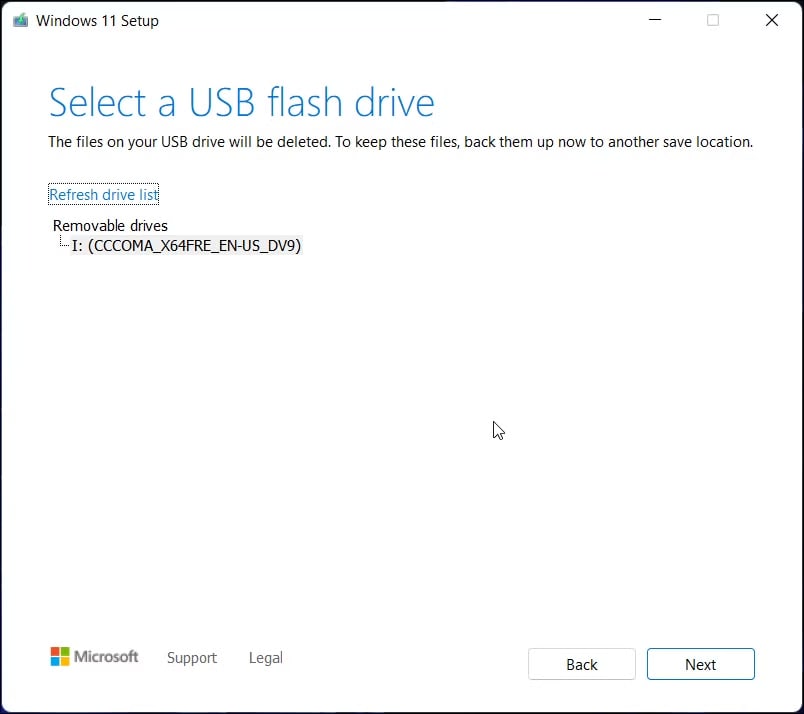
Do not replace this workflow with the old sequence of DiskPart > clean > format. Those commands can erase the wrong disk, and partitioning a USB does not place a Windows bootloader or installation image on it. An ISO must be written by a suitable tool, not copied like a document.
Complete The Pre-Boot Safety Check
- Back up accessible Acer files: If Windows still works, copy important documents, photos, projects, browser exports, and encryption keys before any reset or installation.
- Find the BitLocker key: Firmware changes or recovery tools can trigger a BitLocker prompt. Microsoft's BitLocker guidance explains how to retrieve the 48-digit key from the associated Microsoft, work, or school account.
- Connect AC power: Keep the Acer laptop connected to a reliable charger during recovery or installation.
- Record firmware settings: Photograph the current Boot, Secure Boot, and boot-mode screens before making a necessary change.
- Know the exact model: Use the Acer model or SNID to find its manual because BIOS tabs, available settings, and function-key behavior vary.
- Disconnect unrelated drives: Remove backup drives and memory cards before Windows Setup. Reconnect the destination drive only when recovering files.
Part 3. How To Boot An Acer Laptop From USB
Start with the one-time F12 route. Use BIOS only when F12 is disabled, the USB is missing, or the laptop must boot from the same external device repeatedly. If Windows still starts, Advanced startup provides another controlled route without racing the Acer logo.
Method 1. Use The F12 One-Time Boot Menu
This is the recommended method for an Acer laptop boot from USB. It leaves the normal Windows Boot Manager priority unchanged.
- Shut the laptop down completely. If Windows is usable, choose Start > Power > Shut down instead of Sleep.
- Insert the verified bootable USB directly into the laptop. Avoid a hub, dock, or adapter while troubleshooting.
- Press the power button and immediately tap F12 repeatedly as the Acer logo appears. On a keyboard configured to treat the top row as media keys, the model may require Fn + F12.
- In the Boot Menu, use the arrow keys to highlight UEFI: USB name, USB HDD, or the entry matching the flash drive's brand and capacity.
- Press Enter. The Windows Setup, recovery environment, diagnostic utility, or live system should load from the USB.
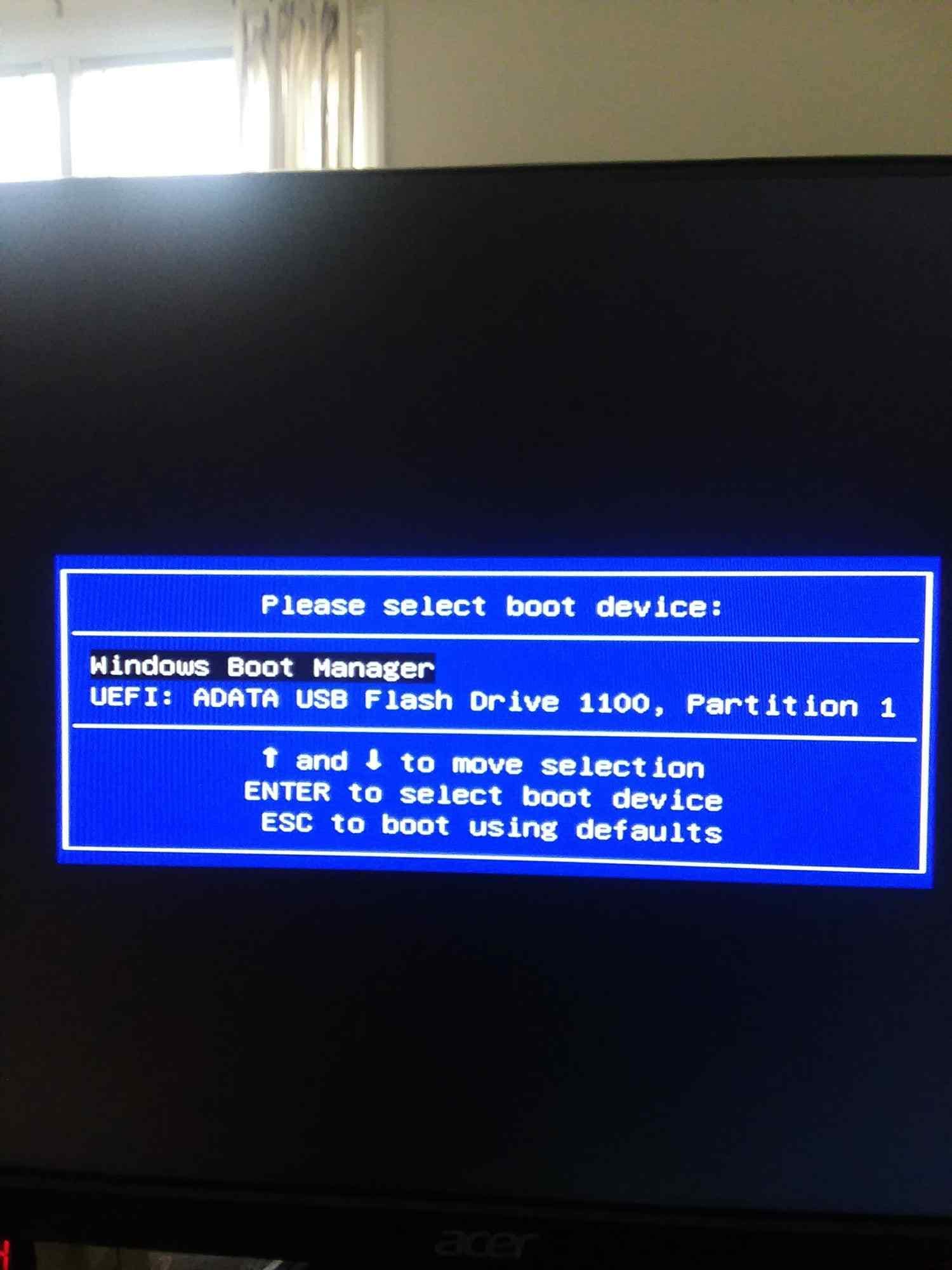
Select the UEFI entry for a current Windows 11 installer on a modern Acer. If both UEFI and non-UEFI entries appear, do not choose Legacy merely because the first attempt failed. Changing firmware mode can make the existing Windows installation temporarily disappear from the boot list.
Method 2. Enable F12 Boot Menu In Acer BIOS
Use this method when F12 does not open a menu. The exact colors and layout may differ, but Acer documents the Main-tab path below for supported notebooks and netbooks.
- Restart or power on the Acer laptop and repeatedly tap F2 while the Acer logo is visible.
- Use the Right Arrow key to open the Main tab.
- Highlight F12 Boot Menu and press Enter.
- Select Enabled and press Enter again.

- Press F10, confirm Save and Exit, and let the laptop restart.
- Tap F12 at the Acer logo, select the USB entry, and press Enter.
If F12 Boot Menu is absent, do not invent a replacement setting. Acer states that some models do not support the feature. Use the exact model manual, the Windows 11 route below, or the BIOS Boot tab if that model permits a saved boot-order change.
Method 3. Start From USB Through Windows 11
If Windows 11 still starts, you can reach its recovery environment without timing F12. The route is useful when the Acer logo passes too quickly or the function row is difficult to use.
- Insert the bootable USB.
- Open Settings > System > Recovery.
- Next to Advanced startup, click Restart now and confirm. You can also hold Shift while choosing Power > Restart.
- At Choose an option, select Use a device.
- Select EFI USB Device or the entry that matches the USB. The Acer restarts from that device.
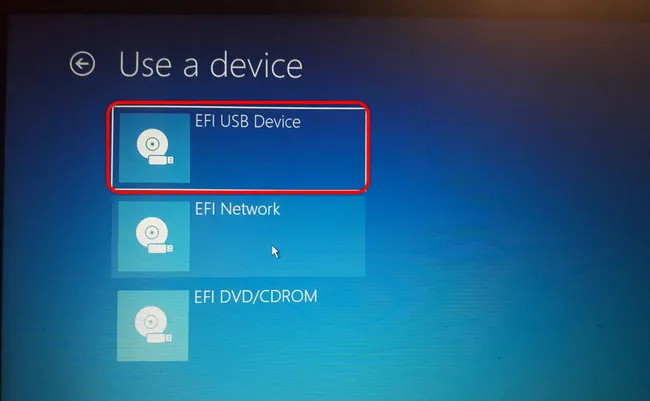
If Use a device is unavailable, choose Troubleshoot > Advanced options > UEFI Firmware Settings > Restart. Microsoft's current Windows Recovery Environment guide documents this firmware route and warns that some tools require the BitLocker recovery key.
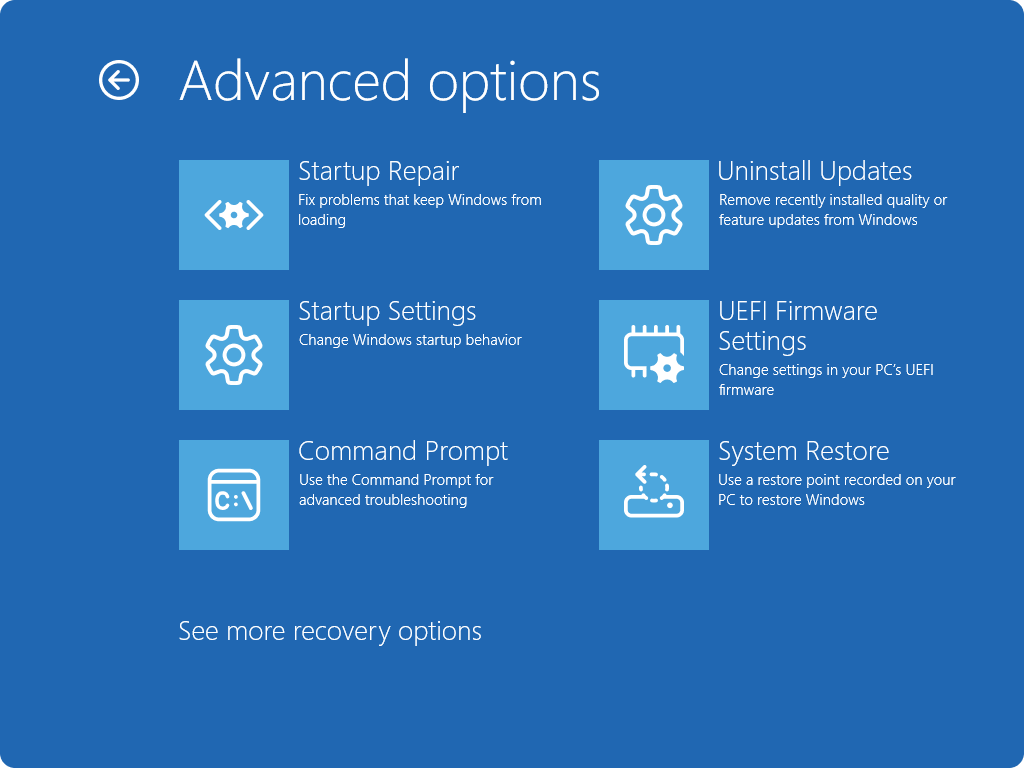
UEFI Firmware Settings opens the Acer firmware interface; it is not the same as the F12 one-time list. Once there, enable F12 under Main or use the Boot tab according to the laptop's model-specific controls.
Method 4. Change The Acer BIOS Boot Order
Use a persistent boot-order change only when the laptop must try the USB on several consecutive starts or when the one-time menu is unavailable. For a single repair or installation, F12 remains the safer and cleaner choice.
- Connect the bootable USB, power on the laptop, and tap F2 at the Acer logo.
- Use the Right Arrow key to open the Boot tab.
- Highlight the USB or UEFI USB entry. Acer's general instructions use F5 and F6 to change order, but follow the controls shown on your screen.
- Move the USB above Windows Boot Manager only for the period in which it must start first.

- Press F10, confirm the change, and restart.
- When repair or installation is finished, remove the USB or put Windows Boot Manager back at the top. Microsoft notes that leaving installation media first can reopen Setup after the installation restarts.
Part 4. Fix An Acer USB That Does Not Appear Or Boot
A missing USB entry is usually a media, connection, firmware-mode, or security problem. Work from low-risk checks to firmware changes. Do not format the Acer's internal drive, initialize a disk, or erase the USB until you have identified the correct device.
| Symptom | Likely Cause | Safe Next Step |
| F12 does nothing | The option is disabled, the key was pressed too late, or the model lacks F12 Boot Menu | Tap F2 at the Acer logo, enable Main > F12 Boot Menu if present, save with F10, and retry. |
| The Boot Menu opens but the USB is absent | The media is not bootable, was attached too late, uses an incompatible boot mode, or is not detected | Recreate the media with the official tool, connect it before power-on, and test another direct port. |
| The USB is listed but selecting it returns to Windows | The bootloader is invalid, the wrong entry was chosen, or firmware rejected the media | Select the UEFI entry, verify the media on another PC, and recreate it if it also fails there. |
| “Security Boot Fail” or a signature error appears | Secure Boot does not trust that bootloader | Use signed current media. Change Secure Boot only when the trusted media provider and Acer model instructions require it. |
| The USB starts, but the internal SSD is missing in Windows Setup | The installer may lack the required storage-controller driver, or the drive may have a hardware/firmware problem | Do not delete unrelated partitions. Obtain the exact Acer storage driver or diagnostic guidance for the model. |
| A BitLocker recovery screen appears | Encryption detected a boot or firmware change | Match the displayed key ID with the 48-digit recovery key in the correct Microsoft, work, or school account. |
| The laptop loops back to Windows Setup after installation | The USB remains first in the saved boot order | Remove the USB at the appropriate restart or restore Windows Boot Manager to first priority. |
Run These Checks In Order
- Confirm The Media Was Written, Not Copied: Recreate a Windows installer with Microsoft's tool. For another OS or diagnostic environment, use its official writer and checksum instructions.
- Insert The USB Before Power-On: Shut the Acer down, connect the drive directly, and then start tapping F12.
- Try Another Port And USB: Remove docks and hubs. A working USB-A port can be easier to isolate than an adapter chain.
- Enable The F12 Menu: Use F2 > Main > F12 Boot Menu > Enabled on supported Acer models.
- Keep UEFI For Current Windows Media: Do not switch to Legacy/CSM as a generic fix. Boot mode must match the media and installed system.
- Treat Secure Boot As A Targeted Exception: Microsoft's current Secure Boot guidance recommends re-enabling it after temporary troubleshooting. Official Windows 11 media should normally be used with UEFI and Secure Boot rather than forcing Legacy mode.
- Check The Exact Acer Manual: Firmware options and key combinations differ among Aspire, Swift, Spin, TravelMate, Nitro, Predator, and older models.
Do not change several firmware settings at once. Change one documented setting, test, and preserve a record of the original value. If Windows disappears after a UEFI/Legacy change, return the setting to its previous state before assuming the SSD has failed.
Part 5. What To Choose After The USB Starts
Successfully starting from USB only puts you in a new environment. The next click determines whether you repair Windows, recover data, or erase and reinstall the operating system.
| Screen Or Goal | Choose | Data Effect |
| Windows Setup appears and you want repair tools | Repair my PC, not Install now | Opens Windows Recovery Environment without beginning a clean installation. |
| Windows fails after an update or system-file problem | Startup Repair, Uninstall Updates, System Restore, or another suitable Advanced option | Designed for repair, but encrypted systems may request the BitLocker key. |
| You need personal files before any repair | Exit the installer and use a dedicated recovery environment | Prioritizes copying data before tools change the Windows volume. |
| You intentionally want a clean installation | Install Windows only after backup and drive identification | Deleting, formatting, or replacing partitions can permanently remove files and recovery partitions. |
| You booted a diagnostic USB | Run only the documented read-only or appropriate hardware test | Some stress, firmware, erase, or repair functions can change hardware or stored data. |
Microsoft's Windows RE guide says that when installation media boots, choose Repair my PC from the initial setup screen to enter recovery options. Start with the least destructive tool that fits the symptom. A repair environment is not a substitute for a backup, and “Keep my files” during Reset is not the same as preserving every application, setting, or file in every location.
Part 6. Recover Files Before Repairing Or Reinstalling Windows
If the Acer will not start but the internal SSD or hard drive is still detected, protecting the files should come before Reset, clean installation, CHKDSK, partition deletion, or factory recovery. A bootable recovery environment can read the internal storage without requiring the installed Windows copy to load.
Wondershare Recoverit fits this situation through its System Crashed Computer workflow. It does not repair an Acer BIOS, bypass BitLocker, or turn an ordinary installer into recovery media. It is useful when the goal is to copy recoverable files from a detected internal drive to separate storage before the system is changed.
Method 5. Recover Files From A Non-Booting Acer With Recoverit
You need a working Windows PC, an empty USB flash drive for the bootable recovery media, and a separate external drive with enough free space for the recovered files. Creating the bootable drive erases its current contents.
- Open System Crashed Computer: Install and launch Recoverit on the working PC. Open Other Tools, choose System Crashed Computer, and click Start.
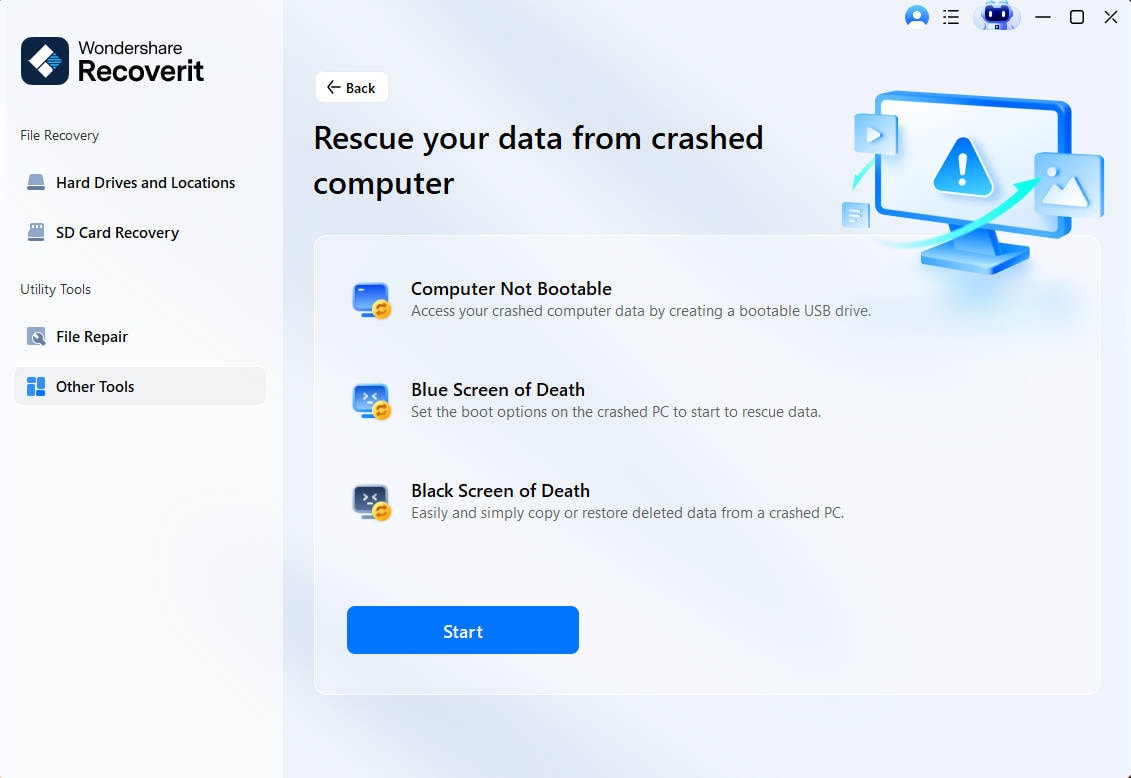
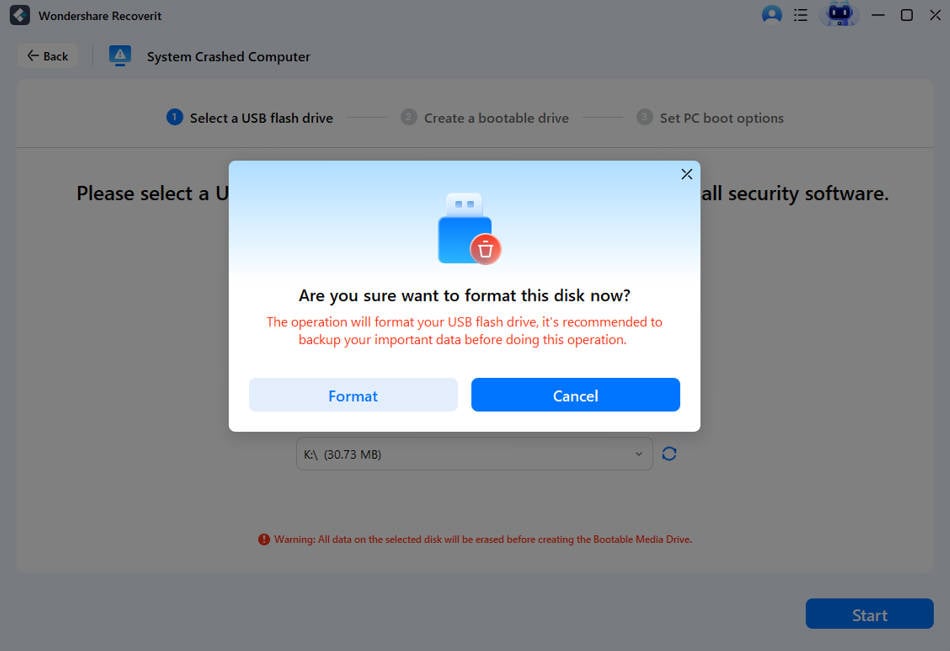
- Select The Correct Rescue USB: Connect the empty flash drive and verify its name and capacity in Recoverit. Do not select a drive that contains the only copy of important files.

- Confirm The USB Format: Read the warning, confirm that the selected USB can be erased, and allow Recoverit to create the bootable drive. Do not disconnect it while the process is running.
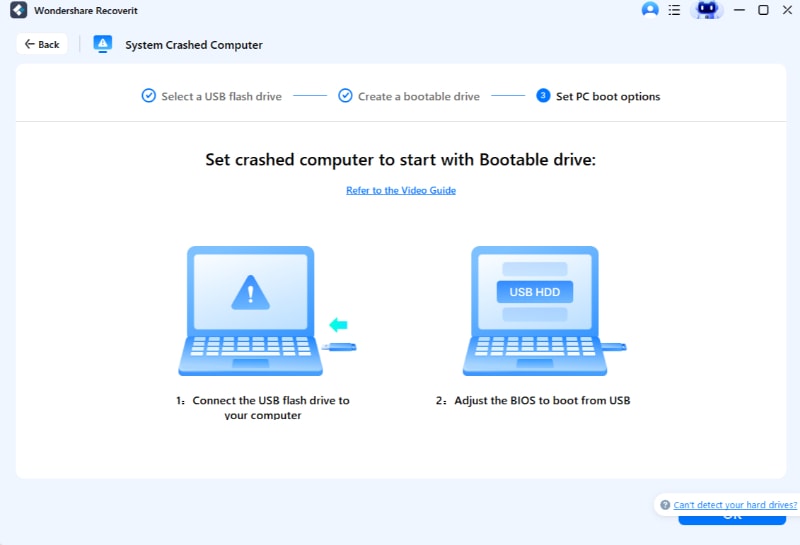
- Boot The Acer From The Recovery USB: Connect the completed drive to the powered-off Acer, tap F12 at the logo, and choose its UEFI USB entry. Use F2 to enable F12 first if necessary.
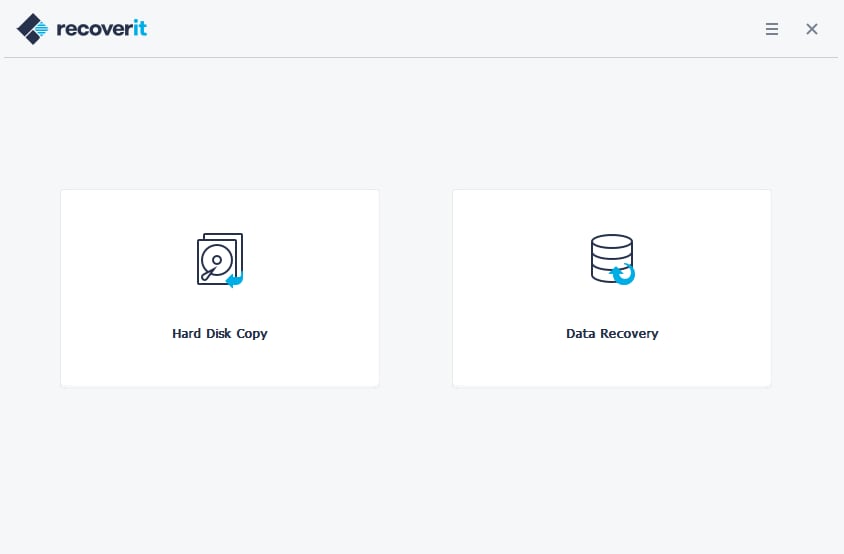
- Recover To Another Drive: In the bootable Recoverit environment, select Data Recovery, choose the Acer's internal drive, scan, preview supported files, and save the selected data to the separate external drive. Never recover back to the source volume.
Recovery depends on whether the drive is detected, its physical condition, encryption, and overwriting. If the internal drive clicks, disappears intermittently, reports the wrong capacity, or is not detected in BIOS, repeated software scans can add stress and a professional recovery service may be the safer choice. If BitLocker protects the volume, the recovery environment still needs the valid key to access encrypted content.
For more detail, use the dedicated recover data when a PC will not boot guide or the bootable data recovery workflow. If the wrong USB was erased while creating Windows media, connect that USB to another computer, stop writing to it, and use the separate USB data recovery path.
Recover Files From A Non-Booting Acer With Recoverit
 Security Verified. Over 7,302,189 people have downloaded it.
Part 7. Restore Normal Boot And Prevent The Next Failure
When the repair, installation, diagnostic session, or recovery is complete, remove temporary changes so the Acer starts normally and remains secure.
- Verify The Result: Open several recovered files or confirm that Windows starts before deleting backups or installer media.
- Restore Windows Boot Manager: If you changed the saved Boot order, return the internal Windows Boot Manager entry to first position and save with F10.
- Re-Enable Secure Boot: If trusted media required a temporary change, return Secure Boot to its original enabled state when the installed OS supports it.
- Restore The Original Boot Mode: Do not leave UEFI/Legacy settings changed after a failed experiment. Windows normally boots only in the mode that matches how it was installed.
- Store The BitLocker Key Safely: Keep the recovery key somewhere accessible from another device, not only on the encrypted Acer.
- Label The USB: Record whether it is a Windows installer, recovery drive, Recoverit boot drive, or diagnostic tool and when it was created.
- Refresh Recovery Media: Old media can lack current security fixes or storage drivers. Recreate it from the official source before a critical recovery if the copy is years old.
- Maintain A Separate Backup: A bootable USB is a tool, not a backup of the Acer's documents. Keep important data on another drive or a trusted cloud service.
The shortest reliable Acer boot-from-USB workflow is: create verified media, use F12 once, and leave firmware security and the normal boot order unchanged unless a documented reason requires otherwise. If the USB is part of a repair or reinstallation, protect the internal data before taking an irreversible step.
Conclusion
To boot an Acer laptop from USB, connect correctly created media before power-on, tap F12 at the Acer logo, select the UEFI USB entry, and press Enter. If F12 is unavailable, enable it through F2 > Main > F12 Boot Menu and save with F10. Windows 11 Advanced startup and the Acer BIOS Boot tab are valid alternatives, but the one-time menu changes the least.
Treat USB creation, USB boot, and Windows installation as three separate actions. Creating installation media erases the selected flash drive; booting from it does not by itself erase the Acer; choices made during Reset or Setup can erase the internal disk. When important files are trapped on a non-booting Acer, recover them to another drive before repair or reinstall.
FAQ
-
What Is The Acer Boot Menu Key?
The Acer laptop boot menu key is usually F12. Press it repeatedly as soon as the Acer logo appears. F2 normally opens BIOS/UEFI Setup, while F10 saves BIOS changes. Some Acer models ship with F12 Boot Menu disabled, and some do not provide the feature. -
How Do I Boot An Acer Laptop From USB?
Shut the laptop down, insert a verified bootable USB, power on, tap F12 at the Acer logo, select the UEFI USB or USB HDD entry, and press Enter. Use F2 to enable Main > F12 Boot Menu if the key does nothing. -
Why Is My USB Not Showing In The Acer Boot Menu?
The USB may not contain a valid bootloader, may have been connected too late, may not match the current UEFI mode, or may not be detected through that port. Recreate it with the official media tool, connect it before power-on, use a direct port, and enable F12 in BIOS. -
Do I Need To Disable Secure Boot To Boot From USB On Acer?
Usually not for current official Windows 11 installation media. Disable Secure Boot only when a trusted media provider and the exact Acer model instructions require it. Record the original value and re-enable Secure Boot after troubleshooting. -
Should I Use F12 Or Change The Acer Boot Order?
Use F12 for a one-time USB boot. Change the BIOS Boot order only when the laptop must try the USB on repeated starts or the one-time menu is unavailable. Restore Windows Boot Manager to first position afterward. -
Can I Boot An Acer From USB Without Entering BIOS?
Yes. F12 opens the one-time Boot Menu without entering BIOS. If Windows 11 still works, Settings > System > Recovery > Advanced startup can also expose Use a device, where you can choose an EFI USB device. -
Does Booting From USB Delete Files On The Acer Laptop?
No. Selecting a bootable USB does not itself erase the internal drive. However, a clean installation, Reset this PC, factory recovery, partition deletion, formatting, or some repair tools can remove or change data. Back up or recover files before those actions. -
Why Does The Acer Keep Returning To Windows Instead Of The USB?
The media may not be bootable, the wrong entry may have been selected, or firmware may have rejected its bootloader. Choose the UEFI USB entry, test the media on another PC, and recreate it if it fails there too. -
What Should I Do If BitLocker Appears After A Firmware Change?
Do not reset or erase the PC. Note the recovery key ID, find the matching 48-digit key in the associated Microsoft, work, or school account, and use it to unlock the drive. Restore unnecessary firmware changes afterward. -
Can Recoverit Fix An Acer That Will Not Boot?
Recoverit is a data-recovery tool, not a BIOS or Windows boot repair utility. Its System Crashed Computer workflow can create recovery media on another PC and copy recoverable files from a detected Acer drive before you reset or reinstall Windows.


