TL;DR:
Choose a professional lab like DriveSavers for physically damaged hardware, undetected drives, or complex RAID arrays, but use recovery software like Wondershare Recoverit as a first step if your device is still readable and the data loss is strictly logical.
● DriveSavers utilizes a mail-in ISO Class 5 cleanroom with a free evaluation and a No Data, No Charge policy, offering turnaround times ranging from ASAP to 14 business days, though exact pricing is only provided after hardware inspection.
● Although Apple recommends DriveSavers for Mac and iPhone storage issues, Apple does not warrant the third-party service, and the lab cannot bypass strong device encryption without your legitimate passwords, recovery keys, or account access.
● When opting for software recovery to retrieve deleted or quick-formatted files, you must stop writing new data to the affected device immediately and install the software on a completely separate drive to prevent permanently overwriting the lost data.
Ask AI for a summary
 ChatGPT
 Perplexity
 Gemini
 Claude
 Grok
Grok
DriveSavers: Quick Review
DriveSavers is worth considering for severe or high-value data loss. It is best suited to physically damaged drives, Apple devices, SSDs, phones, RAID, NAS, SAN, servers, ransomware-related business recovery, and cases where privacy controls and cleanroom handling matter. It is usually not the first choice for simple deletion or formatting when the storage device is still readable.
- Best for: damaged HDDs, SSDs, phones, Macs, RAID/NAS/SAN, enterprise systems, and mission-critical cases.
- Not ideal for: low-budget users, non-urgent logical data loss, or files deleted from a healthy drive.
- Official service model: free evaluation, free shipping label, and "No Data, No Charge" policy.
- Turnaround: Priority starts ASAP; Standard is 1-2 business days; Economy is 5-7 business days, or 10-14 business days for smart devices.
- Cost: DriveSavers does not publish a fixed price table. Final cost depends on complexity, completeness, and turnaround time.
- Recoverit fit: a software alternative for readable storage with logical data loss, not a substitute for a cleanroom lab.
Are you comparing DriveSavers Data Recovery with do-it-yourself recovery software? The right answer depends on the failure type. If a hard drive is clicking, an SSD is not detected, a phone is physically damaged, a RAID has failed, or business data is trapped on damaged hardware, a professional lab such as DriveSavers may be the safer choice. If the drive is still readable and the problem is deletion, formatting, partition loss, or a normal software-level issue, a recovery tool such as Recoverit can be faster and far less expensive.
This DriveSavers data recovery review covers what DriveSavers does, current service plans, pricing factors, security claims, device support, customer feedback, pros, cons, and when Wondershare Recoverit is a practical DriveSavers alternative. It also explains what not to do before shipping a damaged drive or scanning a readable drive.

In this article
Part 1. DriveSavers Data Recovery Review: Quick Verdict
DriveSavers is one of the best-known names in professional data recovery. The company has operated since 1985 and positions itself as a premium lab for severe data loss, including physically damaged hard drives, SSDs, Macs, iPhones, Android devices, removable media, RAID, NAS, SAN, multi-disk servers, and ransomware-related business cases.
The short verdict is straightforward: DriveSavers is strongest when hardware is damaged, business risk is high, privacy controls matter, or the case is too complex for desktop software. It is less attractive when the storage device is healthy and the loss is logical, such as accidental deletion, quick formatting, lost partitions, or files missing from a readable drive. In those cases, software such as Wondershare Recoverit may be the better first step.
Review Scorecard
| Review area | Score | Editorial notes |
| Physical recovery capability | 4.7/5 | Strong fit for damaged drives, failed HDDs, SSDs, Apple devices, phones, and complex hardware cases. |
| Enterprise and RAID recovery | 4.5/5 | DriveSavers officially lists RAID, NAS, SAN, multi-disk servers, ransomware, tape, and enterprise cases. |
| Security and compliance | 4.6/5 | Official pages cite ISO Class 5 cleanroom, annual SOC 2 Type II audit, HIPAA, GLBA, and related security protocols. |
| Price transparency | 3.0/5 | Free evaluation and maximum quote protection help, but there is no simple public fixed-price table. |
| Speed | 4.0/5 | Priority can start ASAP, but Economy and smart-device cases can take longer. |
| Best value for logical data loss | 2.8/5 | Shipping to a premium lab is usually excessive if the drive is readable and the loss is software-level. |
| Overall | 4.1/5 | A premium recovery lab for high-stakes cases, but not always the most practical first option. |
Service vs Software: The First Decision
Before choosing DriveSavers or Recoverit, identify whether your case is physical or logical.
| Data loss symptom | Likely category | Safer first move |
| Drive clicks, grinds, smells burned, was dropped, or is water/fire damaged | Physical or mechanical failure | Stop powering it on and contact a professional lab such as DriveSavers. |
| SSD, phone, or Mac is not detected at all | Possible hardware, firmware, encryption, or controller issue | Do not repeatedly reconnect it. Consider lab evaluation. |
| RAID/NAS/SAN failed or multiple disks are involved | Complex multi-disk recovery | A lab is safer unless you have proven RAID recovery expertise. |
| Files were deleted, Trash was emptied, or a folder is missing | Logical data loss | Stop writing new data and try recovery software if the drive is readable. |
| Drive was quick formatted but still mounts | Logical data loss | Do not reformat. Scan the readable device with recovery software first. |
| Partition is missing but drive is detected | Logical or partition-table issue | Recover files before repartitioning or running risky repair tools. |
Part 2. What Is DriveSavers Data Recovery?
DriveSavers is a professional data recovery service company based in Novato, California. Its official site says the company has recovered data from storage media since 1985 and offers service for home users, small businesses, enterprises, and public-sector customers.
The company is not a simple desktop app. It is a lab-based service. Customers contact DriveSavers, receive shipping instructions, send the device to the lab, receive a free evaluation and quote, approve or decline the work, and then receive recovered data on replacement media if the recovery succeeds.
That model is the opposite of DIY recovery software. It gives you access to professional cleanroom tools and engineers, but it also means shipping the device, waiting for evaluation, approving a quote, and trusting a third party with the storage media.
Part 3. DriveSavers Services, Devices, and Security Claims
DriveSavers covers a broad range of recovery cases. The official service pages list hard drives, SSDs, Macs, Windows devices, iPhones, Android devices, removable media, RAID, NAS, SAN, multi-disk servers, tape, ransomware, and enterprise environments.
Supported Recovery Cases
| Service category | What DriveSavers is suited for | Important caution |
| HDD recovery | Clicking, dropped, mechanically failed, not detected, fire/water damaged, malware-affected, or logically corrupted drives. | Do not open a hard drive yourself. Physical recovery needs a controlled environment. |
| SSD recovery | Failed SSDs, firmware/controller issues, deleted files, and proprietary storage problems. | SSD recovery is affected by TRIM, encryption, controller damage, and detectability. |
| Mac and Apple device recovery | Macs, iPhones, iPads, and Apple storage issues, including damage or deletion scenarios. | Apple encryption can limit recovery. Legitimate credentials, trusted devices, or recovery keys may be required. |
| RAID, NAS, SAN, and servers | Multi-disk arrays, server failures, enterprise systems, and complex storage configurations. | Do not rebuild arrays repeatedly before evaluation because it can make recovery harder. |
| Ransomware and enterprise recovery | Business continuity, incident-related recovery, and mission-critical infrastructure cases. | Coordinate with incident response and legal/security teams before changing affected systems. |
| Removable media | USB flash drives, camera cards, optical media, and other removable storage. | If the media still mounts, software recovery may be a reasonable first step. |
One source-article claim needs correction: DriveSavers should not be described as "breaking encryption." Encrypted-device recovery is not the same as bypassing encryption. A professional lab may be able to help in some encrypted cases, but recovery can still require the legitimate password, recovery key, trusted computer, Apple Account access, or a recoverable device state. If encryption keys are unavailable and data is cryptographically inaccessible, no provider can promise recovery.
Security, Certifications, and Apple Warranty Note
DriveSavers emphasizes security as a major selling point. Its official pages cite an ISO Class 5 cleanroom, annual SOC 2 Type II audit, HIPAA security compliance, GLBA-related requirements, network/security audits, and chain-of-custody style handling for sensitive customers.
Apple's official data recovery and warranty implications page lists DriveSavers among companies recommended by Apple to provide data-recovery service. Apple also says these companies are not Apple Authorized Service Providers, Apple does not warrant their services, and use of third-party recovery companies is at the customer's discretion. That nuance matters: Apple's page supports DriveSavers as a recommended recovery option, but it is not the same as Apple warranty coverage for the recovery attempt.
Part 4. How the DriveSavers Recovery Process Works
The official DriveSavers process is built around consultation, shipping, evaluation, quote approval, recovery, and return of recovered data. Here is the practical flow.
- Call or request an evaluation. DriveSavers offers 24/7 phone support and a free evaluation process. Explain the device type, failure symptoms, business urgency, and whether the drive has been opened, dropped, encrypted, overwritten, or exposed to liquid.
- Receive shipping instructions. DriveSavers says it can email a free shipping label and packaging instructions. Follow the packaging guidance carefully, especially for damaged hard drives and phones.
- Send the device to the lab. Stop using the device before shipment. Do not keep testing a failing drive, run repeated repairs, or try internet tricks such as freezing a drive.
- Free evaluation and quote. Engineers examine the device and determine the condition, recoverability, and quote. The official pricing page says the maximum final price will not exceed the initial quoted range.
- Approve or decline recovery. If you decline the recovery after evaluation, DriveSavers says your cost is zero. If the data is unrecoverable, DriveSavers says there is no charge for the recovery attempt and the device is returned for free.
- Recovery is performed. Work begins after approval. Turnaround depends on service level, device type, severity, and complexity.
- Recovered data is returned. Recovered files are returned on replacement media after payment. In some cases, the folder structure may be original; in others, recovered data may be reorganized if directory damage exists.

For physical damage, this process is safer than running consumer recovery software because repeated power cycles can worsen a failing drive. For logical loss on a healthy drive, however, shipping a device to a premium lab may be unnecessary.
Part 5. DriveSavers Cost and Turnaround Time
DriveSavers does not publish a simple fixed price list for every device. Its official cost page says the final cost depends on recovery success, completeness, selected turnaround time, complexity of the mechanical or logical issues, quality of recovered data, file names, and data structure. It also says a successful recovery will generally fall in the top third of the original quote range and that the final price will not exceed the initial quoted maximum.
| DriveSavers plan | Official turnaround language | Best for |
| Priority | ASAP; recovery begins upon receipt of drive, 365 days a year, including evenings, weekends, and holidays. | Urgent business or mission-critical data where time matters more than cost. |
| Standard | 1-2 business days during normal business hours. | Important cases that need a fast lab turnaround but are not emergency cases. |
| Economy | 5-7 business days; 10-14 business days for smart devices. | Personal files, photos, documents, and cases where cost matters more than speed. |
Public customer reviews often mention four-figure quotes, especially for damaged drives, phones, Mac storage, and complex cases. Treat any article that gives a universal DriveSavers price as an estimate, not a guarantee. The only accurate price is the quote DriveSavers gives after evaluation.
Pricing verdict: DriveSavers can be justified for irreplaceable photos, client work, failed business storage, damaged hardware, encrypted Apple devices, or RAID/server failures. It is often overkill for files deleted from a healthy drive, a quick-formatted external disk, or a readable SD card.
Part 6. DriveSavers Pros, Cons, and Customer Feedback
DriveSavers customer feedback is mixed but useful. The company's own homepage states a 97% customer satisfaction rating from Google and Yelp reviews. Trustpilot currently shows DriveSavers Data Recovery with a 3.6/5 TrustScore from 39 reviews in the U.S. listing we checked. The review themes are consistent: many customers praise successful recovery and helpful staff, while negative or mixed reviews often focus on high cost, communication issues, long timelines, or failed recovery after expensive quotes.

| Pros | Cons |
| Long operating history since 1985 | Pricing can be high, especially for complex or urgent cases |
| Professional lab and ISO Class 5 cleanroom claims | No universal public price table |
| Free evaluation, free shipping label, and No Data, No Charge policy | Shipping a device to a third party is slower than software recovery |
| Strong fit for physical damage, RAID, enterprise, phones, and Apple devices | Not necessary for many readable-drive logical data loss cases |
| Security and compliance credentials for sensitive data | Some recent customer reviews mention communication and cost concerns |
| Apple lists DriveSavers among recommended recovery companies | Apple does not warrant the third-party service or make them an Apple Authorized Service Provider |
The fairest customer-feedback summary is this: DriveSavers is often praised when it succeeds on a severe case, but the price can be painful. Before approving a quote, ask exactly what will be recovered, how recovered data will be delivered, what happens if only partial data is recovered, whether folder structure is expected, and what your cancellation or decline options are.
Part 7. When Should You Choose a Lab Instead of Software?
This is the most important practical section in a DriveSavers review. Choosing software for a physically damaged drive can make the problem worse. Choosing a premium lab for a simple deleted file can waste money.
| Choose DriveSavers or another professional lab when... | Try Recoverit or recovery software first when... |
| The drive clicks, grinds, smokes, overheats, or was dropped. | The drive mounts normally and files were deleted recently. |
| There is water, fire, impact, corrosion, or controller damage. | A partition is missing but the disk is detected. |
| A phone will not power on and contains irreplaceable data. | An external drive or SD card was quick formatted and is still readable. |
| A RAID, NAS, SAN, or server has failed. | Files are missing after copy, transfer, or accidental deletion. |
| The data is mission-critical, regulated, or legally sensitive. | You want to preview recoverable files before paying for software recovery. |
| The device is encrypted and you need expert guidance with legitimate credentials. | You have the password/key and the storage is readable by the operating system. |
If you are unsure, start with the safest non-destructive step. For a failing physical drive, stop using it and ask a lab. For a readable logical-loss device, stop writing to it and scan with software before running destructive repair, formatting, or repartitioning.
Part 8. DriveSavers Alternative: Recoverit Data Recovery
Recoverit is not a cleanroom data recovery lab. It is a desktop data recovery tool for Windows and Mac. That makes it a useful DriveSavers alternative only in the right cases: deleted files, emptied Trash or Recycle Bin, formatted partitions, lost partitions, external drive errors, USB/SD card loss, and other logical problems where the storage device can still be detected.
Recoverit keeps the device in your possession, lets you scan locally, and can be faster for common cases because you do not need to ship hardware. It also lets users preview recoverable files before recovery. But it cannot repair a physically damaged drive, recover data from an undetected device, bypass encryption, or guarantee overwritten data.
When Recoverit Is a Better First Step
| Logical data loss scenario | Relevant Recoverit path | Safety note |
| Deleted files from a healthy hard drive | Recoverit data recovery free | Stop saving new files to the same drive before scanning. |
| Lost data from Windows PC | Windows data recovery | Use another drive for recovered files. |
| Lost data from Mac | Mac data recovery | APFS, FileVault, TRIM, and overwriting can affect results. |
| Lost data from SSD | SSD recovery | SSD TRIM can reduce recovery chances after deletion. |
| Lost RAID data but disks are detected and not physically damaged | RAID data recovery | Do not rebuild or initialize RAID before recovery. |
| Lost files from CFexpress, CF, SD, or camera media | CFexpress recovery and CF card recovery | Stop recording or formatting the card immediately. |
How to Recover Lost Data with Recoverit
Use the following workflow only when the device is readable and the issue is logical. If the drive is physically damaged, clicking, burned, water-damaged, or not detected, use a professional lab instead.
- Install Recoverit on a separate drive if possible. Do not install recovery software on the same drive where the files were lost.
- Select the location. Open Recoverit and choose the disk, external drive, USB drive, SD card, folder, or partition where the files were lost.

- Scan the selected storage. Recoverit scans the location and displays recoverable results as they are found. Let the scan continue if the files are important.

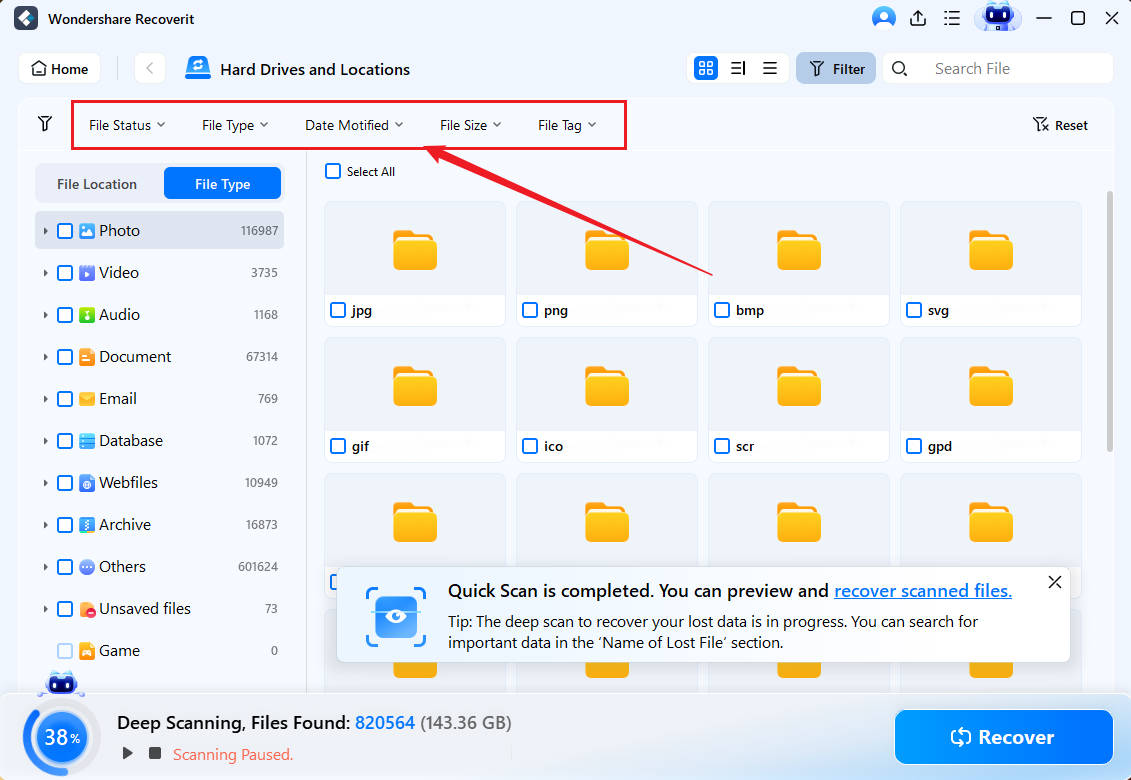
- Filter and search. Narrow results by file type, size, tags, modified date, or keyword.
- Preview files. Preview supported files to confirm that you are recovering the right documents, photos, videos, or other files.

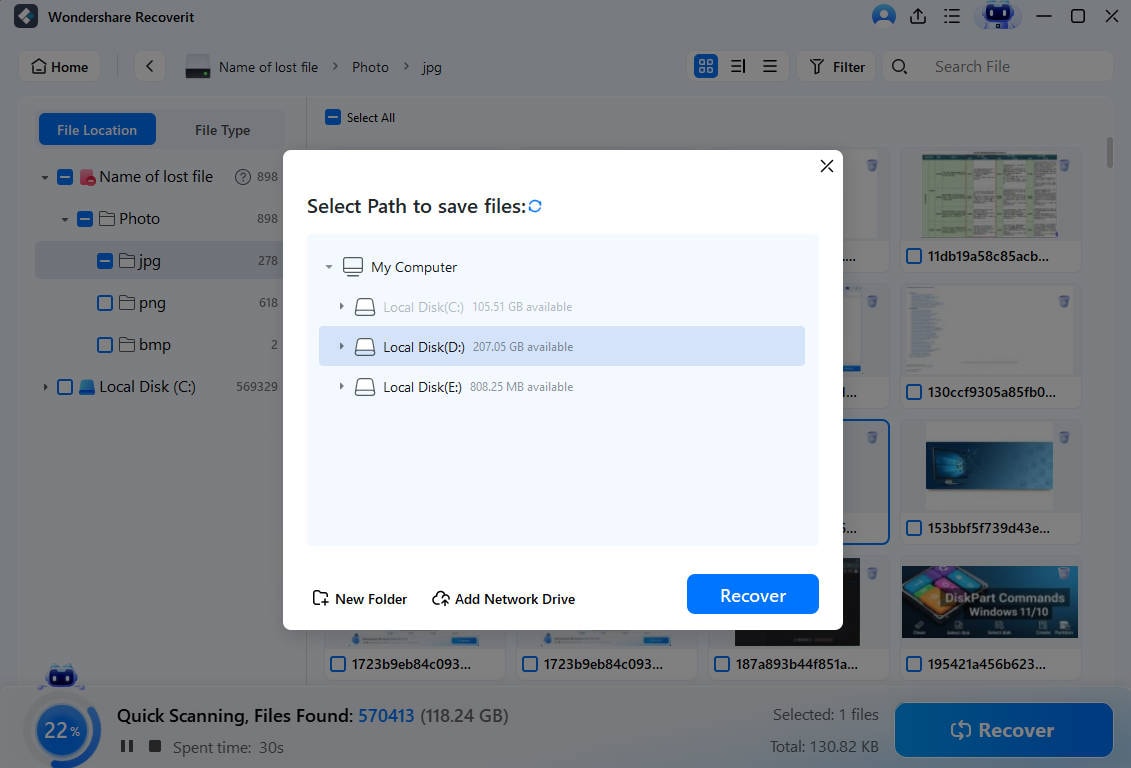
- Recover to a safe location. Select the files you want and save them to a different drive, not the same storage device being scanned.
- Save scan results if needed. If the scan is large, save scan results so you can return later without starting from zero.

Related Video: How to Recover Lost Files from Hard Drive?
Part 9. DriveSavers vs Recoverit: Which One Do You Need?
| Feature | DriveSavers Data Recovery Service | Wondershare Recoverit Software |
| Best use case | Physical damage, failed hardware, phones, RAID/NAS/SAN, enterprise, ransomware, and high-stakes cases. | Accidental deletion, formatting, partition loss, system crash, virus attack, and readable-drive logical data loss. |
| Device handling | You ship the device to a lab. | You keep the device and scan locally. |
| Cost model | Quote-based after evaluation; no universal fixed public price table. | Software pricing with free scan/preview workflow before recovery purchase decisions. |
| Turnaround | Priority, Standard, or Economy, plus shipping and evaluation time. | Minutes to hours for many logical cases, depending on device size and scan depth. |
| Hardware damage | Appropriate for cleanroom or component-level recovery. | Not appropriate for physically failed or undetected storage. |
| Privacy | Professional security controls, but a third party handles the device. | Local scan keeps the storage device in your possession. |
| Payment confidence | No Data, No Charge policy if data is unrecoverable. | Preview and scan results help users decide before saving recovered files. |
The practical recommendation is not "DriveSavers or Recoverit for everyone." It is: use the lab when the hardware or business risk demands it; use software first when storage is readable and the loss is logical.

Conclusion
DriveSavers is a premium data recovery lab with a long history, strong security positioning, free evaluation, free shipping label, and No Data, No Charge policy. It is a serious option for damaged hard drives, failed SSDs, Apple devices, phones, RAID, NAS, servers, ransomware, and regulated or business-critical data.
Its main downside is cost and friction. You need to ship the device, wait for evaluation, approve a quote, and trust a third party with the media. For severe or irreplaceable cases, that can be worth it. For common logical data loss on a readable drive, it may be more than you need.
If your drive is physically damaged, stop using it and contact a professional lab. If your drive is readable and the data loss is deletion, formatting, partition loss, or transfer failure, try a non-destructive recovery workflow first. Recoverit can help scan readable storage for recoverable files, but recovery depends on drive condition, overwriting, encryption, and detectability.
FAQ
-
Is DriveSavers safe?
DriveSavers publishes security credentials such as ISO Class 5 cleanroom, annual SOC 2 Type II audit, HIPAA-related compliance, GLBA-related requirements, and secure handling claims. It is a reputable lab, but you should still review the quote, privacy terms, and service agreement before shipping sensitive devices. -
How much does DriveSavers data recovery cost?
DriveSavers does not publish one fixed price table for all cases. The final cost depends on complexity, completeness, turnaround time, damage type, device type, and recovered file structure. The official pricing page says the final price will not exceed the initial quoted maximum. -
Does DriveSavers charge if it cannot recover data?
DriveSavers advertises a No Data, No Charge policy. If the data is unrecoverable, it says there is no charge for the recovery attempt and the device is shipped back free. -
How long does DriveSavers take?
DriveSavers lists Priority as ASAP upon receipt, Standard as 1-2 business days, and Economy as 5-7 business days, with 10-14 business days for smart devices. Shipping, evaluation, quote approval, and case complexity can affect total time. -
Is DriveSavers recommended by Apple?
Apple lists DriveSavers among recommended companies that provide data recovery services, but Apple also says these companies are not Apple Authorized Service Providers and Apple does not warrant their services. -
Can DriveSavers recover encrypted drives?
DriveSavers may handle some encrypted-device recovery cases, but encryption can still prevent recovery. Legitimate passwords, recovery keys, trusted devices, or account access may be required. No provider should promise to bypass strong encryption without keys. -
When should I use Recoverit instead of DriveSavers?
Use Recoverit first when the storage device is readable and the problem is logical, such as accidental deletion, formatting, partition loss, or lost files from a healthy external drive. Use a lab when the device is physically damaged, clicking, burned, water-damaged, or not detected. -
Can Recoverit recover data from a physically failed hard drive?
No. Recoverit can scan readable storage for recoverable files, but it cannot repair physically failed hardware, recover from undetected drives, bypass encryption, or guarantee overwritten data.