
 TL;DR:
Recovering deleted photos and videos from a Nokia Lumia depends heavily on the original storage location, requiring you to either restore existing cloud backups or extract a removable microSD card for a desktop software scan.
● Media previously uploaded to Microsoft OneDrive can be restored from the cloud Recycle bin within a 30-day window for personal accounts or 93 days for work and school accounts.
● If the missing files were stored on a removable microSD card, switch off the phone, physically remove the card, and scan it directly through a computer card reader to prevent overwriting the remaining data.
● Desktop recovery software cannot retrieve files deleted from the Lumia's internal memory over a standard USB connection, and Android-style USB debugging methods do not function on Windows Phone or Windows 10 Mobile devices.
Ask AI for a summary
 ChatGPT
 Perplexity
 Gemini
 Claude
 Grok
Nokia Lumia photo recovery depends on where the files were saved. Check your original Microsoft OneDrive account and old computer copies first. If the missing photos or videos were on a removable microSD card, connect that card to a computer for recovery. If they were deleted only from the phone's internal memory, a normal USB connection does not establish that desktop recovery software can retrieve them.
Before you start: Stop taking pictures, recording videos, or installing apps on the affected phone. Do not reset the Lumia, reinstall its system, or format a card that contains missing files. Save recovered files to another healthy storage device.
In This Article
Part 1. Choose the Right Lumia Recovery Method
A missing picture in the Photos app does not tell you whether its original file was deleted, backed up, or saved on a different storage location. Identify the source before choosing a Lumia recovery tool.
Check Where the Photos and Videos Were Stored
Use the situation that matches your missing files. Having a memory card in the phone does not mean the camera saved every photo or video to it.
| Your situation | Best next step | What this can retrieve |
| You previously uploaded the files to OneDrive | Check the original account and its Recycle bin | Existing cloud copies or deleted cloud items still eligible for restoration |
| The phone opens and the files are still visible | Copy accessible files to a computer over USB | Files that remain on the phone; copying does not undelete missing files |
| The files were on a removable microSD card | Switch off the phone, remove the card, and scan it through a card reader | Recoverable data still present on a readable card |
| The files were deleted from internal memory and no backup exists | Preserve the phone and consider a specialist assessment | Possibilities depend on the exact model, condition, and remaining data |
Check your exact model's manual before removing a card. For example, the original Nokia Lumia 520 user guide documents a removable memory card and instructs owners to switch off the phone before taking it out. Do not assume every Lumia has the same storage options.
Lumia Software Recovery Tool vs. Photo Recovery
A search for a Lumia software recovery tool can lead to phone-system recovery software. In its official 2014 Windows Phone update guidance, Microsoft described the Nokia Software Recovery Tool as a way to reset a device. Resetting the phone is a different task from retrieving deleted photos, and can erase personal content. Use the backup, file-copy, or memory-card methods below for missing media.
Understand the Limits of Phone Memory Recovery
Seeing a Lumia in File Explorer is not proof that its deleted internal files can be scanned. The Lumia 1020 user guide describes browsing the phone as a portable device to copy existing files. Microsoft's Windows Portable Devices architecture distinguishes Media Transfer Protocol from mass-storage access. The practical implication is that ordinary file browsing should not be treated as a deleted-sector recovery connection.
In this guide, Recoverit is used for a removable microSD card connected to the computer. It is not presented as a tool for extracting deleted Lumia internal memory over USB. Android recovery apps and Android-style USB debugging instructions do not apply to a Lumia running Windows Phone or Windows 10 Mobile.
Part 2. Restore Lumia Photos and Videos from OneDrive
Use this method if: Your Lumia previously uploaded the missing media to Microsoft OneDrive, formerly SkyDrive. You can check those existing copies from a current browser without getting the old phone's apps working again.
Step 1. Check the Microsoft account you used on the Lumia
Open Microsoft OneDrive on a computer or another working device. Sign in with the original account. Look through your photos and folders, including any camera-upload folder you used. An empty account is a reason to check the sign-in address before assuming your backup is gone.
Step 2. Restore eligible items from the Recycle bin
If the files are absent from your folders, open "Recycle bin," select the missing items, and choose "Restore." The Microsoft example below shows the same restore control with sample documents; the side navigation can differ between personal and work accounts.
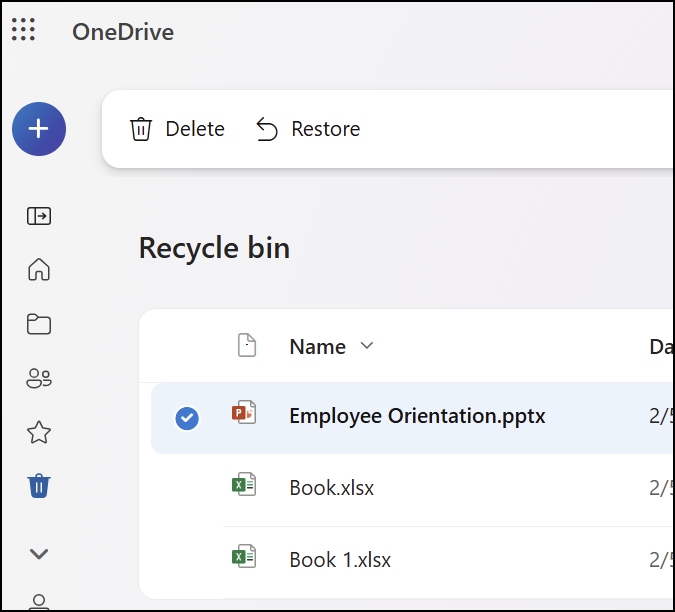
Microsoft OneDrive screenshot. Used with permission from Microsoft.
Microsoft's OneDrive restoration guidance gives personal accounts a 30-day deleted-item window; work or school accounts normally have 93 days unless an administrator changes the setting. These periods concern deletion from OneDrive, not how many years ago the photo was taken. Items permanently deleted from its Recycle bin cannot be restored there.
Step 3. Download and check your recovered copies
Download the files you found or restored to your computer. Open the photos and play the videos to confirm that the files contain the memories you need, then keep a second copy on another device.
If nothing appears: OneDrive cannot supply photos or videos that were never uploaded. Check an old computer, external backup, or previously shared copy, then use the card method below if the originals were stored on microSD. Enabling cloud backup now will not recreate an already deleted original.
Part 3. Copy Photos and Videos That Are Still on the Phone
Use this method if: The Lumia can turn on, you can unlock it, and a compatible Windows computer can browse its media folders. This preserves files that still exist, including files missing from an app's view. It does not recover files already deleted from internal memory.
Step 1. Connect and browse the phone
Connect the unlocked Lumia with a USB cable that supports data transfer. Open Windows File Explorer and look for the phone under "This PC" or the available portable devices. Open the phone entry and locate its photo and video folders. Depending on the device, these may include "Pictures," "Camera Roll," and a separate memory-card location.
This follows the file-manager transfer route documented for the Lumia 1020 and Lumia 520. It depends on the computer actually exposing those folders; it should not be assumed to work identically on older Windows Phone 7 models.
Step 2. Copy the files to the computer
Select the accessible photos and videos and use "Copy" or "Ctrl+C." Open a destination folder on your computer and use "Ctrl+V." Keep the source files in place until you have verified the copies. In the Windows 11 menu example below, "Copy" is the second icon on the top row.
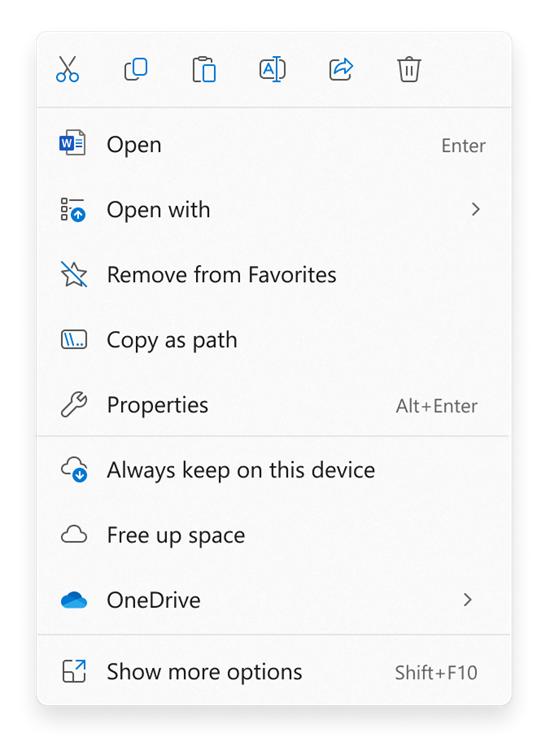
Microsoft Windows 11 screenshot. Used with permission from Microsoft. This example illustrates the Copy command for a document; other menu options can differ for files on your phone. See Microsoft's File Explorer guidance.
Step 3. Verify the photos and videos
Open several copied photos at full size and play important videos through different points in the recording. Check dimensions and file sizes if an image looks unusually small. Keep all available versions until you know which is the original.
If the phone does not appear: Check that it is unlocked, then try another data cable or USB port. Avoid resetting or reinstalling its system to force detection. If its folders remain inaccessible, return to existing backups or the removable-card route.
Part 4. Recover Deleted Files from a Lumia Memory Card
Use this method if: The missing photos or videos were saved on a removable microSD card and the card can be read reliably by your computer. Recoverit memory card recovery can scan this storage for recoverable files after deletion or formatting. Wondershare's supported-device list includes microSD cards.
If this matches your situation, download Recoverit to the computer, connect the card through a reader, and inspect the scan results. The download is free; saving recovered files depends on the applicable plan and limits. Recovery is not guaranteed, and overwritten data cannot be restored by a scan.

Lost precious photos or videos from your Nokia Lumia? If they were stored on a removable microSD card, Recoverit can scan the readable card for deleted or formatted files. Preview recoverable memories and save them safely to another drive.
Step 1. Remove the card and prepare a safe destination
Switch off the Lumia and remove the microSD card as described in its model-specific manual. Have a card reader and a separate healthy drive ready. Install Recoverit on the computer, not on the affected card. The following screens show the Windows workflow from the official Recoverit user guide.
Step 2. Open SD Card Recovery and connect the card
Launch Recoverit and choose "SD Card Recovery" in the left sidebar. Connect the removed microSD card with your reader. The screen below shows the card-recovery workspace before a card is connected.
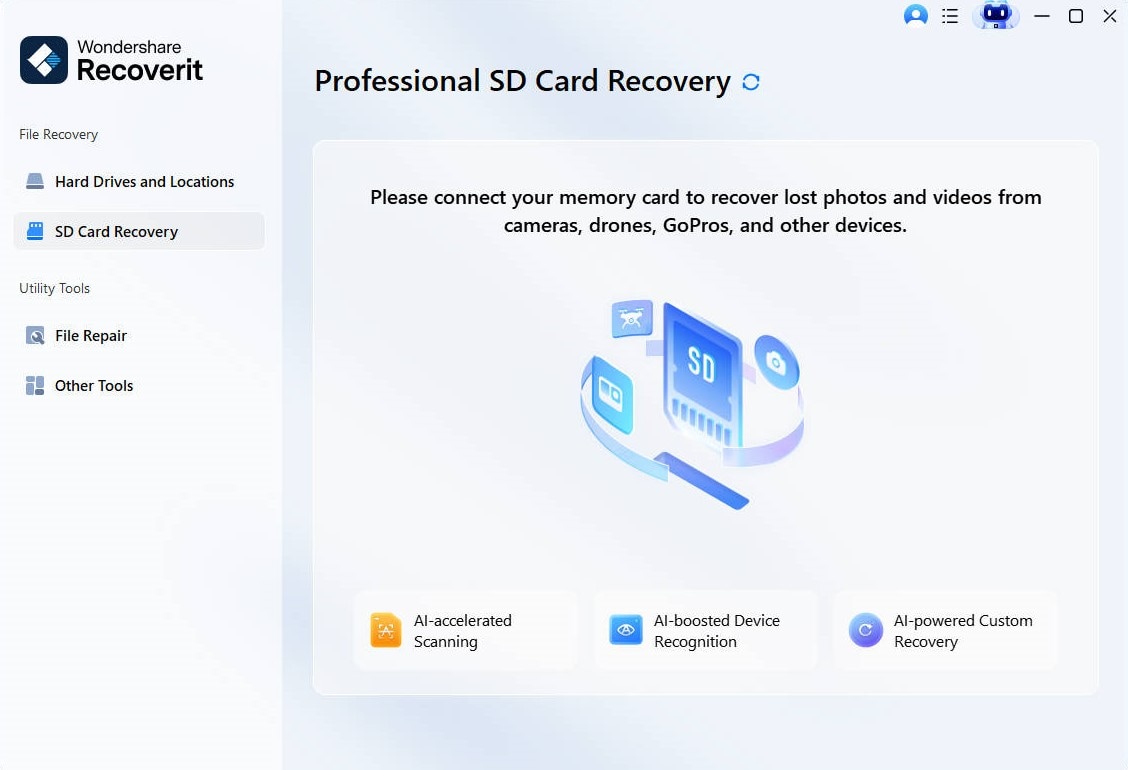
If Windows asks you to format the card, cancel that request. Formatting is not a prerequisite for recovery. Confirm the detected card's capacity so you do not accidentally select your computer's drive.
Step 3. Scan the card and inspect the results
Select the detected card and start "Scan." Use the "Photo" and "Video" categories to narrow the results, and preview the files you need where supported. The sample scan below uses the label "USB Drive (G:)"; your card's name and drive letter may be different.
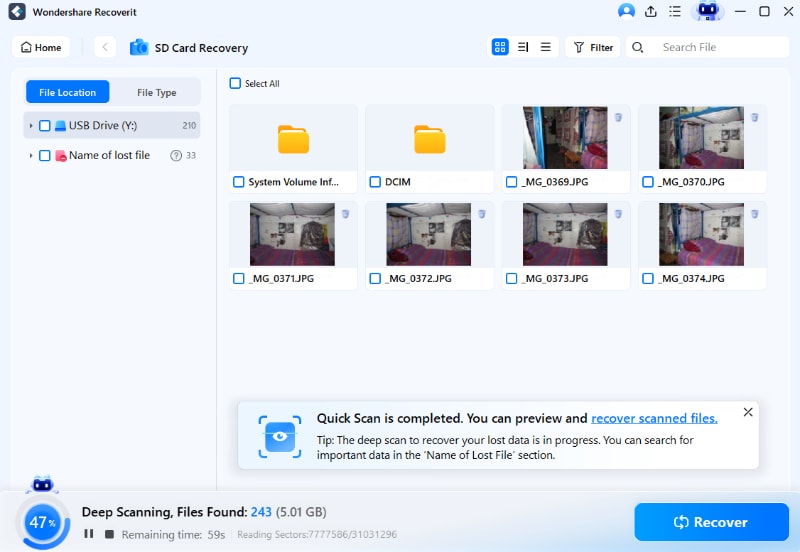
Check the actual photo content and video playback rather than relying on filenames alone. A result listed in a scan is not a guarantee that every part of the file remains intact.
Step 4. Save to another drive and verify the files
Select the files to keep, choose "Recover," and save to your computer or another healthy drive. Do not save to the source microSD card. The destination dialog below illustrates this separate-drive choice.
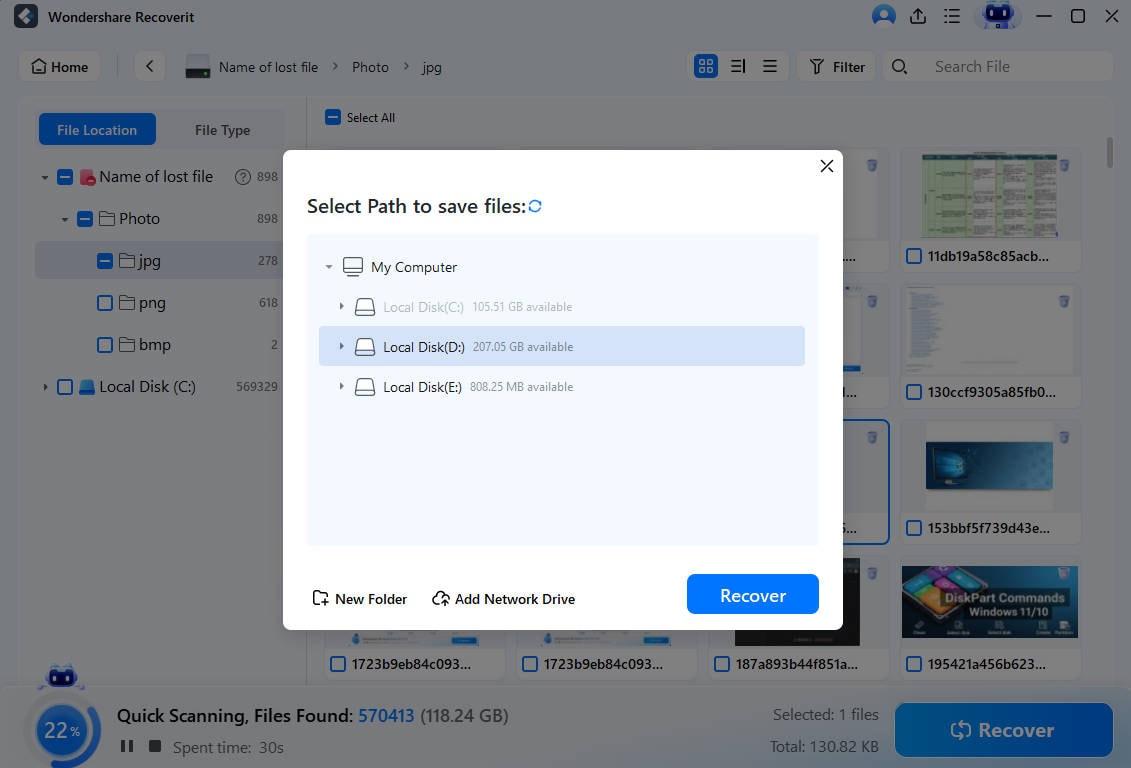
Open the saved files outside Recoverit and check important photos and videos. Keep the card unchanged until you have verified the result and made a second copy of the files you recovered.
If the scan cannot start: A card that is not detected, repeatedly disconnects, or has physical damage needs a different approach. Stop repeated scan attempts when access is unstable. The guide to an SD card not being detected covers connection checks; preserve the data before following any repair or formatting instructions.
Part 5. What to Do If Your Files Are Still Missing
The next step depends on what stopped the recovery. Use these boundaries to avoid spending time on a method that cannot reach your original files.
- The card was formatted: Recovery may still be worth attempting if the card is readable and recoverable data remains. Stop using it and follow the formatted SD card recovery guide for that specific case.
- The only copy was deleted from phone memory: Check earlier cloud, computer, and shared copies. If the files are irreplaceable, ask a qualified recovery service to assess the exact Lumia model and its condition before any reset or system reinstall. An assessment does not guarantee recovery.
- The phone or card has physical damage: Stop do-it-yourself software attempts and seek a professional assessment. A storage scan cannot repair failed hardware.
Conclusion
To recover Nokia Lumia photos and videos, start with the storage location: restore an existing OneDrive copy, copy files that are still accessible, or scan a removable microSD card. Use Recoverit when the lost media was on a card your computer can read, and save the results elsewhere. For deleted internal-memory files without a backup, preserve the phone and seek a realistic assessment instead of following Android app or USB debugging instructions.
FAQ
-
Can I recover deleted Lumia photos without a computer?
You can retrieve existing OneDrive copies or eligible cloud Recycle bin items from another device with a working browser. That requires a copy already stored in the account. The removable-card scan described here requires a computer and card reader. -
Will resetting my Lumia bring back missing photos?
No. A factory reset is not an undelete method and can erase personal content, as the Nokia Lumia 520 manual explains. Preserve available files and backups before considering a reset for any separate device problem. -
Is there a time limit for recovering deleted photos from a Lumia memory card?
A microSD card does not follow OneDrive's 30-day Recycle bin rule. Recovery depends on whether readable file data remains and has not been overwritten. Stop using the card promptly; the number of days since deletion alone cannot predict the result. -
Why are some recovered Lumia 1020 photos lower resolution?
The original Lumia 1020 guide describes a 5-megapixel sharing image and a full-resolution counterpart in its Nokia Pro Camera workflow. Check all available files and their dimensions. Recovering a smaller copy does not reconstruct a missing full-resolution original.


