How to Restore a Hard Drive to its Full Capacity?

Jun 03, 2026 • Filed to: Answer Hard Drive Problems • Proven solutions
If you also have a similar query and would like to restore your external hard drive to its full capacity, then you have come to the right place. Too many times, while formatting or using the hard drive, it can shrink or suffer from logical errors. The good news is that learning how to restore a hard drive to its full capacity is easy. In this post, I will teach you how to restore a hard drive to its original size in different ways.
| If Your Drive... | Likely Cause | Recommended Fix |
| Shows exactly 32GB (was 1TB+) | Used as Bootable/Installation Media | Disk Management / Delete Partition |
| Shows "Unallocated Space" | Partition Table Corruption | Diskpart Utility (Clean Command) |
| Is not recognized at all | Outdated Drivers | Update Disk Drivers |
Lost data after restoring size |
Formatting/Wiping the drive | Wondershare Recoverit |
Why Does 1 TB Hard Drive Only Shows 32 GB Space?
To learn how to restore a hard drive capacity, it is important to understand the common triggers behind this issue. Ideally, your hard drive’s capacity could have shrunk due to the following reasons:
- You would have formatted the hard drive incorrectly or the process could be halted in between.
- If you have made the hard drive a bootable media (like Windows PE), then it might only show the shrunk space of 32 GB.
- The file system of the hard drive might not be supported by your computer (like using an APFS drive on Windows).
- The connected hard drive has not been authorized or is blocked by your computer.
- The respective drivers running on your system could be corrupt or outdated.
- The external hard drive might not be removed properly or suffers from a connectivity issue.
- Lastly, your hard drive can be attacked by malware or might be suffering from a logical error (like unassigned storage).
| File System | Best For... | Max Capacity Support |
| NTFS | Windows Internal/External Drives | Up to 8PB (Standard) |
| exFAT | Cross-platform (Windows & Mac) | Up to 128PB |
| FAT32 | Older devices/Legacy USBs | Limited to 32GB (Windows limit) |
How to Restore a Hard Drive to its Original Capacity?
As you can see, there could be so many reasons for an external hard drive for only showing 32 GB space. To overcome this and fix the 1 or 2 TB hard drive only showing 32 GB space issue, you can follow these suggestions.
Fix 1: Perform a Quick Format of the Hard Disk
A while back, when my external hard drive was only showing 32 GB space, I performed a quick format and it instantly fixed the problem. The best part is that you can learn how to restore a hard drive capacity with this method easily by following these steps:
- Connect your hard drive to your computer (if it is an external drive) and launch My Computer (or This PC) on Windows Explorer.
- Now, right-click the icon of the hard drive that has been shrunk and go to the “Format” option from the context menu.
- Here, you can select a preferred file system or change the formatting scheme for the drive. In the end, click on the “Format” button and wait as your hard drive would be reassigned.

Fix 2: Delete the Partition and Reformat it via Disk Management
If a quick format is not able to fix the issue and your 1 TB hard drive is only showing 32 GB storage, then try this approach. In this, we will take the assistance of the Disk Management application to delete the partitions and then format the hard drive entirely.
- Once the hard drive has been connected to your system, you can launch the Disk Management application from the start menu. You can also open the Run prompt and enter the “diskmgmt.msc” command.

- As the Disk Management application would be launched, you can select the partition and right-click. From here, you can choose to delete the 32 GB partition of your drive.
- After getting rid of all the partitions, you can right-click the hard drive icon, and choose to format it instead.

- This will open a dedicated wizard from where you can select an appropriate file system for the drive. You can follow the wizard and enter the relevant details to format the entire disk successfully.

Fix 3: Use the Diskpart Utility to Format the Drive
At times, users find it hard to learn how to restore the hard drive to its original size due to different reasons. In this case, I would recommend launching Command Prompt and using the Diskpart utility to fix this issue.
- If the external hard drive is only showing 32 GB space, then connect it to your computer first, and launch Command Prompt as an administrator.
- Once the Command Prompt is launched, enter the “diskpart” command to load the disk partition utility.
- Now, just enter the “list disk” button to get a list of all the connected disks. You can further use the “select” command followed by the identifier to mark it (like select disk 2).

- Great! Once the disk is selected, you can type and enter the “clean” command to wipe its storage.
- Afterward, enter the “create partition primary” command to create the primary partition on your drive.
- In the end, you can enter the “format” command to format the drive followed by its file system. For instance, to format the disk in the NTFS file system, you can enter the “format fs=ntfs” command.

If you are trying to restore a drive larger than 2TB and it only shows 2TB of usable space, your disk is likely initialized as MBR (Master Boot Record). MBR cannot address space beyond 2TB.
The Fix: In the Diskpart utility, after using the clean command, type convert gpt. This will change the partition style to GUID Partition Table (GPT), allowing Windows to recognize the full capacity of modern, large-scale hard drives.
Fix 4: Update the Relevant Hard Disk’s Drivers
In case your system is running on an old or outdated driver, then you can find it hard to restore the external hard drive to its full capacity. To fix this, you can just update the drivers (disk or USB) to the latest available versions. Here’s how to restore the hard drive to full capacity by updating the drivers.
- Go to the Start menu and look for “Device Manager” to open the application. Alternatively, you can also open the Run prompt and enter the “devmgmt.msc” command.

- As the Device Manager window will open, you can expand the relevant category and select your hard drive or USB driver.

- Right-click the driver’s icon and choose to update the driver from here. This will launch a dedicated wizard that you can follow to look up relevant updates and install them on your system.
Fix 5: Manually Install the Software for the USB Driver
Lastly, if your external hard drive is only showing 32 GB space, then you can manually install its drivers. For this, you need to know the device’s details and can find the compatible driver by visiting its website.
- Just launch the Device Manager application and right-click the driver’s icon to go to its properties.
- As the Properties window would open, go to the Details section and check the specifications of the installed driver.

- Now, you can just go to the official website of the driver and install the relevant software on your system to fix it.
By following these methods on how to restore the hard drive to its original size, you would be able to fix this issue. Though, if your 1 or 2 TB hard drive is still only showing 32 GB space, then you can consider visiting an expert or the service center of the manufacturer to get it fixed.
How to Retrieve Data from a Hard Disk That Lost its Capacity?
While learning how to restore a hard drive to full capacity, you might have to format the disk. In this case, your important files from your hard drive might be deleted or lost. While this might seem like an unforeseen situation, you can get your files back with a dedicated tool like Wondershare Recoverit Data Recovery. It is a 100% safe and user-friendly solution to extract your lost, deleted, and inaccessible files under all possible scenarios.
- With the help of Recoverit Data Recovery, you can restore your photos, videos, documents, audios, and all kinds of data.
- The application supports data recovery from the internal hard drive or any other source (like an SD card or external hard disk).
- It is also fully compatible with hard drives manufactured from all the popular brands and in different file systems (like NTFS, FAT, exFAT, APFS, and more).
- Users can select a source (like a partition, folder, or the entire drive) from where their data has been lost.
- Recoverit Data Recovery has one of the highest success rates and would yield positive results in all scenarios like lost partition, formatted disk, and more.
To restore your lost or deleted data from your computer’s drive or an external hard disk, you can follow these instructions.

Step 1: Mark a location to scan
Firstly, install and launch Recoverit Data Recovery on your computer and select a location to scan. You can pick any partition of your computer or can select any other connected source (like an external hard drive).

Step 2: Let Recoverit extract your data
As you would click on the “Start” button, you can just wait for a while and let Recoverit scan the selected source. It is recommended to wait for a while and check the progress from the on-screen indicator. If you have got your data back, then you can pause or stop the process from here.

To make things easier for you, Recoverit will automatically list your data under different categories. Besides that, you can also use the inbuilt search and the available filters to look for specific files (based on size, file type, and more).
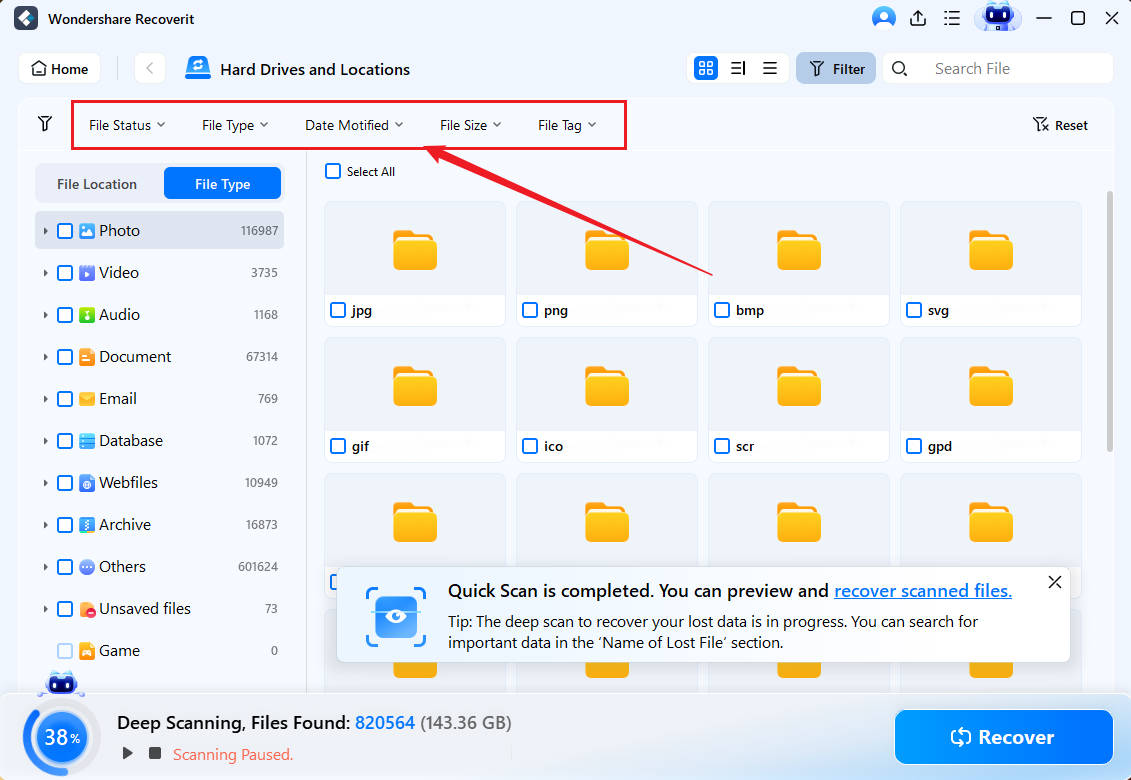
Step 3: Preview your files and recover your data
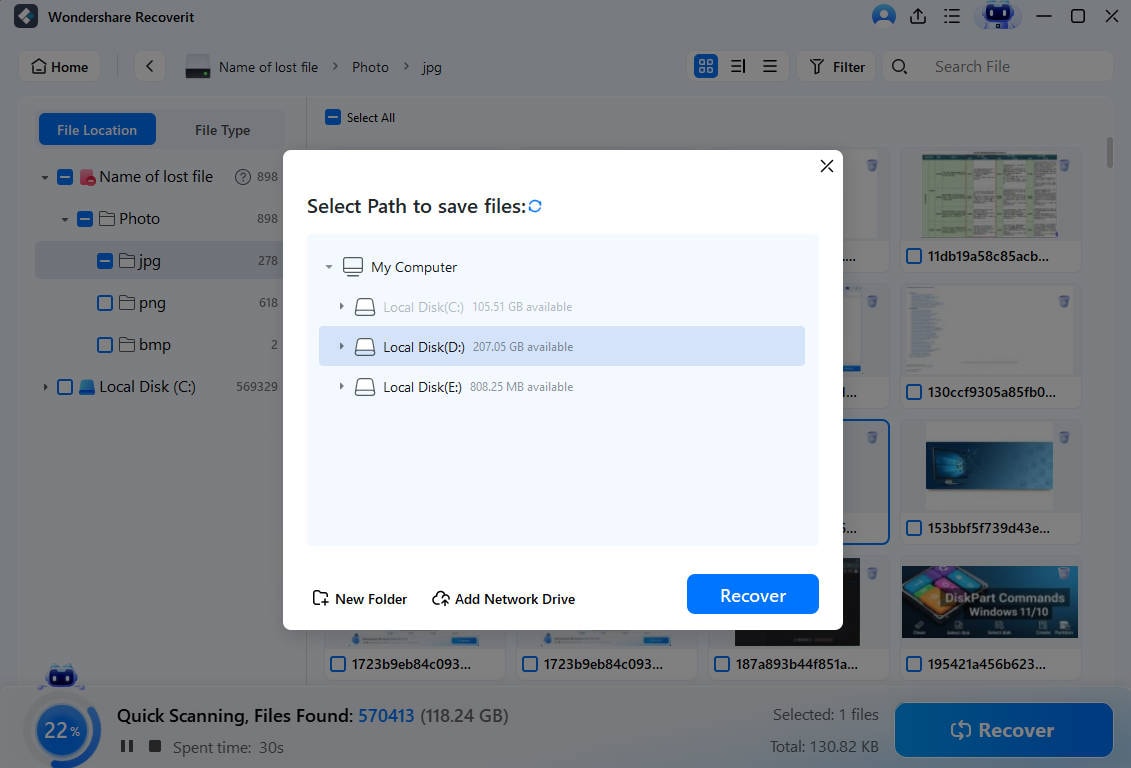
You can also get a preview of your photos, videos, audio files, documents, etc. that are retrieved by Recoverit. Lastly, just select what you wish to get back and click on the “Recover” button.

This will let you select a new location where you want to save your data. I would recommend saving your data to any other drive that you can still access without any trouble.
Restoring a hard drive to its full capacity usually requires wiping the existing partition table, which results in total data loss. Whether you use Disk Management or the Diskpart clean command, the process is highly effective but destructive. To ensure you don't lose years of files in the process, always run Wondershare Recoverit after the restoration. It can deep-scan the "unallocated" or "formatted" sectors to retrieve your original data even after the drive's capacity has been reset.
People Also Ask
-
Why is my 1TB hard drive only showing 32GB of space?
The most common reason is that the drive was used to create a Windows Installation Media or a Recovery Drive. Windows automatically creates a 32GB FAT32 partition for these bootable tools, leaving the remaining capacity as "Unallocated" and invisible to File Explorer. You will need to delete this partition and reformat the drive to reclaim the full 1TB. -
Will restoring my hard drive to full capacity delete my files?
Yes. Methods such as Quick Format, Disk Management, and the Diskpart "clean" command involve wiping the drive's partition table or reformatting the file system. Because these processes are destructive, it is highly recommended to use a tool like Wondershare Recoverit to rescue your important data either before you start or immediately after the restoration is complete. -
What should I do if my 3TB+ drive only shows 2TB after formatting?
This issue occurs because the drive is using the MBR (Master Boot Record) partition style, which cannot address storage space beyond 2TB. To fix this, you must convert the drive to GPT (GUID Partition Table). You can do this via Disk Management by right-clicking the disk (after deleting all volumes) and selecting "Convert to GPT Disk," or by using theconvert gptcommand in Diskpart. -
Is it possible to recover data from a hard drive that was "shrunk" to 32GB?
Yes, it is possible. When a partition is shrunk, the data in the "lost" portion of the drive is usually still physically present on the platters or flash chips; it is simply no longer indexed by the operating system. Professional software like Wondershare Recoverit can perform a deep scan of these raw, unallocated sectors to identify and reconstruct files even after the partition structure has been altered.
What's Wrong with Drive
- Recover Your Drive
- Get WD files back now.
- Recover Seagate data easily.
- Drive damaged? Recover data
- Recover Toshiba drive data.
- Top tools to recover hard disk.
- Recover deleted files from C drive
- Fix Your Drive
- Repair external hard drive
- Fix an undetected hard disk.
- Fix drive I/O error.
- Solve hard drive crash.
- Remove all bad sectors.
- Get data off old hard drive
- Fix "The file or directory is corrupted and unreadable"
- Format/Wipe Drive
- Best hard drive eraser.
- Recover hard drive without formatting
- How to unformat a hard drive
- Erase Mac drive
- Format external hard drive on Mac
- Know Your Drive
- What is PATA?
- What is a Solid State Drive?
- What is a hybrid drive and do i need it?
- What is optical drive and how does it work?
- Magnetic Disk Guide
- Increase hard drive speed.
- What Is Zip Drive?
- What Is Floppy Disk?
- What Is SATA?
- What Is NVMe?
- Top 10 cheapest external drive.
- 5 external drive for Mac.
- Clone your hard drive.
- Recover data from dead computer


Theo Lucia
chief Editor