
 TL;DR:
Updating a PS4 via USB safely bypasses network failure loops and requires installing the official `PS4UPDATE.PUP` file through the console's Safe Mode using a specifically formatted drive.
● The USB flash drive must be formatted to FAT32 or exFAT (NTFS is strictly unsupported) and contain the exact uppercase folder structure `PS4` > `UPDATE` to host the downloaded firmware file.
● To execute the installation, fully power down the console, hold the power button for 7 seconds until a second beep sounds to boot into Safe Mode, connect a DualShock 4 controller via USB cable, and select "Update System Software."
● Ensure you download the standard update file rather than the larger reinstallation package, as selecting the "Initialize" or "Reinstall" options in Safe Mode will permanently erase all internal user data.
Ask AI for a summary
 ChatGPT
 Perplexity
 Gemini
 Claude
 Grok
Grok
A PS4 update can fail when the internet drops or downloads stop halfway. A USB update avoids network issues and gives you more control. This guide shows how to update your PS4 system software using a USB safely. You will learn what the USB must include and where files must go. Moreover, readers will see how to start the update from standard menus. If the console cannot load menus, Safe Mode can still help.
Try Recoverit to Perform PS4 File Recovery
 Security Verified. 3,591,664 people have downloaded it.
🎮 PS4 System Update Method Comparison Index
Evaluate which firmware deployment strategy fits your current console environment:
| Update Method | Primary Advantage | Required Tools | Best Used For | Risk Profile |
| Over-the-Air (OTA) | One-click automation | Active Wi-Fi / Ethernet | Standard, functional console maintenance | High risk of failure on unstable networks |
| Manual USB Update | Bypasses network errors | PC + FAT32/exFAT USB Drive | Resolving error loops, partial downloads, slow internet | Low; requires strict adherence to folder capitalization |
| USB Fresh Initialization | Recovers bricked consoles | PC + Full OS Reinstallation File | Severe system corruption, new HDD/SSD upgrades | High; completely erases all internal console user data |
In this article

Part 1. Why Updating Your PS4 System Software Is Important
Before learning how to update PS4 system software, understand why these updates matter first.
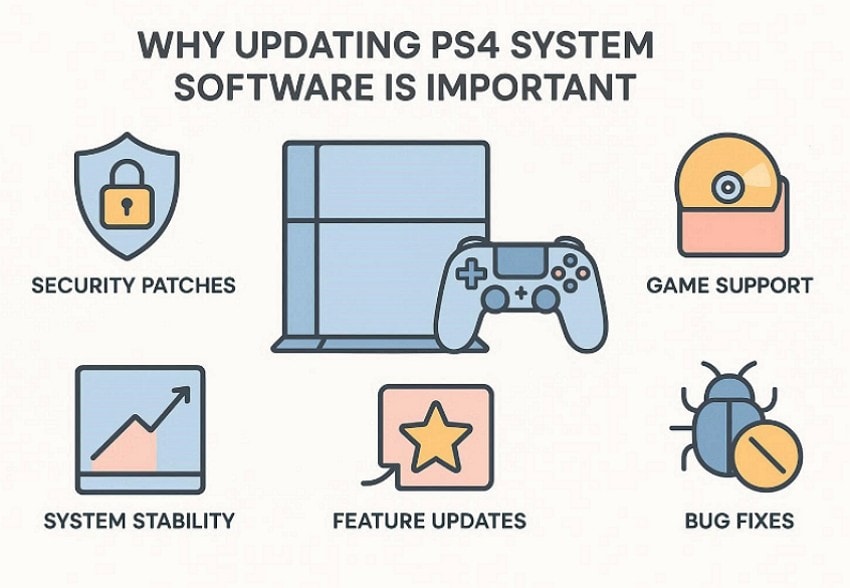
- Security Patches: Updates remove weak points that hackers may target during online gaming sessions. Stronger protection keeps logins and payment details safer on your console.
- Game Support: Many new titles need the latest firmware before they can start properly. Fresh system updates help DLC, patches, and multiplayer features run smoothly.
- System Stability: Updates correct glitches that cause crashes, freezing, or sudden restarts while playing. Better performance makes menus load faster, and apps switch more reliably.
- Feature Updates: Some updates add new settings that improve control and everyday ease. Others improve sharing tools and accessibility options for different user needs.
- Bug Fixes: Updates repair common issues that interrupt downloads or block installations completely. Fewer errors mean fewer popups and fewer repeated update failure warnings.
Part 2. Requirements For Updating PS4 System Software Using USB
Executing a manual firmware deployment requires exact hardware configurations to ensure the PlayStation 4's custom operating system can recognize the external storage blocks. Ensure you meet these criteria before proceeding:
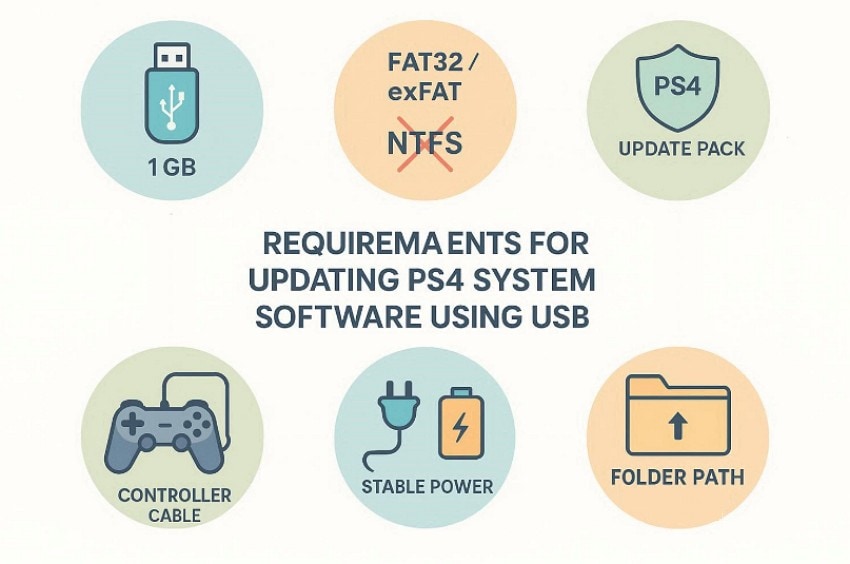
- USB Drive Compatibility: A stable USB flash drive or external drive enclosure with at least 1 GB of total storage capacity.
- File System Format: The drive volume must be formatted to FAT32 or exFAT. Windows-proprietary NTFS partitions are completely unrecognized by the console hardware.
- Exact Capitalization Directory Structure: The storage controller checks specific string pathways. The firmware installation package will fail to execute if folder names are lower-case or misaligned.
Part 3. Steps To Get The PS4UPDATE.PUP File For USB Update
Downloading the Firmware Package
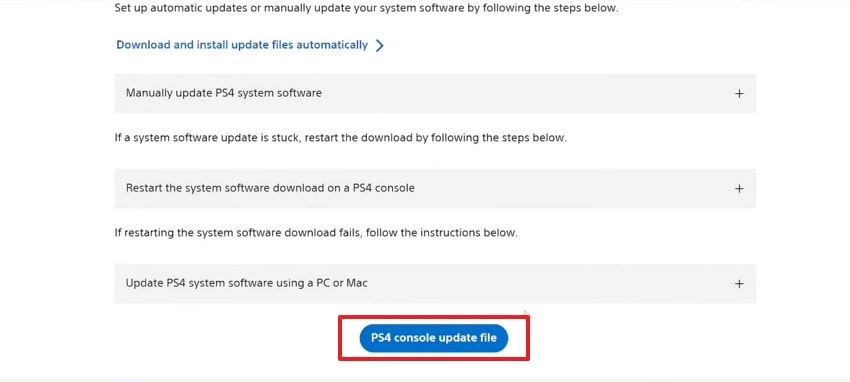
- Navigate to the official PlayStation Support System Software page.
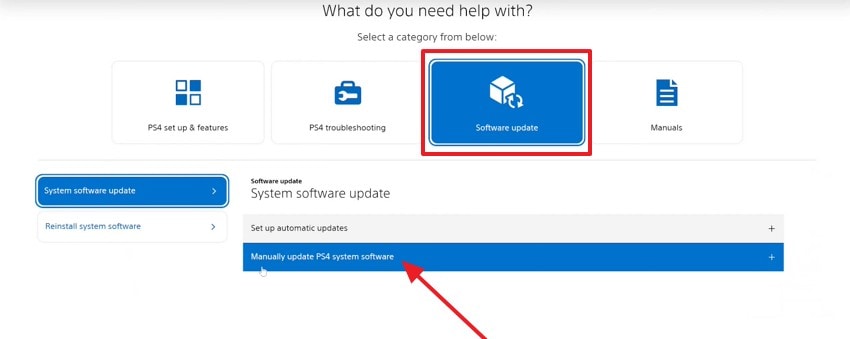
- Locate the PS4 console update file button down the page.
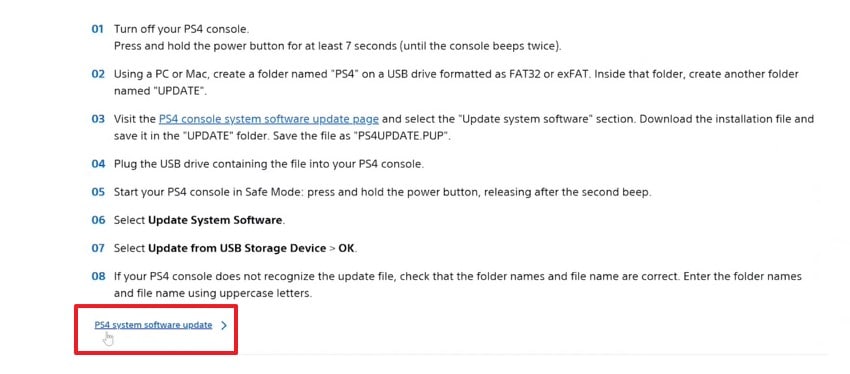
- 3. Right-click the download asset hyperlink, select Save As, ensure the file extension remains exactly labeled as `PS4UPDATE.PUP`, and click save.
Preparing Your USB Media Volume
- Reformat to a Compatible Architecture (Clear conflicting disk tables)
Insert your flash media into your PC or Mac laptop. Open File Explorer (or Disk Utility on macOS), right-click your drive icon, select Format, change the File System drop-down menu selection to FAT32 or exFAT, and click Start.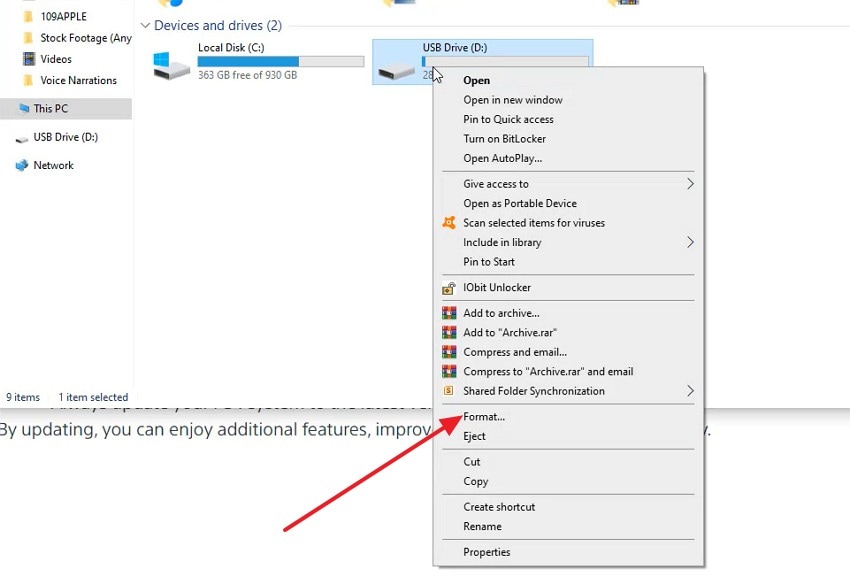
- Build the Mandatory Folder Trees (Configure system-recognizable string paths)
Open the newly formatted root directory window of your USB volume. Right-click, create a new folder, and name it PS4. Open the PS4 folder, create a new subfolder inside it, and name it UPDATE. Ensure both folder titles are written completely in uppercase letters.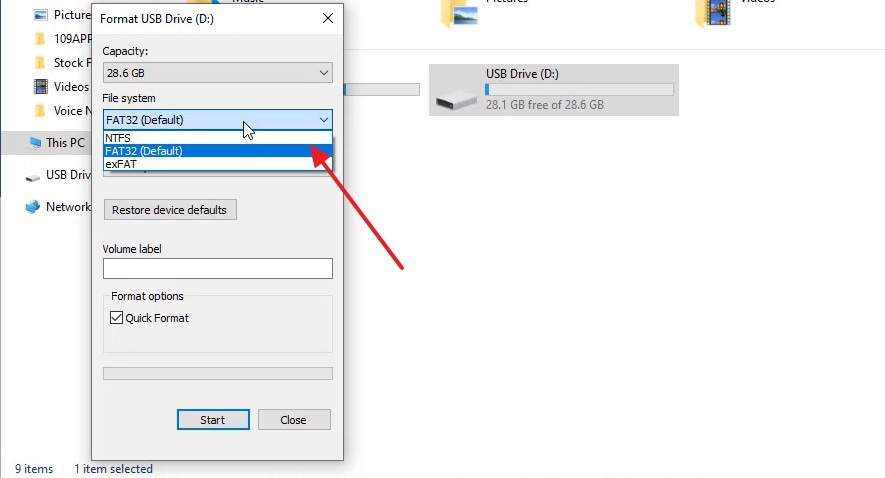
- Inject the Core Firmware Binary (Stage the installation file package)
Locate the downloadedPS4UPDATE.PUPfile on your computer. Drag or copy-paste it directly inside your newly built UPDATE subfolder. Double-check that your file configuration exactly matches thePS4 > UPDATE > PS4UPDATE.PUPsequence.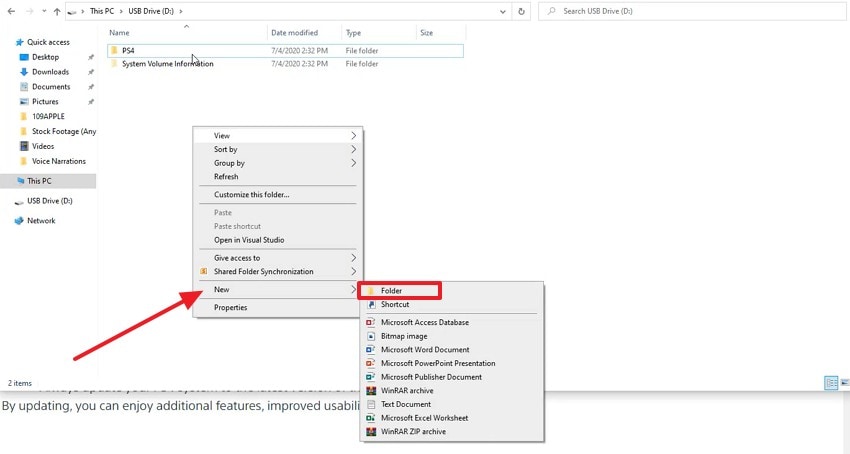
- Perform a Safe Hardware Ejection (Prevent unwritten sector caching corruption)
Right-click your USB flash drive icon in your computer system tray toolbar and select Eject. Wait for the safe hardware removal message prompt before physically pulling the drive out from your computer port.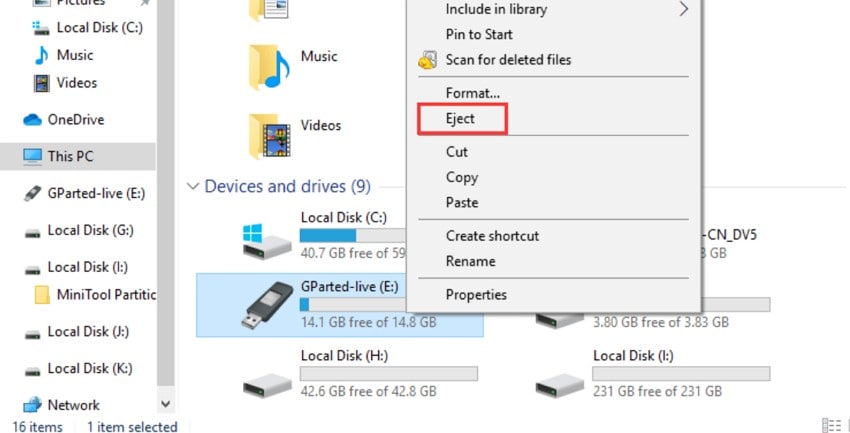
Part 4. Step-By-Step Guide To Install PS4 System Update From USB
Before proceeding, verify that your console is completely shut down. A blinking white indicator or amber rest-mode light means the system is still active. Ensure the console is fully powered off to prevent block write errors.
- Boot Into the PS4 Safe Mode Console (Trigger low-level boot parameters)
Insert your prepared update USB flash drive into an open front-facing USB slot on the console. Press and hold the physical console Power button on the front panel. Keep it pressed down for approximately 7 seconds until you hear a clear second system audio beep, then release the button. - Establish a Hardware Controller Link (Initialize manual interface overrides)
Connect your DualShock 4 controller directly to the console front port using an official USB data cable. Press the physical PS button centered on the controller faceplate to activate the hardware control menus.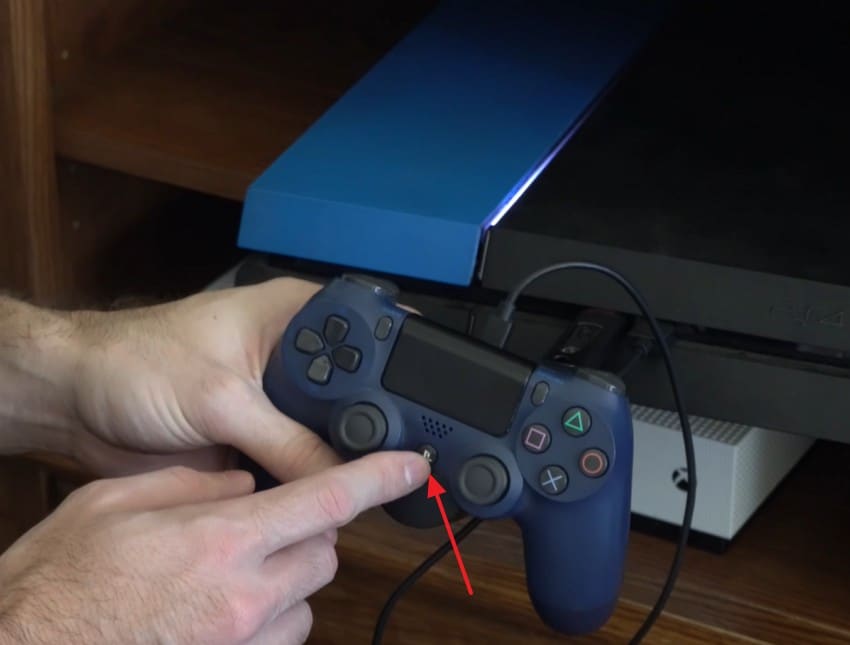
- Navigate to the Update Command Center (Direct the system to search external ports)
Use the controller directional pad to scroll down the safe mode menu list options. Highlight Option 3: Update System Software and press the X selection button.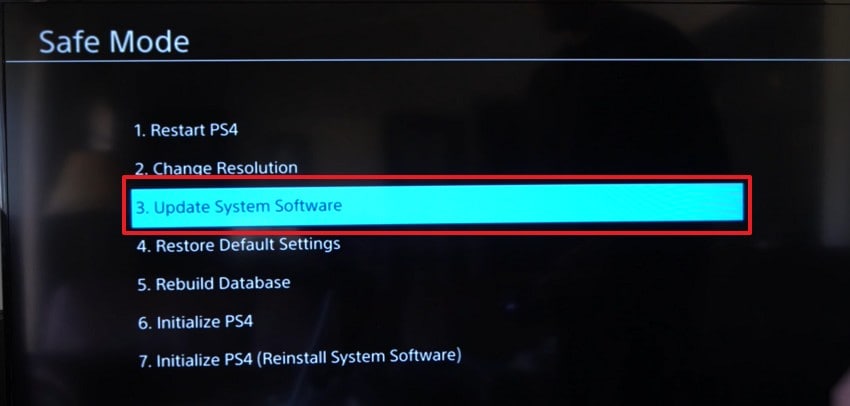
- Trigger the External Storage Update Sequence (Authorize disk verification maps)
Select Update from USB Storage Device from the resulting menu options. Review the screen prompt asking to connect your firmware file data, and select OK to begin reading the digital package.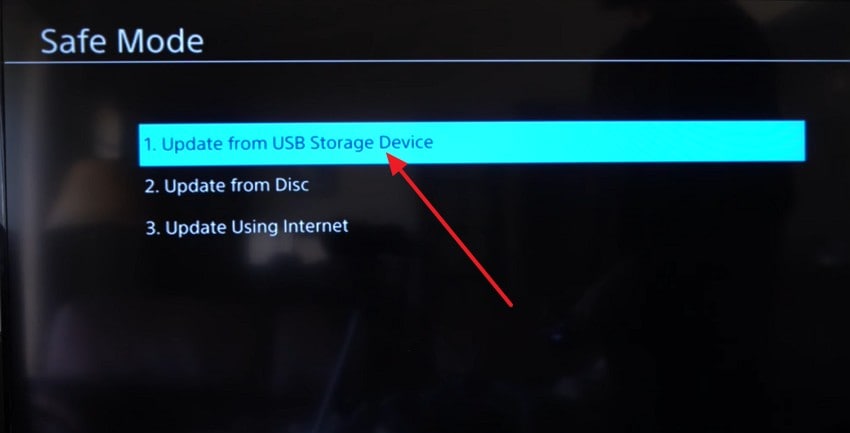
- Execute the Update Block Write Sequence (Allow the system to finish rebuilding firmware structures)
Select the final confirmation Update option. The system will start writing binary files and automatically reboot the console hardware layout. Crucial Rule: Leave the power cord plugged in and do not remove the USB media until your standard dashboard menu reappears.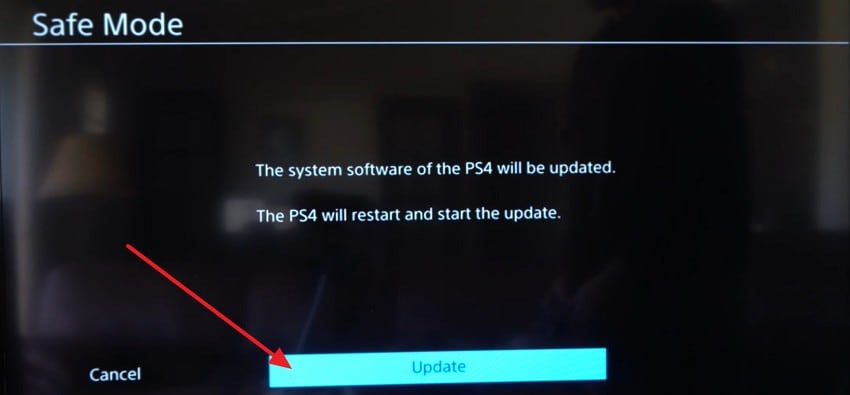
Part 5. Troubleshooting Common USB Update Errors
If you are learning how to install a PS4 update from USB, these quick fixes solve most failures:
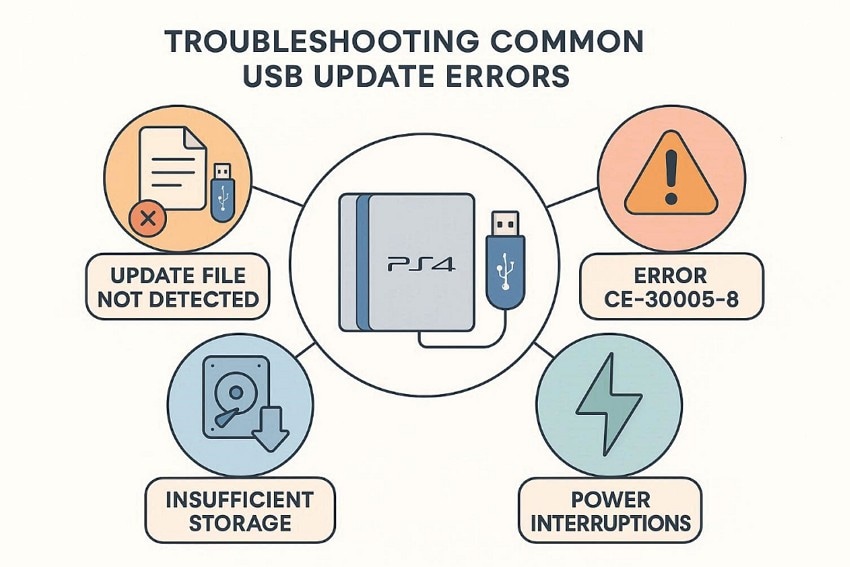
1. Update File Not Detected
Your PS4 cannot see the update file on the USB drive. This usually happens when the folder path or name is wrong. It can also happen if the USB format is unsupported or damaged.
Solution
To fix this, create the folders exactly as PS4, then UPDATE, using uppercase letters. Make sure the file is named PS4UPDATE.PUP and sits inside "UPDATE." After that, reformat the USB to FAT32 or exFAT, then copy the file again.
2. Error CE-30005-8
Error CE-30005-8 often means the PS4 cannot read the USB properly. A corrupted download or failing flash drive can trigger this message. It may also appear when the USB has bad sectors or unstable power.
Solution
To resolve this, reformat the USB to FAT32, and avoid quick format if possible. Download the update again from the official PlayStation support page. Moreover, try a different USB drive and port, then restart Safe Mode installation.
3. Insufficient Storage
The update needs free space to unpack files and finish installation. If storage is low, the PS4 stops and shows a not enough space warning. Large games, captures, and updates can fill storage faster than expected.
Solution
Delete unused games or apps and remove old captures from the Gallery. Then, move big files to external storage, or upload captures before deleting. Restart the PS4 after freeing space, then run the USB update again.
4. Power Interruptions
A power cut during updating can stop the process and risk corruption. You may see the update fail, or the PS4 restart without finishing. Unstable extension boards and loose plugs are common causes of interruptions.
Solution
To address this issue, plug the PS4 directly into a wall outlet with a steady power supply. Use a UPS if outages are common, and avoid moving cables during updates. Plus, do not remove the USB or turn off the console until completion appears.
Recoverit Safeguard: Protecting Your Media and Update Assets
System maintenance tasks such as entering Safe Mode or reformatting flash media carry data loss risks. If an unstable USB connector cuts out mid-transfer or a corrupted drive configuration forces a complete console drive initialization, you risk permanently losing your saved game files and capture gallery assets.
If a drive formatting mistake clears your files or a system crash leaves your external media unreadable, you can use **Wondershare Recoverit** to restore your data. Recoverit runs an unsegmented deep scan across your drive's raw memory sectors, bypassing broken partition mapping tables to reconstruct lost media clips, save profiles, and missing installation files.
Core Recovery Advantages:
- Formatted Volume Recovery: Rebuilds file directory trees even after a drive volume layout format choice has cleared the sectors.
- Corrupted Partition Correction: Salvages original folder tracking configurations, including lost `PS4/UPDATE` sub-allocations.
- Pro Media Repair Engine: Features advanced deep-carving file scripts that scan, verify, and stitch together fragmented MP4 video clips or corrupted screenshots from your console capture galleries.
Step-by-Step Recovery Workflow:
To recover lost data while updating the PS4 system software with Recoverit, follow the steps below:
1. Select the Recovery Location
Upon launching Recoverit, navigate to "Hard Drives and Locations" to proceed. After that, under External Drives, choose your "USB Drive" and confirm the correct drive letter/label, then start the scan.

2. Scan and Filter the Results
Now, wait while Recoverit scans and lists found files, use the left panel "File Location/File Type" to narrow results.

3. Preview and Complete Recovery
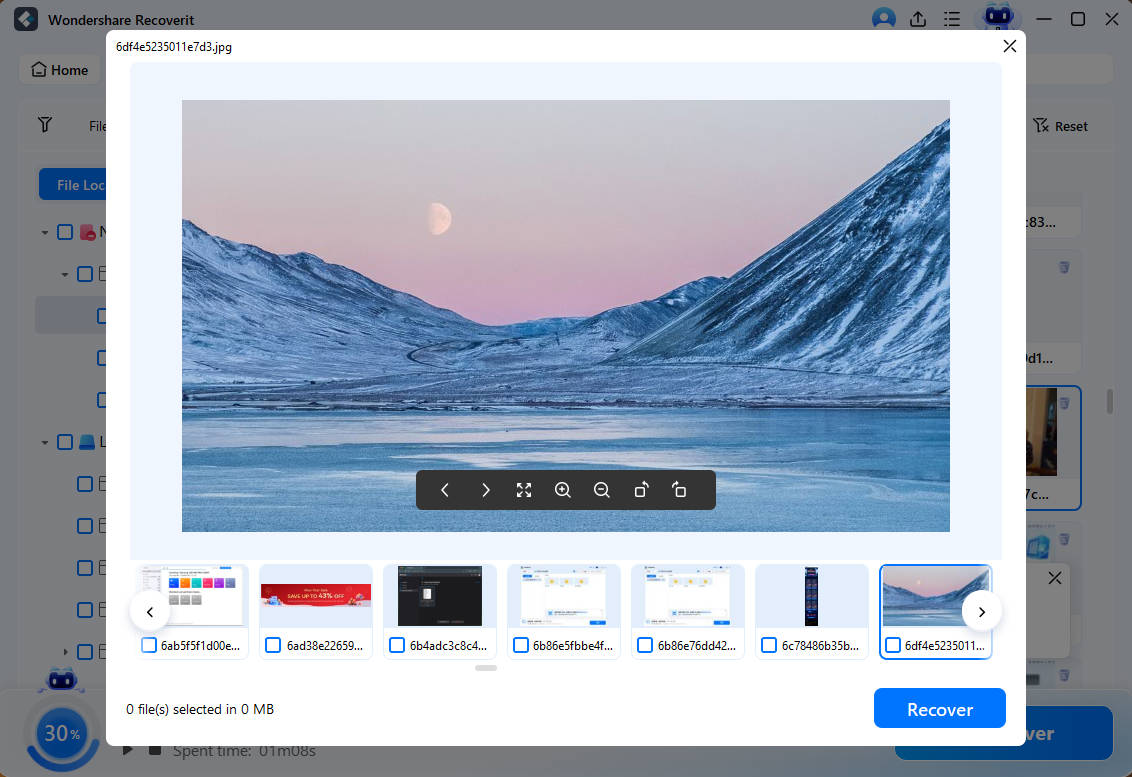
Lastly, double-click a file to "Preview," then select the file and press the "Recover" button to proceed.
Conclusion
To conclude, updating through USB is a reliable option when internet updates fail unexpectedly. This article explained file download, USB setup, Safe Mode installation, and quick fixes. By following each step carefully, you can learn how to update your PS4 system software using a USB without errors or data loss. For extra protection, use Recoverit to recover missing files quickly if problems occur.
FAQ
-
1. What's the difference between the update file and the reinstall file?
The update file refreshes firmware without wiping your storage, settings, or accounts today. The reinstallation file is larger and resets the PS4, so backup saves first. -
2. Why does my PS4 say the update file isn't detected?
Usually, the folders are not uppercase, or PS4UPDATE.PUP sits in the wrong place inside. Reformat to FAT32 or exFAT, then rebuild PS4\UPDATE and copy again carefully once. -
3. Will a USB update delete my games or saved data?
A normal USB update won't delete games or saves, but keep backups anyway. Only the Initialize or Reinstall options erase data, so double-check the Safe Mode choice. -
4. Can I use any USB drive, and must it be empty?
Any USB drive works, but it must be formatted and readable by the PS4. It does not need to be empty, yet fewer files reduce mix-ups during setup.


