


 TL;DR:
When a WD My Passport fails to appear on a Mac, diagnosing whether the failure is at the hardware connection, file-system, or visibility layer dictates the safest fix and prevents unnecessary data loss.
● If Disk Utility detects the drive but Finder does not, either enable "External disks" in Finder Settings or select the gray indented volume in Disk Utility and click "Mount" to restore access without formatting.
● Securely copy or recover readable files to a different healthy drive before executing First Aid or erasing, as repairing file-system structures can alter metadata and initialization permanently destroys existing data.
● An illuminated power light does not guarantee a working data connection; if the drive continuously clicks or remains completely absent from macOS System Information across two computers with a known-good cable, software cannot scan the media and professional hardware recovery is required.
Ask AI for a summary
 ChatGPT
 Perplexity
 Gemini
 Claude
 Grok
Grok
⚡ TL;DR: Quick Fix
Check Where It Disappears: If the WD drive is mounted in Disk Utility but absent from Finder, enable External disks in Finder Settings. If the volume is gray, select the volume and click Mount.
Test The Connection Layer: Connect the My Passport directly, use a known-good data cable and another port, then check System Information > USB or Thunderbolt/USB4. A power light does not prove that the Mac has a working data connection.
Protect Files Before Repair: If Disk Utility detects the drive but files are missing or the volume will not open, copy readable files or recover them to another disk before First Aid, erasing, repartitioning, or repeated troubleshooting.
Do Not Format Too Early: NTFS normally mounts read-only on macOS; it does not automatically explain a drive that is completely absent. Reformat only after the files are safe and only if you intentionally need a different file system.
Quick answer: When a WD My Passport is not showing up on a Mac, first connect it directly with a known-good cable. Then open Disk Utility > View > Show All Devices. Mount a visible but gray volume, or enable External disks in Finder Settings if the volume is already mounted. If Disk Utility does not list the drive, use System Information to determine whether macOS detects the USB hardware. Recover important files before First Aid or reformatting.
A missing icon can describe several different failures. Finder may be hiding a healthy mounted volume; Disk Utility may see an unmounted or damaged volume; System Information may see the USB bridge but not usable media; or the Mac may not detect the hardware at all. Each result calls for a different next step, so the safest fix begins with diagnosis rather than formatting.
Fact-checked on September 1, 2026: The connection, Finder, Disk Utility, password, file-system, and recovery guidance was checked against current Apple and Western Digital documentation for macOS.
In This Article
-
- Method 1. Test The Cable, Port, Power, And Another Mac
- Method 2. Show External Disks In Finder
- Method 3. Check System Information And Disk Utility
- Method 4. Unlock A Password-Protected WD My Passport
- Method 5. Mount The Volume In Disk Utility
- Method 6. Run First Aid In The Correct Order
- Method 7. Erase And Reformat Only After Data Is Safe
Part 1. Find Where The WD My Passport Disappears
Start with three views: Finder, Disk Utility, and System Information. Finder shows mounted volumes that macOS is configured to display. Disk Utility shows disks, containers, and volumes that the storage system can manage. System Information reveals whether the USB or Thunderbolt bus has enumerated the connected hardware. Checking all three prevents a simple visibility setting from being mistaken for data loss and prevents a hardware failure from being treated as a formatting problem.
| What You Find | What It Means | Safest Next Step |
| The drive opens in Finder but is missing from the desktop | The volume is mounted; only the desktop display option is off. | Enable External disks in Finder Settings. No repair or recovery is required. |
| The volume is mounted in Disk Utility but absent from Finder | Finder's sidebar setting is off, or Finder needs to refresh. | Enable External disks under Finder Settings > Sidebar, then reopen Finder. |
| The volume is gray in Disk Utility | macOS detects the disk and volume, but the volume is not mounted. | Select the indented volume and click Mount. If mounting fails, protect data before First Aid. |
| The physical WD disk appears, but no normal volume is beneath it | The partition map, file system, encryption state, or media may be damaged. | Do not initialize or erase. Recover files if the disk can be scanned, or seek professional help if it is unstable. |
| System Information lists a USB device, but Disk Utility does not list usable media | The Mac sees the USB bridge or controller, but the storage media is not being exposed normally. | Retry once with a direct connection and another Mac. Persistent failure can indicate an enclosure, controller, or drive fault. |
| The drive is absent from System Information on two Macs | No working hardware-level data connection has been established. | Change the cable and port. If still absent, software recovery cannot scan it; use WD support or a professional recovery service. |
| The drive clicks, beeps, repeatedly disconnects, was dropped, or got wet | Physical damage or unstable power is possible. | Disconnect it. Repeated power cycles and scans can worsen a mechanical failure. |
If macOS reports that the disk is not readable, the Initialize button opens Disk Utility; it does not instantly erase the disk. The destructive action occurs only if you select the device and complete Erase. Apple's current storage initialization instructions define initialization as erasing and reformatting, so close the prompt or inspect the disk without proceeding to Erase when files matter.
What The Activity Light Can And Cannot Tell You
A light or vibration confirms that the My Passport receives some power. It does not confirm that the cable carries data, that the USB link is stable, that the drive has exposed usable media, or that the file system can mount. Treat the light as one clue, not proof that the drive is healthy.
Part 2. Protect Important Files Before Repair
Choose the least invasive action that matches the drive's condition. A Finder setting and a manual mount do not erase files. First Aid is designed to check and repair file-system structures, but a repair can change metadata. Erase, Partition, and WD's forgotten-password reset are destructive. The value of the files and the physical stability of the drive should determine how far you proceed.
| Drive Condition | Data-Preservation Action | Avoid For Now |
| Drive mounts and files open | Copy the irreplaceable folders to another healthy disk and open several copied files. | Do not assume one successful mount means the drive is reliable. |
| Drive is detected but the volume is inaccessible | Use read-focused recovery before destructive repair if there is no verified backup. | Erase, repartition, initialize, or save recovered files to the source drive. |
| Drive repeatedly disconnects or makes abnormal sounds | Disconnect it and consult a professional service for high-value data. | Long scans, repeated First Aid runs, cable swapping while powered, or opening the enclosure. |
| Drive is not detected by any computer | Resolve the cable, port, enclosure, controller, or physical failure first. | Installing recovery apps cannot make an absent hardware device scannable. |
If the disk remains present long enough for macOS and recovery software to read it, Recoverit for Mac can scan the detected device for inaccessible, deleted, or lost files. It cannot bypass a forgotten WD hardware-encryption password, repair a mechanically failing disk, or scan a drive that macOS never detects.
Part 3. How To Fix A WD My Passport Not Showing Up On Mac
Work through the methods in order. The sequence begins with reversible connection and visibility checks, then moves to mounting and file-system repair. Recovery appears before reformatting because preserving the files is more important than making the disk empty and mountable.
Method 1. Test The Cable, Port, Power, And Another Mac
Western Digital says its external drives should be recognized and mounted automatically by macOS and do not need a separate storage driver. Its current macOS detection guide recommends a direct connection, a known-good cable, a different port, and another computer before software repair.
- Disconnect Safely If Possible: If the drive appears anywhere and is stable, eject it before unplugging. If it is frozen or repeatedly vanishes, shut down the Mac before changing the connection.
- Remove The Hub Or Adapter Chain: Connect the My Passport directly to the Mac. If the Mac lacks the required port, use one known-good adapter rather than several chained devices.
- Use A Data-Capable Cable: Try the original WD cable or a known-good replacement that supports data, not a charge-only USB-C cable.
- Try Another Port: Inspect the connectors for lint, looseness, or damage. Do not force a plug.
- Disconnect Other Bus-Powered Devices: A portable My Passport draws power from USB. If macOS warns that a USB accessory needs more power, test the drive directly; if a hub is unavoidable, use a reputable self-powered hub connected to AC power.
- Restart And Test Another Mac: Restart with the drive disconnected, reconnect after sign-in, and test a second computer. A drive that fails on multiple hosts with a known-good cable is more likely to have a drive-side fault.
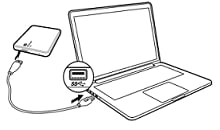
If the drive begins clicking, beeping, spinning up and down, or disconnecting every few seconds, stop here. The next methods are for stable devices, not physically distressed media.
Method 2. Show External Disks In Finder
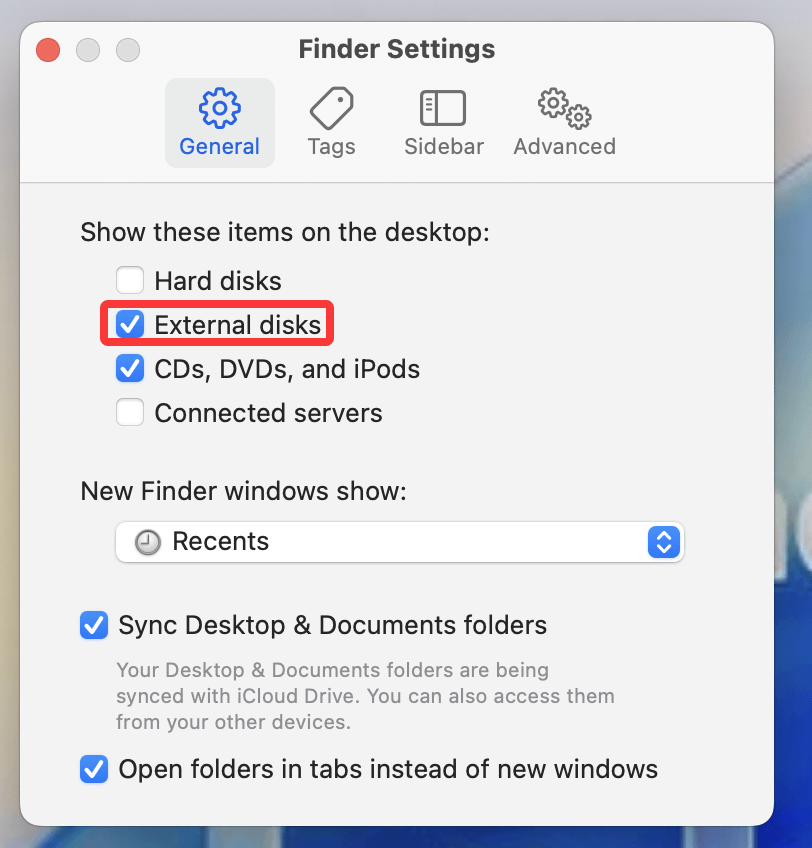
Use this method only when Disk Utility shows the volume as mounted or another app can access it. Finder visibility settings cannot repair an unmounted or undetected drive. On current macOS versions, Apple uses Finder > Settings; older versions label the same menu Preferences.
- Open Finder, choose Finder > Settings, and select General.
- Under Show these items on the desktop, select External disks.
- Open the Sidebar tab.
- Under Locations, select External disks.
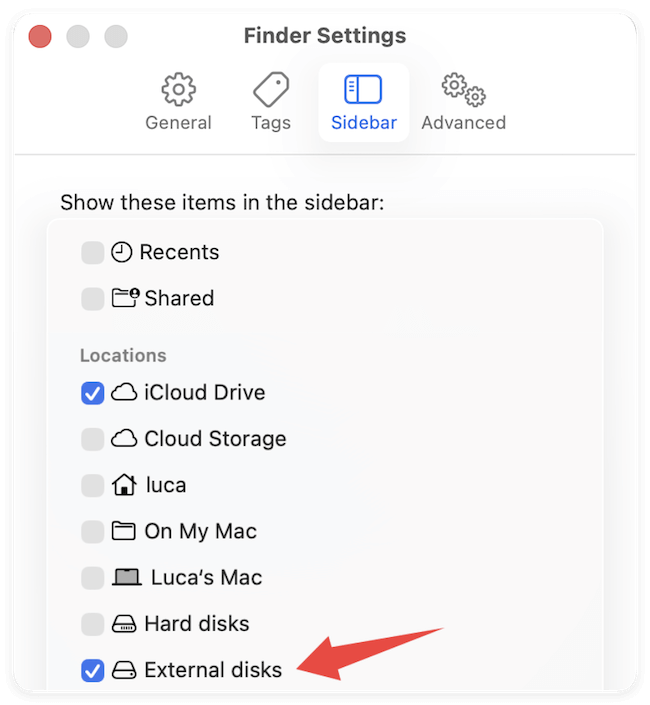
- Open a new Finder window and look under Locations. If the volume is mounted but still missing, relaunch Finder or sign out and back in once.
These are the current paths documented in Apple's Finder display settings. If Disk Utility says the volume is not mounted, continue to the detection and mounting methods instead of repeatedly changing Finder options.
Method 3. Check System Information And Disk Utility
This two-stage check separates a USB connection problem from a volume problem. System Information answers “Does the Mac see the attached hardware?” Disk Utility answers “Does macOS see a disk and mountable volume?”
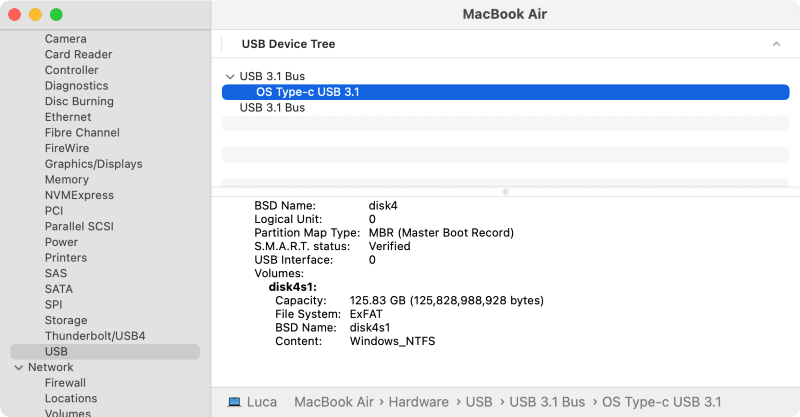
- Hold Option, open the Apple menu, and choose System Information. You can also open System Settings > General > About > System Report.
- In the Hardware section, select USB or Thunderbolt/USB4, depending on the connection path.
- Look for a Western Digital device, My Passport, WD Unlocker, or a USB storage bridge. Record whether it appears and whether the listing vanishes when the drive disconnects.
- Open Disk Utility with Spotlight or from Applications.
- Choose View > Show All Devices. This reveals the physical disk, any container, and the indented volumes.
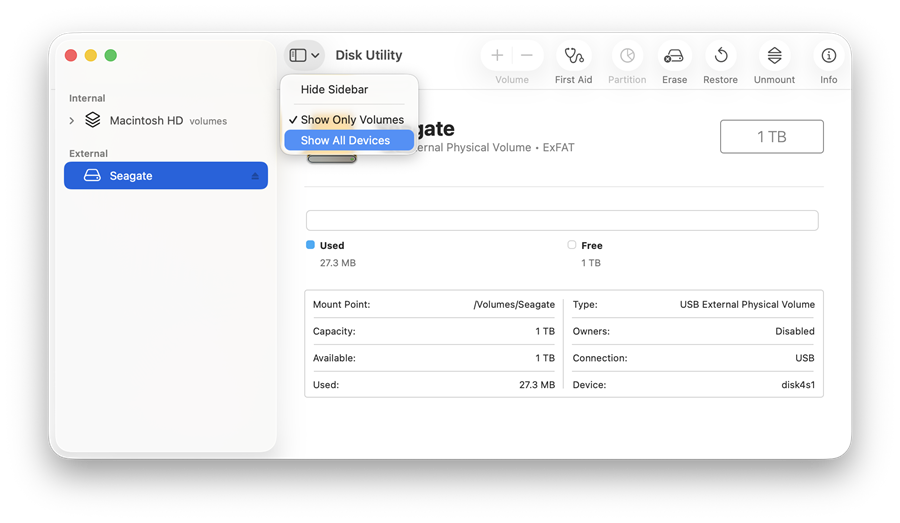
- Look under External. Do not select the internal Apple SSD when performing later actions.
If System Information and Disk Utility both list the drive, move to unlocking or mounting. If only System Information sees it, retry a direct connection and another Mac; the USB bridge may be visible while the media is not. If neither sees it after a known-good cable and second computer, software cannot scan the drive.
Method 4. Unlock A Password-Protected WD My Passport
A locked WD drive can expose a small WD Unlocker volume while keeping the data volume unavailable. This is different from an APFS-encrypted volume and different from an undetected drive. Use the password workflow that matches how the disk was encrypted.
- If Finder shows WD Unlocker, open it and launch the unlock application. Otherwise open the current WD Security app for your supported model.
- Enter the correct drive password and click Unlock Drive. Reconnect the drive after it reports that the unlock succeeded.
- If macOS itself asks for a password for an encrypted APFS or Mac OS Extended volume, enter that volume password in the macOS prompt.
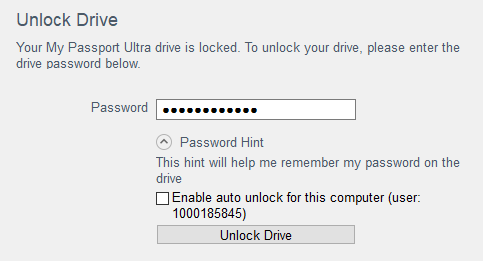
Western Digital's current WD Security instructions list support for macOS 26 Tahoe, macOS 15 Sequoia, and macOS 14 Sonoma. If the WD hardware password is forgotten, data recovery software cannot decrypt it. WD's password-removal process without the password requires erasing the drive, so do not attempt it when the stored files are needed.
Method 5. Mount The Volume In Disk Utility
A gray volume with a valid name and file system may simply be unmounted. Mounting does not format the disk. Select the indented volume rather than the top-level WD device.
- In Disk Utility, choose View > Show All Devices.
- Expand the WD physical disk and select its indented volume.
- Click Mount in the toolbar.
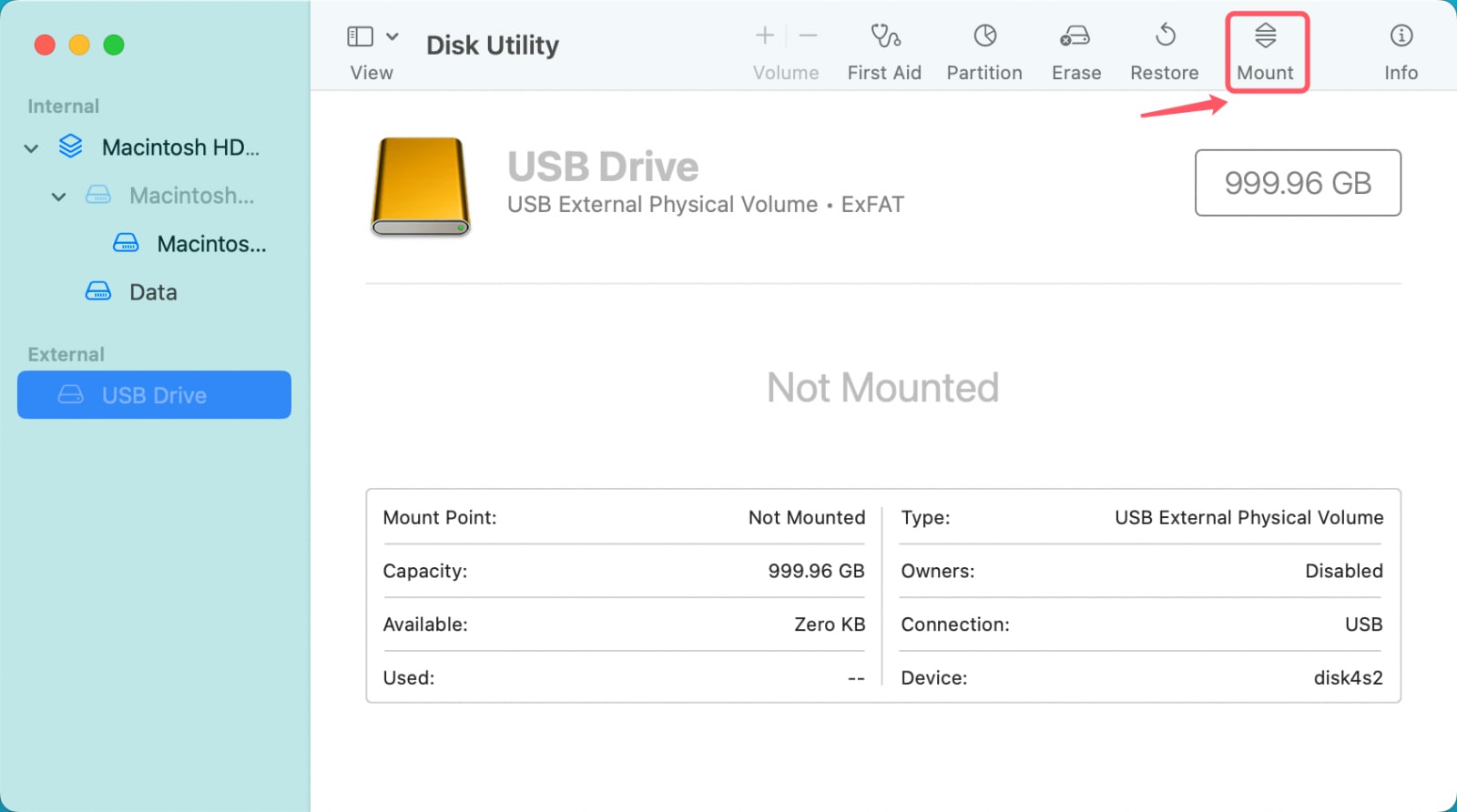
- If prompted, enter the volume password. When the button changes to Unmount and a mount point appears, return to Finder.
Apple's current Disk Utility mount guide confirms that mounting makes a volume available in Finder. If Mount fails, note the exact error. Do not jump to Erase when files matter.
Method 6. Run First Aid In The Correct Order
Use First Aid when the WD disk remains stably detected but a volume will not mount, reports file-system errors, or behaves inconsistently. If the drive contains irreplaceable files without a backup, recover or copy them first. If the drive is physically unstable, skip First Aid and seek professional help.
- Open Disk Utility and choose View > Show All Devices.
- Select the last indented volume under the WD drive, click First Aid, and choose Run.
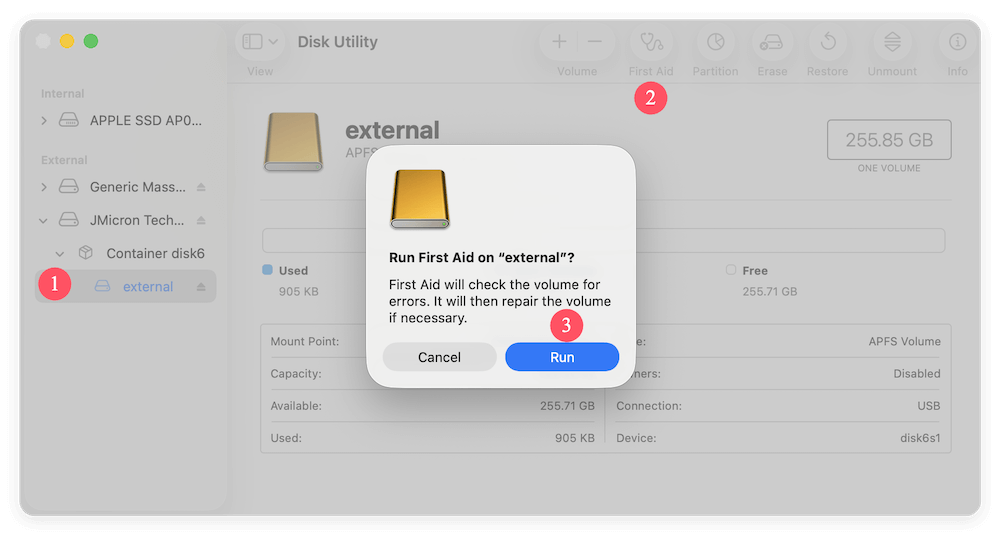
- Repeat First Aid for each remaining volume.
- Move upward and run First Aid on each container, if present.
- Finally select the top-level WD physical device and run First Aid once more.
- If Disk Utility reports that the disk appears OK or was repaired, eject it, reconnect it, and test several files.
This bottom-up order follows Apple's current First Aid procedure. Apple also states that Disk Utility cannot detect or repair every disk problem. If First Aid cannot repair the device, protect as much data as possible before erasing. If it says the disk is about to fail, replace the disk rather than continuing repair attempts.
Method 7. Erase And Reformat Only After Data Is Safe
Erasing is appropriate only when there is no needed data, a verified copy exists elsewhere, or recovery is complete. It creates a new partition map and file system; it is not a way to recover access to existing files.
- Confirm that every needed file has been copied or recovered to another physical disk.
- Open Disk Utility and choose View > Show All Devices.
- Select the top-level WD physical device under External and click Erase.

- Enter a name, choose GUID Partition Map, and select a format: APFS for current Mac-only use, Mac OS Extended for legacy compatibility, or exFAT for Mac and Windows sharing.

- Click Erase, wait for completion, and reconnect the disk.
- Copy test files to the disk, eject it safely, reconnect it, and open the test files before trusting the drive.
For a more detailed file-system and Disk Utility walkthrough, use the Recoverit guide to format a WD My Passport for Mac. If the disk disappears again after a successful erase, replace it; repeated detection or file-system failure is not a safe storage condition.
Part 4. Recover Files From A Detected WD My Passport

Recovery is the right next step when Disk Utility or Recoverit lists the WD disk but Finder cannot open the volume, First Aid cannot repair it, files disappeared, or the disk was accidentally formatted. Start before new files overwrite lost data and save all recovered files to a different healthy device.
Wondershare Recoverit fits this detected-but-inaccessible scenario. It does not need the WD volume to appear normally in Finder, but the physical storage device must still be presented to macOS. For the broader workflow and supported loss scenarios, see external hard drive recovery or the dedicated WD My Passport recovery guide.
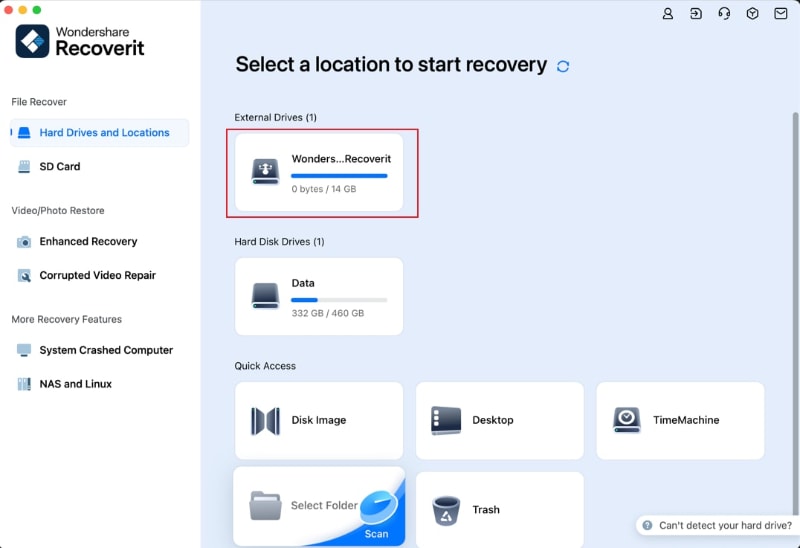
- Select The WD Drive: Connect the stable My Passport directly, open Recoverit for Mac, and select the physical external drive. If it is absent from the device list, return to the hardware checks; a scan cannot start without detection.
- Scan Without Writing To The Source: Start the scan and use file type, path, search, and status filters to narrow the results. Keep the WD drive connected and prevent the Mac from sleeping during a stable scan.

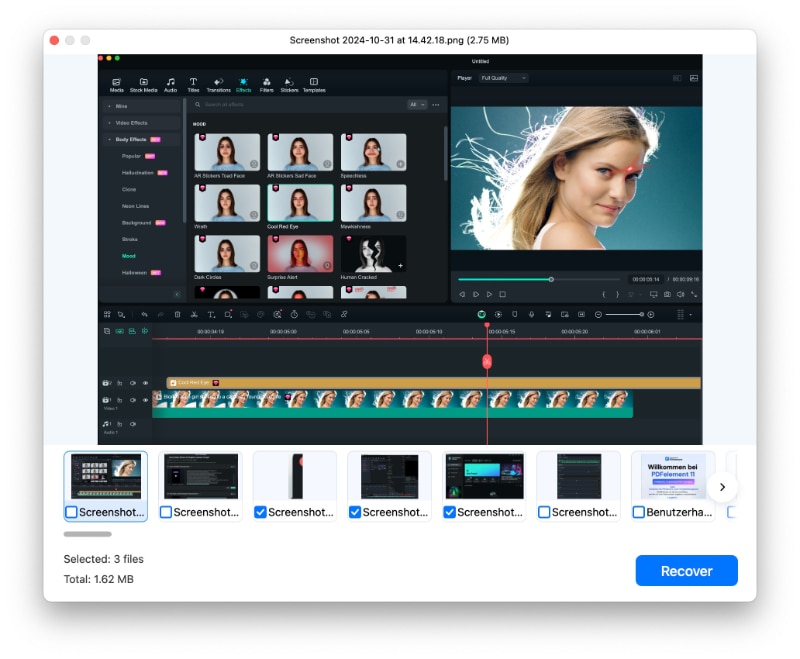
- Preview And Recover Elsewhere: Preview representative photos, videos, or documents when available. Select the required items and save them to the Mac's internal disk or another healthy external drive, never back to the affected My Passport.
Recover Files From A Detected WD My Passport
 Security Verified. Over 7,302,189 people have downloaded it.
| Recovery Can Be Appropriate | Software Recovery Is Not The Right Tool |
| The physical drive is detected but the volume is RAW, unmounted, inaccessible, deleted, or formatted. | The drive is absent from System Information and Disk Utility on multiple computers. |
| Files were deleted, moved incorrectly, or lost after a file-system error. | The drive clicks, scrapes, smells burnt, was exposed to liquid, or disconnects continuously. |
| First Aid failed and the disk remains stable enough to read. | The WD hardware-encryption password is unknown; software cannot decrypt the locked data. |
Part 5. Choose The Right File System For Mac
File-system compatibility affects whether a mounted drive is writable, but it should not be confused with hardware detection. In particular, Apple states that NTFS disks are read-only on Mac. An NTFS volume may stop you from copying files to the drive, but NTFS alone does not explain a WD device missing from System Information.
| Format | Mac Behavior | Best Use | Important Limit |
| APFS | Native read and write on current macOS | Current Mac-only storage and current Time Machine workflows | Windows does not provide native APFS access. |
| Mac OS Extended (Journaled) | Native read and write | Older Macs, legacy workflows, and compatible mechanical-drive use | Limited native compatibility outside Apple systems. |
| exFAT | Native read and write | Sharing large files between Mac and Windows | Not journaled; unsafe unplugging can make corruption more likely. |
| NTFS | Native read-only access in normal macOS use | Windows-focused disks that a Mac only needs to read | Writing requires a compatible third-party driver or reformatting after backup. |
| FAT32 | Native read and write | Older devices that require broad legacy compatibility | Individual files cannot exceed 4GB. |
WD's current guidance confirms that APFS and Mac OS Extended mount read/write on macOS and that exFAT mounts read/write on both macOS and Windows. Choose based on the computers and devices that will actually use the disk, not on a claim that one format repairs failing hardware.
Part 6. Know When Software Cannot Help
DIY troubleshooting should stop when it is no longer producing a stable, readable device. A software guide cannot repair failed heads, damaged platters, a burnt controller, a broken USB bridge, or severe media degradation. Continuing to power a clicking mechanical drive can reduce the remaining recovery window.
- No Detection Anywhere: The My Passport is absent from System Information and Disk Utility on two computers with a known-good cable.
- Abnormal Sound: The drive clicks, scrapes, chirps, or repeatedly spins up and down.
- Physical Event: The drive was dropped, crushed, opened, exposed to liquid, or connected after electrical damage.
- Severe Instability: Every read causes immediate disconnection or the drive becomes unusually hot.
- High-Value Data: The only copy contains business, legal, research, or irreplaceable personal files and the drive is degrading.
Disconnect the drive and contact Western Digital about warranty options or a reputable professional recovery laboratory. Warranty replacement normally replaces hardware; it does not restore the data stored on the failed unit. Ask any recovery provider about diagnostic fees, clean-room capability for mechanical damage, confidentiality, and whether payment depends on successful recovery.
Part 7. Prevent Another WD Passport Detection Failure
- Keep More Than One Copy: An external drive is not a backup if it contains the only copy. Keep important data on at least two devices, with one copy off-site or in a trusted cloud service.
- Eject Before Disconnecting: Wait until writes finish, eject the volume in Finder, and unplug only after it disappears.
- Protect The Cable And Connector: Avoid bending the cable at the drive port, transporting the drive while connected, or letting the connector bear the drive's weight.
- Do Not Work Directly From One Portable Disk: Copy active projects to a working disk and keep another verified backup.
- Investigate Repeat Disconnects Early: Replace a questionable cable immediately. If the symptom follows the drive across computers, migrate the data and retire the drive.
- Verify Backups: Open sample files, compare folder counts or checksums for critical archives, and periodically test that backups can be restored.
Conclusion
When a WD My Passport is not showing up on a Mac, the most useful question is not “Which repair should I try?” but “At which layer does the drive disappear?” A mounted disk missing only from Finder needs a visibility setting. A gray volume needs mounting. A stable detected disk with file-system damage may need recovery and then First Aid. A disk missing from the USB hardware tree needs connection or hardware diagnosis.
Keep reformatting last. Copy or recover important files to another disk, run repairs only on stable hardware, and retire a drive that repeatedly disappears. That order fixes simple cases quickly while giving valuable files the best chance of survival.
Try Wondershare Recoverit to Perform Data Recovery
Security Verified. Over 7,302,189 people have downloaded it.
FAQ
-
Why Is My WD My Passport Not Showing Up On My Mac?
The cause may be a hidden Finder setting, an unmounted volume, a locked drive, a damaged file system, an unreliable cable or port, insufficient USB power, or hardware failure. Check Finder, Disk Utility with Show All Devices enabled, and System Information to identify the layer that is failing. -
Why Is My WD Passport Not Showing Up On Mac Even Though The Light Is On?
The light confirms some power reaches the drive, not that the cable carries data or that macOS can read the media. Try a direct connection, a known-good data cable, another port, and another Mac. Then check the USB or Thunderbolt/USB4 section of System Information. -
What If My WD My Passport Appears In Disk Utility But Not Finder?
If Disk Utility says the volume is mounted, enable External disks in Finder Settings under both General and Sidebar. If the volume is gray or says Not Mounted, select the indented volume in Disk Utility and click Mount. -
What If WD My Passport Is Not Showing Up In Disk Utility?
Check System Information. If the USB device appears there, macOS sees the connection but may not be receiving usable storage media. Retry with a direct connection, another cable, and another Mac. If the drive is absent from System Information everywhere, software cannot scan it. -
Does Clicking Initialize Erase A WD My Passport?
The Initialize button in the “disk not readable” alert opens Disk Utility; that click alone does not erase the drive. Selecting the device and completing the Erase command is destructive. Inspect the disk or recover files first if the contents matter. -
Will First Aid Delete Files From A WD My Passport?
First Aid is designed to verify and repair file-system structures, not erase a disk. However, repair changes metadata and cannot fix every failure. Copy or recover irreplaceable files first when possible, and do not run it on a clicking or repeatedly disconnecting drive. -
Can A Mac Read A WD My Passport Formatted As NTFS?
Yes. Current macOS normally mounts NTFS volumes read-only, so you can read but not natively write files. NTFS alone does not explain a drive that is absent from System Information. Use exFAT for native Mac and Windows read/write access after backing up and reformatting. -
Can Recoverit Recover A WD My Passport That Is Not Showing Up?
Recoverit can scan a WD My Passport when macOS detects the physical storage device even if the normal volume is inaccessible, deleted, or formatted. It cannot scan a drive absent from the hardware and disk lists, bypass an unknown WD encryption password, or repair physical damage. -
Can I Recover Files After Formatting A WD My Passport On Mac?
Recovery may be possible if the erased space has not been overwritten and the drive remains healthy and detectable. Stop using the drive immediately, scan it, and save recovered files to another disk. Results depend on the erase method, file system, overwriting, encryption, and drive condition. -
Should I Replace A WD Passport That Keeps Disconnecting?
First rule out the cable, port, adapter, and power path. If the disconnections follow the drive across computers, move or recover the data and replace the drive. Repeated disappearance is not a safe condition for the only copy of important files.


