
 TL;DR:
If files disappeared from your external hard drive on a Mac, don't panic — the data is usually still on the disk. First check the simple causes: Trash, hidden files (Terminal: defaults write com.apple.finder AppleShowAllFiles YES; killall Finder), app permissions (grant Full Disk Access), and the USB cable/port. Then scan with Wondershare Recoverit for Mac to restore deleted, formatted, or corrupted files, and run Disk Utility > First Aid for file-system errors. Only physical damage needs professional repair. Always eject the drive properly and back up with a 3-2-1 strategy.
Ask AI for a summary
 ChatGPT
 Perplexity
 Gemini
 Claude
 Grok
Files disappearing from an external hard drive on Mac is usually recoverable — deletion, formatting, hidden files, and corruption are not permanent, and only physical damage requires professional repair. This guide explains why files vanish from external hard drives on Mac, then walks you through six fixes — from a data recovery tool to Disk Utility's First Aid — so you can recover your files and prevent it from happening again.
How Can Files Disappear From an External Hard Drive on a Mac
Files disappearing from an external hard drive on a Mac is common — and in most cases the data is still there. Deletion, formatting, hidden files, permission changes, or a failing cable can all make files look gone. The table below lists the most frequent causes and what each one means.
| Reason | Explanation |
| 🗑Files Were Accidentally Deleted | Everyone has made this mistake at least once. Accidentally deleting data you weren't supposed to is common, but you're not powerless in such situations. Numerous data recovery tools can help recover accidentally deleted files, even if you've emptied the Trash Can on your Mac. |
| 🧹Files Disappeared Because of Formatting | Having the wrong format on an external hard drive can cause numerous incompatibility issues, in which case you'd need to format it. However, formatting the drive also deletes everything from the device, leading to files disappearing from an external Mac hard drive. At the same time, errors where the external hard drive no longer shows files on a particular computer or asks you to reformat again, even after the device has worked for months, are also common. |
| ⛔The File System is Corrupted | Hard drives consist of sectors in which they write data and from which they pull files when you request to access them. These can sometimes become corrupted if the external hard drive is older, has been written on numerous times, or has sat around for an extended period. |
| 👁Files Are Hidden | Hiding files is a force of habit for users who handle sensitive or private data, and sometimes, it can even be done by the operating system. However, having hidden files doesn't mean that the files have disappeared from a Mac hard drive, and fixing the issue is relatively simple. |
| 🕷Malware or Virus | While not many viruses infect Macs, infection is always possible. It can happen by clicking random internet links or opening suspicious emails. The harmful software can wreak havoc on your system, causing various problems, including those that make your files disappear from an external hard drive on a Mac. |
| 🔨The Drive is Physically Damaged | Since hard drives are mechanical devices with many moving parts, they can easily break if not handled carefully. Thus, your issues might be caused by physical damage to the drive, which can happen if you drop the external HDD, hit it with something, or expose it to strong magnets. |
| 🔌The Drive Was Unplugged Without Ejecting | Pulling an external drive out without ejecting it first (Finder > Eject, or the eject icon) can corrupt the file system. On the next connection, macOS may report the drive as unreadable or show files as missing even though the data is still on the disk. |
| 🪟The Drive Is Formatted as NTFS | Windows-formatted NTFS drives mount as read-only on macOS by default. Files are present but appear "locked" or missing to apps that cannot write — connect via a tool that supports NTFS write, or the drive may need reformatting (which erases data, so recover first). |
| 👤Permission or macOS Update Changes | A macOS update or changed user permissions can make existing files inaccessible or hidden on the external volume. Check Get Info on the drive and re-grant read/write access to your account before assuming the files are gone. |
| 🔒App Permission Changes (macOS Catalina and later) | Apps without Full Disk Access cannot read files on external volumes, making files look "missing." Grant the app access in System Settings > Privacy & Security > Full Disk Access, then re-check the drive. |
| 🔌Unstable USB Cable or Power | A loose or low-quality USB cable, or insufficient power for a 2.5-inch drive, can make the disk disconnect intermittently. Try a different cable/port, or a powered USB hub, before assuming data loss. |
Learning more about the reasons behind disappearing files on external Mac hard drives will help you recognize your issue and apply the appropriate solution.
How To Recover Files Disappeared From an External Hard Drive on a Mac
Missing files are usually still on the disk. Try these six methods in order — most cases are solved by Method 1 or 2. A summary table follows the steps.
| Method | Best For | Difficulty | Software Needed? |
| 1. Data Recovery Tool (Recoverit) | Deleted, formatted, corrupted, or malware-lost files | Easy | Yes |
| 2. Recover From Mac Trash | Recently deleted files not yet purged | Easiest | No |
| 3. Reboot Your Device | Temporary glitches, drive not refreshing | Easiest | No |
| 4. Disk Utility First Aid | File system errors, minor corruption | Medium | No (built-in) |
| 5. Unhide Your Data | Files hidden by user or OS | Easy | No (Terminal) |
| 6. Professional Repair | Physical damage (drop, click, not recognized) | Hard | N/A |
Method 1: Use a Reliable Data Recovery Tool
Whether the files were accidentally deleted, formatted, corrupted, or exposed to malware, Wondershare Recoverit for Mac can get them back — it is the fastest fix for every software-based cause of disappearing files.
This hard drive recovery software provides an incredibly straightforward solution to recover files that were disappeared from hard drive on Mac. If the missing data is mostly photos or videos, the same workflow applies — photo recovery and video recovery are fully supported on external drives.
- Recovers data from 2000+ storage media, including HDDs, SSDs, USB drives, SD cards, etc.
- Enables recovery of data lost due to formatting, disk corruption, virus attack, and more.
- Works with all popular file systems, such as NTFS, FAT, HFS+, and APFS, among others.

Nevertheless, we've still included detailed instructions on using it. Here's how:
- Connect the external hard drive to the Mac and launch Wondershare Recoverit.
- Select Hard Drives and Locations and click on the external device.
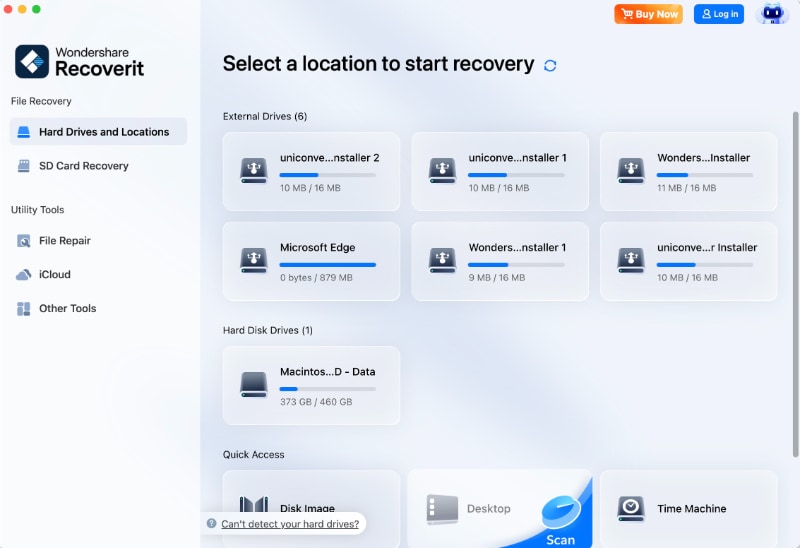
- The app will automatically start scanning the external device for deleted or lost data.

- Wondershare Recoverit lets users preview data it finds, and when you're ready, you can save the recovered files by clicking Recover.

You can pause or stop the scan as soon as the files you're looking for have been found. At the same time, the scan will be much faster if you adjust filters for file types and sizes or add keywords to search for particular data.
Method 2: Recover Files From Mac Trash
If you accidentally deleted the files, they may still be in the Trash. Open the Trash, locate your files, right-click them, and choose Restore — they return to their original location. If the Trash has been emptied, use a recovery tool instead (Method 1).
Method 3: Reboot Your Device
A restart clears temporary file-system and mount glitches that can hide external drive files. Do the following:
- Save your work and close any active apps.
- Unplug the problematic external hard drive from the Mac.
- Hit the Apple button in the top left corner and tap Restart.
- Once booted up, reconnect the external hard drive and check whether the files are there.
Alternatively, you can hold the power button until the Mac shuts down if it's stuck.
Method 4: Use First Aid to Fix the Drive
Disk Utility First Aid checks and repairs the drive's file-system structure. It is the right fix when files vanish because of index errors, corruption, or mount problems — not for deleted or formatted files, which it cannot bring back.

To use First Aid for a disappeared files issue on an external hard drive on your Mac computer, follow these steps:
- Navigate to Applications > Utilities > Disk Utility.
- Click View > Show All Devices.

- Click on the external hard drive on the left and then on First Aid at the top.
- Click Run and give the tool a few seconds. Click Done.
Although quite valuable, Disk Utility's First Aid tool can only do so much, so don't expect it to fix deleted files or formatted drives.
Method 5: Unhide Your Data
Hidden files are the least problematic cause of disappearing files on external hard drives on Mac. Fixing it is incredibly straightforward, and here's how:
- Navigate to Applications > Utilities > Terminal.
- Enter the following commands, pressing Enter after each:
defaults write com.apple.finder AppleShowAllFiles YESkillall Finder

Alternatively, you can navigate to your external hard drive and hit Command + Shift + Period.
Method 6: Send to a Professional Hard Drive Repair Service (for Severe Physical Damage)
If the drive has been dropped, hit, or exposed to strong magnets, its mechanical parts may be damaged and no software can fix it. Stop using the drive immediately, and take it to a professional repair service to save your vital data.
Conclusion
Files disappearing from an external hard drive on a Mac is almost always solvable — start with a data recovery tool like Wondershare Recoverit, then check Trash, reboot, run First Aid, or unhide files. Only physical damage (dropped, clicking, unrecognized) requires a professional repair service. To prevent it happening again, eject the drive properly and follow a 3-2-1 backup strategy: at least three copies, on two different media, with one copy offsite.
Easily recover deleted or lost files from 2000+ storage devices like HDDs, SSDs, external drivs, USB drives, memory cards, and more. The software confidently retrieves all data types, regardless of how they went missing.
FAQs
-
How do I find missing files on my external hard drive on a Mac?
Whether you'll be able to find missing external Mac hard drive files depends on the culprit that caused them to disappear in the first place. If the files are hidden, you only need to unhide them. And if the files disappear due to deletion, formatting, corruption, or viruses, you'll need a data recovery tool like Wondershare Recoverit. However, if the device is physically damaged, you must take it to a repair shop. -
Why do files suddenly disappear on Mac?
Various elements might cause disappearing files. Sometimes, the cable connection can break when you move the drive – other times, it can be due to a physically damaged device. In most cases, however, these issues are caused by human and software errors like hidden or deleted files, formatted hard drives, corrupted data, and malware. -
How to view files on an external hard drive on a Mac?
While an external hard drive should automatically appear on the Mac's desktop once you connect the drive to the computer, there's a chance that this setting is turned off. You'll need to navigate to Finder > Preferences and ensure that Hard disk and External disks are checked under the General tab. From there on, you should see the external hard drive on the desktop. Double-clicking the external Mac hard drive will open it and show you all of the drive's files. -
Can I recover files after unplugging the external drive without ejecting?
Yes, in most cases. An un-ejected disconnect can corrupt the file system index, but the data usually remains. Stop using the drive, then scan it with a recovery tool like Wondershare Recoverit, or run Disk Utility First Aid first if the drive still mounts. Going forward, always use Finder > Eject before unplugging. -
Can Time Machine local snapshots help if my external drive fails?
If you have Time Machine enabled, macOS automatically keeps local snapshots of your startup disk on APFS. Even without a network or external backup drive, you can enter Time Machine and restore from a local snapshot taken before the failure. This is a useful extra layer when your external drive itself is the problem. -
Why can't I see files on my external drive after a macOS update?
macOS may change privacy permissions during updates. Apps that previously accessed your external drive can lose Full Disk Access, making files appear missing. Go to System Settings > Privacy & Security > Full Disk Access, enable access for the apps you use (including Finder extensions and third-party tools), then reconnect the drive. -
Could a bad USB cable make my external drive files disappear?
Yes. A loose or low-quality USB cable, or insufficient power, can make a 2.5-inch external drive disconnect and reconnect intermittently, so files seem to vanish. Try a different cable, a different port, or a powered USB hub. If the drive mounts normally and files return, the cable or port was the problem — not data loss.


