


 TL;DR:
Choose APFS when the drive will be used mainly with modern Macs, exFAT when it must work with both Mac and Windows, and Mac OS Extended (Journaled) for older Mac versions or legacy Mac workflows. Use GUID Partition Map for a modern Mac-only drive and usually for exFAT on current systems. Back up important files before opening Disk Utility and clicking Erase.
- Back up or recover files from the Toshiba drive.
- Choose a file system based on Mac-only or Mac-and-Windows use.
- Open Disk Utility and select View > Show All Devices.
- Select the physical Toshiba disk, then choose Erase.
- Verify the name, format, and scheme before confirming.
Ask AI for a summary
 ChatGPT
 Perplexity
 Gemini
 Claude
 Grok
Grok
Toshiba external hard drives, including Canvio models, can be used with Mac computers, but the best file-system format depends on how you plan to use the drive. A drive formatted as NTFS may be readable on macOS while native write access is limited, so it may appear in Finder but still fail when you try to copy files to it.
Formatting a Toshiba hard drive changes its file system and usually erases the data on the selected volume. Back up or recover important files before you begin, then use the built-in Disk Utility app to choose a format and partition scheme that match your Mac and any Windows computers you will use.

This guide explains which format to choose and how to format a Toshiba external hard drive for Mac step by step.
Why Format a Toshiba Hard Drive for Mac?
A Toshiba external hard drive can be ready for Mac immediately if it uses a compatible file system. Some models are shipped with an NTFS volume for Windows use, while other models are designed for cross-platform storage. A Mac may read an NTFS drive but cannot normally write to it without additional software, so reformatting may be useful when you need full read-and-write access.
According to the original product grouping, Toshiba Canvio Flex, Canvio Gaming, and Canvio Slim may be sold with Mac-compatible support, while Canvio Advance, Canvio Advance Plus, Canvio Ready, and Canvio Basics may require a format change for the way you plan to use them. Check the current documentation for your exact model because the preinstalled format can vary by product and region.
toshiba external hard drive specifications
Do You Need to Format the Toshiba Drive?
| Your Situation | Do You Need to Reformat? | First Action |
| The drive opens and you can copy files both ways | Usually no | Back up the data and continue using it |
| The drive is readable but Mac cannot copy files to it | Maybe | Check whether the volume is NTFS; choose a compatible write solution |
| You want Mac and Windows compatibility | Often yes | Back up files and consider exFAT |
| The drive asks to be initialized or erased | Do not format yet | Cancel and recover important data first |
| The drive is not detected by Disk Utility | Formatting is not the first fix | Test the cable, port, power, and another computer |
Available Mac Format Options for Toshiba Hard Drives
The best format depends on the Mac versions, Windows computers, file sizes, and features you need. Formatting removes the existing file-system structure, so choose carefully before clicking Erase.
| Format | Best For | Important Limitation |
| APFS | Modern Mac-only storage, especially SSDs | Not the best choice for regular Windows access |
| Mac OS Extended (Journaled) | Older macOS versions and legacy Mac workflows | Less suitable than APFS for some modern SSD workflows |
| exFAT | Sharing files between current Mac and Windows computers | Use safely eject and maintain backups because it lacks journaling |
| FAT32 | Older devices and broad compatibility | Individual files cannot exceed 4 GB |
| NTFS | Windows-focused storage | macOS usually reads it but does not provide native write access |
Determine the Best Format for Your Toshiba Hard Drive on Mac
Use the following decision rule:
- Mac only: Choose APFS for a modern Mac workflow, especially when using an SSD. Choose Mac OS Extended (Journaled) when you need compatibility with older macOS versions or legacy Mac software.
- Mac and Windows: Choose exFAT for large files and cross-platform transfers. Confirm that the other devices support exFAT before formatting.
- Older devices: Choose FAT32 only when required, because one file cannot be larger than 4 GB.
- Windows-only drive: Keep NTFS if you mainly use Windows. On Mac, expect read-only behavior unless compatible third-party software provides write access.
APFS and Mac OS Extended are Mac-oriented formats, while exFAT is usually the practical choice for a Toshiba drive shared between current Mac and Windows computers. Do not choose a format only because it is listed in Disk Utility; match it to your actual devices and backup plan.
Which Partition Scheme Should You Choose?
| Scheme | Recommended Use | Compatibility Note |
| GUID Partition Map | Modern Macs and most current storage setups | Recommended for current macOS workflows |
| Master Boot Record | Some older Windows systems or devices | Use only when the target device specifically requires it |
| Apple Partition Map | Very old PowerPC Mac systems | Not recommended for current Macs unless legacy compatibility is required |
How to Format a Toshiba Hard Drive for Mac
Before starting, copy important files to another healthy location, connect the Toshiba drive directly or through a reliable powered hub, and confirm that you selected the correct device. The steps below erase the selected volume.
- Connect the Toshiba external hard drive to your Mac.
- Open Finder > Applications > Utilities > Disk Utility.
- Choose View > Show All Devices.

- Select the physical Toshiba drive under External, not a different internal disk.
- Click Erase.

- Enter a recognizable name.
- Choose the file system format that matches your use: APFS or Mac OS Extended for Mac-only use, or exFAT for current Mac and Windows use.
- Choose GUID Partition Map unless an older device specifically requires another scheme.

- Review the selected device, format, and scheme, then click Erase to confirm.
- Click Done after the process completes and check the drive in Finder.
How to Recover Lost Data from an Accidentally Formatted Toshiba Hard Drive
Formatting a Toshiba hard drive can remove the file-system references to photos, videos, documents, and other files. Stop using the drive immediately after accidental formatting. Do not copy new files to it, install recovery software on it, or format it again.
Recoverit Data Recovery may be able to scan a Toshiba drive that macOS still detects, but recovery is not guaranteed. The chance of recovery decreases when new data overwrites the old file content.
- Disconnect the formatted Toshiba drive from normal use.
- Connect it only when you are ready to scan and make sure macOS detects it.
- Launch Recoverit and select the Toshiba drive under Hard Drives and Locations.
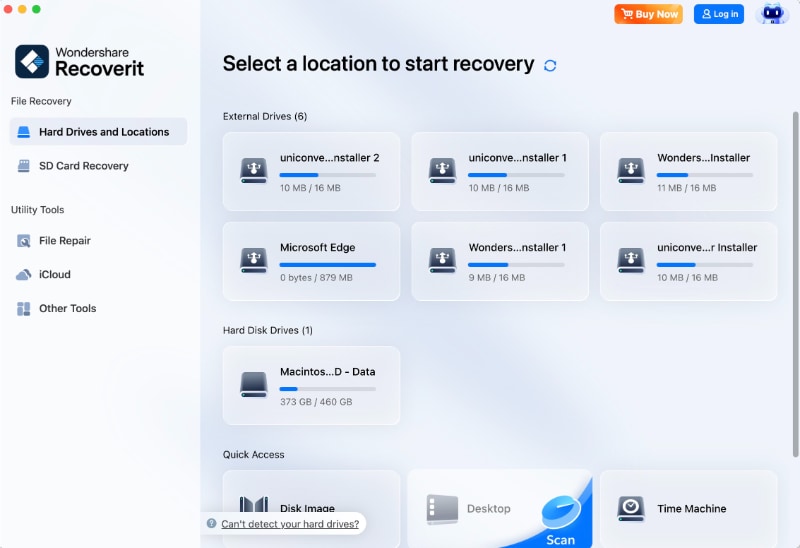
- Run the scan and filter results by file type, name, or location.

- Preview recoverable files where supported.
- Save recovered files to the Mac's internal drive or another healthy storage device, never back to the formatted Toshiba drive.
What If the Toshiba Drive Is Not Detected?
Formatting is not the correct first step when the Toshiba drive is absent from Disk Utility. Test one known-good cable, another Mac port, the power adapter, and another computer if available. If the drive remains invisible, or if it clicks, overheats, or disconnects repeatedly, repeated formatting attempts can worsen the situation.
Software recovery generally requires macOS to detect the storage device. A professional recovery lab may be more appropriate for a failed enclosure, controller, or disk mechanism.
Conclusion
Formatting a Toshiba hard drive for Mac is straightforward in Disk Utility, but the correct format depends on whether the drive is Mac-only, shared with Windows, or needed by older devices. APFS is suitable for modern Mac-only use, while exFAT is usually the practical choice for current Mac and Windows computers.
Back up or recover important files before clicking Erase. If a formatted Toshiba drive still contains needed data, stop writing to it and scan it from a detected location, saving recovered files elsewhere. If the drive is not detected or shows physical failure signs, seek professional help.
FAQ About Formatting Toshiba Hard Drives for Mac
-
Why does my Toshiba hard drive show up on Mac but not let me copy files to it?
The drive may be formatted as NTFS. macOS usually supports reading NTFS but not native writing. Back up the files before choosing a compatible write solution or reformatting. -
Should I select the physical Toshiba disk or the volume in Disk Utility?
Choose View > Show All Devices, then select the physical Toshiba disk when you need to erase and set the partition scheme. Verify the device name and capacity before confirming. -
Will exFAT work on both Mac and Windows?
exFAT is commonly supported by current macOS and Windows and supports files larger than 4 GB. Older devices may have limited or no exFAT support. -
Can Recoverit recover files after formatting a Toshiba hard drive?
It may recover files when macOS still detects the drive and the data has not been overwritten. Save recovered files to another healthy location and do not write to the formatted drive. -
What should I do if Disk Utility cannot see my Toshiba drive?
Test a compatible cable, port, power source, and another computer once. If the drive remains undetected or makes unusual sounds, stop using it and consider professional recovery. -
Can I format a Toshiba hard drive without losing data?
Not with a normal Disk Utility erase. Copy or recover the data to another location first, then format the Toshiba drive after confirming the backup.


