


 TL;DR:
The most practical video format for broad web and mobile compatibility is an MP4 container encoded with H.264 video and AAC audio, whereas professional editing workflows benefit more from intermediate codecs like Apple ProRes or Avid DNxHR.
● File extensions such as MP4, MOV, and MKV are simply containers wrapping individual media streams, meaning you cannot fix playback failures or improve visual fidelity by merely renaming the file extension.
● High-efficiency codecs like HEVC and AV1 reduce file sizes for modern web delivery, but they require compatible hardware decoders and should be tested before assuming universal device or browser support.
● When re-encoding is necessary for cross-platform delivery, use FFmpeg to export an H.264 and AAC copy while strictly maintaining the untouched camera originals to preserve metadata and avoid irreversible generational detail loss.
Ask AI for a summary
 ChatGPT
 Perplexity
 Gemini
 Claude
 Grok
Grok
What is the best video file format? For a video that needs to play on most phones, computers, and sharing sites, MP4 with H.264 video and AAC audio is a practical starting point. For smoother professional editing, an intermediate codec such as Apple ProRes or Avid DNxHR may be preferable. For efficient web delivery, modern H.265 or AV1 codecs can reduce file size, but support varies by hardware, browser, and device.
Those answers are not contradictory: they solve different problems. A file extension tells you its container, not necessarily the quality or codec inside it. This guide compares ten familiar video file types, explains how to choose a high-quality or editing-friendly workflow, and shows how to inspect and export a file without accidentally replacing your original footage.
In This Article
-
- 1. MP4 (.mp4): The Best All-Round Video File Format
- 2. MOV (.mov): Flexible QuickTime Container for Production
- 3. MKV (.mkv): Flexible Playback and Archival Container
- 4. WebM (.webm): Modern Browser-Focused Delivery
- 5. AVI (.avi): Legacy Container for Older Workflows
- 6. WMV (.wmv): Windows-Oriented Legacy Video
- 7. M4V (.m4v): MP4-Family Video with Apple History
- 8. FLV (.flv): Flash-Era Format to Preserve or Migrate
- 9. 3GP (.3gp): Compact Legacy Mobile Video
- 10. MTS and M2TS (.mts/.m2ts): Camera and Transport-Stream Media
Part 1. Which Video Format Is Best for Your Purpose?
The right answer depends on where the video will go and what you need to do with it. A compact file for a customer may be a poor working master for a complex color-grading project.
Best Video Format by Use Case
Start with the destination, then choose a container and compatible codecs. These are useful defaults, not guarantees that every device accepts every encoding profile.
| Your goal | Practical format and codec | Why it fits | Watch out for |
| Everyday sharing and email | MP4, H.264 video, AAC audio | Broad compatibility and manageable sizes | High-resolution high-bitrate exports can still be large |
| Upload to YouTube | MP4, H.264/AAC for a broadly supported workflow | Matches Google's published recommended upload settings | YouTube will create its own encodes after upload |
| Editing a complex timeline | MOV or MXF containing ProRes/DNxHR, or proxies | Editing-friendly codecs and predictable decode performance | Large intermediate files and application support |
| Long-term camera original/archive | Preserve the original camera file and verified backup | Maintains metadata and the original recording | A converted MP4 should not be the only archive |
| Web-native encoded clips | WebM using VP9/AV1, or compatible MP4 | Modern codecs for browser delivery | Check browser, OS, and hardware support |
| Multitrack playback and subtitles | MKV with appropriate codecs | Flexible track and chapter handling | Not universal on TVs and editing applications |
| Highest practical editing quality | Camera originals or high-quality ProRes/DNxHR intermediate | Reduces avoidable generational loss while editing | No codec can restore detail absent from the source |
For social sites, first check the platform's export guidance rather than assuming that an AVI or MOV file will upload better. Google's YouTube recommended upload settings specify the MP4 container and H.264 among its standard upload recommendations; the best encoding choice for a specific workflow can still differ.
Understand the Difference Between a Container, a Codec, and Quality
A container wraps video, audio, subtitle, and metadata streams into one file. MP4, MOV, MKV, and WebM are containers. A codec describes how picture or sound is encoded or decoded: H.264, H.265/HEVC, AV1, ProRes, and DNxHR are examples of video codecs. H.264 and AV1 are not interchangeable names for .mp4 or .mkv extensions.
Two clips can use the same H.264 picture and AAC sound while one is stored as .mkv and the other as .mp4. If the streams are copied without re-encoding, switching containers does not automatically improve or worsen visual quality. Conversely, two .mp4 files can behave very differently if one contains H.264 and the other contains an AV1 stream that a destination device cannot decode. The HandBrake container reference documents how codec and track support differs between MP4, MKV, and WebM.
Visible fidelity also depends on source detail, resolution, frame rate, bitrate, chroma sampling, bit depth, color management, encoder settings, and repeated re-encoding. A higher bitrate cannot recover detail that was already discarded, and a bigger file is not always a better-looking file.
Part 2. The 10 Most Common Video File Formats Explained
This list preserves the core families covered by the original guide while distinguishing present-day delivery formats from older camera or application-specific containers. It is a practical popularity and usage list, not a measured worldwide market-share ranking.
1. MP4 (.mp4): The Best All-Round Video File Format
MP4 is the safest default for general distribution because modern devices and services commonly accept H.264 video and AAC audio inside the container. MP4 also accommodates other codecs, including HEVC and AV1, but those combinations may not play on older hardware. The extension alone does not tell you which one you have.
- Best for: sharing, websites, slides, mobile playback, and final deliverables
- Strength: common tools, reasonably compact encodes, and broad H.264/AAC playback support
- Trade-off: high-compression inter-frame codecs are not necessarily ideal for effects-heavy timeline editing
MP4 does not inherently make editing software crash. Poor playback can be related to the particular codec, long-GOP compression, variable frame rate, damaged media, or resource limits. A presentation failing to accept an MP4 can similarly be a codec issue rather than a bad filename; the separate PowerPoint MP4 insertion troubleshooting page covers that different task.
2. MOV (.mov): Flexible QuickTime Container for Production
MOV, associated with Apple's QuickTime file format, is a flexible container commonly encountered in camera output and professional workflows. It can carry different codecs, including highly compressed H.264/HEVC and editing-friendly ProRes. A .mov file encoded with H.264 is not automatically higher quality than an .mp4 with comparable encoding settings.
- Best for: camera originals, QuickTime workflows, and editing intermediates when the target editor supports the contained codec
- Strength: broad production use and support for rich media tracks
- Trade-off: compatibility and size depend on the actual codec, not the MOV extension
For cross-platform delivery, check the receiving app's tested MOV codecs or export a separate H.264/AAC MP4 while retaining the source MOV.
3. MKV (.mkv): Flexible Playback and Archival Container
Matroska Video (MKV) is designed to hold multiple media streams, subtitles, and chapters. It is useful for maintaining tracks from local media collections and for flexible archival packages when compatible players are available. It is not a codec, and choosing MKV by itself does not preserve extra pixels or bypass lossy compression.
- Best for: multiaudio playback, subtitles, chapters, and compatible local video libraries
- Strength: broad codec and track support
- Trade-off: some hardware players, editors, and online upload forms prefer MP4
An H.264 video remuxed between MKV and MP4 can remain visually identical because the picture stream need not be recompressed. That is different from a transcode, which decodes and re-encodes the frames.
4. WebM (.webm): Modern Browser-Focused Delivery
WebM is a constrained, web-oriented container from the Matroska family. Its common video combinations include VP9 or AV1 with Opus audio. It is relevant for online media but not necessarily the best single archival or handoff format when the receiving editor expects H.264/AAC MP4.
- Best for: compatible browsers and web-native media delivery
- Strength: efficient modern video codecs and open tooling
- Trade-off: device, editor, and embedded-player support should be tested
AV1 is a codec, not a .av1 container requirement. The related AV1 video codec and extension article covers whether a particular device or Windows installation needs additional AV1 decoding support.
5. AVI (.avi): Legacy Container for Older Workflows
AVI is an older Microsoft multimedia container still found in legacy capture, editing, and archival collections. Its size can be small or enormous depending on the compressed or uncompressed streams inside. A file may require a decoder that modern systems do not ship by default.
- Best for: maintaining older recordings or specific legacy equipment
- Strength: supported by many desktop multimedia utilities
- Trade-off: not a universal browser delivery format; size and playback support are codec-dependent
Do not choose AVI only because a file seems clearer or because an older guide recommends it for short clips. Preserve a historical original, then make a more compatible distribution copy when needed.
6. WMV (.wmv): Windows-Oriented Legacy Video
WMV is associated with Windows Media Video encoding and Windows-focused file workflows. Older presentations, business archives, and recording programs may still produce or require it. Modern multiplatform sharing usually benefits from a more widely supported MP4 encode.
- Best for: existing Windows-based collections or an application that explicitly requests WMV
- Strength: compatibility with some older Windows tools
- Trade-off: unnecessary friction on certain phones, browsers, and modern editing devices
WMV is not inherently better for every Windows application. Check the exact application and version rather than defaulting to a legacy format.
7. M4V (.m4v): MP4-Family Video with Apple History
M4V is frequently associated with Apple's media ecosystem, but an unprotected M4V can be structurally similar to MP4. DRM-protected store purchases are a separate compatibility case: changing a file extension or running a transcoder does not remove access restrictions.
- Best for: existing M4V libraries and software that explicitly supports the format
- Strength: can hold familiar MPEG-4-family media streams
- Trade-off: DRM and device-specific playback restrictions can be more important than the extension
For ordinary new exports, there is little reason to choose M4V over a broadly compatible MP4 unless your workflow specifically calls for it.
8. FLV (.flv): Flash-Era Format to Preserve or Migrate
FLV became familiar through Flash-era internet video. With Flash Player retired from modern browsers, it is no longer a default choice for newly published web videos. Legacy FLV archives can still be valuable, but compatibility should be tested in a modern player or conversion workflow.
- Best for: historical web recordings that must be retained
- Strength: availability in certain legacy archives and tools
- Trade-off: old browser playback assumptions no longer apply
If the original is important, do not delete it immediately after generating an MP4. Compare duration, picture, audio and captions before accepting the new copy.
9. 3GP (.3gp): Compact Legacy Mobile Video
3GP was designed around mobile multimedia and constrained bandwidth. It still matters when recovering older phone recordings, but it is rarely the best quality-first option for a new 4K video project. Earlier hardware and software may support only a limited set of video and audio streams.
- Best for: older mobile-phone archives and device-specific compatibility
- Strength: historically efficient delivery under severe size limits
- Trade-off: older codec and resolution profiles compared with modern workflows
When preserving family recordings from older phones, keep the original file intact and create a separate viewable copy if necessary.
10. MTS and M2TS (.mts/.m2ts): Camera and Transport-Stream Media
MTS and M2TS are transport-stream file extensions encountered in AVCHD camera workflows and Blu-ray-related media. They can package higher-bitrate video, but support depends on the recorder and selected profile. Blanket statements that MTS or AVCHD can never contain 4K footage are misleading across different devices and transport-stream workflows.
- Best for: retaining original files from compatible camcorders and legacy disc workflows
- Strength: camera recording continuity and potential metadata or playlist relationships
- Trade-off: some editing programs need the original folder structure or optimized media
Another specialized file is INSV, created by certain Insta360 recording workflows. It is not a universal replacement for MP4: preserve original device metadata and use the camera manufacturer's current export procedure for a standard deliverable. Such proprietary camera files should remain in your backup even after export.

Part 3. Best Video Format for Editing and Best Video Quality
High quality, small file size, and smooth editing are separate goals. Choosing the correct codec family for each stage usually matters more than choosing an impressive-looking file extension.
What Is the Best File Format for Video Editing?
For everyday editing, H.264 MP4 is often a workable source when the timeline is simple and the computer decodes it comfortably. For multi-layer, multicamera, effects-heavy, or high-resolution work, professional editing codecs can make the timeline easier to scrub and render. Apple ProRes and Avid DNxHR are common intermediate options because they prioritize editing performance and consistency over minimal delivery size.
A typical division is to retain camera originals, create optimized/proxy media if playback is slow, edit against those copies, then export the final program for the destination. In its current Final Cut Pro media playback guidance, Apple describes ProRes 422 optimized media and ProRes 422 Proxy or HEVC proxies; it also reminds editors to switch back to original or optimized media before sharing a project. That final step is crucial.
ProRes typically appears inside MOV, while DNxHR may appear in MOV or MXF depending on the workflow. Editors can also work from supported camera originals without converting everything first. Adobe's Premiere supported export reference includes ProRes and production interchange formats, but the export menu and available codecs depend on the app version, operating system, and project.
If you are using a proxy workflow, use proxies for editing efficiency rather than treating them as your highest-quality master. Save the original media and project metadata so relinking is possible later.
What Is the Best Format for Video Quality?
There is no universally highest-quality file extension. For footage you already own, the best preserved quality is generally the original camera recording or a verified lossless copy. If you must re-encode, favor a codec and profile appropriate for the next processing stage, and avoid repeated delivery-to-delivery transcodes. Lossless codecs and lightly compressed intermediates preserve more information, but produce much larger files.
For practical delivery, a high-bitrate H.264, HEVC, or AV1 encode can look excellent at its intended resolution. The choice depends on playback support, encoder quality, color space, HDR handling, and bitrate. HEVC and AV1 often provide better compression efficiency than H.264 at comparable perceived quality, but encoding speed and decoder availability vary.
Pay attention to bit depth and color pipeline if you shoot 10-bit HDR or log video. Exporting an HDR master to an ordinary 8-bit SDR profile without correct tone mapping can change appearance regardless of MP4 versus MOV. Keep separate, labeled copies for archival, editing, and public delivery rather than overwriting one master file.
H.264 vs HEVC vs AV1: Which Codec Should You Use?
H.264 remains a pragmatic broad-compatibility choice. HEVC/H.265 is common for higher-resolution capture and compact 4K video on supported devices. AV1 is increasingly relevant for bandwidth-efficient delivery where compatible players and hardware are available, but a file carrying AV1 inside MP4 is not guaranteed to work everywhere.
| Video codec | Typical strength | Main decision |
| H.264 / AVC | Broad device and app support | Use for dependable sharing unless your destination recommends something else |
| H.265 / HEVC | High-resolution efficiency and modern capture | Verify decoder availability, licensing/software support, and HDR compatibility |
| AV1 | Efficient web delivery in supported environments | Test the target browser, editor, GPU, or device before standardizing |
| ProRes / DNxHR | Editing intermediates rather than smallest upload size | Choose the profile supported by your editing system and storage budget |
Keep codec choice separate from storage format: you might use H.264 in MP4 for delivery while retaining the original ProRes MOV for future work. Re-encoding a low-quality clip into ProRes does not reconstruct missing detail.
Choose Resolution, Frame Rate, and Compression Settings
Choose resolution based on the source and destination instead of automatically upscaling a low-resolution clip. Preserve the capture frame rate when practical; a 24 fps narrative clip need not become 60 fps merely because a preset is available. For general SDR output, a common H.264 profile with AAC audio is a reliable baseline. For HDR footage, verify transfer characteristics and color metadata on the actual target player.
When using a constant-quality encoder, start near the default of an appropriate preset and examine a short sample at normal viewing distance. HandBrake's official presets demonstrate a practical split between General, Web/Creator, Devices, Matroska, and Production presets. Higher-quality settings do not have the same numeric meaning across different encoders, so avoid comparing RF numbers as if they were universal quality scores.
Part 4. How to Check and Export a Video in the Right Format
You can make a better decision by inspecting the actual streams before converting anything. The following two reproducible methods use FFprobe and FFmpeg, official command-line tools from the FFmpeg project; they are optional technical workflows rather than requirements for every video creator.
Method 1. Check the Actual Video Codec and Container with FFprobe
Use this read-only method when an MP4, MOV, or MKV file behaves unexpectedly, or before you commit to an editing workflow. It reveals the file's container and codec identifiers without changing the media. Install FFmpeg/FFprobe from a trusted official package first, and use a copy if the drive or source is unstable.
Step 1. Open a terminal in the folder containing your source file. Keep the original filename and extension unchanged; in the verified example the test file is named source-camera-clip.mkv.
Step 2. Run ffprobe -v error -show_entries format=format_name,duration:stream=index,codec_type,codec_name,width,height -of default=noprint_wrappers=0 "source-camera-clip.mkv". Use your own existing file path and keep quotation marks if it contains spaces.
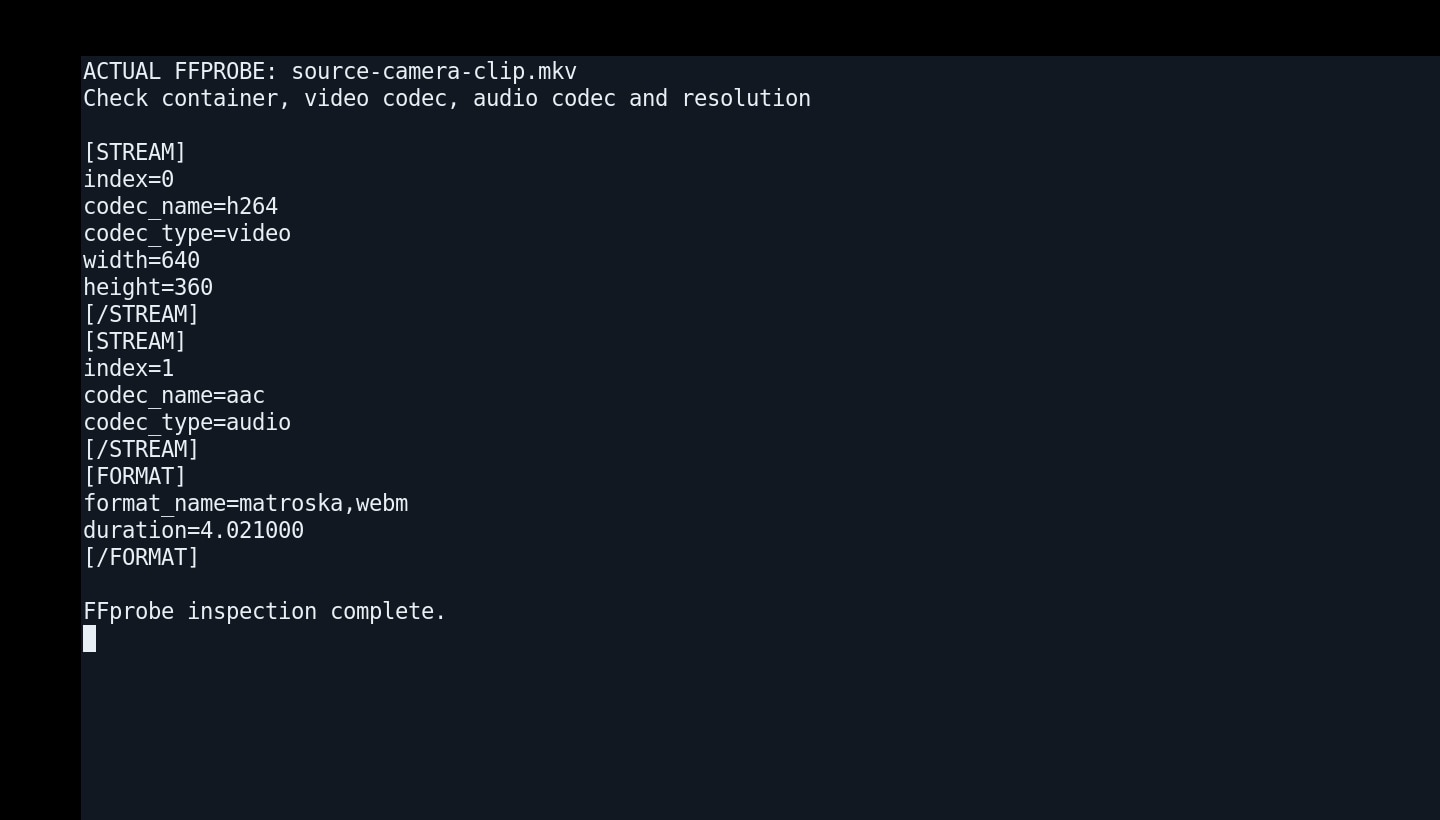
Step 3. Look for the entries codec_name in the video and audio streams and format_name for the container. The screenshot shows an actual MKV source with H.264 video and AAC audio. A file ending in .mkv does not have to use a unique MKV video codec.
Success check: You can read the container, video codec, audio codec, and dimensions. If FFprobe reports a parsing error, test a separate copy in a capable player and verify that your storage is healthy. An unreadable or incomplete source requires a different investigation; simply changing .mkv to .mp4 will not recover missing frames.
Method 2. Export a Compatible MP4 Copy with FFmpeg
This method applies only to a readable, playable source when you need a broadly compatible distribution copy. It re-encodes the video with H.264 and audio with AAC into MP4; encoding changes may create some quality loss, so retain your source and do not overwrite it. The test below ran successfully on a generated four-second sample, not on personal or commercial footage.
Step 1. Keep the input file in a safe folder, confirm adequate free space, and select a different output name. The example uses source-camera-clip.mkv as input and share-ready-video.mp4 as output.
Step 2. Run ffmpeg -i "source-camera-clip.mkv" -c:v libx264 -preset veryfast -crf 20 -c:a aac -b:a 160k -movflags +faststart "share-ready-video.mp4". This sample command creates an H.264/AAC MP4 with its MP4 header arranged for progressive delivery. Hardware speed, available encoders, and source characteristics vary.
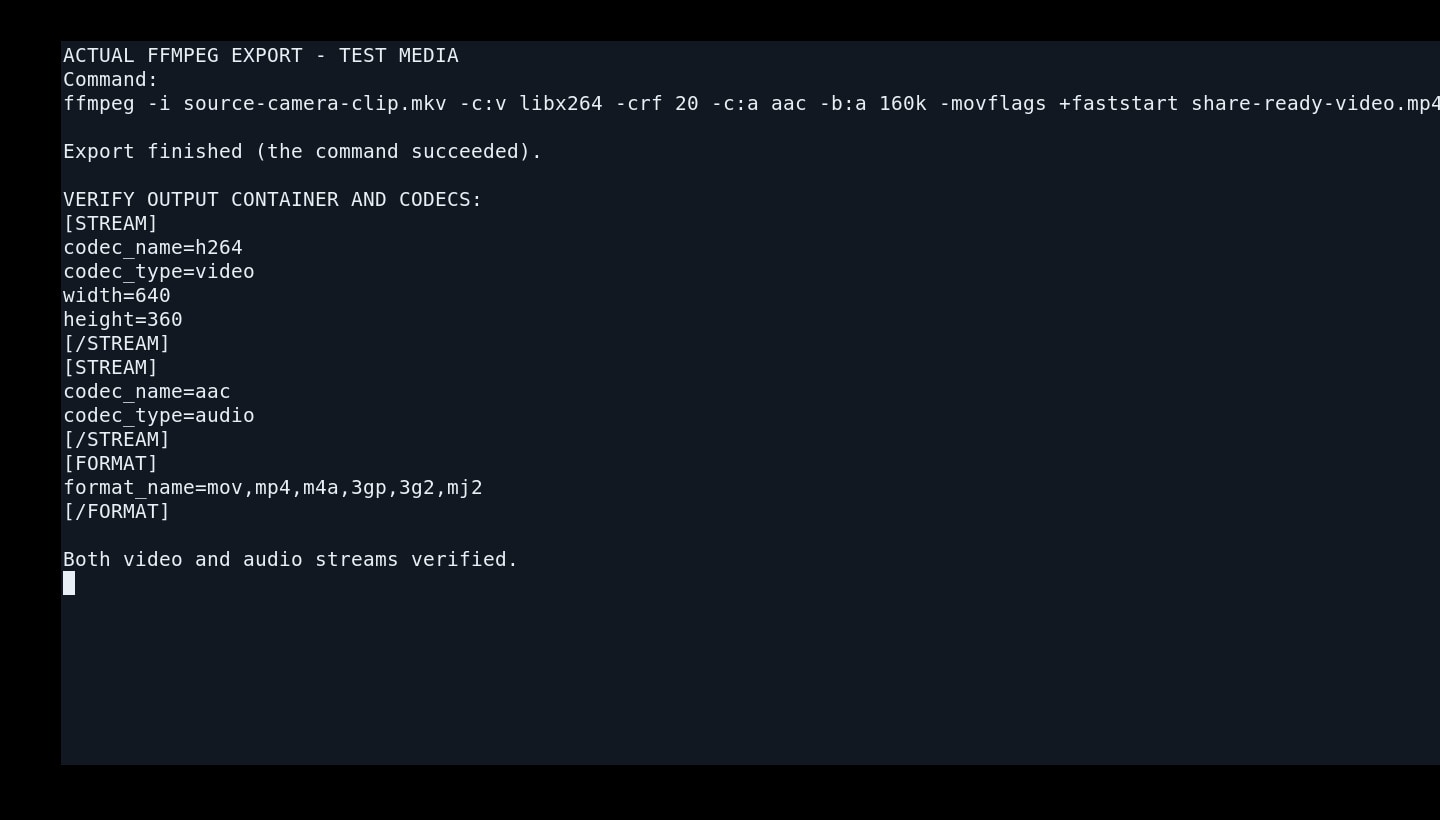
Step 3. Inspect the output with FFprobe and open it in the intended player. Check the beginning, middle, and end for video, audio, captions where applicable, correct duration, and expected color. Compare the new file with the untouched source before considering deletion of extra copies.
Success check: The output reports an MP4-family container containing H.264 video and AAC audio and plays in the target environment. If FFmpeg cannot decode the original, it may be damaged or unsupported rather than merely wrapped in the wrong extension. Do not repeatedly transcode a failing original; preserve it for diagnosis. The detailed FFmpeg documentation explains the encoder options if you need a different quality or profile.
Part 5. Protect Original Footage and Troubleshoot Format Problems
Compatibility and data loss require different solutions. Before running a conversion or repair program, identify whether the video exists and can be decoded.
The File Exists but Won't Play
First try another current player or inspect the codec name. A device may support MP4 containers but not a particular AV1 or HEVC profile. If the video is 4K and stutters only in one player, decoding hardware, driver configuration, storage throughput, and rendering performance are plausible causes; the separate 4K playback in VLC guide focuses on those symptoms.
When multiple applications fail to decode the same file, and the original also has missing timestamps or incomplete data, investigate the source and transfer history. This can be a corruption problem rather than a format-choice problem. A dedicated damaged MP4 troubleshooting workflow is more appropriate than blindly renaming or repeatedly recompressing it.
The Source Video Was Deleted or Lost During Editing
A format conversion cannot recover a file that no longer exists. If video vanished from a card, drive, or editing project folder, stop creating new files on the affected storage and check backups or the original camera media before doing more editing. When the drive remains readable and the data has not been overwritten, Recoverit Video Recovery provides an option to scan for lost video files. Save recovered material to a different drive and review the results before returning to your edit.
Recoverit is a recovery tool for missing data, not a codec converter or a fix for incorrect export settings. Recoverability depends on storage condition and whether the original data survived. If a recovered file still will not play, treat repair as a separate next decision on a copy.
Keep Separate Originals, Editing Media, and Delivery Copies
A robust workflow retains three clearly labeled media categories: original camera files and related folder metadata; temporary editing/optimized/proxy media; and distribution copies made for a platform. Back up original recordings before editing, copying cards, or clearing storage. When the deliverable is signed off, the editing cache can often be regenerated; the original recorded frames often cannot.
This distinction prevents a common mistake: exporting one compressed MP4, deleting the camera original, and assuming the smaller file is an equivalent archival master. It may look similar at first, yet retain fewer choices for future color grading, re-edits, or professional delivery.
Conclusion
For most everyday playback and sharing needs, MP4 containing H.264 and AAC is still a practical baseline. For production editing, retain camera originals and consider ProRes, DNxHR, or appropriate proxies according to the editing system. For browser delivery, modern MP4 or WebM codecs may offer smaller files but require compatibility testing. The best video format is the one that meets the destination's needs without sacrificing source footage or essential metadata.
Always choose the container and the actual codec together, verify a short output before processing an entire library, and keep a safe original. If playback fails, inspect the codec first; if a recording is missing, protect its storage before any recovery attempt.
FAQ
-
What is the most common video file format?
MP4 is among the most widely supported and frequently encountered file containers for general sharing. Broad playback usually means an MP4 holding H.264 video and AAC audio; MP4 may also hold other codecs with different compatibility. -
Is MOV better than MP4 for video quality?
Not automatically. MOV and MP4 are containers. A ProRes MOV is commonly suited to editing, while a high-bitrate MP4 may look excellent for delivery. Compare the source codec, bitrate, bit depth, and intended use. -
What is the best video file format for editing?
For complex timelines, Apple ProRes or Avid DNxHR intermediates can help editing performance when supported. For simpler edits, compatible MP4 footage may work directly. Proxies improve responsiveness but should not replace the original master at export. -
Which video format has the best quality?
No extension guarantees the highest quality. Preserve the original source or a verified lossless copy; use an editing-friendly intermediate if necessary and select an appropriate high-quality encode for final delivery. -
Are AVI and WMV still good video formats?
They remain relevant for older applications and archives, but modern MP4/H.264 workflows are generally easier to share across current devices. Retain legacy originals and test any newly converted copy. -
Is AV1 a file format like MP4?
No. AV1 is a video compression codec that can be carried in suitable containers such as MP4 or WebM. Support depends on the playback application and decoder hardware or software. -
Will renaming an MKV file to MP4 improve compatibility?
No. A filename change does not rewrite the container or its video/audio streams. Use a proper remux when the codec is already supported or transcode when a compatible codec is required. -
Can video format conversion recover a deleted or corrupted original?
No. Conversion only works on decodable source data. Preserve an incomplete or corrupted original for diagnosis; for missing recordings, stop writing to the affected storage and evaluate backups or appropriate recovery before doing anything else.


