TL;DR:
Reopen Keynote first if the loss followed a crash. Then check Trash, iCloud Drive, and Time Machine. For a presentation that was permanently deleted and has no backup, stop using the affected Mac drive and scan it with Recoverit Data Recovery. Save the recovered file to another drive and open it in Keynote to verify the slides.
- Stop writing new data to the affected Mac drive.
- Reopen Keynote and check for an automatic recovery prompt.
- Check Trash, iCloud Drive, and Time Machine.
- Use recovery software for permanently deleted files without a usable backup.
- Open and verify the recovered .key file before continuing work.
Ask AI for a summary
 ChatGPT
 Perplexity
 Gemini
 Claude
 Grok
Grok
If a Keynote presentation was deleted, closed without saving, or lost after a Mac crash, recovery may still be possible. The correct method depends on whether the file had been saved, whether it was moved to Trash, and whether it was stored in iCloud Drive or a backup.
Stop downloading, installing, or saving new files to the Mac drive where the presentation was stored. Check Keynote recovery prompts, Trash, iCloud Drive, and Time Machine before using recovery software.

This guide explains six practical ways to recover deleted or unsaved Keynote presentations on a Mac.
Can Deleted or Unsaved Keynote Presentations Be Recovered?
Often, yes. A saved Keynote file may still be in Trash, iCloud Drive, or a backup. An unsaved presentation may be available through Keynote's recovery data after a crash, although temporary recovery files are not guaranteed to exist.
Permanently deleted presentations may be recoverable from the Mac drive when the storage is readable and the deleted data has not been overwritten. Stop using the affected drive before scanning it. Keynote recovery usually targets the drive or backup where the file was stored rather than the Keynote application itself.
| What Happened | Best First Check | Important Limitation |
| Keynote crashed before saving | Reopen Keynote and check recovery prompts | Recovery data may not exist after every crash |
| Saved file was deleted | Check Trash and backups | Trash may have been emptied |
| File was stored in iCloud Drive | Check iCloud Drive and account status | The correct Apple Account and sync history are required |
| File was permanently deleted with no backup | Use recovery software | Stop writing to the affected drive |
| Mac drive is failing or not detected | Professional recovery assessment | Repeated scans may worsen a failing drive |
How to Recover Deleted Keynote Presentations on Mac
Method 1: Recover a Keynote File with Recoverit
Recoverit Data Recovery can scan a readable Mac drive or external storage for deleted Keynote files. Use it when the presentation is no longer in Trash, iCloud Drive, or an available backup.
- Protect the source: Stop saving new files to the drive where the presentation was stored.
- Select the location: Open Recoverit and choose the Mac drive, external drive, or other storage location.
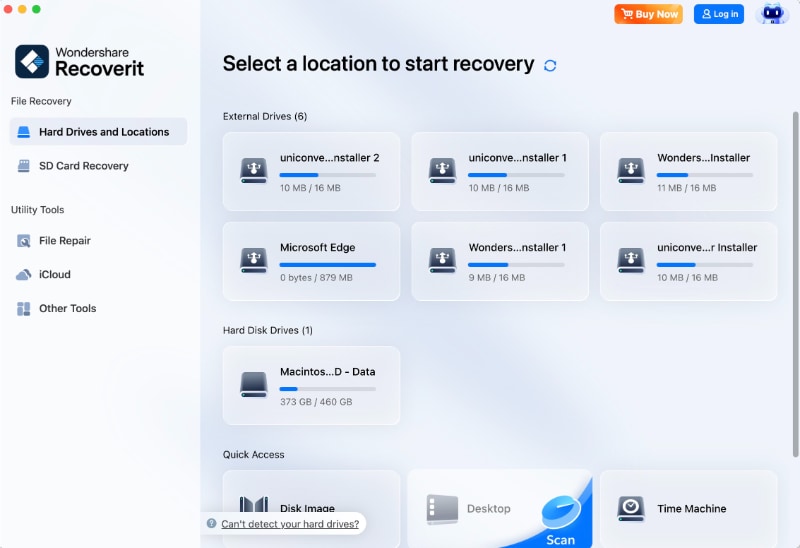
- Scan the drive: Start the scan and avoid using the affected storage while it runs.

- Filter and preview: Search for
.keyfiles and preview results when supported.
- Recover elsewhere: Save the presentation to another drive or external location.
- Verify the file: Open the recovered presentation in Keynote and check its slides, media, and notes.
Try Wondershare Recoverit to Recover Your Vital Data
 Security Verified. Over 7,302,189 people have downloaded it.
Method 2: Reopen Keynote After a Crash
If Keynote or macOS closed unexpectedly before you saved, reopen Keynote immediately. The application may display a recovery prompt or reopen an autosaved version.
- Open Keynote from Applications or the Dock.
- Wait for any recovery dialog or reopened presentation window.

- Save the recovered presentation with a new filename to another safe location.
- Check the slides and media before closing Keynote again.
Method 3: Check Keynote AutoSave or Recovery Data
Keynote and macOS may keep recovery data for an unsaved presentation, but the location and retention behavior can vary by Keynote and macOS version. Search the documented Keynote container or recovery location only when the file was unsaved after a crash.
- In Finder, choose Go > Go to Folder.

- Check the Keynote container or AutoSave location referenced by the current macOS and Keynote version.
- Look for recent files or packages associated with the presentation.
- Open a candidate copy in Keynote and immediately save it to a different location.
Method 4: Check Temporary Files Carefully
Temporary files may contain fragments of an unsaved presentation, but this is not a guaranteed recovery path. Use Finder's Go to Folder command to inspect locations related to Keynote only when you know the file was never saved.
- Press
Command + Shift + Gin Finder. - Inspect the current Keynote container or temporary location documented for your macOS version.

- Look for recent Keynote-related files or packages.
- Copy a candidate file to another folder before trying to open it.
Method 5: Restore a Keynote File from Trash
If a saved presentation was deleted from Finder, check the Mac Trash before using recovery software.
- Open Trash from the Dock.
- Search for the presentation or files ending in
.key. - Right-click the file and choose Put Back.
- Open the restored presentation and save a backup copy.
Method 6: Recover a Synced File from iCloud Drive
When the presentation was stored in iCloud Drive, sign in with the correct Apple Account and check the iCloud Drive folder where the file was saved. A file removed from iCloud may also be available through iCloud data recovery options for a limited period.
- Visit iCloud.com or open iCloud Drive in Finder.
- Check the folder where the Keynote file was stored.

- Use iCloud's recovery or Recently Deleted option when it is available.
- Download or copy the file to a local folder and open it in Keynote.

Method 7: Restore a Keynote File from Time Machine
Time Machine can restore a saved Keynote file or an earlier copy of a presentation when the file was included in a backup.
- Connect the Time Machine backup drive.
- Open the folder where the Keynote presentation was stored.
- Enter Time Machine and select a date before the file was deleted or changed.
- Select the presentation and click Restore.
- Open the restored file and verify the slides and media.
What If the Recovered Keynote File Will Not Open?
- Copy first: Work on a copy so the original recovered file remains unchanged.
- Check the extension: Confirm that the file ends in
.keyor is a valid Keynote package. - Try a compatible Keynote version: Older files may need a compatible application or macOS version.
- Check the file size: A zero-byte or unusually small file may be incomplete.
- Recover another result: A different scan result may contain a more complete copy.
- Use a backup: Time Machine or iCloud may provide a cleaner version than a fragmented recovery result.
Tips for Mac Keynote Recovery
- Act quickly: Stop using the affected drive after deletion.
- Save to another location: Do not save recovered or restored files over the source file.
- Use Time Machine: Keep regular backups of important presentations.
- Use iCloud carefully: Confirm that the correct Apple Account and iCloud Drive folder are being used.
- Keep manual copies: Store important presentations on an external drive or approved cloud service.
- Verify recovered files: Open slides, media, notes, and links before deleting other copies.
- Protect the Mac drive: If it is slow, failing, or repeatedly disconnecting, limit further use and consider professional recovery.
Conclusion
To recover a deleted Keynote presentation on Mac, first reopen Keynote after a crash, then check Trash, iCloud Drive, and Time Machine. For a permanently deleted file without a backup, stop using the affected drive and scan it with recovery software.
Save any recovered presentation to another location and open it in Keynote to verify the slides and media. If the Mac drive is failing or the file is irreplaceable, professional recovery is safer than repeated repair attempts.
FAQ About Keynote Recovery on Mac
-
Can I recover a deleted Keynote presentation on Mac?
Often, yes, if the file is in Trash, iCloud Drive, Time Machine, or readable storage that has not overwritten the deleted data. -
Where does Keynote save unsaved presentations?
Keynote may keep recovery data after a crash, but the exact location and retention depend on the Keynote and macOS version. Reopen Keynote first and avoid changing recovery files. -
Can iCloud recover a deleted Keynote file?
It may help when the file was stored in iCloud Drive and the correct Apple Account is used. Check iCloud Drive and available recovery or Recently Deleted options. -
Can Time Machine recover an older Keynote presentation?
Yes, if the file or its containing folder was included in a backup created before deletion or unwanted changes. -
Why will my recovered Keynote file not open?
The file may be incomplete, overwritten, fragmented, or incompatible with the installed Keynote version. Try another recovery result or restore a backup copy. -
Where should I save a recovered Keynote presentation?
Save it to another drive or folder, not the original location, then open it in Keynote and verify its slides and media.